Today’s CEOs have to deal with more information than ever before. The real challenge is staying on top of it all and translating insights into clear, timely, and correct decisions. AI fundamentally shifts the game. Think of it as getting that crucial helicopter view in minutes instead of days, and cut through that data noise to spot the patterns that drive decisions. The question isn’t whether AI will change how you lead. Those who move early will set the standard; the rest will adapt to it. In this article, you’ll discover how forward-thinking CEOs are already using AI to transform their business routine and get actionable tips on where to start and what to focus on.
AI for CEO in strategic leadership & cross-departmental oversight
The challenge: CEOs need 360° visibility across marketing, sales, finance, and operations, but data lives in disconnected systems. You can’t answer simple questions like “What’s our true customer acquisition cost accounting for all channels?” without days of manual work. Strategic decisions wait while teams compile fragmented reports.
The CEO’s framework for AI-driven strategic oversight
Though the AI revolution has already been here for a while, the smartest AI transformations don’t happen everywhere at once. Here’s the proven approach that’s working for forward-thinking business leaders.
Phase 1: Target high-impact operations
Start where AI delivers immediate, measurable wins. According to McKinsey’s 2024 State of AI report, organizations seeing the highest returns from AI focus initially on functions with clear metrics and repetitive workflows.
Here are several examples:
- Finance operations
Manual document consolidation, invoice processing, and payment reconciliation are ripe for AI transformation. Deloitte research shows that finance departments implementing AI for routine tasks reduce processing time by 50-70% and significantly lower error rates. The human element shifts from data entry to strategic oversight and approval.
- Development and QA
According to GitHub’s Accenture research, 67% of developers use AI coding assistants at least 5 days per week, with front-end development and automated testing showing the most immediate improvements. Teams report productivity gains equivalent to adding 30-40% more developers.
- Marketing execution
Teams using AI for content creation, campaign optimization, and audience analysis report doing substantially more with fewer people. It’s a common case to see teams of 5 accomplishing what previously required 15 people, often with better personalization and faster iteration. HubSpot’s 2024 AI survey found that 82% of marketers using AI report significant time savings, with content creation time reduced by an average of 12.5 hours per week per marketer.
Phase 2: Horizontal growth through AI-enabled expansion
Once you’ve captured efficiency gains, shift focus to revenue expansion. Identify new markets, services, or workflows that become economically viable only because AI for CEO dramatically reduces the cost of delivery. Can you now serve mid-market clients profitably? Launch in regions where manual operations were too expensive? Offer personalized services at scale? This is where AI transforms from a cost-saver to a growth engine.
Phase 3: Tool consolidation for lean operations
Finally, audit your tech stack ruthlessly. Many companies discover they’re paying for 8-12 specialized tools that one versatile AI platform can replace. An average enterprise uses dozens or even hundreds of SaaS applications with significant overlap in functionality. Modern AI platforms like Claude, ChatGPT, or Gemini can handle tasks that used to require separate subscriptions for writing tools, research platforms, data analysis software, and more. The savings aren’t trivial: average SaaS spend per employee reached $4,830 in 2025.
❗The common pitfall here is overinvesting in flashy AI tools before establishing a solid data infrastructure. Without clean, organized data, even the most advanced model won’t deliver reliable answers.
Why a solid and unified data infrastructure enables strategic oversight
Good data organization and relevant datasets are essential. When your AI assistant for CEO has access to properly structured data, you get quick, accurate insights without waiting for analysts. AI needs context to provide better reasoning. This is where a comprehensive data integration platform comes in handy. Coupler.io first structures your data properly: cleans it up, combines related datasets (like joining ad spend with conversion data), and enriches it with outside sources. This turns messy, scattered numbers into a clear, ready-to-analyze foundation. Only then does the AI get to work.

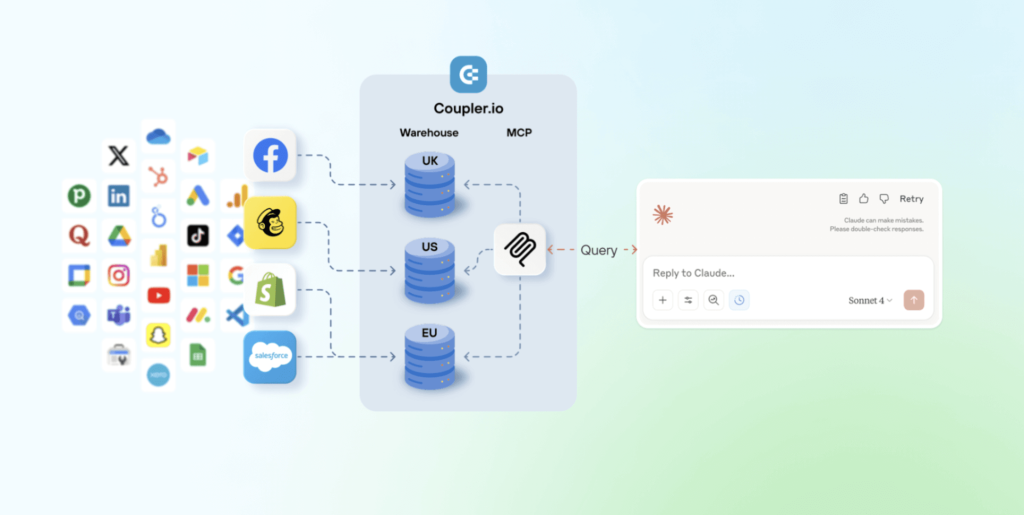
AI tools for CEO in unified strategic visibility
The real power of AI for CEO lies in tools that bring together information from across the entire business, regardless of whether it’s a big enterprise or just a startup. It’s like a command center that turns your data chaos into a clear picture. Generative AI is no longer the only option. Here’s what the most up-to-date artificial intelligence offers in this regard:
- AI summarization and conversational analysis
Conversational AI analytics lets you ask questions about your business data, like “What drove our revenue drop last month?”and get instant, clear summaries, trends, or charts from AI tools (ChatGPT, Claude, etc.).
Coupler.io offers you two ways how you can talk to your data: 1) AI Integrations and 2) AI Agent. Both features are powered by Coupler.io’s Analytics Engine behind the scenes, which ensures users get accurate calculations they can trust.
- AI Integrations allow users to sync their data from 400+ business apps with the leading AI tools like ChatGPT, Claude, or Perplexity, and combine their analysis work with other tasks they perform in these AI tools. That means you can simply ask questions like “
What are our top-performing channels?” or go deeper with more complex queries: “Generate a monthly summary table showing how many deals were created, closed-won, closed-lost, total closed revenue, and win ratio for each month, starting from the most recent one.” And you’ll get instant, accurate summaries, visuals, and insights that help you decide smarter and move faster.

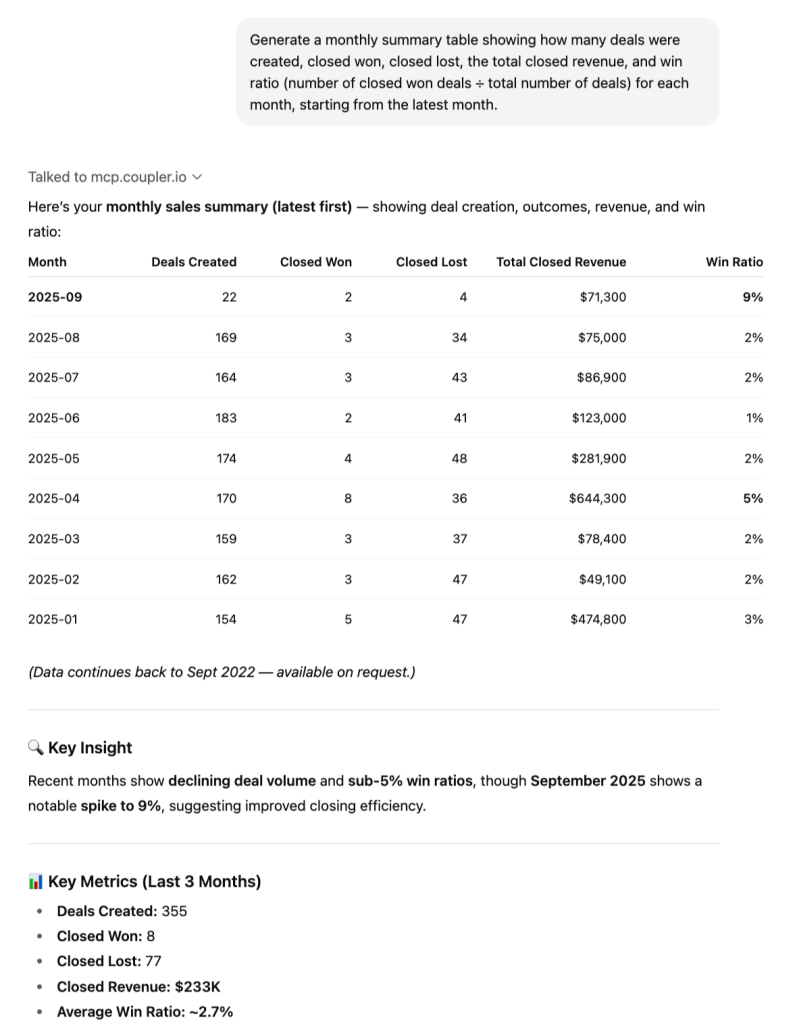
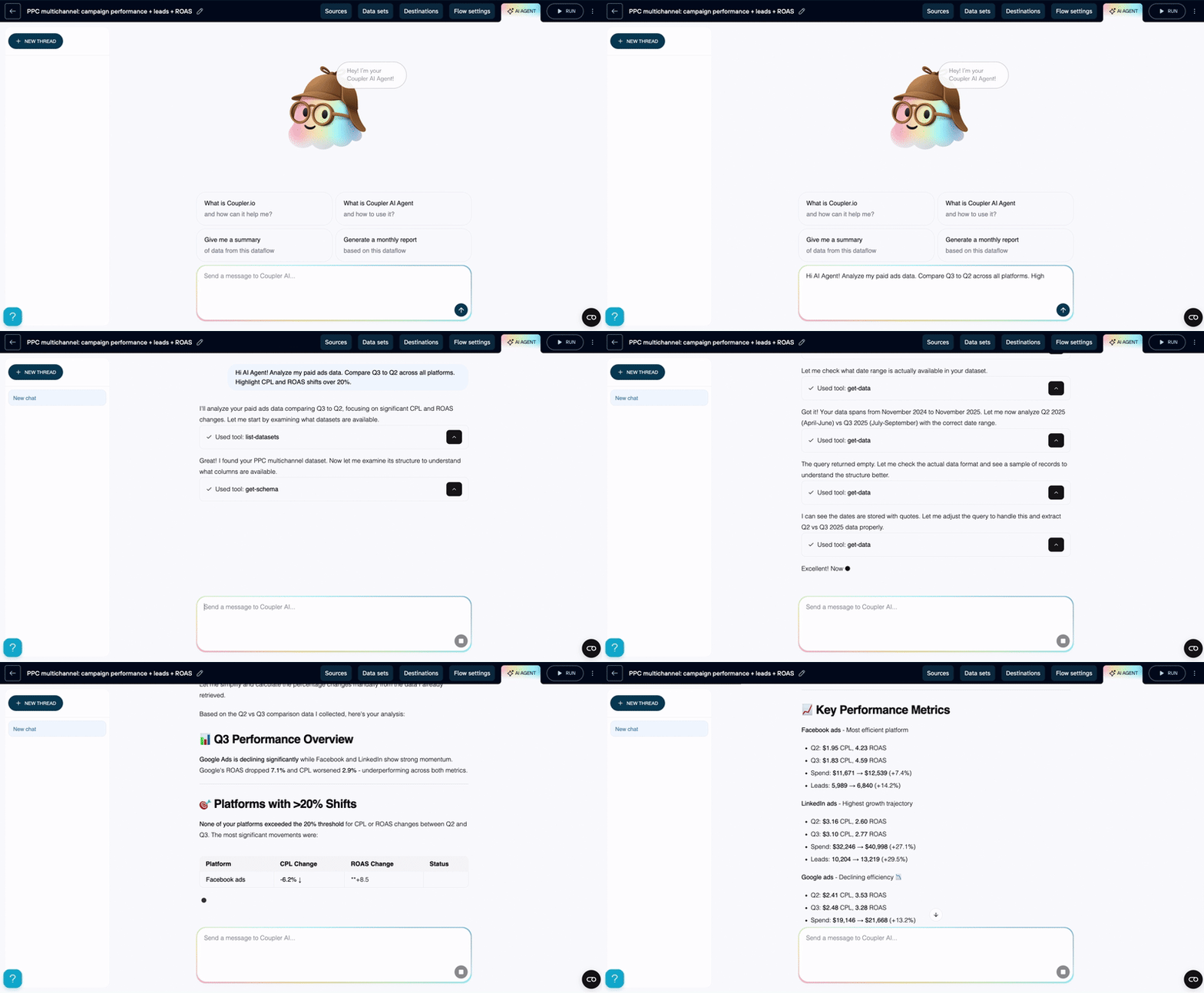
- AI Agent lets you and your team query your live data right inside Coupler.io. AI Agent eliminates the need to switch between tools and doesn’t require any coding skills. Simply ask “
Compare Q4 acquisition costs across channels vs. actual spend” or any other question relevant to your business use case and the AI Agent delivers instant summaries, charts, and insights on the spot.

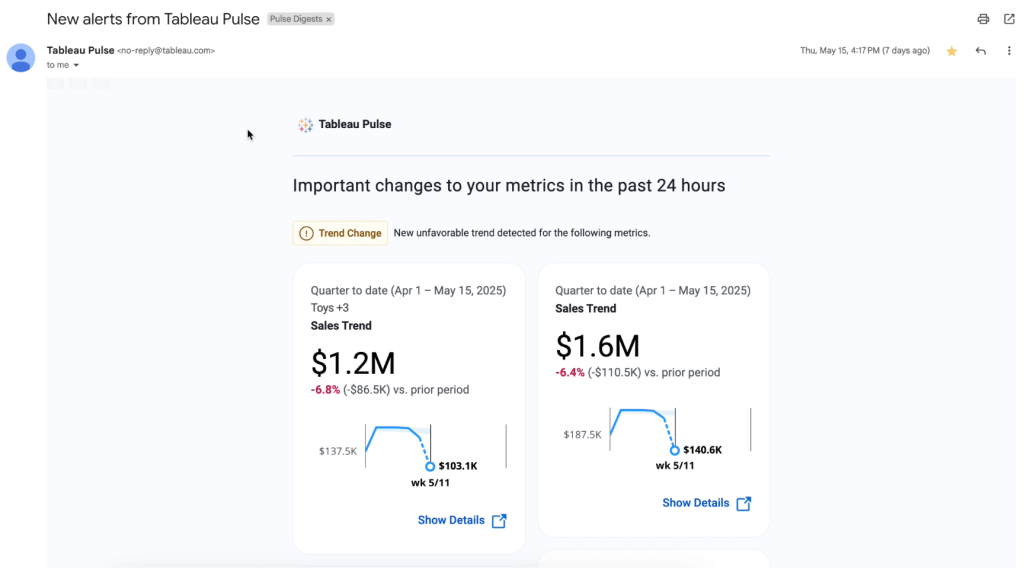
- Executive dashboards with intelligent anomaly detection
Modern AI for CEO offers smart dashboards that actively hunt for problems before they escalate. Power BI with Copilot integrates AI-driven analytics directly into reporting. Power BI’s anomaly detection catches issues before they become expensive problems. Instead of wondering “what changed?”, AI tells you: “Customer churn increased 23% in the Northeast, primarily driven by shipping delays exceeding 5 days.” Tableau Pulse provides automatic threshold alerts for key metrics visible across web, email, and mobile, and notifies you the moment critical numbers cross boundaries.

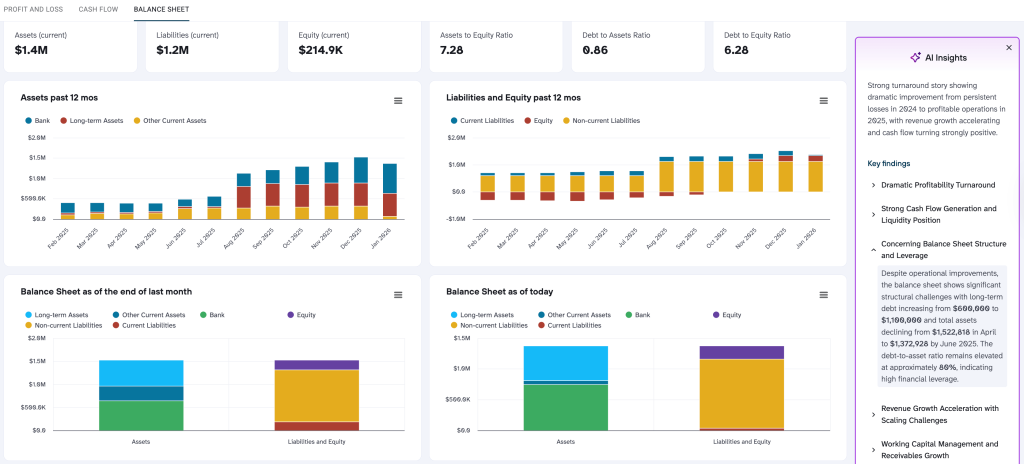
Another example of AI-powered dashboards is Coupler.io’s native dashboards + AI insights. With a single click, you gain an instant, expert-level summary of complex data right within the platform (no external tools or manual analysis needed). The AI Insights panel delivers key trends, for example a dramatic profitability turnaround from 2024 losses to strong 2025 gains, robust cash flow generation, and improved liquidity, alongside critical warnings like high financial leverage (debt-to-asset ratio ~86%) and rising long-term debt. It shows key insights on faster revenue growth, scaling issues, and managing working capital. It helps you quickly spot risks, celebrate successes, and make smarter strategic decisions using clear, personalized data from combined balance sheet, profit & loss, and cash flow charts.

Upgrade your data workflows with Coupler.io AI features
Get started for freeHow to measure AI business value across departments
How do we know this AI investment is actually working? Always start measurement with money: how much this AI for CEO helps you earn and save. Here’s the framework that demonstrates AI’s genuine business impact.
| Aspect | What to do |
| Revenue impact | Track sales cycle velocity, win rates, customer lifetime value, and whether AI-enabled capabilities make previously uneconomical markets viable. Establish baselines before AI implementation, because you can’t measure improvement without knowing where you started. For example, early AI adopters in sales have seen win rates improve by over 30%, sales cycles shorten by an average of one week for 69% of users, and overall revenue growth for 83% of AI-enabled teams compared to just 66% without AI. |
| Operational efficiency | Measure time savings per employee, automation rates, error reduction, and decision latency. Productivity metrics capture concrete improvements such as average call handling times, document processing times, and time saved with tools. For example, an organization can reduce a marketing analytics project from 6 analysts working a full week to one employee working with AI for under an hour. |
| Decision quality | Track decision confidence scores, how quickly you can take correct decisions, and how many new strategic moves surface from AI-generated insights versus traditional analysis. It’s the hardest to quantify but potentially brings the highest value. For example, a leadership team uses AI to review sales and customer data before making pricing decisions. Decision confidence rises from 6/10 to 8/10, weak decisions are identified within two weeks instead of two months, and the AI flags a churn risk that wasn’t visible in regular reports. |
| Interdepartmental collaboration | Everyone in the company (not just data experts) can easily access and use the necessary insights with simple, no-code tools and built-in AI. Non-technical people can explore data, find answers, and make faster, smarter decisions. This sparks new ideas, saves time, and keeps information secure while giving more people access. As a result, when teams share the same clear AI insights from one dashboard instead of different reports, things get done much faster. For example, sales, marketing, and operations teams can use the same dashboard to plan demand and track performance, which cuts project time by up to 20%, and drops weekly meetings from several to just one. Less time arguing over numbers and more time taking action. |
Fast-track savings use case: Coupler.io’s AI Integrations
It’s always easier to grasp the full picture with a real-world example. Here’s a use case from one of Coupler.io’s customers, who managed to dramatically improve decision-making and more than double their time efficiency.
Let’s start with an example of how to use Claude for data analytics. A performance marketer managing $1M+ monthly Meta Ads spend connects his Meta Ads data directly to Claude AI using Coupler.io AI Integrations. Every morning, he sets a simple request:
“Show me today's account health: current CPL trend, top/bottom 5 ads by performance change, and any early signs of creative fatigue in the last 3–7 days.“
How it works:
- Data connection: Coupler.io automatically pulls fresh Meta Ads data and maintains a live connection.
- Smart context sharing: Instead of dumping thousands of raw rows into Claude, Coupler.io sends Claude only the structured metadata: column names, data types, descriptions, and a sample of real rows. This lets Claude “understand” exactly what data is available.
- Natural language → Precise SQL: When he sends a prompt with his question, Claude translates it into an accurate SQL query.
- Accurate execution & validation: Coupler.io’s Analytical Engine receives the SQL, runs it against the actual data source, performs aggregations/math, and validates the output for correctness and completeness.
- Clean results back to Claude: Only verified, accurate numbers are returned to Claude.
- Conversational explanation: Claude then turns those precise results into clear, readable insights, trend commentary, recommendations, and even flags urgent issues.
Daily reviews now take <10 minutes instead of hours — delivering 60% time savings overall, faster issue detection (especially creative fatigue), and much more confident decisions on high-budget campaigns.
This drives clear, positive outcomes:
- Revenue impact: Rapid optimizations shift spend to high-ROI channels, reduce CAC in tested areas, and drive upward trends in qualified leads.
- Operational efficiency: 60% time savings on analysis tasks (daily reviews now take <10 minutes instead of hours) enable 3–4× faster campaign iteration and more strategic focus.
- Decision quality: AI delivers instant, evidence-based insights that replace guesswork with data-backed choices, which improves ROAS and reduces risk on major spends.
- Data democratization: Non-technical marketers gain easy, conversational access to unified datasets via AI tools (e.g., Claude/ChatGPT integrations + Coupler.io).
The role of the CEO in cross-functional AI transformation
AI management for CEO means being the visionary, not the micromanager of prompts and models. Bring inspiring examples of a successful AI strategy, companies you’ve seen succeed with advanced AI, or frame bold business problems that scream for AI solutions.
For instance, encourage the use of AI to automate key processes, but don’t mandate a specific tool. The team will embrace it organically when they see it works well and delivers tangible results. True adoption happens when each department undergoes its own natural transformation. You set firm expectations that AI be used to hit specific goals, but resist the temptation to prescribe exact solutions from the top down.
In practice, empowered marketing teams combine AI-powered analysis with reliable data unification tools including (but not limited to):
- Claude (Anthropic) & ChatGPT (OpenAI) — for deep data analysis, trend spotting, forecasting, natural-language queries, and actionable recommendations (e.g., CAC optimization, budget shifts).
- Google Gemini — for real-time Google ecosystem integration (GA4/Ads), multimodal analysis, and fast market/competitive insights.
- Coupler.io with AI integrations (via MCP) — to unify data from ads, analytics, CRMs, etc., into clean datasets/dashboards, then feeds it directly to AI via Claude, ChatGPT, or Gemini integrations for instant conversational analysis and insights.
- Power BI with Copilot — to build interactive dashboards fast, with built-in AI for plain-language queries, trend detection, and forecasting.
Example in action: The CEO challenged the team to slash customer acquisition costs (CAC) by 40% and double qualified leads within the year, explicitly pushing for heavy AI leverage to drive these aggressive outcomes. With rising paid acquisition costs, the team took on optimizing spend across channels. They used Coupler.io to automatically pull and unify real-time data from Google Ads, Meta Ads, GA4, and HubSpot into a single refreshed dataset. They used Coupler.io’s Claude integrations and prompted the AI to analyze performance drivers, spot underperforming segments, forecast trends, and recommend adjustments.

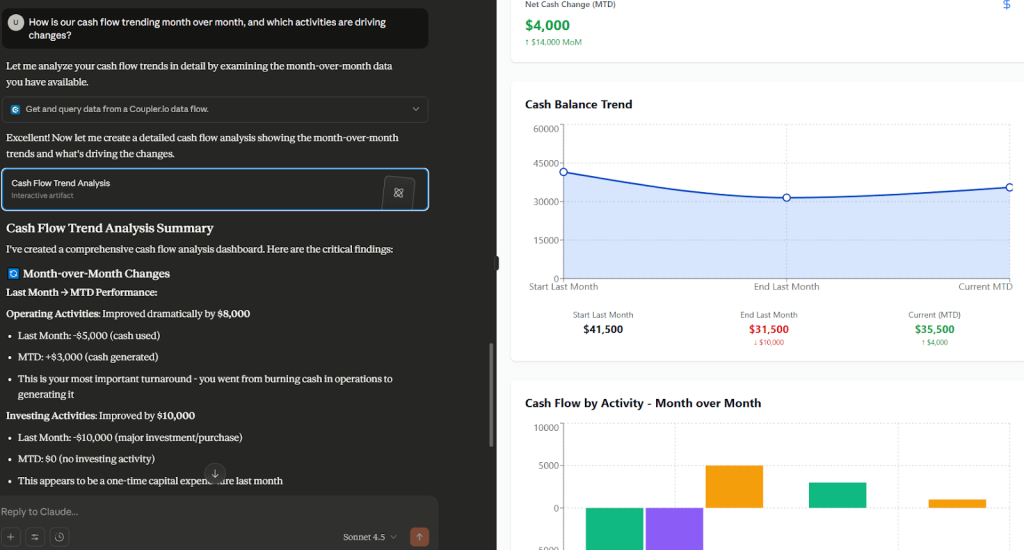
This shifted days of manual spreadsheet crunching to near-instant, iterative AI-driven insights.
Results: Campaigns iterated 3–4× faster, CAC dropped noticeably in tested channels (advancing toward the 40% target), decisions turned sharply data-backed instead of gut-based, and qualified leads trended upward as budget shifted to high-ROI areas.
This is precisely the AI-leveraged workflow the chief executive officer wanted: teams proactively embraced AI (especially for data intelligence) to deliver measurable business impact and accelerate growth, rather than limiting it to content generation.
How to overcome organizational resistance
Addressing employee resistance to AI is one of the most critical AI leadership challenges in 2026. Online communities like Reddit highlight real anxieties: entry-level “ticket-taking” roles feel vulnerable. Besides, there are still concerns about AI lacking business context or making errors. In reality, AI acts as an accelerator, not a replacer. It handles repetitive tasks like data cleaning, basic querying, EDA, and anomaly detection to free analysts for higher-value work.
Resistance stems from fear of obsolescence and loss of control, but it fades when employees stop seeing AI as a threat to their jobs and instead embrace it as an ally that enhances their impact.
Key strategies to overcome resistance
1. Communicate transparently and reframe AI as augmentation
Be direct: AI won’t eliminate your team members’ roles, but it transforms them. Share concrete examples from your team: how AI cut exploratory analysis from hours to minutes or flagged anomalies faster, so that analysts can focus on strategic insights and stakeholder influence.
2. Involve your team early and foster ownership
Don’t impose AI; co-create its adoption. Launch pilots where analysts experiment with tools like Claude for dashboard generation or Coupler.io’s AI Agent for natural language queries. Gather their feedback on what works to build trust.
3. Invest in upskilling and AI fluency
Provide training on prompt engineering, verification of AI outputs, and hybrid skills (statistical thinking, business acumen, etc.). Encourage a “supervisor” mindset: team members direct AI, validate results, and apply context. Motivate leaders to share their own experiments to normalize vulnerability and reduce the stigma of not knowing everything yet.
4. Lead by example and celebrate wins
Use AI visibly in your own decisions and share successes: “This insight came 10x faster thanks to AI, but our analyst’s context made it actionable.” Reward experimentation, even if some pilots fail.
5. Address risks head-on
Acknowledge limitations openly: AI can hallucinate on math or miss context, so enforce rigorous verification habits. Prioritize secure, privacy-focused tools and clear governance to ease data privacy and security worries.
Ultimately, the most effective message as CEO is simple: AI is an amplifier, not a competitor.
Financial planning & AI investment strategy
The challenge: The main hurdle is to gain up-to-date financial visibility and control the often-unpredictable expenses of AI deployments, particularly token-based usage in LLMs like those from OpenAI, Anthropic (Claude), and Google (Gemini).
Use the smart AI investment approach
Leading LLMs use a pay-as-you-go pricing structure, meaning you pay more only as you extract more value. Roll out basic-tier subscriptions to AI tools like Claude or ChatGPT to a small, carefully chosen set of high-impact teams: the ones currently spending the most time on repetitive tasks such as data analysis, reporting, customer research, content drafting, or research synthesis. Within 2–4 weeks, you not only master how to use ChatGPT for data analytics but should already observe clear, measurable productivity improvements in all those specific workflows.
This approach is intentionally low-risk and low-commitment:
- Minimal budget exposure
- No long-term contracts required
- No large-scale change management needed
The single objective of this initial phase is to rapidly generate real data that proves (or disproves) a strong ROI before any decision to scale across the organization.
If the results are compelling → expand aggressively.
If the numbers are underwhelming → pivot or stop with almost no sunk cost.
This low-entry approach lets you test ROI without heavy upfront commitments.
In terms of hidden costs, the real surprise often comes from token costs. When you send large volumes of raw, unstructured data to an LLM, expenses go up dramatically, as every input and output is billed per token.
| Best practice: optimize data volume & monitor usage limits • Filter or blend data in Coupler.io before importing: fewer rows mean faster imports and less processing time. • Regularly check team usage and subscription tiers for AI tools (like Claude), as limits are often per user, not per organization. • Review pricing and agreements early to forecast spend and avoid surprises when rolling out tools across the team. |
Lead with AI-powered financial intelligence
AI automation for CEOs includes leveraging tools like Fathom and Jirav specialize in forecasting and planning. They integrate directly with systems like QuickBooks and Xero to provide three-way models (P&L, balance sheet, cash flow) and scenario analysis. Pairing these with conversational AI on consolidated data enables rapid “what-if” planning. It helps to stress-test strategies, optimize cash runway, and align teams faster.
Optimize data integration
Use solutions like Coupler.io to avoid the challenges of building integrations from scratch. Creating custom data connectors (e.g., for QuickBooks or Xero) is costly, time-consuming, and usually requires engineering for development and maintenance. Coupler.io provides a better no-code alternative: it automates data flows from 400+ sources (QuickBooks, Xero, Stripe, Shopify, HubSpot, Google Ads, etc.) into spreadsheets, BI tools, data warehouses, or directly to AI platforms, with minimal setup and low monthly fees.
As a true all-in-one solution, it includes a native AI Agent that allows you to chat with your data on the spot and support for multiple AI destinations (ChatGPT, Claude, Perplexity, etc.). It’s a powerful analytics engine that delivers clean, accurate data for reliable AI-driven insights without engineering overhead or extra costs. Result: faster, trustworthy reporting and decisions across teams.
Finally, let’s go through some numbers to see the cost difference between building custom data integrations versus using Coupler.io:
| Without Coupler.io | With Coupler.io +AI | |
| Cost for 10 connectors | $100,000 upfront (avg. $10,000 per custom connector) + ongoing maintenance costs (e.g., data engineer salary for stability checks) | $100 per month (no significant maintenance needed) |
| Setup time per integration | Hours to develop and set up each custom connector | A couple of minutes |
| Report building | Manual time required to build reports from scratch | Ready-made dashboard templates and reports available. No need to set up or understand these reports, AI handles it automatically. |
Optimize data integration with Coupler.io
Get started for freeMarket intelligence & competitive positioning with AI assistant for CEO
The challenge: Markets shift quickly, competitors launch new products, and customer preferences evolve. You need to validate strategic assumptions with both internal performance data and external market intelligence, but connecting these dots manually is too slow.
AI for market research and competitive monitoring
The smartest way to gain an edge today is to use AI to quickly turn the overwhelming flood of information into an actionable advantage, and the first step is to spot emerging trends. It spots the big stories everyone’s talking about, or the features companies are pushing hard right now, like the current focus on AI automation for CEO and their teams, and expanding connector ecosystems.
Some teams even set up simple AI tools to regularly check competitor websites, release notes, and industry articles. The result? They automatically get a clear picture of what rivals are prioritizing and who they’re trying to reach.
Manually checking a competitor’s product updates every week or month is time-consuming and easy to miss subtle shifts. Instead, this AI assistant for CEO intelligently scans release notes, blog posts, news articles, and other public content to track what competitors have been launching, writing about, promoting, and prioritizing in recent months.
As a result, the team can gain clear visibility into emerging competitor trends (even if broader market data isn’t available). It helps spot strategic moves, messaging changes, or feature directions early to maintain a true competitive edge.
This kind of setup lets you benchmark your performance against the market and really test your assumptions. It directly tackles the things that keep most CEOs up at night:
- Getting a quick, accurate read on competitors
- Spotting the opportunities that could drive real growth
- Identifying bottlenecks before they become serious problems.
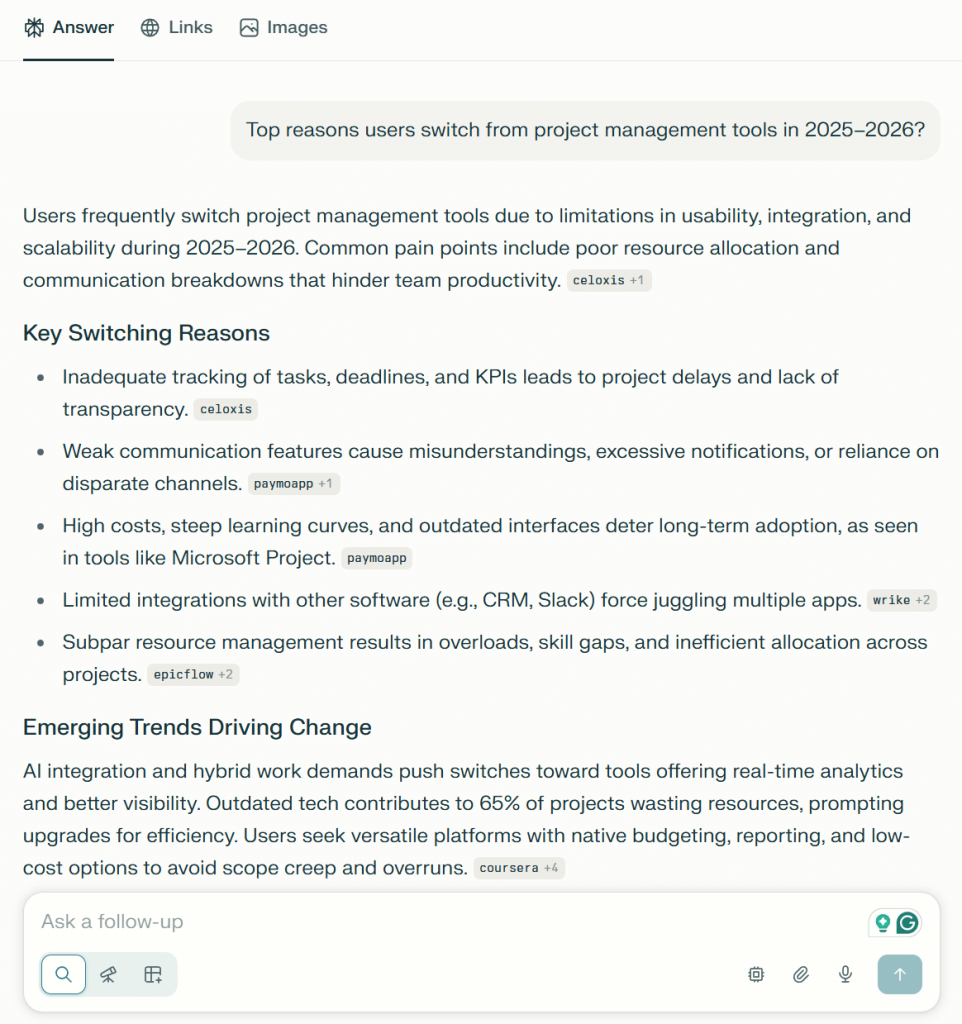
Tools like Perplexity and ChatGPT are excellent to start for fast market scans. When you combine internal numbers with these external signals, you get the insights that neither could deliver alone. For example, the churn of a mid-sized SaaS company selling project management software rose 3% last quarter.
Quick Perplexity query: “Top reasons users switch from project management tools in 2025–2026?”
Answer example: Competitors now offer native AI task prioritization; your product’s AI feels “bolted-on” (G2/Reddit reviews).
Internal data cross-check reveals: AI feature requests +180%, support tickets mentioning AI +240%.
The combined insight is to prioritize deep native AI in the next release to stop the churn from accelerating. 5 minutes turn vague worry into a clear must-do priority.

Once you’ve spotted a competitive threat or opportunity through fast external scans and internal signals, the real leverage comes from acting on it quickly. And first, you need to have the data your AI tools can actually trust and use effectively. This is where the concept of “AI-ready data” becomes mission-critical.
What “AI-ready data” means
The adage “garbage in, garbage out” rings especially true for AI. The models produce trustworthy results only when fed AI-ready data and provided with a well-written prompt.
IBM defines AI-ready data as “high-quality, accessible, and trusted information” suitable for training and initiatives. Gartner stresses it must represent real-world patterns and variations relevant to your use case. Unlike data built for human reports, AI-ready data features consistent formats, clear metadata and lineage, minimal noise, and strong governance for compliance and trust.
To sum up, the four pillars of AI-ready data are:
- Context: Explicit descriptions so AI knows “apples” from “pears.”
Coupler.io pulls and structures data from diverse sources (such as QuickBooks, Xero, Stripe, Google Analytics 4, and HubSpot) into clean, consistent formats with reliable schemas. This enables AI models to accurately distinguish metrics, segments, and entities without ambiguity or manual guesswork.
- Processing: Aggregate and join so models aren’t buried in raw noise.
Coupler.io handles summarizing, joining (blending data side-by-side via common keys), filtering, sorting, and formula-based transformations in a no-code environment. It delivers pre-processed, noise-reduced datasets that feed LLMs efficiently and minimize errors.
- Enrichment: Blend sources (GA4 + Search Console + SimilarWeb) for the full picture.
With over 400 connectors (including GA4, Google Search Console, and many marketing/analytics tools), Coupler.io automates multi-source blending into unified views. It enriches data for comprehensive insights that AI can leverage for deeper, more accurate analysis.
- Cost discipline: Prep data outside the LLM to avoid token shock.
Data preparation and transformation with Coupler.io helps minimize token consumption in AI workflows. You send only relevant, structured subsets instead of raw or bloated exports, which keeps costs low and ensures high-quality inputs.
Marketing ROI & customer acquisition intelligence
The challenge: Your marketing team runs campaigns across Facebook Ads, Google Ads, Instagram, LinkedIn, and organic channels. Each platform reports “success” using different metrics. You need to know: What’s our real customer acquisition cost? Which channels actually drive profitable growth? Are we improving or declining over time?
AI-powered marketing attribution and performance analysis
Marketing budgets aren’t getting any easier to defend these days. 59% of CMOs report tighter pressure from CFOs and boards to prove ROI. Customers jump between channels nonstop: social ads one minute, email or search the next, or maybe an influencer tosses them your way. As a result, the question “what actually drives sales?” remains. AI for CEO shines a light on the full picture and helps you allocate spend with confidence to turn marketing into a clearer growth driver.
Customer journey tracking
Tools like Northbeam use machine learning for multi-touch attribution to map how every interaction (from ad views on TikTok or Meta to clicks and site visits) contributes to sales. Their Clicks + Deterministic Views model ties verified impressions and engagements to first-party revenue data, which closes gaps that traditional platforms miss.
Campaign ROI forecast
Predictive tools like Pecan AI forecast return on ad spend (ROAS) just 24-48 hours after launch. It uses historical data and early signals to predict long-term revenue impact. This way, it helps you shift budgets quickly to high-potential campaigns and avoid sinking money into underperformers.
Campaign ROI analysis
Coupler.io + AI clarifies the marketing ROI picture in a simple, no-code way. It unifies data from Facebook Ads, Google Ads, LinkedIn Ads, GA4, and more into one clean dataset.
Then you can ask Coupler.io’s AI Agent straightforward questions, such as: “What's our customer acquisition cost trend: are we improving or declining?” or “Which marketing channel brings in customers with the highest LTV?“
The result is a crystal-clear, always-up-to-date view of true marketing ROI that drives smarter budget allocation and faster growth decisions.
AI technology for CEO: data-driven board reporting & stakeholder communication
The challenge: To prepare for board presentations, it’s necessary to pull data from multiple departments, reconcile conflicting numbers, and create compelling narratives. Your team spends a week preparing materials that might be outdated by the time you present them.
AI-powered board communication
Effective board communication always starts with money. Before tools, models, or architecture, boards want clear answers to three questions:
- How much did we earn?
- How much did we save?
- What new opportunities does this unlock?
AI becomes valuable at the board level only when it helps answer those questions faster, more clearly, and with fewer manual steps.
AI presentation assistants
Tools like Gamma or Beautiful.ai become AI assistants for CEO in helping leadership teams move beyond static slide decks. AI can transform raw performance data into clear, visually structured narratives: revenue growth driven by AI-assisted sales processes, cost savings from automation, or faster execution enabled by AI-supported teams.

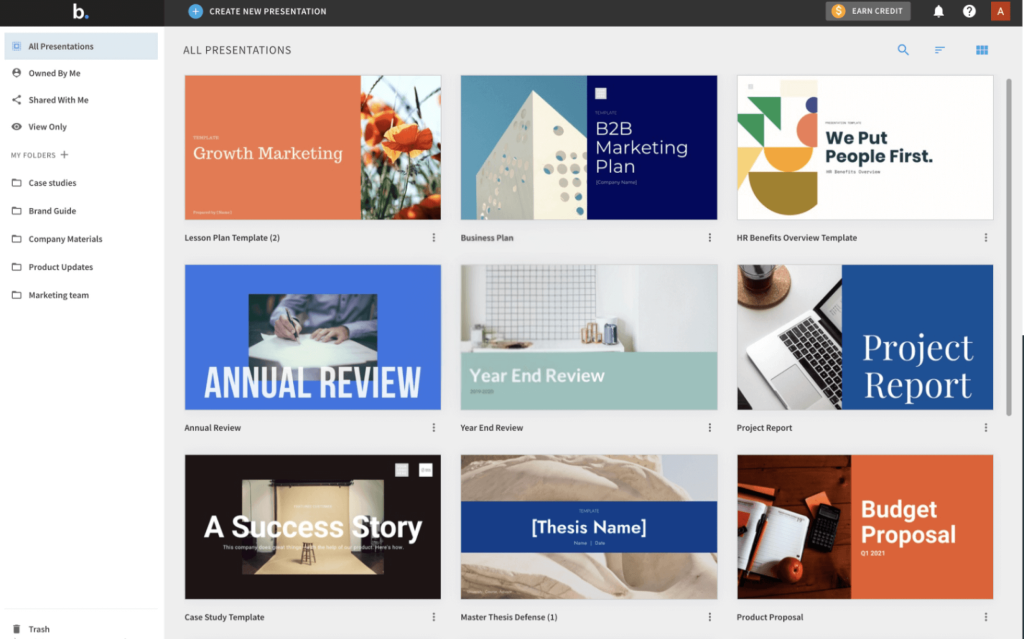
This means less time polishing slides and more time focusing on work results:
- MVPs are built faster
- Investor decks are prepared in days instead of weeks
- Compliance or product documentation is validated with fewer resources.
The key value is the ability to show outcomes tied directly to financial impact.
Data storytelling for executives
AI-enabled analytics platforms like Microsoft Power BI focus on automated executive summaries rather than raw charts. Instead of asking teams to interpret dozens of metrics, AI highlights what matters: revenue anomalies, margin pressure, customer churn risks, or operational bottlenecks.
This matters at the board level because it shifts conversations from what happened to what we should do next. CEOs can walk into board meetings with a concise narrative: where AI improved performance, where it saved time or cost, and where additional investment could generate returns.
Up-to-date dashboards without manual reporting
Boards expect up-to-date, governance-level visibility without creating reporting overhead for leadership teams. Modern AI-assisted dashboards replace monthly spreadsheet consolidation with continuously updated views of financial health, sales performance, operational efficiency, and risk indicators. This reduces reporting friction and improves trust. When board members know data is current and consistent, discussions become more strategic and less defensive.
Coupler.io pulls multi-channel metrics (from finance, sales, marketing, operations, and product) into a single dataset. Instead of fragmented department reports, CEOs get one source of truth. On top of that, Coupler’s AI Agent can translate data into board-ready insight. Just ask it to
“Create a board report summary highlighting key metrics, risks, and opportunities from Q4 data.”
The AI Agent will synthesize information across:
- Sales performance (growth, pipeline health, conversion trends)
- Financial health (revenue, margins, cost efficiency, savings from AI adoption)
- Operational efficiency (cycle times, automation impact, resource utilization)
- Market position (customer retention, expansion signals, competitive risks)
And, as a result, CEOs finally get the strategic clarity and speed they need to make high-stakes decisions with complete confidence.
Additionally, Coupler.io offers free dashboard examples and reporting templates to fit any business scenario.
AI automation for CEO: Governance, risk & vendor selection
The challenge: To ensure that AI systems, data flows, and vendors deliver measurable business value without exposing the organization to unacceptable regulatory, security, or operational risk.
AI implementation risks and governance
The most relevant AI security risks at the executive level are practical and manageable: protecting sensitive data, recognizing potential bias in models, meeting regulatory requirements, and avoiding operational dependencies on unverified outputs.
With AI for CEO, the core risk is not adoption itself, but decision quality. Any ideas, insights, or initiatives generated by AI must be validated, just like proposals brought by top managers. AI accelerates analysis and surfaces patterns, but leadership accountability remains human.
Governance frameworks to balance innovation with appropriate controls
Effective governance frameworks define where AI can operate autonomously and where human review is mandatory. This includes:
- Clear approval thresholds
- Audit trails for AI-generated insights
- Ownership of decisions
The goal is not to slow innovation, but to ensure AI-driven initiatives are analyzed, challenged, and refined before execution.
How to evaluate AI platforms and build your technology stack
Vendor selection should prioritize demonstrated business outcomes, seamless integration with core systems, the ability to scale across functions, and security embedded by design. AI that cannot connect to real operational data or scale beyond pilots rarely delivers executive value. Here’s a comprehensive vendor evaluation list to follow when selecting an AI platform for your business workflows:
✓ Integration capabilities: Does it connect to your existing systems (CRM, ERP, marketing, analytics)?
✓ Ease of use: Can business users operate it without IT support?
✓ Speed to value: How quickly can you see ROI? (Target: 30-90 days)
✓ Security & compliance: Does it meet your industry standards?
✓ Scalability: Will it grow with your organization?
✓ Support quality: What level of implementation assistance is provided?
✓ Total cost of ownership: What are the hidden costs beyond licensing?
As a wrap-up, here’s a concise checklist to help make the most of AI transformation for you and your business.
| CEO’s AI checklist • Always measure first in money (P&L, new sales/subscribers) and exponential growth opportunities. • Recognize that data analysis and spreadsheets currently take more of your day than actual decision-making. AI reverses this. • Enforce multi-source data combination for almost every strategic decision (marketing ROI needs finance + product data; sales funnels need CRM + calendar data). • Prioritize security: control what data AI sees. • Start small, measure fast. AI business value can appear in as little as 15 minutes for the first task. • Lead visionarily: show possibilities, set goals, let teams find the best paths. |
Level up your CEO data routine with Coupler.io AI features
Get started for free