Comparison verified as of July 2026 against each vendor’s live pricing and product pages. Pricing and features change, so check the vendor’s own pricing page before you commit to a plan.
A search for a “Coupler.io alternative” usually comes down to one of a few things. You want a cheaper entry point, a tool built specifically for agency reporting, deeper ad attribution, or a bigger connector count for an enterprise data stack. Coupler.io has closed much of that gap over the past year. It now connects 400+ data sources, blends and transforms data natively, and sends the same data to spreadsheets, BI tools, warehouses, and AI tools like Claude and ChatGPT. But depending on what’s driving your search, another tool may fit better.
I compared five real alternatives on pricing, connectors, refresh speed, security, and AI, and matched each to the use case it actually fits. So you can see where Coupler.io holds up and where another tool does the job better.
Key takeaways: Should you look for a Coupler.io alternative?
Consider an alternative if:
- You only need 1–3 marketing connectors blended into Google Data Studio (formerly Looker Studio) or Google Sheets and want the cheapest possible entry point (Porter Metrics, Two Minute Reports).
- Attribution modeling or a niche warehouse destination like Databricks is your main requirement (Windsor.ai).
- You run a large marketing data operation and need 500+ connectors, dedicated measurement (MMM, MTA), and a data engineering budget to match (Funnel, Supermetrics).
Pick Coupler.io if:
- You’d rather run one platform than pay several vendors to connect data, prepare it, and send it to Sheets, BI, warehouses, and AI tools.
- You need CRM, finance, or e-commerce data in the same reports as your ad platforms, not a marketing-only connector list.
- You want blending, transformation, and dashboards included in your plan, not sold back to you as paid add-ons.
- You want a bill driven by connected accounts and destinations, not one that climbs with every extra row you sync.
- You want your AI tool answering from numbers a calculation engine already checked, not from whatever pattern it guesses out of a pasted spreadsheet.
- You don’t want to hit a wall every time you add a platform, the way tools that cap active source types make you.
- You want a working dashboard today from a template, not a blank canvas and a week of setup.
- You need SOC 2 Type II and GDPR-grade security without jumping to a heavy enterprise ELT platform.


Try Coupler.io before considering alternatives
Star free trialQuick comparison
| Feature | Coupler.io | Porter Metrics | Windsor.ai | Two Minute Reports | Supermetrics | Funnel |
|---|---|---|---|---|---|---|
| Starting price | $24/mo, billed annually | $12.50/account/mo, billed annually | $19/mo, billed annually | $9/mo | $44/mo, billed annually | $300/mo, billed annually |
| Data sources | 400+, all on every plan, spanning CRM, finance, e-commerce, marketing, and sales | 20+, marketing-focused, all on every plan | 325+ listed, but active source types capped per plan (3-7) | 30+, marketing-focused | Marketing/ad-platform focused, capped at 3 on Starter | 121-579+, marketing-focused, gated by plan |
| Destinations | Sheets, BI tools, warehouses, and AI tools, all from one platform | Sheets and BI tools (Google Data Studio, Power BI, BigQuery) | Deep BI and warehouse catalog, including Databricks and Fabric | Sheets and Looker Studio only | Sheets, BI tools, plus Supermetrics Studio | Dashboards and BI tools; warehouses from Business up |
| Data blending | Built in on every plan | Included on every plan, including free | Not a core feature, mostly raw sync | Basic blending across 30+ sources | Separate paid product (Supermetrics Studio) | Included on every plan |
| AI analytics | 6 AI tools via MCP, plus an in-app AI Agent and an Analytical Engine that verifies calculations | Claude and ChatGPT via MCP, free | 5 AI tools via MCP, raw data passed to the model | Claude, ChatGPT, Manus via MCP | Claude, ChatGPT, Copilot as destinations | Funnel MCP only |
| Best for | Teams wanting one platform across spreadsheets, BI, warehouses, and AI | Small teams on 1-5 marketing accounts, cheapest entry point | Attribution modeling or niche warehouse destinations | Small agencies doing PPC/social reporting on a tight budget | Teams standardized on Supermetrics Studio or needing SSO from entry tier | Enterprise teams needing MMM/MTA and the widest connector count |
Comparison verified as of July 2026 against each vendor’s own pricing and product pages. Figures change often, so re-check before you rely on them.
Specs are one thing, but here’s how teams rate Coupler.io and its alternatives across popular review platforms:
| Coupler.io | Porter Metrics | Windsor.ai | Two Minute Reports | Supermetrics | Funnel |
| G2: 4.8/5 Capterra: 4.9/5 | G2: 4.6/5Capterra: – | G2: 4.4/5Capterra: – | G2: 4.8/5Capterra: – | G2: 4.4/5Capterra: – | G2: 4.5/5Capterra: – |
What Coupler.io offers as of now
Coupler.io has grown into a no-code data integration platform and AI analytics solution, so it’s worth seeing the fresh picture before weighing alternatives against it. It’s also built for teams with compliance requirements: SOC 2 Type II certified, GDPR compliant, and running on HIPAA-compliant Google Cloud infrastructure.
On the data integration side, Coupler.io connects 400+ sources across marketing, sales, CRM, finance, e-commerce, and project management, and every source is available on every plan. Blend and transform data inside the platform with formula, filter, aggregate, append, and join operations, then send it to spreadsheets, BI tools, data warehouses, or AI tools. A single data flow can feed multiple destinations at once, so the same numbers can power a dashboard, a warehouse table, and an AI chat without building a separate pipeline for each. It also refreshes automatically on the schedule you set, from daily down to every 15 minutes.

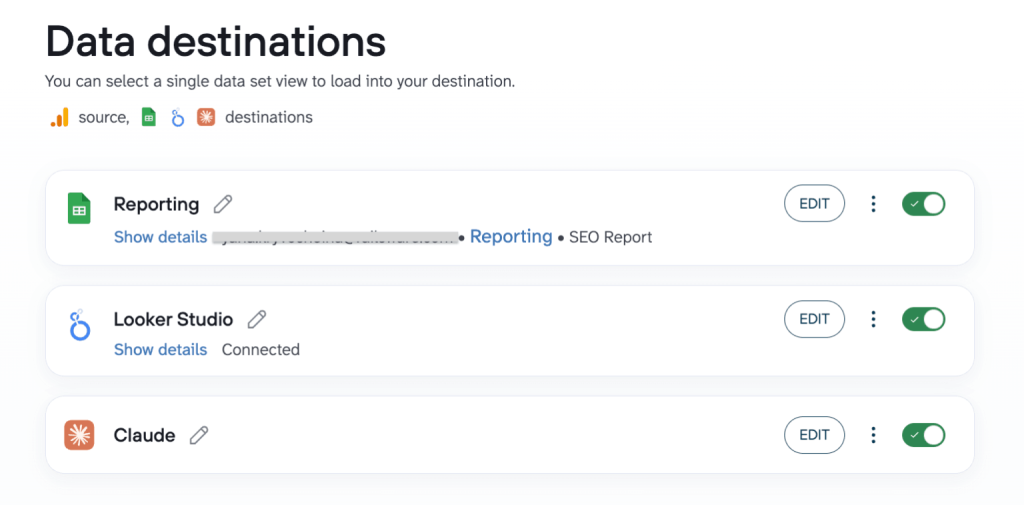
On the AI analytics side, Coupler.io does more than pipe data into a chatbot. Its Analytical Engine runs the calculations against the full dataset and verifies them, then hands only the checked results to the AI model. The model interprets those numbers in plain language. That happens through the in-app AI Agent or AI integrations (like Claude or ChatGPT connected via Coupler.io’s MCP server). The practical effect: the numbers come from a calculation layer, so the answers hold up better than pasting a spreadsheet into a general-purpose chatbot.

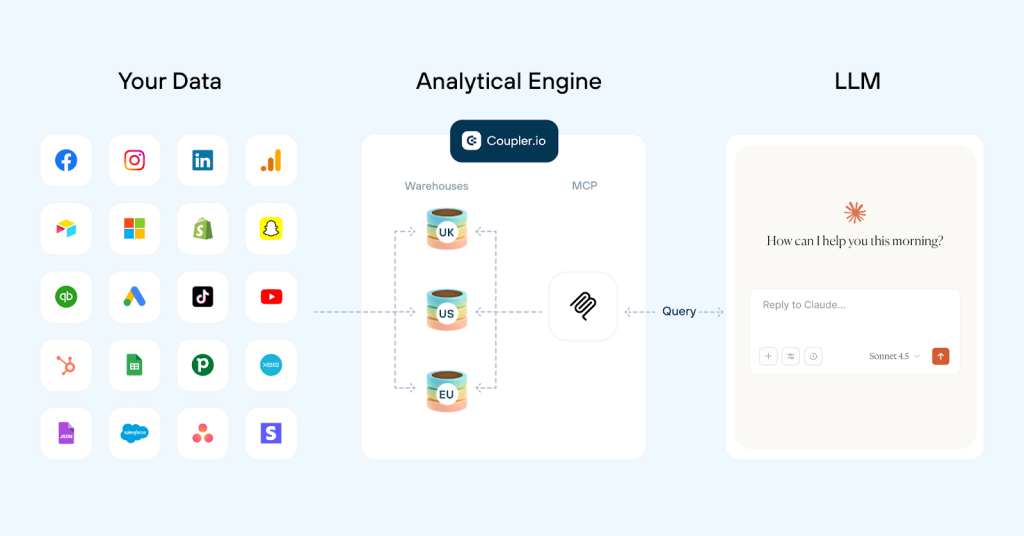
Here you can also add Context to your data to make the AI analysis more accurate. It’s all no-code, and the bill is based on connected accounts, destinations, and refresh frequency.

What some alternatives’ roundups get wrong about Coupler.io
Myth: “Coupler.io has no native Google Data Studio connector.”
Truth: Google Data Studio has been a core Coupler.io destination for years, alongside Power BI, Excel, and Google Sheets.
Myth: “There are no pre-built report templates.”
Truth: Coupler.io’s dashboard gallery lists 200+ templates across marketing, sales, finance, and ecommerce.
Myth: “There’s no built-in data blending.”
Truth: Append, join, aggregate, filter, and formula operations ship on every plan, not as an add-on.
Myth: “It starts at $49/month with 53 connectors.”
Truth: The current Starter plan is $24/month billed annually, and every plan includes all 400+ sources.
When Coupler.io is a better choice
Coupler.io fits best when a team needs more than one type of destination from the same underlying data. Say Google Data Studio for the marketing team, BigQuery for the data team, and Claude for ad hoc questions. You get all three without paying separately for blending, templates, or an AI connection. That’s the case for most teams that have outgrown a single-purpose reporting tool but aren’t yet ready for an enterprise ELT platform.
Connect any data source to AI with Coupler.io
See how AI Integrations workHow Coupler.io compares to its alternatives
Here’s how Coupler.io stacks up against each alternative, including the narrow cases where another tool may be a closer fit.
Coupler.io vs Supermetrics
| Feature | Supermetrics | Coupler.io |
|---|---|---|
| Starting price | $44/mo, billed annually | $24/mo, billed annually |
| Entry-plan data sources | 3 | 400+, no cap on source types |
| Entry-plan destinations | 1 core destination | 1 (Starter), 3 (Active) |
| Data volume fees | None | None on Active plan and above |
| AI | Claude, ChatGPT, Copilot as destinations | Claude, ChatGPT, Gemini, Perplexity, Copilot, Cursor via Coupler.io’s MCP server, plus an in-app AI Agent and an Analytical Engine that verifies calculations before the model sees them |
| SSO | Included from the entry (Starter) plan | Not called out at the entry tier |
Supermetrics gates its entry plan hard: $44/month for just 3 sources and 1 destination, with the next tier up quadrupling the price and a catalog skewed to marketing and ad platforms. Coupler.io’s entry plan costs less, connects 400+ sources across far more categories, includes transformation, and doesn’t lock you to a single destination. For any team reporting on more than ads, that gap only widens as sources are added.
When Supermetrics might fit: your team is already standardized on Supermetrics Studio, or you need SSO and its security posture starting from the entry tier.
Coupler.io vs Windsor.ai
| Feature | Windsor.ai | Coupler.io |
|---|---|---|
| Starting price | $19/mo, billed annually | $24/mo, billed annually |
| Data sources listed | 325+ | 400+ |
| Active source types on entry plan | 3 (Basic), 7 (Standard) | All 400+, no cap on source types |
| Warehouse pricing | Metered by monthly active rows (MAR); overages billed per 1M rows | Set by accounts/destinations, not row volume |
| Fastest refresh | Every 15 minutes (Professional/Enterprise) | Every 15 minutes (Agency/Enterprise) |
| AI | Claude, ChatGPT, Gemini, Copilot, Perplexity via Windsor MCP (raw data passed to the model) | Same AI tools via Coupler.io’s MCP server, plus an in-app AI Agent and an Analytical Engine that runs verified calculations before the model sees the numbers |
Windsor caps how many source types you can run at once (three on Basic, seven on Standard) then meters warehouse destinations by monthly active rows, so a multi-platform team pays more as data grows. That row-based pricing is exactly what sends many teams looking at Windsor.ai alternatives in the first place. Coupler.io lifts both limits: every source on every plan, and pricing set by accounts and destinations, not row volume. The bigger your data gets, the more that difference favors Coupler.io.
When Windsor might fit: your single requirement is attribution modeling or aDatabricks/Microsoft Fabric destination Coupler.io doesn’t natively support.
Coupler.io vs Funnel.io
| Feature | Funnel | Coupler.io |
|---|---|---|
| Starting price | $300/mo, billed annually | $24/mo, billed annually |
| Entry-plan data sources | 121 connectors (Starter) | 400+, no cap on source types |
| Entry-plan destinations | Funnel Dashboards + 3 reporting destinations; no warehouse or export | 1 (Starter), 3 (Active) |
| Data volume fees | None (flexpoint system instead) | None on Active plan and above |
| Measurement (MMM/MTA) | Available as a paid add-on from Business up | Not offered |
| AI | Funnel MCP | Claude, ChatGPT, Gemini, Perplexity, Copilot, Cursor via Coupler.io’s MCP server, plus an in-app AI Agent and an Analytical Engine that verifies calculations before the model sees them |
Funnel starts at $300/month, which is 12x Coupler.io’s entry price and more than its top self-serve plan, with no warehouse or export destinations until Business and a flexpoint model that’s hard to budget. Coupler.io delivers the same no-metering pricing from $24/month, with warehouse and AI destinations on lower tiers. You get the enterprise-style cost model without the enterprise entry fee.
When Funnel might fit: a large enterprise running formal media mix modeling or multi-touch attribution with a budget to match.
Coupler.io vs Porter Metrics
| Feature | Porter Metrics | Coupler.io |
|---|---|---|
| Starting price | $12.50/account/mo, billed annually | $24/mo, billed annually |
| Data sources | 20+ | 400+ |
| Data blending | Included on every plan, including free | Included on every plan |
| Warehouse destinations | BigQuery only | BigQuery, Snowflake, PostgreSQL, Redshift |
| AI | Claude and ChatGPT via MCP, free on every plan | Claude, ChatGPT, Gemini, Perplexity, Copilot, Cursor via Coupler.io’s MCP server, plus an in-app AI Agent and an Analytical Engine that verifies calculations before the model sees them |
Porter’s low per-account price only holds for a handful of marketing accounts: it carries just 20+ connectors, no non-marketing sources, and no warehouse beyond BigQuery. Coupler.io matches its Google Data Studio reporting and blending, then keeps going with 400+ sources across CRM, finance, and e-commerce plus real warehouse destinations. The moment you need data beyond ads, Porter runs out of room and Coupler.io doesn’t.
When Porter might fit: you run 1–5 ad accounts, report only into Google Data Studio or Sheets, and never expect to add another source or destination.
Coupler.io vs Two Minute Reports
| Feature | Two Minute Reports | Coupler.io |
|---|---|---|
| Starting price | $9/mo | $24/mo, billed annually |
| Data sources | 30+ | 400+ |
| Destinations | Looker Studio, Google Sheets | Sheets, Excel, Looker Studio, Power BI, BigQuery, Snowflake, PostgreSQL, Redshift, dashboards, AI tools |
| Accounts per connector | 2 (Lite), 10 (Basic), 50 (Pro) | Not capped per connector; capped by total connected accounts on the plan |
| AI | Claude, ChatGPT, Manus via MCP | Claude, ChatGPT, Gemini, Perplexity, Copilot, Cursor via Coupler.io’s MCP server, plus an in-app AI Agent and an Analytical Engine that verifies calculations before the model sees them |
Two Minute Reports ties its account allowance to each connector instead of a shared pool, so a multi-client agency hits the cap sooner than the price implies, and it exports to just two destinations with no warehouse. Coupler.io handles the same client reporting, pools accounts across the plan, and adds warehouses, transformation, and 400+ sources. It scales with the agency instead of capping it.
When Two Minute Reports might fit: a solo or very small agency reporting only into Google Data Studio or Sheets on the tightest budget.
Pricing scenarios by team type
List prices only tell part of the story. Here’s what three realistic setups actually cost once accounts, destinations, and data volume come into play.
Solo marketer’s scenario: One Google Ads account into Google Data Studio, no blending yet.
Porter Metrics is the cheapest route at $15/month for a single account, or $12.50 billed annually. Coupler.io’s Starter plan is $24/month billed annually and includes three accounts and a destination. Porter wins on price alone here. Coupler.io makes more sense the moment you expect to add non-marketing sources.
Growing agency’s scenario: Twelve client accounts across three platforms, feeding Google Data Studio and Sheets on a daily refresh.
Two Minute Reports Basic is $49/month but caps you at 10 accounts per connector, a tight fit at 12, so you’d likely move to its $99/month Pro tier for headroom. Coupler.io’s Active plan is also $99/month billed annually, with 15 accounts, three destinations, and unmetered data volume. The two land in the same range, but Coupler.io adds warehouse destinations and blending that Two Minute Reports doesn’t offer.
Cross-functional ops team’s scenario: Five accounts and three source types into BigQuery and Google Data Studio, daily refresh, around 8M rows a month.
Windsor.ai’s Standard plan is $99/month billed annually and includes 7.5M monthly active rows, so the extra 0.5M adds roughly $5/month. Coupler.io’s Active plan is also $99/month, with the same 15 accounts and three destinations but no row metering. Same price today, and Coupler.io stays flat as the data grows.
That last scenario is where the two pricing models pull apart:
- How Windsor.ai pricing works: the bill is driven by data sources, accounts, and destination tasks, and warehouse destinations like BigQuery are metered in monthly active rows (MAR). Exceed your plan’s MAR and extra usage is billed per million rows, so the same setup costs more as the business grows.
- How Coupler.io pricing works: the bill is driven by connected accounts, destinations, and refresh frequency. The Active plan ($99/month billed annually) includes 15 accounts and 3 destinations with no row metering, so you can scale the data you move without the invoice moving with it
You can also check out Coefficient.io pricing, which is another Coupler.io competitor that has not been included in this overview.
Security, support, and scalability
Coupler.io’s security covers what most enterprise buyers check for: SOC 2 Type II, GDPR, encryption in transit and at rest, and MFA. Here’s how it lines up against each alternative.
| Control | Coupler.io | Porter Metrics | Windsor.ai | Two Minute Reports | Supermetrics | Funnel |
|---|---|---|---|---|---|---|
| SOC 2 Type II | Yes | No — states it is not yet certified (expected 2026) | Yes (SOC 2 Type II, Windsor Group AG) | No — only its cloud providers (GCP/AWS) hold SOC 1/2/3 | Yes — annual SOC 2 Type II audit | Yes — SOC 2 Type 2 attestation |
| GDPR | Yes | No — states it is not GDPR compliant | Yes | Yes | Yes (GDPR and CCPA) | Yes (GDPR and CCPA) |
| Other frameworks | Dedicated DORA page; infrastructure inherits SOC 2, ISO 27001, HIPAA/HITECH, and FedRAMP posture from its Google Cloud and AWS hosting | None claimed | None of its own claimed | None of its own; ISO 27001 and PCI-DSS held by cloud providers (GCP/AWS) | None of its own; ISO 27001 via cloud providers | ISO 27001:2022 certified; CSA STAR Level 1 |
| Encryption in transit/at rest | TLS in transit, AES-256 at rest | SSL/HTTPS in transit; at rest not documented | Encrypted in transit and at rest | TLS 1.2/1.3 in transit; stored tokens encrypted (no standard stated) | TLS 1.2+ in transit; encrypted at rest | TLS 1.2 in transit; AES-256 at rest |
| MFA / SSO | MFA enforced on supported sources | Google sign-in only; MFA not documented | SSO on Enterprise (Google/Microsoft login); MFA not documented | Google sign-in for users; 2FA only for internal admin access | SSO on standard plans, SAML SSO on Enterprise; MFA for internal admin | SSO + MFA via Okta/Google/Azure AD; Google SSO on Starter/Business, SAML/OIDC/SCIM on Enterprise |
| Data hosting | Google Cloud and AWS (AWS KMS, AWS IAM) | Google Cloud / BigQuery (clients can own data in their own GCP project) | Germany (Hetzner) plus Google Cloud (US/EU); Cloudflare CDN | Google Cloud and AWS (region not stated) | AWS and Google Cloud, EU region | AWS; EU data center option at Enterprise |
Proof from real teams
The pattern repeats across industries: manual reporting eats hours, Coupler.io automates the data flow, and the team gets the time back. Every figure below comes from Coupler.io’s own case studies.
Agencies and marketing teams:
- Right Percent, a B2B agency managing over $1M in monthly ad spend, couldn’t afford slow reporting cycles. A Claude-based workflow on Coupler.io cut its PPC reporting time by 60%. As performance marketer Gabe Solberg puts it, connecting his data to an LLM through Coupler.io makes him “not only faster but exponentially better,” something he calls “vibe reporting.”
- ULTRA\OPS, a digital consultancy, needed client dashboards without building a costly custom API. It piped a custom Airtable app into Looker Studio, cut reporting build time by 90%, and had enterprise-grade dashboards live in a single day.
- SellThru, a digital marketing agency in the GCC region, was spending up to two weeks setting up each client’s reporting. Consolidating ad platforms and GA4 through Coupler.io dropped that to 2–3 days and lifted tracking reliability above 95%.
Finance and accounting:
- DE-YAN‘s finance team kept hitting delays and budget oversights from manual QuickBooks reporting. Live Google Sheets flows gave them real-time budget tracking and, by Coupler.io’s account, saved up to 15 hours of admin time a day.
- Project Alfred, an Australian accounting firm serving tech companies and non-profits, needed reporting and cash-flow forecasting beyond what Xero offered natively. Unifying Xero and HubSpot data saved 20–40 hours a month and enabled 12–24 months of scenario-based forecasts.
E-commerce:
- Habitium, an international online retailer with 200+ distributors and 400k+ products, was drowning in manual stock and pricing work. Automating its GA4 and Search Console data cut that labor from about 50 hours a month to 10, and helped lift margin by 5% and sales by 11%.
Non-profits:
- United Way Northwest Indiana struggled to consolidate data from ad platforms, GA4, and Search Console. Automating it saved roughly 80 hours a month and $20,000 a year, and freed up campaign budget that returned upwards of $50,000 in donations.
For unfiltered peer opinions beyond vendor case studies, see the discussions in r/PPC on Coupler.io.
How to decide if you need Coupler.io alternative
For most teams, the honest answer is that you don’t. Coupler.io is the broadest option here: one platform that connects 400+ sources, blends and transforms the data, and sends it to spreadsheets, BI tools, warehouses, and AI tools, without paying separate vendors for each step. If you want that range from a single tool, start with Coupler.io. The exceptions are narrow and specific:
- Porter Metrics or Two Minute Reports, if you only run 1–5 marketing accounts into Google Data Studio or Google Sheets and want the lowest price.
- Windsor.ai, if attribution modeling or a niche warehouse like Databricks is your one core requirement.
- Supermetrics, if your team is already standardized on Supermetrics Studio or needs SSO from the entry tier.
- Funnel, if you need formal media mix modeling or multi-touch attribution at enterprise scale.
For one platform across spreadsheets, BI, warehouses, and AI, start a free trial and rebuild an up-to-date report. Check the list of 400+ connectors first. For a larger migration or an agency/enterprise setup, the Coupler.io team can walk through your current stack and map out what moves first.