Agencies that want to stop building client reports by hand often end up with Databox vs AgencyAnalytics on the shortlist. Both sell a plan made for agencies. Both connect to Claude and ChatGPT through MCP, and both let you brand what clients see.
They are built around different things, though. AgencyAnalytics gives every client a white-labeled portal for one flat price per client. Databox gives your team a shared set of metric definitions and an AI analyst that works across client accounts. In Databox, white-labeling is an add-on.
At a typical roster, their list prices land within a dollar of each other. So the choice comes down to what your clients see and what your team does with the data. I priced a 10-client agency on both and added Coupler.io as a third option for agencies whose clients read reports in their own BI tools.
Key takeaways
- Different centers. AgencyAnalytics is a client reporting workspace with a branded portal. Databox calls itself an “agentic analytics platform”, built around Genie, its AI analyst.
- Entry prices. AgencyAnalytics costs $20 per client per month, billed annually. Databox Agency starts at $79 a month for 4 client accounts, plus $20 for each extra account pack.
- Trials. Both offer 14 days with no credit card. The AgencyAnalytics trial is capped at 15 clients, and Databox’s pricing FAQ says it has no free plan.
- Coverage. AgencyAnalytics lists 90+ marketing integrations with unlimited sources per client. Databox lists 130+ tools plus databases and a custom API builder, with a source cap per plan.
- Security on paper. Databox’s trust center lists a SOC 2 Type 1 report. None of the AgencyAnalytics pages I checked mention a SOC 2 report.
- A third option. Coupler.io blends client data from Google Ads, Meta, GA4, HubSpot, Shopify and more and keeps it up to date in Data Studio, Sheets, Power BI or Claude. Plans start at $24 a month, billed annually.
Databox vs AgencyAnalytics at a glance
This table sums up both tools. The facts come from each company’s own website as of November 2026. The ratings come from G2.
| Category | Databox | AgencyAnalytics |
|---|---|---|
| Built around | Metric definitions, AI analyst, MCP | Client reports and a white-labeled portal |
| Agency pricing unit | Account packs (1 account, 5 sources, 50 AI credits) | Per client |
| Agency entry price | $79/month for 4 accounts, billed annually | $20 per client per month, billed annually |
| Trial | 14 days, no card | 14 days, no card, up to 15 clients |
| Data sources | 130+ tools, databases, custom API; capped per plan | 90+ marketing integrations; unlimited per client |
| Where reports live | Dashboards, reports, AI artifacts; PDF and JPG snapshots | Reports, dashboards, client portal |
| Users | Unlimited on Agency | Unlimited staff and client users |
| White-label | $80/month add-on | Included |
| AI | Genie, Skills, Routines; credit pool | AgencyAI, Skills, Scheduled Prompts; no usage limits |
| MCP | Read and write, all paid plans | Read and write, included |
| Security pages | SOC 2 Type 1 report, SAML SSO | GDPR, MFA; no SOC 2 listed |
| G2 rating | 4.4/5 (195 reviews) | 4.7/5 (464 reviews) |
Client portal or AI analyst
Most differences in this comparison trace back to who reads the numbers first, your client or your team.
AgencyAnalytics is built for the client side. Each client gets a branded login with reports and dashboards, on your own domain. Reports go out on a schedule, and custom permissions control what each staff member and client sees. The price follows the same idea, with one fee per client that covers every feature.
Databox is built for the analyst side. You define each metric once in what it calls a semantic layer, a shared set of metric definitions that people and AI both use. Genie then answers questions about any client account, and Routines run that analysis on a schedule. Databox’s own comparison page says it fits agencies that want “analysis and recommendations on every client account”.

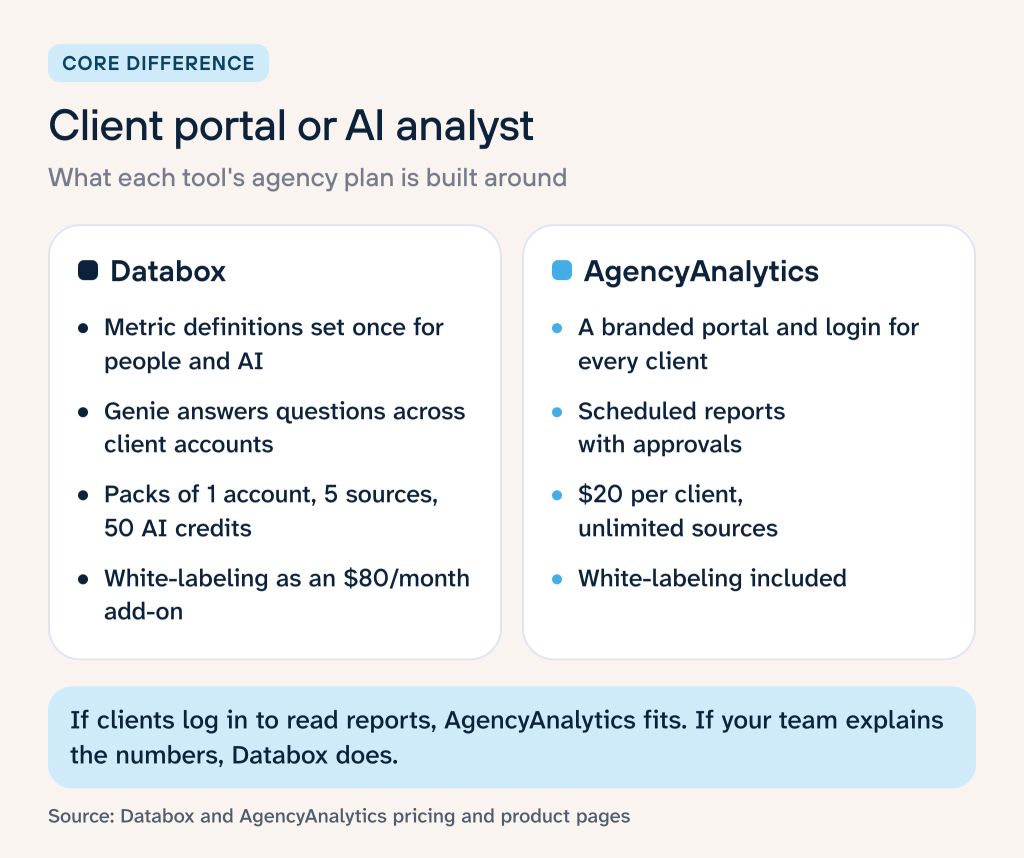
If clients log in to read their own reports, AgencyAnalytics speaks to that. If your team spends its time explaining why numbers moved, Databox targets that work.
Who each tool is built for: the Databox vs AgencyAnalytics audience
AgencyAnalytics serves agencies only. Its Databox comparison page says it is built “for marketing agencies, and marketing agencies only”. The company says 7,000 agencies use it, across SEO, PPC, social, web design and multi-location brands.
Databox sells to in-house teams and agencies on separate plans. Its Business plan is for teams that want to “put AI to work themselves”, with up to 10 users. The Agency plan adds unlimited users and one login across client accounts. Databox says 20,000+ businesses and 1,000+ agencies use it.
G2’s compare page shows the same split. 91.3% of AgencyAnalytics reviewers work at small businesses of 50 or fewer people, against 72.5% for Databox.
Databox vs AgencyAnalytics data sources
AgencyAnalytics covers marketing channels in depth. Databox adds databases, warehouses and custom APIs to its app catalog.
AgencyAnalytics lists 90+ marketing integrations, and its integrations page counts 96. They span PPC, SEO, social, email, call tracking, local listings, analytics and e-commerce. Every client gets unlimited data sources, and some integrations take up to 10 accounts per client. Database connectors, such as BigQuery and MySQL, come as an add-on or with volume pricing. Custom data enters through a Google Sheets integration.
Databox says it connects “130+ tools, plus your databases, spreadsheets, and APIs”. Its library filter shows 107 one-click integrations, so the two counts differ. It reads from warehouses and databases, and its no-code builder syncs custom data from apps with API access. Sources are capped, though. Databox counts each account, property or view as one data source, and Agency includes 20 before packs. Coupler.io bills by connected accounts instead, with every source available on every plan.
For a pure marketing roster, both catalogs cover Google Ads, Meta, GA4 and Search Console. If a client’s data sits in a database or an in-house app, Databox lists more ways to reach it. Check your exact platforms in both catalogs before you shortlist.
Destinations and exports in AgencyAnalytics vs Databox
Both tools keep your reports inside their own apps. Neither lists an export to Google Sheets, a BI tool or a data warehouse on the pages I checked.
AgencyAnalytics delivers through the client portal and scheduled reports. AgencyAI answers can also become shareable HTML pages. Databox shares dashboards by link, sends PDF or JPG snapshots on a schedule, and saves AI artifacts as PDF or HTML.
If your clients use Data Studio or Power BI, ask both vendors how data gets there, since neither lists that export. Coupler.io is built for that route: it sends the same client data to Data Studio, Power BI, Sheets or BigQuery on a schedule.
Databox vs AgencyAnalytics pricing for a 10-client agency
The two vendors count your agency in different units, yet the bills come out close. AgencyAnalytics charges per client. Databox charges per account pack, and each pack holds one client account.
AgencyAnalytics has one plan, which its pricing page calls “Our core plan”. It costs $20 per client per month on annual billing, with no minimum client count stated. The pricing page shows only annual billing, while other AgencyAnalytics pages list $25 per client on monthly billing. Agencies with 25+ clients can ask sales for discounted per-client rates. Add-ons include Rank Tracker at $41.67 a month per 500 keywords and AI Tracker at $20.83 a month per 250 credits, both billed annually.
Databox Agency costs $79 a month, billed annually, for 4 accounts, 20 data sources and 300 AI credits. Each account pack adds 1 account, 5 data sources and 50 AI credits for $20 a month. Databox shows Agency prices billed annually only. White-labeling costs $80 a month and the AI credit top-up $200 a month, both billed annually.
One agency, two bills
Picture an agency with 10 clients. Each client runs Google Ads, Meta Ads, GA4 and Search Console, so 4 data sources each. All prices are billed annually.
AgencyAnalytics. Ten clients at $20 each come to $200 a month, or $2,400 a year. White-labeling, the client portal and AgencyAI are included.
Databox. Ten clients need 10 accounts, so the base plan plus 6 packs. That costs $79 plus 6 times $20, or $199 a month. The plan then holds 50 data sources, enough for the 40 this agency uses. With white-labeling, the bill is $279 a month. Each new client adds $20, as long as it uses 5 data sources or fewer.

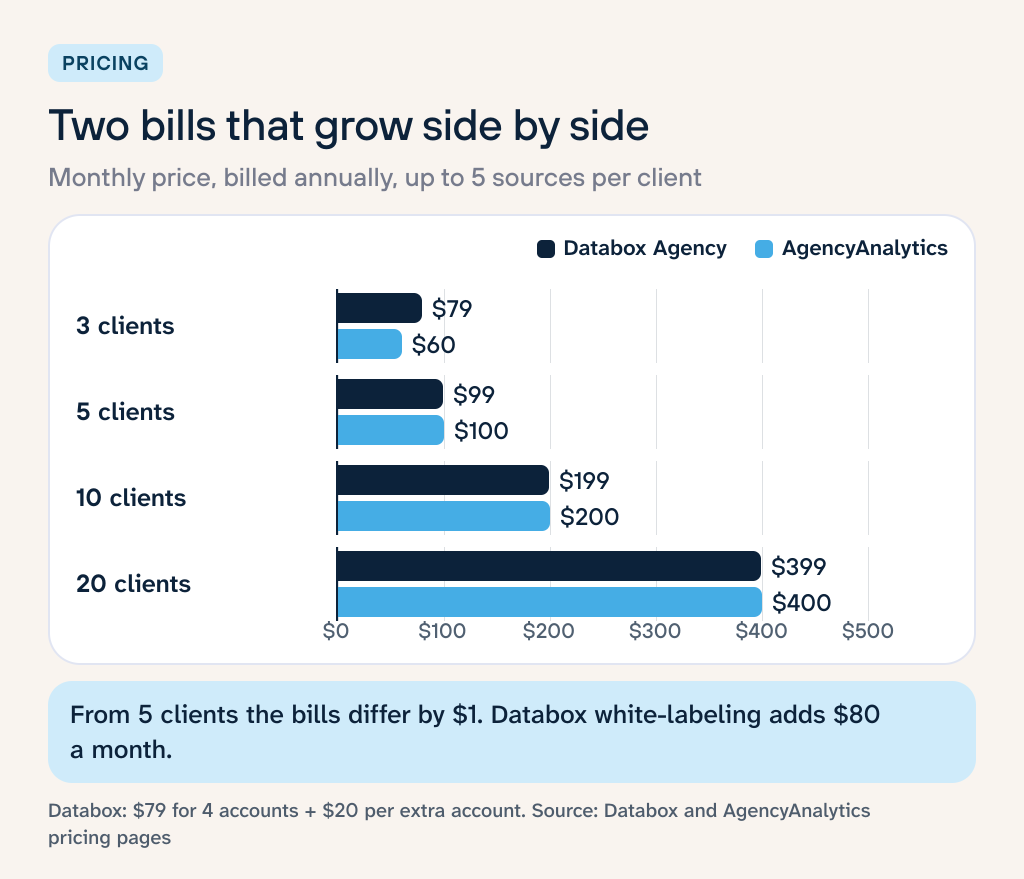
In this scenario, the list prices are $200 and $199 a month. At 3 clients, AgencyAnalytics comes to $60 and Databox to its $79 base. With branding, Databox’s bill is $279 against $200. Databox’s help center says you can buy one white-label add-on per account, so ask how it bills across clients.
The same 10 clients on Coupler.io. The 10 clients connect 40 accounts. Coupler.io’s Pro plan covers 50 accounts with hourly refresh and unlimited destinations for $199 a month, billed annually. Extra accounts cost $4.49 each a month, billed annually. See Coupler.io pricing.


Map your client accounts to one Coupler.io plan
Book a demo with Coupler.ioAgencyAnalytics vs Databox key features for agency work
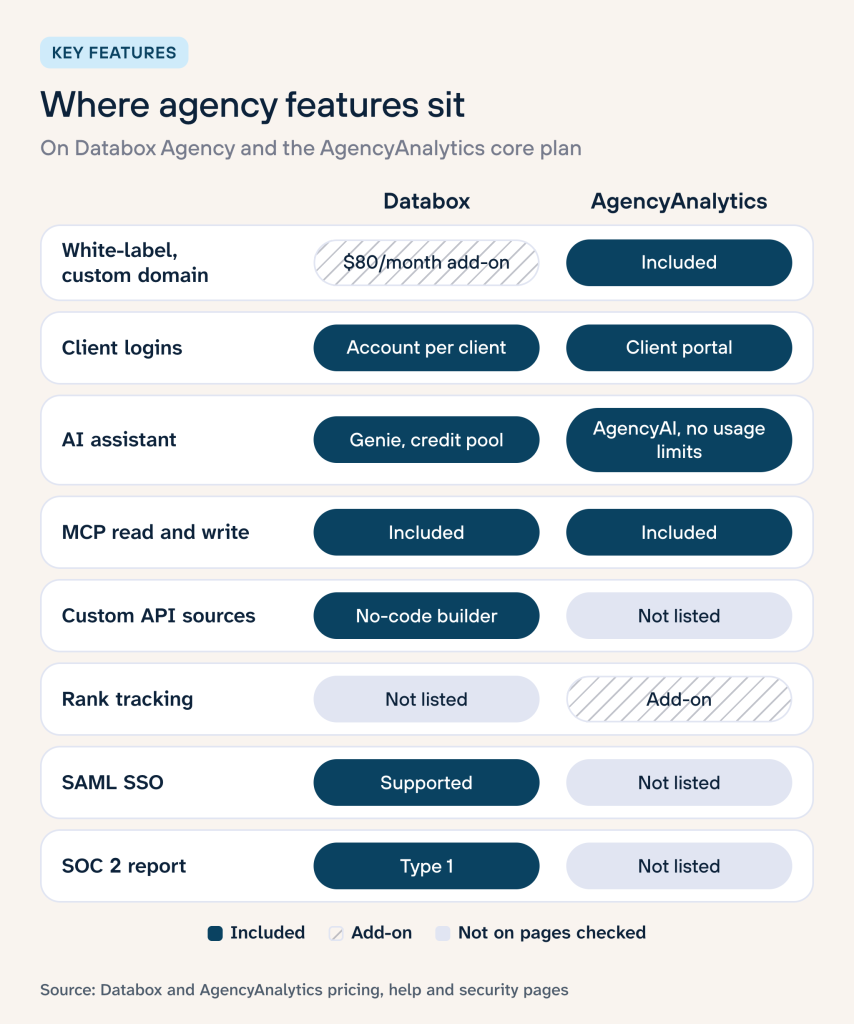
AgencyAnalytics covers the monthly reporting routine end to end. Databox goes deeper on metrics, goals and analysis.
If you send many client reports each month
AgencyAnalytics bundles the tools agencies use every week. Report scheduling, report approvals and version history cover the sending side. Roll-up reports and dashboards are on the feature list as well. Goals, alerts, anomaly detection, benchmarks and forecasting sit on every client. Rank Tracker and AI Tracker are paid add-ons for SEO teams.
If your team analyzes across clients
Databox builds on its shared metric definitions. Agency adds one login across client accounts, bulk actions, custom templates and cross-client reporting with AI. Goal tracking is built in, while OKRs cost $14 a month and a fiscal calendar $160, billed annually.

Databox vs AgencyAnalytics AI
Both tools now ship an AI assistant, reusable skills, scheduled prompts and an MCP server. The difference is how you pay for AI and how far it reaches.
AgencyAI is “Included on every plan” with “no usage limits”, says AgencyAnalytics. It answers questions about any client, runs Skills, and repeats prompts on a schedule. Client Context lets you upload up to 20 files per client, such as contracts or meeting notes. The MCP server connects to Claude and ChatGPT, and since October 2026 it can also add clients or build metrics.
Databox’s Genie answers in plain language and can build metrics, dashboards and goals. Skills save repeat analysis, and Routines deliver it by email or Slack. The MCP server reads data and can push new data into Databox. Genie can also pull context from tools like HubSpot through connectors. Genie, Skills, Routines and the MCP server draw credits from a shared pool, 300 a month on Agency plus 50 per pack. Databox’s help center puts a light analysis at about 3 to 4 credits and a deep one at about 11 to 13.
For a 10-client agency, that is 600 Databox credits a month, roughly 50 deep analyses. If your team asks AI questions all day, AgencyAnalytics’ flat terms are simpler to plan for.
Where Coupler.io fits with your AI. Both tools point their AI at marketing data stored in their own apps. With Coupler.io, your AI works on client data blended from ads, CRM, accounting and e-commerce apps. The AI asks, Coupler.io calculates, and every query is logged, so each number can be checked. AI Integrations bring the same data into Claude and ChatGPT. The AI agent sets up data flows when you describe what you need.
Let Coupler AI do the data work for you
Tell Coupler AI what you need to know, from which source, and how often. It connects your account, sets up the data flow, keeps it refreshed, and lets you analyze the results inside Coupler.io or another AI tool.
Try for free

Ask Claude about every client with Coupler.io
Start your free 7-day trialDatabox vs AgencyAnalytics security & stability on paper
Databox publishes more security detail. I checked AgencyAnalytics pages, but none has named any security certification.
Databox’s trust center lists a SOC 2 Type 1 report. That audit checks how controls are designed at one point in time. I found no Type 2 report there. Its security policy says it is “not currently ISO 27001 certified”, and it lists GDPR and CCPA. Data sits on AWS in the US, encrypted with AES-256 at rest and TLS 1.2 or higher in transit. SAML SSO is supported, and the $40 advanced security add-on enforces SSO and 2FA.
AgencyAnalytics’ security FAQ says it is “not HIPAA compliant at this time” and can’t sign BAAs. It publishes a data processing agreement for GDPR. Its privacy policy says personal data is processed in Canada and the USA. Its help center says email-code MFA is on all plans. None of the pages I checked mention SOC 2, ISO 27001 or SAML SSO. Its help center says uptime is typically “more than 99.9%”, with no SLA.
If your clients send security questionnaires, ask both vendors for their documents before you sign. Coupler.io has a SOC 2 Type II report, which audits how security controls work over months, not on a single day. The platform is also GDPR compliant. AI tools don’t connect to client data sources directly, and every AI query is logged so your team can check it. On the Custom plan, agencies also get SAML SSO and an enterprise SLA, with audit logs on request.
Databox vs AgencyAnalytics ease of use, support on G2
On G2, AgencyAnalytics leads every comparison score. It rates 4.7/5 from 464 reviews, against 4.4/5 from 195 for Databox.

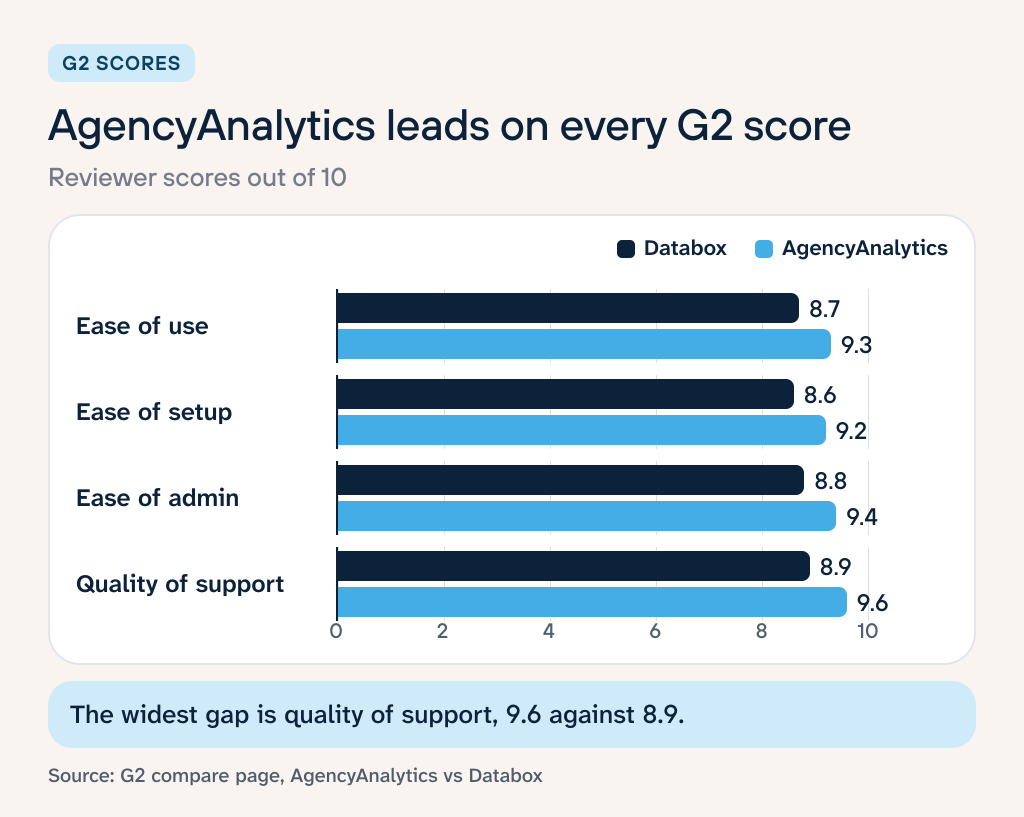
The widest gap is in quality of support, 9.6 against 8.9. AgencyAnalytics says its chat answers 24/5, and its pricing page includes email support and a free onboarding call, with dedicated onboarding from 25 clients. Databox includes email support on Business and Agency. Its Custom service, from $15,000, adds hands-on help from its engineers.
Both trials run 14 days without a card. AgencyAnalytics caps the trial at 15 clients and turns off custom email. Databox stops syncing and pauses scheduled reports if you don’t add payment details.
Questions to ask in a Databox or AgencyAnalytics demo
- Databox: does one $80 white-label add-on cover every client account, or is it priced per account?
- Databox: what refresh rate does the Agency plan include, and what does the 15-minute sync add-on cost?
- AgencyAnalytics: what per-client rate applies at 25, 50 and 100 clients?
- Both: can we export client data to Google Sheets or a warehouse if we leave?
Where Coupler.io fits if neither tool matches
Some agencies want neither a portal nor an in-app analyst. Their clients already read reports in Data Studio, Sheets or Power BI. Others want ad spend and revenue blended in one dataset per client. Both tools build reports inside their own apps, so these agencies need a different route.
Coupler.io is a reporting automation platform for business teams. It automatically collects and blends data from 400+ apps and keeps it up to date for your reports and AI. For agencies, that means reports for every client, in whatever tool each client uses. More than 200K users rely on it, and it is rated 4.9/5 on G2 and Capterra.
| Area | Coupler.io | Databox | AgencyAnalytics |
|---|---|---|---|
| Pricing unit | Connected accounts | Account packs | Clients |
| 10 clients, 4 sources each | Pro, $199/month | $199/month, $279 with white-label | $200/month |
| Sources | 400+ apps across ads, CRM, accounting and e-commerce, plus databases and JSON APIs; all sources on every plan | 130+ tools, databases, custom API | 90+ marketing integrations |
| Where reports live | Sheets, Excel, Data Studio, Power BI, BigQuery, AI tools | Databox dashboards and reports | AgencyAnalytics reports and portal |
| Client-facing branding | In the client’s own BI tool | Add-on | Included portal |
| AI | AI Integrations, AI agent; every query logged | Genie, Skills, Routines, MCP | AgencyAI, Skills, MCP |
| Security on pricing or trust page | SOC 2 Type II, GDPR | SOC 2 Type 1 report | No certification listed |
Coupler.io doesn’t replace everything here. AgencyAnalytics keeps its lead on the client portal. Coupler.io dashboards can’t be white-labeled or shared outside your Coupler.io account, so branded client reports run through the client’s own BI tool, such as Data Studio or Power BI. Databox keeps Genie, goals and forecasts inside one app. To keep clients separate, Coupler.io offers a workspace per client: 3 on Pro and unlimited on Custom.
See how Coupler.io compares in detail with Coupler.io vs Databox and Coupler.io vs AgencyAnalytics. If you’re leaving AgencyAnalytics, there is a migration guide.
Send client data to the tools your clients already use
Start your free 7-day trialPicking between them
Pick AgencyAnalytics if…
Your clients log in to read their reports, and you want a branded portal on your own domain. You prefer one price per client with every feature included, and AI without usage limits. See our AgencyAnalytics pricing guide for larger rosters.
Pick Databox if…
Your team wants to analyze performance across clients with shared metric definitions. You need sources beyond marketing, or a SOC 2 report from your vendor. White-labeling at $80 a month fits your budget.
Consider Coupler.io if…
Your clients already read reports in Data Studio, Sheets, Power BI or Claude. You want ads blended with CRM, finance or e-commerce data, on account-based pricing.
Look past both if…
You need enterprise controls such as SAML SSO, audit logs and an SLA. When reviewing the AgencyAnalytics pages, I haven’t found any of the three. Databox lists SSO and activity logs through its $40 add-on, with no SLA on the pages I checked. Coupler.io’s Custom plan lists all three. For a wider shortlist, see these AgencyAnalytics alternatives and Databox alternatives.