What is financial consolidation?
Financial consolidation is the process of combining financial data from multiple subsidiaries, divisions, or legal entities. It is required for group reporting and helps present the overall financial health of the organization as a single economic unit. This view is crucial for external stakeholders and internal strategic decisions.
Imagine trying to understand your company’s true financial position when one subsidiary uses QuickBooks in USD, another uses Xero in EUR, and a third operates on a legacy system in GBP. Each month, your finance team spends days copying data into spreadsheets, converting currencies manually, and hunting for mismatched intercompany transactions. Financial consolidation solves this problem—and automation makes it manageable.
Although the concept seems straightforward, the process is complex. Different accounting systems must be harmonized, multiple currencies managed, and all internal transactions carefully eliminated. For this reason, many organizations are moving away from manual methods and adopting automated solutions to collect, standardize, and consolidate data.
Why do you need automated consolidation of financial statements?
Multi-entity organizations often rely on separate QuickBooks, Xero, or other cloud-based accounting systems for each subsidiary. As a result, collecting and combining this data by hand takes time and leaves room for mistakes.
To simplify this, make consolidation a self-running process with Coupler.io. It automatically pulls your QuickBooks/Xero data, lets you turn it into a standardized report, and delivers it to a BI tool or database on schedule. This gives you a clear, unified view of your group’s finances without tedious manual work.
Look at some cases where automation of financial consolidation makes a difference.
Consolidated reporting for multinational businesses
Different countries typically have disparate reporting standards and varying Chart of Accounts (CoA) structures. These inconsistencies make it difficult to manage international operations. To resolve them, you need to combine all the data into one report, a process that is time-consuming and prone to errors.
With Coupler.io, you can automatically collect P&L reports, balance sheets, and cash flow statements from QuickBooks or Xero accounts across your international entities – and bring them together in a single view.

Impact: Instead of manually merging data from regional QuickBooks or Xero accounts in spreadsheets, you collect, standardize, and consolidate them directly in Coupler.io. This eliminates repetitive tasks, keeps reporting consistent across entities, and provides faster access to reliable insights into your multinational business.
Time period comparisons (current year vs. prior year)
Strategic planning relies on understanding historical financial performance. You need to compare the current period’s results against prior ones or internal benchmarks to identify trends and make informed decisions.
To automate this process, use Coupler.io. It enables you to extract historical general ledger data with all required parameters configured on the go. This ensures your finance team has standardized, accurate period-over-period data ready for analysis.

Impact: With consolidated historical insights at your fingertips, you no longer have to manually compile spreadsheets or reconcile data from multiple systems.
For example, if you’re a SaaS company, you can quickly identify patterns in subscription revenue, churn, and customer lifetime value across regions or product lines. This lets you track monthly recurring revenue trends, compare current performance against last year, and forecast next quarter’s growth with confidence.
Automated financial consolidation for multi-currency data
Currency exchange volatility is a major challenge for multinational organizations. Manually managing local-currency data from numerous entities requires extensive effort and careful attention.
Luckily, Coupler.io simplifies the process by centralizing all financial data from local entities and self-updating exchange rates from QuickBooks or Xero. With formula and data aggregation features, you can then apply consistent conversion methods and deliver ready-to-use reports to your destination tool.

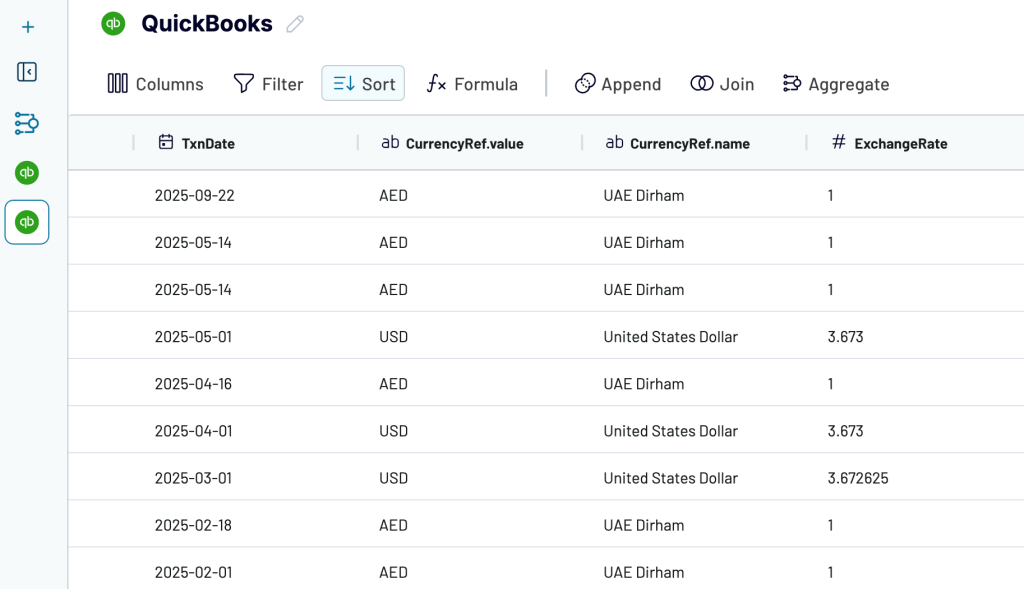
Impact: You no longer need to manually copy daily or monthly exchange rates from each subsidiary into spreadsheets.
Just imagine: you just pull USD and other rates, apply historical rates to last month’s invoices, and produce a consolidated report in the reporting currency. This makes conversion accurate and repeatable, prevents misstatements, and allows you to focus on performance rather than reconciling rates.
To sum up, if you automate the collection, standardization, and flow of data from all your entities, financial consolidation comes with:
- Time savings: Reduce the month-end close from days to hours.
- Strategic visibility: Make real-time decisions with consolidated dashboards.
- Compliance efficiency: Simplify audit prep with traceable data.
Explore Coupler.io for financial reporting automation
Get started for freeLet’s see how to set up automated financial consolidation, step by step.
Steps of the financial consolidation process
Financial consolidation follows a structured sequence of accounting procedures that we outline as key steps below:
- Standardization and alignment of accounting policies – to maintain consistency across entities.
- Data collection – to gather trial balances and general ledger information from all subsidiaries.
- Chart of accounts mapping – to combine financials under a unified structure.
- Foreign currency translation adjustments – to reflect all results in the group’s reporting currency.
- Intercompany eliminations and reconciliation – to remove internal transactions.
- Adjustments for non-controlling interest (NCI) – to correctly represent ownership and allocate results. 👇
Standardization and alignment of accounting policies
Differences in how local entities record revenue, value inventory, or calculate depreciation can skew the overall group results. To ensure accurate consolidation of financial statements, all subsidiaries should use consistent reporting schedules and apply the same key accounting policies.
👉 For this, you need to align reporting schedules and adjust financial accounting policies to match the group’s master standards. Each entity reconciles its local practices to these rules.
As a result, the records become fully compliant. This provides a reliable basis for the next step: collecting your financial data.
Data collection
Data from multiple local entities is often scattered across different sources, such as accounting, billing, and CRM systems. To overcome this, you need to build integrated data flows that sync information between platforms for a complete financial picture.
With Coupler.io, it only takes a few minutes to collect your data automatically. In our example, we’ll use Xero as the data source. But feel free to create a data flow for your financial data right away. Sign up for Coupler.io (it’s free and no credit card is required).
Once you’re in, you’ll see the main dashboard where you need to click Create a data flow button. You’ll be guided through three simple steps:
Step 1: Choose your source. Select Xero from the list of available sources. You’ll then authorize your Xero account, which allows Coupler.io to securely access your financial data.
Step 2: Configure source settings. After authorization, you’ll configure what data to pull:
- Specify the Xero tenant from which you’d like to pull data (if you manage multiple organizations).
- Pick the particular data entity you will export. Accounts are preselected by default, but you have 20+ other options, such as bank transactions, payments, purchase orders, and more.


Move forward, and to fetch data from another entity, simply add Xero as an extra source and follow the same steps. A similar process applies when you need to load records from other kinds of sources, such as QuickBooks.
Once done, proceed to view your gathered data – now you’re ready for the chart of accounts mapping covered below.
Chart of accounts mapping
Data collected from different local entities frequently follow disparate Chart of Accounts (CoA) structures. For example, similar transactions across entities are often recorded under inconsistent account codes, which makes the analysis misleading. This creates the need to map each local CoA to the parent company’s standardized one.
Understanding CoA mapping conceptually: Think of CoA mapping as creating a translation table. If Subsidiary A records “Office Supplies” under code 6100 and Subsidiary B uses code 5200 for the same expense, you’d map both to your parent company’s master code—say, 6500-Supplies. This ensures that when you consolidate, all office supply expenses roll up correctly under a single category, regardless of how each subsidiary originally coded them.
👉 To implement this mapping with your gathered data, use Coupler.io’s transformation features:
Hide unnecessary columns
To focus only on relevant accounts, hide unnecessary columns that aren’t needed for consolidation, e.g., QuickBooks’ Memo/Description or Split, which don’t affect results.

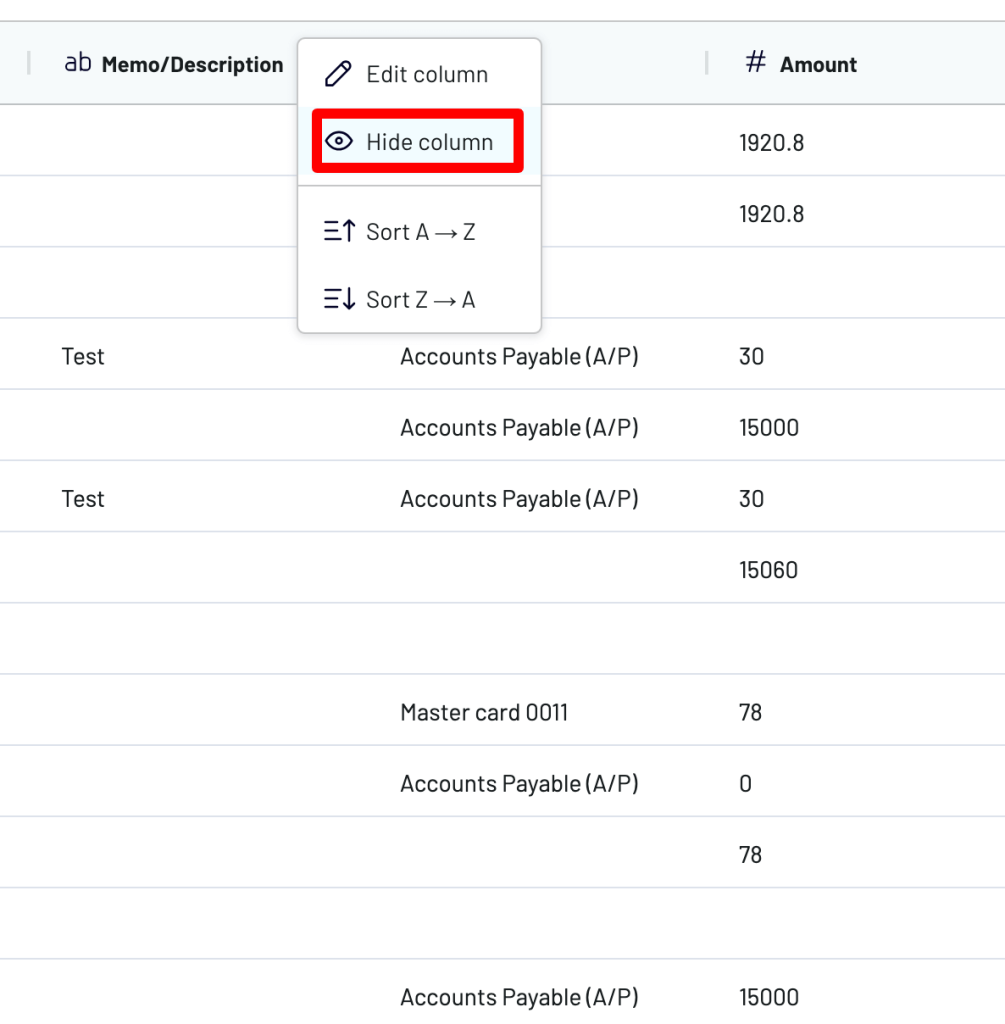
This keeps only essential fields like Account, Date, Amount, and Balance for accurate aggregation.
Standardize data labels
If you need to standardize data labels, edit columns to rename or adjust them to match the group’s master CoA, for example, Amount → Local Amount.

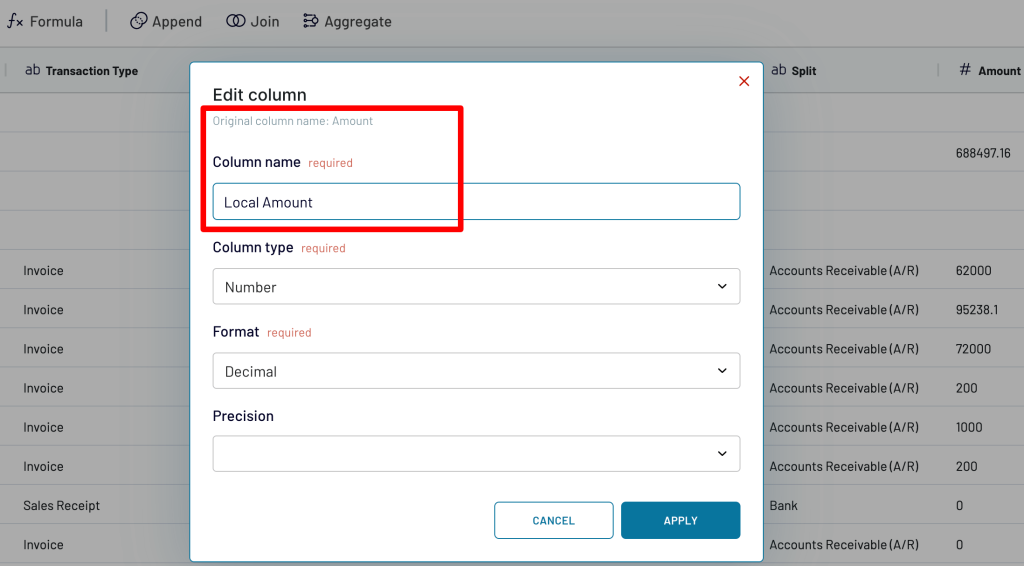
As a result, you align your chart with the parent company’s standardized Chart of Accounts.
Filter by relevant criteria
To include only specific transactions, filter the data by period, entity, or account type. For instance, filter by Date to show only Q3 2025 transactions.

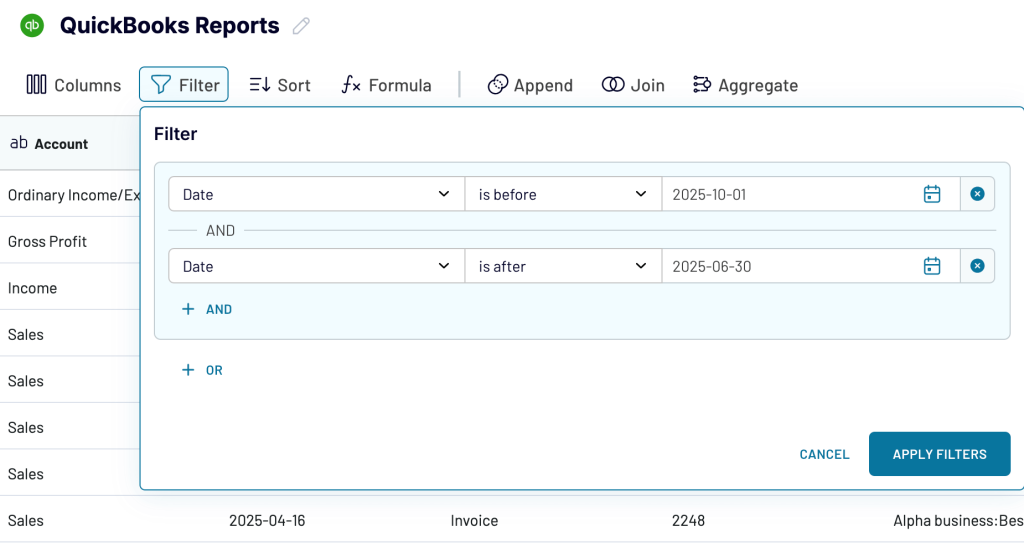
This way, you focus on the relevant period and financial scope.
Sort for clarity
If you want to spot trends or discrepancies, sort the data to organize it clearly, e.g., by Account (alphabetical) and then by Date (ascending) to trace the evolution of each account’s activity.


This makes it easier to review patterns or spot anomalies like double-posted entries.
Aggregate for insights
To calculate consolidated totals and reveal key financial patterns across your group, use the aggregation feature with operations like sum, average, count, min., or max. For instance, group by Account and sum the Amount column to get consolidated totals per account.


Here’s what you get:

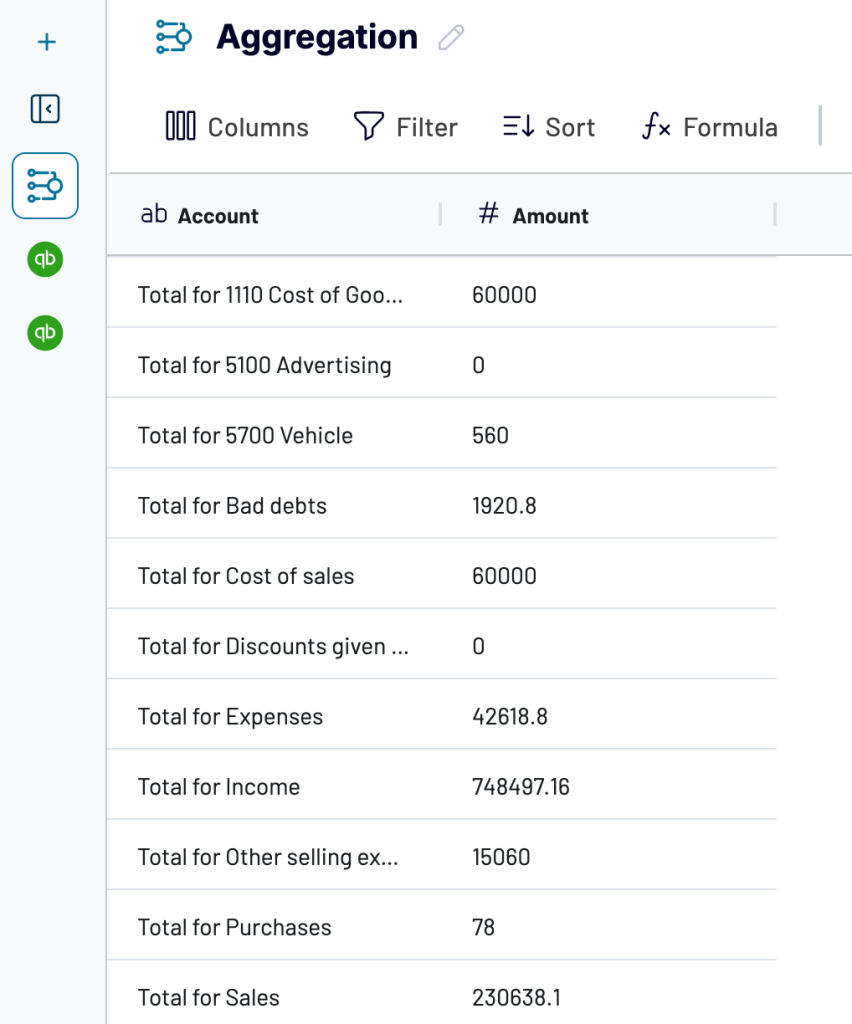
Consequently, you reveal overall group performance by account category, e.g., total revenue or expenses across subsidiaries.
Combine time periods
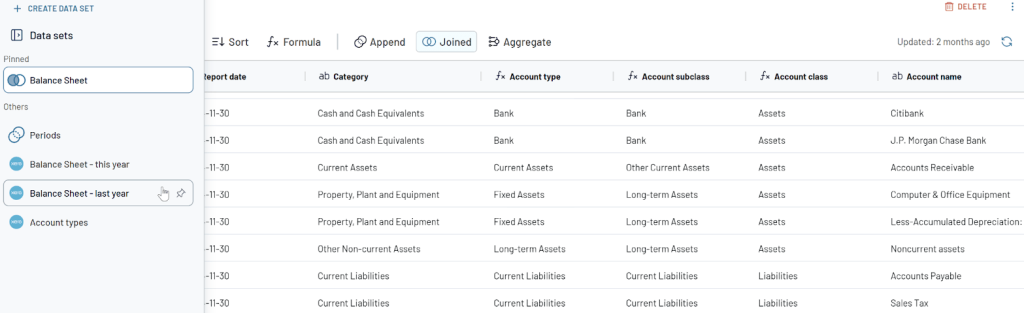
To get a single, unified view of data from multiple similarly structured sets, use the append feature. For example, if you combine Xero balance sheets from last year and this year using this feature, you’ll create a continuous, chronological dataset:

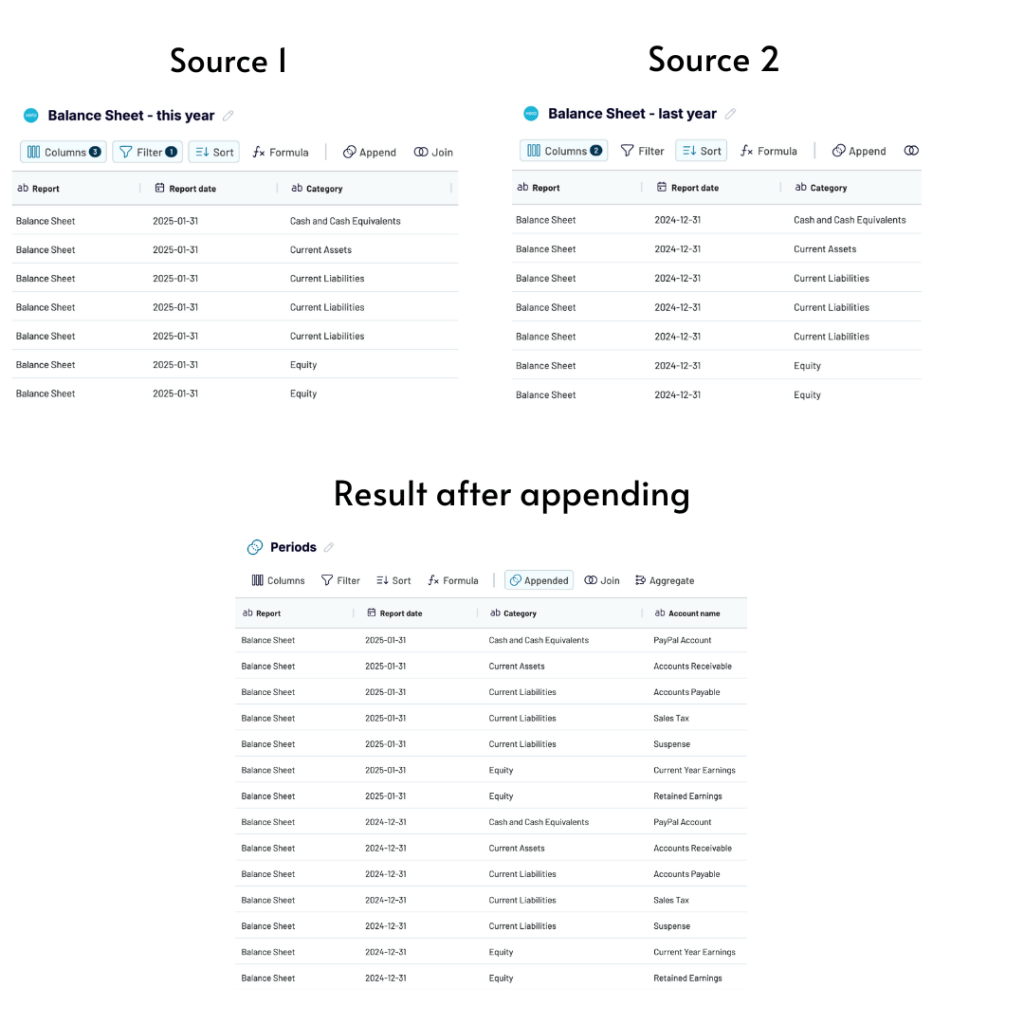
This allows you to analyze trends over time and track changes.
Enrich with contextual data
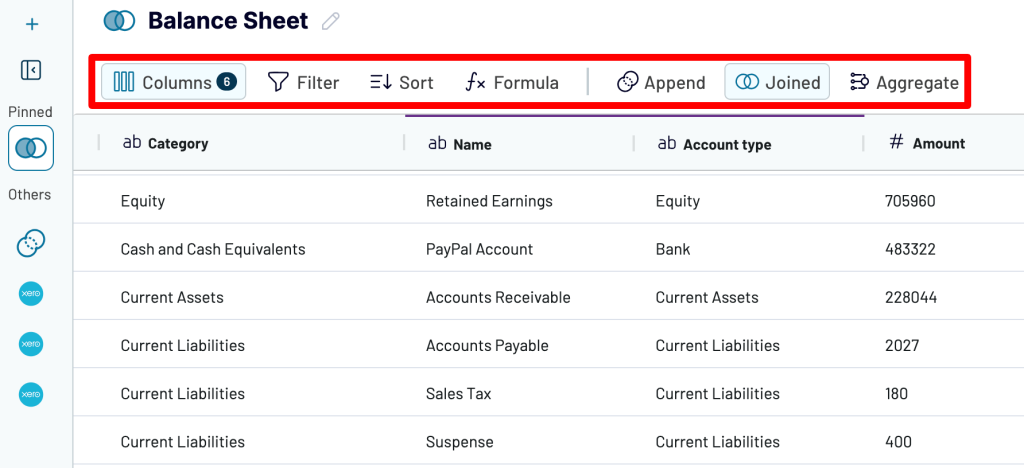
If you want to add context to your data using related details from another set, use the join feature. For example, by joining your balance sheet with the account types report from Xero, you can match each financial category with its account name, type, and currency:

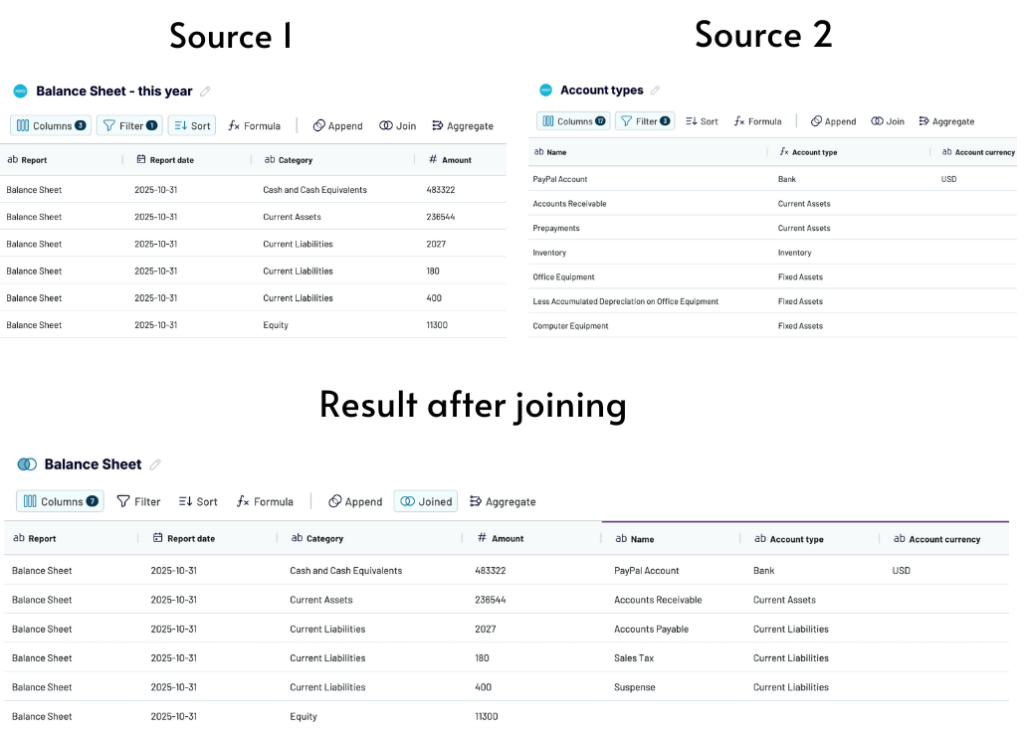
This enriched context helps you quickly categorize accounts for regulatory reporting and identify currency-specific balances that need translation. Instead of viewing balances in isolation, you now understand the nature and classification of each account—essential for proper consolidation and compliance.
In the end, all financial data is collected, cleaned, and standardized in a way that ensures comparability across entities. The mapped and organized dataset provides a reliable foundation for the next step.
Foreign currency translation adjustments
When subsidiaries operate in different currencies, their financial statements can’t simply be added together. Exchange rate fluctuations distort results, and without proper currency conversions, consolidated reports fail to reflect the group’s true economic position. So you must convert amounts into the parent’s reporting currency.
To calculate adjusted balances, use Coupler.io to create calculable columns with custom formulas. Let’s say, for transaction-level translation, you need to add a column called Adjusted Amount with the Amount × Exchange Rate formula to standardize foreign subsidiaries’ monetary balances.


As a result, all foreign-currency data is translated into the parent company’s reporting currency, and exchange rate differences are accurately captured.
Intercompany eliminations and reconciliation
When multiple entities in a group trade with each other through sales, loans, dividends, or internal transfers, these transactions can inflate consolidated results if not adjusted. Without systematic elimination, group revenues, assets, and liabilities appear overstated, misrepresenting the organization’s true financial position. Matching and reconciling intercompany transactions across multiple systems is often time-consuming and prone to errors.
To simplify the process, use Coupler.io as follows:
- Isolate or trace specific intercompany relationships. You can do this using filtering and sorting to focus on relevant accounts and transactions.
- Perform preliminary adjustments with calculable columns to identify discrepancies or compute adjusted balances.
- Summarize intercompany balances through Coupler.io aggregation to get entity-to-entity totals.
- Combine with master entity data using joins to ensure all entities and relationships are fully reconciled.
The final elimination and posting of intercompany balances must still occur in your consolidation or reporting tool, but Coupler.io prepares clean, reconciled, and structured data for accurate downstream processing.
Adjustments for non-controlling interest (NCI)
In many group structures, the parent company owns less than 100% of certain subsidiaries. The portion of net income and equity belonging to outside shareholders must be identified and separated. Without proper NCI adjustments, consolidated statements would overstate the parent’s share of profits and equity.
To handle this in Coupler.io:
- Incorporate ownership information using joins to merge financial data with ownership percentages for each subsidiary.
- Calculate NCI allocations with calculable columns to compute each subsidiary’s NCI share of net income and equity.
- Filter relevant entities to focus on partially owned subsidiaries and sort them to arrange for review.
- Summarize NCI across the group through aggregation to total NCI balances by region, subsidiary type, or other relevant categories.
- Keep calculations up to date by setting up automatic data refresh.
With NCI properly calculated in Coupler.io, consolidated financial statements accurately reflect both controlling and non-controlling interests. This reduces manual reconciliation, minimizes errors, and ensures that reporting is complete, compliant, and ready for downstream analysis or visualization.
Optimize your financial function with Coupler.io
Get started for freeThe critical benefits of financial data consolidation
The ultimate objective of financial reporting consolidation goes far beyond compliance. When performed accurately and on time, it empowers:
- Elevated strategic decision-making and forecasting – to make informed, forward-looking business decisions.
- Acceleration of the financial close cycle – to close books faster and focus on analysis.
- Regulatory compliance and building investor confidence – to meet standards and strengthen stakeholder trust.
- Improved intercompany visibility and risk management – to detect anomalies and manage internal flows efficiently.
- Operational efficiency and resource optimization – to reduce manual work and maximize the finance team’s impact.
Elevated strategic decision-making and forecasting
Consolidation of financial statements provides a holistic, top-down view of the entire group’s performance. This unified picture is crucial for making informed decisions regarding capital allocation, underperforming segments, M&A strategy, and data-driven forecasts.
By connecting all entities into a single, standardized reporting flow, you move beyond fragmented spreadsheets and siloed insights. So you gain a reliable, group-level perspective that reflects the true financial standing of the enterprise. This enables proactive financial planning, smarter investments, and confident long-term strategy execution.
Acceleration of the financial close cycle
Automated data aggregation and reconciliation (the most time-consuming stages of consolidation!) speed up the financial close cycle. By minimizing manual effort and repetitive data handling, you can reduce closing timelines from days to hours.
This shift allows finance professionals to:
- Focus on higher-value analysis instead of routine compilation.
- Deliver timely insights to executives and stakeholders.
- And ultimately close the books faster than the competition.
Regulatory compliance and building investor confidence
Financial data consolidation is essential for compliance with global accounting standards such as IFRS 10 and ASC 810 so that group reports meet both regulatory and public disclosure requirements. If you present a unified, transparent financial picture, you not only fulfill statutory obligations but also reinforce the organization’s credibility and governance maturity.
By maintaining standardized, audit-ready data flows, finance teams can easily trace and validate every number across entities. This transparency builds confidence among auditors, investors, and lenders. As a result, the organization secures funding, strengthens investor relations, and demonstrates long-term financial reliability.
Improved intercompany visibility and risk management
Automated intercompany reconciliation provides deep visibility into the internal flow of capital, transactions, and resources across subsidiaries. This consolidated view allows you to proactively detect discrepancies, prevent potential fraud, and strengthen liquidity management across the group.
Therefore, you can align all intercompany transactions with the group’s reporting structure. This lets you identify mismatches or anomalies faster, better manage internal balances, reduce risk, and ensure the organization’s financial integrity at every level.
For example, Siemens Global Business Services transformed its financial reporting and accounting processes through automation, operating across a $150 billion enterprise. The company moved from fragmented tools and manual effort to a nearly touchless close process and achieved higher compliance.
Operational efficiency and resource optimization
Automated financial data consolidation eliminates redundant, error-prone tasks such as manual spreadsheet updates, cross-checking journal entries, and repetitive reconciliations. By removing these time-consuming steps, you can focus on higher-value work rather than clerical data manipulation.
Standardized data flows and automated updates free personnel to take on strategic analytical roles. This also maximizes the value that finance delivers across the organization and supports more agile business operations.
For instance, Juni, a financial technology company, reduced its time to financial close by 2 full days after implementing automation. The company automated over 95% of standard transactions across reconciliations that previously required multiple saved searches and manual Excel exports. This gave them the ability to focus on value-added activities like reviewing outlier or high-risk transactions and strategic planning.
To build automated, consolidated financial data flows with ease, use Coupler.io to collect, integrate, and standardize data across multiple sources. This also lets you address the complexities that often go unresolved when financial consolidation is done manually.
The complexities of financial reporting consolidation
Consolidation of financial statement, particularly for multinational groups, is inherently complex. To achieve a fast and accurate close, you need to anticipate and proactively address a range of operational and technical challenges:
- Data silos and inconsistent source systems.
- Complexity of intercompany eliminations and reconciliation.
- Managing multiple currencies and exchange rate volatility.
- Chart of Accounts mapping and data standardization gaps.
- Regulatory compliance across multiple jurisdictions.
- Lengthy close cycles and limited auditability.
These hurdles, if not properly managed, slow financial data consolidation, introduce errors, and compromise the integrity of group-level reporting. Let’s dive in. 👇
Data silos and inconsistent source systems
Problem: Many large organizations acquire subsidiaries that operate on disparate platforms, separate instances of QuickBooks, Xero, or legacy ERP systems, creating fragmented data silos.
This complexity slows down the financial close, increases the risk of omissions or inconsistent reporting, and erodes confidence in the accuracy of consolidated figures.
Solution: By automating data collection and harmonization with Coupler.io, you can bridge these silos so that all entities feed into a unified, reliable dataset ready for consolidation.
Complexity of intercompany eliminations and reconciliation
Problem: Intercompany transactions are one of the most common sources of consolidation errors. You normally need extensive manual effort to accurately identify, match, and eliminate all internal sales, loans, and payables/receivables across multiple entities.
Delays or mistakes in this process are a leading cause of missed close deadlines and inaccurate consolidated statements.
Solution: Automate data collection and standardization with Coupler.io to reduce errors and ensure that consolidated financials reflect the true economic activity of the group.
Managing multiple currencies and exchange rate volatility
Problem: International financial reporting consolidation introduces significant challenges in translating statements from different currencies. Finance teams must apply appropriate exchange rates: current, average, or historical, for various line items, and more.
Mistakes in applying rates or translating balances result in material misstatements of the group’s financial position.
Solution: To address this issue, use Coupler.io to centralize foreign-currency data and provide accurate, auditable inputs for the consolidated reporting process.
Regulatory compliance across multiple jurisdictions
Problem: Multinational organizations must navigate a complex landscape of local accounting standards, tax laws, and regulatory requirements. Meanwhile, they need to ensure consolidated financial statements comply with a single global framework, e.g., IFRS 10 or US GAAP (Generally Accepted Accounting Principles).
Manually tracking and applying these evolving compliance requirements across multiple jurisdictions is labor-intensive and increases the risk of human errors, omissions, or penalties.
Solution: Use tools like Coupler.io to maintain standardized, audit-ready data while staying aligned with both local regulations and international financial reporting standards.
Lengthy close cycles and limited auditability
Problem: The combination of manual consolidation tasks, data inconsistencies, and complex intercompany transactions often results in a lengthy and stressful financial close. You’re left with minimal time to perform meaningful analysis or provide actionable insights.
Relying on manual processes also weakens the audit trail. It gets harder to trace figures back to their source transactions – a critical requirement for audits and investor confidence.
Solution: With automated data collection and standardization using Coupler.io, you can shorten the close process and maintain robust, auditable records for every reporting period.
Best practices for financial statements consolidation
To achieve a fast and reliable financial close, you need best practices in governance, data flows, and continuous process improvement:
- Enforce a continuous close model – to maintain up-to-date financial information and reduce last-minute bottlenecks.
- Mandate robust audit trails and version control – to ensure transparency, traceability, and compliance for every cycle of financial statements consolidation.
- Invest in inter-entity training and process governance – to align teams on policies, responsibilities, and standardized procedures. 👇
Enforce a continuous close model
Instead of doing all reconciliation work at the end of the month, it is better to follow a continuous close model. This means you check intercompany accounts, validate data, and make initial adjustments every day or week.
By handling these tasks early, you shorten the final close process, reduce errors, and turn consolidated reports from a past summary into near-real-time, useful business information.
Mandate robust audit trails and version control
A clear audit trail is essential for regulatory compliance and for keeping stakeholders confident. You need transparent data records so auditors can trace any consolidated number back to the original transaction.
It is also important to keep strict control over all data submissions and changes.
For this use, rely on Coupler.io to automate data collection and ensure reproducible, traceable workflows. By sending data to controlled destinations like Google Sheets or databases, you can maintain a transparent history of all data used.
Invest in inter-entity training and process governance
Even with advanced consolidation tools, you still need to align people and processes. To address this, regularly educate staff on group-wide accounting policies and the correct use of consolidation systems.
You also require clear process rules that define who owns the data, who makes adjustments, and who approves final reports. This creates accountability, reduces delays, and improves the reliability of financial reporting consolidation.
Finally, it is best to focus on automation for data collection and standardization. Automated data flows let you remove manual errors, speed up consolidation, and free up time for analysis and strategic decision-making.
To experience how automation can optimize your consolidation workflow, try Coupler.io for free and see the benefits firsthand.