
Summarize this blog post with:





Funnel.io collects, normalizes, and routes marketing data to BI tools and warehouses. It does that part well. But its Flexpoints pricing model makes costs hard to predict, the free plan was removed in late 2025, and the Starter plan now sits at $200/month. If your reporting goes beyond marketing or you want transparent billing, those are real friction points.
So, I’ve reviewed even Funnel.io alternatives below, each matched to a specific use case, so you can find the right fit without testing all of them yourself. But first, ask yourself whether migration from Funnel.io is the option you’re looking for.
TL;DR: Should you switch from Funnel.io?
Switch if:
- You are paying more than you expected because Flexpoints scale unpredictably as you add sources, destinations, or refresh cycles.
- You need data integration beyond marketing (finance, product, operations) and Funnel does not cover those sources on affordable plans.
- You want built-in dashboard templates and AI analytics instead of relying on external BI tools for everything.
Stay if:
- You depend on Funnel’s marketing data normalization engine across dozens of ad platforms, currencies, and naming conventions.
- Your team already built deep custom rules and historical data workflows inside Funnel that would take significant effort to rebuild.
Fastest way to test Coupler.io: Start a free trial and rebuild 1-2 of your current data flows. Most users finish in under 30 minutes using templates.


Data integration and Ai analytics in one platform – Coupler.io
Get started for freeWhat are the best Funnel.io alternatives?
| Feature | Funnel | Coupler.io | Adverity | Supermetrics | Domo | Fivetran | Whatagraph | Tapclicks |
| Starting price/month (annual billing) | $200/month | $24/month | Custom | $37/month | Custom | Custom | $229/month | Custom |
| Free trial | ✅ | ✅ | ✅ | ✅ | ✅ | ✅ | ✅ | ✅ |
| Total data sources | 600+ | 400+ | 600+ | 170+ | 1000+ | 700+ | 50+ | 250+ |
| All data sources available in all plans | ⛔ | ✅ | N/A | ⛔ | ✅ | ✅ | ⛔ | N/A |
| Data destinations | BI tools Ad platforms Databases Analytics apps, etc. | BI tools Spreadsheets Databases JSON AI tools | BI tools Spreadsheets Databases Analytics apps Datalakes CRMDMP Ad platforms, etc. | Spreadsheets BI tools Databases Datalakes | Cloud storage Databases CRMs Marketing automation platforms Spreadsheets Custom and developer tools, etc. | Datalakes Databases Data streaming platforms, etc. | BigQuery Looker Studio Google Sheets | Google Sheets Looker Studio Databases File storage Cloud data warehouses, etc. |
| Minimum update frequency | ~3-4 hours | 15 minutes | 15 minutes | ~every hour | 15 minutes (or more frequently on demand) | every minute | 30 minutes | every day |
| Dashboard templates | 15+ | 200+ | ⛔ | 90+ | Available, number not public | ⛔ | 40+ | Available, number not public |
| AI capabilities | AI Data Chat AI-powered analytics Intelligent workflows | AI agent AI integrations AI insights | AI agents Adverity MCP Data Conversations Transformation Copilot | Insights agent AI assistant AI summaries | AI Assistants Agent Catalyst | ⛔ | AI report generator | AI Insights Agents SmartSlides SmartEmail |
| Analytics services | ⛔ | ✅ | ✅ | ✅ | ✅ | ✅ | ⛔ | ✅ |
| User reviews (Capterra) | 4.7/5 | 4.9/5 | 4.5/5 | 4.4/5 | 4.3/5 | 4.4/5 | 4.4/5 | 4.3/5 |
The table for these Funnel.io alternatives is verified as of April 2026. Pricing and features may change.
Top Funnel.io alternative – Coupler.io


Coupler.io is a no-code data integration and AI analytics platform. It connects 400+ sources to spreadsheets, BI tools, databases, and AI tools from a single interface. Pricing starts at $24/month with all sources and destinations available on every plan, including the free one.
Where Funnel focuses on marketing data ingestion and normalization for BI-heavy workflows, Coupler.io covers marketing, finance, product, and operations. It ships with built-in transformations, 200+ dashboard templates, and AI-driven analytics without gating features behind custom enterprise contracts.
Real outcomes from teams that switched to Coupler.io:
- ClaritySeed automated multichannel reporting from GA4, Facebook Ads, and Google Ads. The switch saved over 40 hours per month and cut report delivery time by 5 hours.
- DE-YAN moved QuickBooks data into Google Sheets. Budget visibility improved, and manual reporting time dropped by up to 15 hours per day.
- XRay.Tech set up Airtable data flows into BigQuery. Reporting stayed accurate and up to date without extra manual work.
Coupler.io also offers custom data analytics services for teams that need help with integrations, dashboard creation, or reporting optimization.
Why Coupler.io is the best alternative to Funnel.io
No-code data integration and ETL. Coupler.io lets you build complete data pipelines without SQL, Python, or custom scripts. You can connect sources, apply transformations, blend data, and export it using a visual, no-code interface.
Funnel is optimized for reliable marketing data ingestion and normalization, but advanced transformations and analytics workflows typically happen outside, in BI tools or warehouses.
All data sources available on every plan. Coupler.io provides access to all 400+ data sources on every plan, including the free one.
Funnel supports 600+ marketing and sales platforms, but access, pricing, and custom connectors depend on negotiated plans and enabled features. The Starter plan limits you to 121 connectors. The full 579+ library requires the Business plan at $800/mo.
Flexible destinations. With Coupler.io, you can export data to spreadsheets (Google Sheets, Excel), BI tools (Looker Studio, Power BI, Tableau, Qlik), databases (BigQuery, PostgreSQL, Redshift), AI tools (ChatGPT, Claude, Perplexity, Cursor, Gemini), monday.com, JSON, and CSV.
Funnel destinations depend on your plan tier. The Starter plan covers Funnel Dashboards, Looker Studio, Google Sheets, and Excel. Data warehouse exports (BigQuery, Redshift, Snowflake) require the Business ($800/mo) or Enterprise plan. Visualization tools like Power BI and Tableau are also locked behind the Business tier.
Powerful no-code data transformations. Coupler.io includes built-in transformations for everyday reporting and analytics workflows: column management, filtering and sorting, custom calculations, data aggregation (sum, avg, count, min, max), and data blending (append and join).

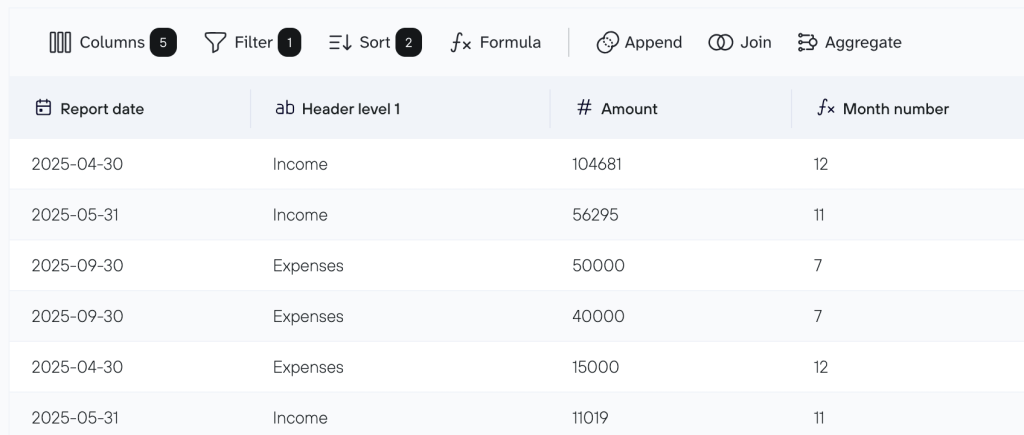
Funnel focuses on data mapping, normalization, currency conversion, and blending for marketing datasets. This works well for standardized pipelines but offers less flexibility for cross-department reporting.
Templates: datasets and dashboards. Coupler.io ships with 210+ dashboard templates for Looker Studio, Power BI, Google Sheets, and native Coupler.io Dashboards. In addition, you get around 100 data set templates with predefined metrics and transformations.
Save hours of manual work with Coupler.io’s ready-to-use dashboard templates

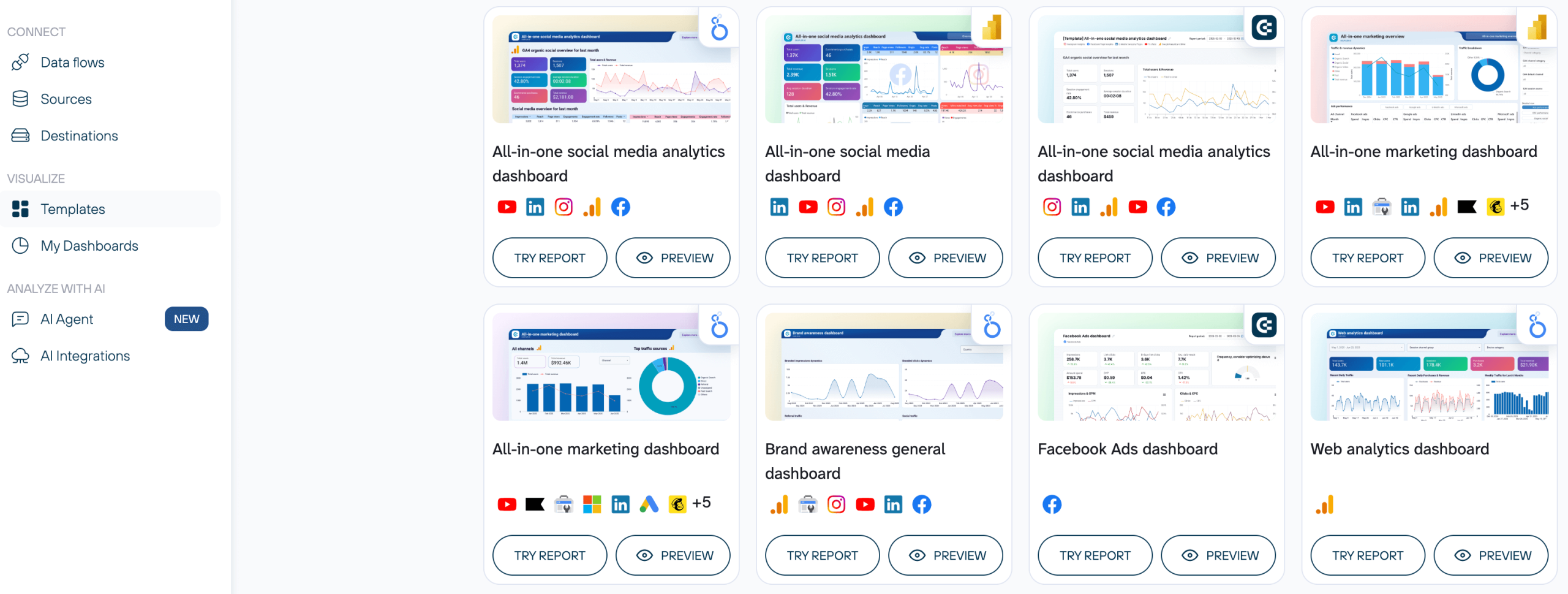
Save hours of manual work with Coupler.io’s ready-to-use dashboard templates
View all templatesFunnel provides 15+ dashboard templates, primarily oriented around marketing performance and BI exports.
AI-powered analytics. Coupler.io includes native AI capabilities: AI-generated insights, an AI agent for conversational analytics, and integrations with AI tools via MCP.

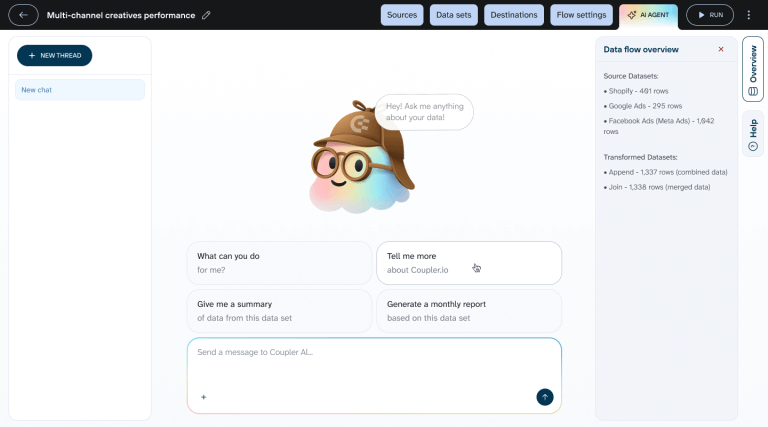
Funnel offers AI Data Chat, AI-powered analytics, and Intelligent workflows. However, it doesn’t support direct AI tool integrations.
Exceptional support. Coupler.io maintains a 95% customer satisfaction rate and consistently strong user reviews, with 4.9/5 on Capterra.
Funnel is also well-rated, with 4.7/5 on Capterra, but users often note a steeper learning curve and higher cost.
Funnel.io vs. Coupler.io – head-to-head comparison
| Feature | Funnel | Coupler.io |
| Starting price/month (annual billing) | $200/month | $24/month |
| Free trial | ✅ | ✅ |
| Total data sources | 600+ | 400+ |
| All data sources available in all plans | ⛔ | ✅ |
| Data destinations | BI tools Ad platforms Databases Analytics apps, etc. | BI tools Spreadsheets Databases JSON AI tools, etc. |
| Data transformation | Currency conversion Custom dimensions and metrics Data mapping Data blending, etc. | Column management Filtering Sorting Custom calculations Data aggregation Data blending, etc. |
| Minimum update frequency | ~3-4 hours | 15 minutes |
| Dashboard templates | 15+ | 200+ |
| AI capabilities | AI Data Chat AI-powered analytics Intelligent workflows | AI insights AI agent AI integration via MCP |
| Analytics services | ⛔ | ✅ |
| User reviews (Capterra) | 4.7/5 | 4.9/5 |
Integrations. Funnel has the larger marketing connector library at 600+ sources. It covers advertising, analytics, CRM, and e-commerce platforms with deep normalization for currencies, naming conventions, and time zones. If your entire workflow revolves around standardizing marketing data for a single BI tool or warehouse, that depth matters.
Coupler.io supports 400+ sources but extends well beyond marketing. Operations tools (Asana, ClickUp, Trello, Slack), finance and accounting (Xero, QuickBooks), scheduling and forms (Calendly, Typeform, Jotform), and product tools (Canny, Bugsnag, Appfigures) are all available. For teams whose reporting crosses department boundaries, that breadth makes a difference.
Export, merge, enrich and analyze data from over 400 apps

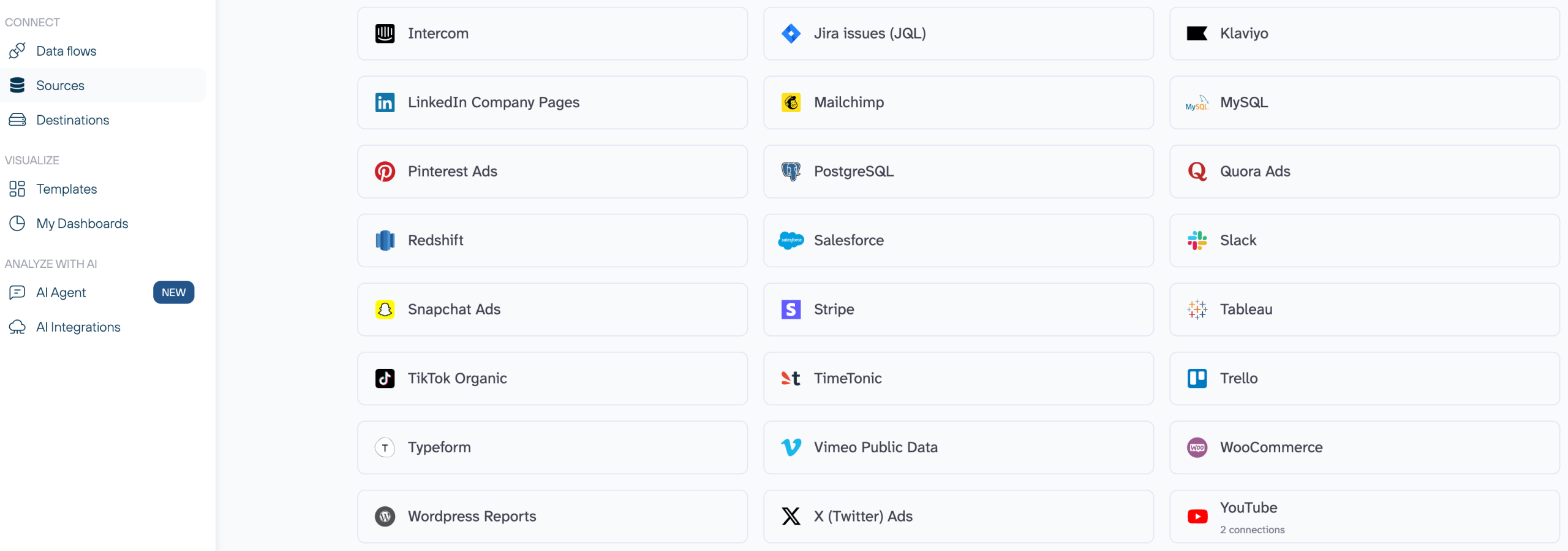
Export, merge, enrich and analyze data from over 400 apps
Explore all sourcesData transformation. Funnel excels at marketing-specific normalization, historical data storage, and standardized reporting exports to BI tools. Coupler.io prioritizes flexible, no-code transformations (filtering, sorting, custom calculations, aggregation, append and join) that cover most real-world reporting needs across teams. It allows users to shape data before it reaches dashboards, spreadsheets, warehouses, or AI tools without relying on downstream modeling.
Dashboards/templates. Funnel has some in-app dashboard templates, but it’s just not as extensive as external BI reporting in most use cases. Coupler.io provides a ready-made reporting ecosystem, with dashboard templates available in the app itself as well as in Looker Studio, Google Sheets, and Power BI. It also includes dataset templates that simplify reporting setup through predefined metrics and criteria.
Automatic data refresh. Funnel typically refreshes data every 3-4 hours, which may be sufficient for many marketing use cases but limits near-real-time reporting. Exports run daily on the Starter plan and every 2 hours on Business/Enterprise.
Coupler.io supports scheduled refreshes down to every 15 minutes, as well as event-driven automation via webhooks.
Pricing scenario
Funnel uses a Flexpoints credit system. Every connector, destination, and account consumes credits. The Starter plan ($200/mo) only covers basic visualization destinations (Looker Studio, Google Sheets, Excel). Adding a warehouse destination like BigQuery requires the Business plan at $800/month. Each additional connector or account burns more Flexpoints, and once you exceed your allocation, costs increase. The free plan was removed for new users in December 2025.
How Funnel pricing works: You pick a plan that determines your available connectors and destinations. The Starter plan ($200/mo) gives you 121 connectors and basic visualization exports. Adding warehouse destinations (BigQuery, Snowflake, Redshift) or advanced BI tools (Power BI, Tableau) requires the Business plan at $800/mo. Each connector and account consumes Flexpoints, and exceeding your allocation means buying more capacity. Costs are hard to predict for growing teams.
Coupler.io charges based on connected accounts, destinations, and refresh frequency. All 400+ sources are available on every plan, including Free. Plans start at $24/month (annual billing). What pushes you to a higher plan is needing more accounts, more destinations, or faster refresh intervals (daily, hourly, or every 15 minutes). You can also add extra accounts individually without upgrading. There are no per-source fees, no credit system, and no usage-based surprises.
How Coupler.io pricing works: You pick a plan based on how many accounts you connect and how fast you want data refreshed. The Active plan ($99/mo annual) includes 15 accounts and 3 destinations with daily refresh. If you need hourly refresh or more than 50 accounts, the Pro plan ($199/mo) handles that with unlimited destinations. No Flexpoints, no credit system, no per-source fees.
Here is an example of a pricing comparison based on a typical setup:
| Requirements | Funnel cost | Coupler.io cost | Winner | |
|---|---|---|---|---|
| Setup | 1 user 8 marketing sources 2 destinations (Looker Studio + BigQuery) hourly refresh | ~$800/mo (Business plan required for warehouse destinations) | $99/mo (Active plan, 15 accounts, 3 data destinations) | Coupler.io saves ~$700/mo |
Switching from Funnel.io?
Data flows need to be recreated in Coupler.io, but any data you already loaded into your destinations stays there. Start by rebuilding 1-2 key flows, run both tools in parallel for a week to confirm the numbers match, then cut over. Most flows take 5-10 minutes to set up with a prebuilt template. Funnel’s historical data storage does not transfer, so export any data you need from Funnel before canceling.
When to use Coupler.io instead of Funnel.io
Choose Coupler.io if your reporting spans multiple departments (not just marketing), and you want transparent pricing that does not depend on a credit system. Other criteria might involve refresh intervals faster than 3-4 hours, or AI integrations with tools like ChatGPT or Claude built into your data workflow. The Coupler.io vs Funnel.io breakdown lays out the differences side by side.
Choose Funnel.io if you need the deepest possible coverage of marketing platforms with built-in normalization across currencies, naming conventions, and time zones, and your workflow centers on exporting standardized marketing data to a single BI tool or warehouse. Funnel’s historical data storage is also a genuine differentiator if you need access to past data even after source configurations change.
Optimize your data integration and analytics with Coupler.io
Get started for freeOther Funnel.io competitors
Adverity


Adverity is an enterprise-grade marketing data platform designed to centralize, transform, govern, and activate data from hundreds of sources. It goes beyond data extraction by combining ETL, data quality management, analytics services, and AI-assisted insights in one environment.
The platform is best suited for large marketing teams and enterprises that require strong governance, complex transformations, and multi-destination data delivery.
Funnel vs. Coupler.io vs. Adverity – comparison
| Feature | Funnel | Coupler.io | Adverity |
| Starting price/month (annual billing) | $200/month | $24/month | Custom |
| Free trial | ✅ | ✅ | ✅ |
| Total data sources | 600+ | 400+ | 600+ |
| All data sources available in all plans | ⛔ | ✅ | N/A |
| Minimum update frequency | ~3-4 hours | 15 minutes | 15 minutes |
| Dashboard templates | 15+ | 200+ | ⛔ |
| AI capabilities | Data Chat AI-powered analytics Intelligent workflows | AI insights AI agent AI integration via MCP | AI agents Adverity MCP Data Conversations Transformation Copilot |
| Analytics services | ⛔ | ✅ | ✅ |
| User reviews (Capterra) | 4.7/5 | 4.9/5 | 4.5/5 |
Adverity connects with 600+ marketing, sales, and analytics platforms, including Google Ads, Meta Ads, Amazon Ads, Shopify, Salesforce, and Adobe Analytics. Data can go to BI tools, spreadsheets, databases, cloud warehouses, and marketing platforms.
The platform offers enterprise-grade ETL and ELT workflows, advanced data harmonization, data quality monitoring, and AI-assisted anomaly detection. It is designed for complex, large-scale marketing organizations that need governance and multi-destination data delivery.
Adverity pricing is custom and depends on data sources, destinations, transformation complexity, and usage volume. No public pricing tiers are available, so a free trial is the only way to estimate costs.
Pros:
- Very large connector ecosystem (600+).
- Strong data governance and quality controls.
- Advanced transformation and harmonization.
- AI-assisted insights and anomaly detection.
Cons:
- Steep learning curve. Not a quick setup for small teams.
- Pricing is not transparent. You need a sales conversation to get a quote.
- Overkill if your reporting needs are straightforward. Check if a simpler Coupler.io alternative fits better.
When to use Adverity over Funnel: You manage a large marketing organization that requires enterprise-grade governance, advanced transformations, and multi-destination data activation. Your team has the technical resources to handle the learning curve, and your budget supports custom enterprise pricing. For a direct comparison with Coupler.io, see the Coupler.io vs Adverity breakdown.
Supermetrics


Supermetrics pulls marketing data into spreadsheets, BI tools, and data warehouses. It is popular with marketers who work primarily inside Google Sheets, Excel, or Looker Studio. The strength is simplicity and destination-specific connectors rather than unified data management.
Funnel vs. Coupler.io vs. Supermetrics – comparison
| Feature | Funnel | Coupler.io | Supermetrics |
| Starting price/month (annual billing) | $200/month | $24/month | $37/month |
| Free trial | ✅ | ✅ | ✅ |
| Total data sources | 600+ | 400+ | 170+ |
| All data sources available in all plans | ⛔ | ✅ | ⛔ |
| Minimum update frequency | ~3-4 hours | 15 minutes | ~1 hour |
| Dashboard templates | 15+ | 200+ | 90+ |
| AI capabilities | Data Chat AI-powered analytics Intelligent workflows | AI insights AI agent AI integration via MCP | Insights agent AI assistant integrations AI summaries |
| Analytics services | ⛔ | ✅ | ✅ |
| User reviews (Capterra) | 4.7/5 | 4.9/5 | 4.4/5 |
Supermetrics supports 170+ marketing and sales platforms, including Google Ads, Facebook Ads, LinkedIn Ads, GA4, HubSpot, and Salesforce. Destinations include Google Sheets, Excel, Looker Studio, Power BI, and major data warehouses.
Pricing follows a destination-based structure. Plans start at around $37/month for entry-level spreadsheet or single-tool connectors. Costs increase with the destination type, number of sources, and features. Warehouse destinations carry custom pricing. A 14-day free trial is available.
See how Supermetrics pricing works in 2026 for the full details.
Pros:
- Reliable spreadsheet integrations. Google Sheets and Excel connectors work well.
- Strong coverage of marketing platforms.
- Familiar workflows for marketers who already live in spreadsheets.
- 90+ dashboard templates.
Cons:
- Pricing scales quickly when you add multiple destinations. Each destination is a separate product with its own billing.
- No unified data management layer. Each destination connector operates independently.
- Limited automation and orchestration compared to full ETL platforms.
When to use Supermetrics over Funnel: Your team primarily works inside spreadsheets or BI tools and needs quick, reliable access to marketing data without managing a full ETL stack. Budget is a concern, and you do not need Funnel’s normalization engine. If you’re weighing Coupler.io alongside it, see the Coupler.io vs Supermetrics breakdown.
Domo


Domo combines data integration, BI, analytics, and low-code app development in one platform. It connects to 1,000+ sources and is designed for organizations that want to centralize data and build interactive applications on top of it.
Funnel vs. Coupler.io vs. Domo – comparison
| Feature | Funnel | Coupler.io | Domo |
| Starting price/month (annual billing) | $200/month | $24/month | Custom |
| Free trial | ✅ | ✅ | ✅ |
| Total data sources | 600+ | 400+ | 1000+ |
| All data sources available in all plans | ⛔ | ✅ | ✅ |
| Minimum update frequency | ~3-4 hours | 15 minutes | 15 minutes |
| Dashboard templates | 15+ | 200+ | Available, number not public |
| AI capabilities | Data Chat AI-powered analytics Intelligent workflows | AI insights AI agent AI integration via MCP | AI Assistants Agent Catalyst |
| Analytics services | ⛔ | ✅ | ✅ |
| User reviews (Capterra) | 4.7/5 | 4.9/5 | 4.3/5 |
Domo connects with 1,000+ SaaS tools, databases, cloud platforms, CRMs, and marketing systems. Data is primarily analyzed within Domo using its built-in BI, visualization, and app-building tools. Pricing is custom and a 30-day free trial is available.
Pros:
- Powerful BI and analytics built in. No need for a separate visualization tool.
- Largest connector ecosystem in this comparison (1,000+).
- Real-time data availability.
- Low-code app development and workflow automation.
Cons:
- Steep learning curve. This is not a quick-start tool.
- Not marketer-focused by default. It is a platform for data teams and IT.
- High total cost of ownership. Enterprise pricing with implementation costs.
When to use Domo over Funnel: You want an all-in-one analytics and application platform rather than a dedicated marketing data pipeline tool. Your organization has the technical resources and budget for enterprise-scale implementation.
Fivetran


Fivetran moves large volumes of data into cloud warehouses and data lakes. This enterprise-grade ELT platform is built for data engineering teams, not marketers. Transformations happen downstream using tools like dbt.
Funnel vs. Coupler.io vs. Fivetran – comparison
| Feature | Funnel | Coupler.io | Fivetran |
| Starting price/month (annual billing) | $200/month | $24/month | Custom |
| Free trial | ✅ | ✅ | ✅ |
| Total data sources | 600+ | 400+ | 700+ |
| All data sources available in all plans | ⛔ | ✅ | ✅ |
| Minimum update frequency | ~3-4 hours | 15 minutes | every minute |
| Dashboard templates | 15+ | 200+ | ⛔ |
| AI capabilities | Data Chat AI-powered analytics Intelligent workflows | AI insights AI agent AI integration via MCP | ⛔ |
| Analytics services | ⛔ | ✅ | ✅ |
| User reviews (Capterra) | 4.7/5 | 4.9/5 | 4.4/5 |
Fivetran supports 700+ connectors across SaaS apps, databases, events, and file systems. Destinations include Snowflake, BigQuery, Redshift, Databricks, and other cloud warehouses. Pricing is usage-based on Monthly Active Rows (MAR). A free tier (up to 500k MAR) and 14-day trial are available. Costs scale with data volume, sync frequency, and connector type.
Pros:
- Extremely reliable at scale. Trusted by data engineering teams worldwide.
- Automatic schema migration and incremental syncs.
- Every-minute refresh frequency.
- Strong governance and security features.
Cons:
- No reporting, dashboards, or visualization. You need a separate BI tool for everything.
- Costs scale quickly with data volume. MAR-based pricing gets expensive for high-volume pipelines.
- Not marketing-focused. No templates, no normalization, no AI analytics.
When to use Fivetran over Funnel: Your priority is large-scale, warehouse-first data ingestion managed by a data engineering team. You handle transformations in dbt or another downstream tool and do not need marketing-specific normalization.
Whatagraph


Whatagraph is a marketing reporting platform for agencies and in-house teams that need fast, client-ready dashboards. It combines data collection, light transformation, and native visualization. The platform prioritizes presentation over deep data engineering. I listed Whatagraph among the key Geckoboard alternatives in a separate post.
Funnel vs. Coupler.io vs. Whatagraph – comparison
| Feature | Funnel | Coupler.io | Whatagraph |
| Starting price/month (annual billing) | $200/month | $24/month | $229/month |
| Free trial | ✅ | ✅ | ✅ |
| Total data sources | 600+ | 400+ | 50+ |
| All data sources available in all plans | ⛔ | ✅ | ⛔ |
| Minimum update frequency | ~3-4 hours | 15 minutes | 30 minutes |
| Dashboard templates | 15+ | 200+ | 40+ |
| AI capabilities | Data Chat AI-powered analytics Intelligent workflows | AI insights AI agent AI integration via MCP | AI report generator |
| Analytics services | ⛔ | ✅ | ⛔ |
| User reviews (Capterra) | 4.7/5 | 4.9/5 | 4.4/5 |
Whatagraph connects with 50+ marketing platforms (Google Ads, Facebook Ads, Ahrefs, Google Search Console, HubSpot, Mailchimp). For unsupported sources, it provides a custom API. Data exports go to Looker Studio, Google Sheets, or BigQuery.
Pricing uses a source-credit model. Paid plans start at $229/month and scale as you add credits and integrations. A free tier exists for basic reporting.
Pros:
- Excellent client-ready reports with white-label options.
- Clean UI and report templates.
- Easy for non-technical marketers. No data engineering required.
Cons:
- Limited destinations (BigQuery, Looker Studio, Google Sheets only).
- Smaller connector library (50+). Not suitable for cross-department reporting.
- Expensive for small teams or agencies on tight budgets. See our post on Whatagraph alternatives for more options.
When to use Whatagraph over Funnel: Your main goal is fast, polished, white-labeled marketing reports for clients and stakeholders. You do not need deep data engineering, warehouse exports, or broad source coverage.
TapClicks


TapClicks is a marketing operations platform for agencies and large marketing teams. It combines data pipelines, analytics, reporting, and workflow automation. The platform handles 250+ data sources and focuses on operational workflows alongside standard reporting.
Funnel vs. Coupler.io vs. TapClicks – comparison
| Feature | Funnel | Coupler.io | TapClicks |
| Starting price/month (annual billing) | $200/month | $24/month | Custom |
| Free trial | ✅ | ✅ | ✅ |
| Total data sources | 600+ | 400+ | 250+ |
| All data sources available in all plans | ⛔ | ✅ | N/A |
| Minimum update frequency | ~3-4 hours | 15 minutes | every day |
| Dashboard templates | 15+ | 200+ | Available, number not public |
| AI capabilities | Data Chat AI-powered analytics Intelligent workflows | AI insights AI agent AI integration via MCP | AI Insights Agents SmartSlides SmartEmail |
| Analytics services | ⛔ | ✅ | ✅ |
| User reviews (Capterra) | 4.7/5 | 4.9/5 | 4.3/5 |
TapClicks supports 250+ marketing, sales, and advertising platforms. Data exports go to databases (PostgreSQL, MySQL, Amazon Aurora), file storage (Amazon S3, Azure Blob Storage), and cloud warehouses (BigQuery, Redshift, Snowflake). Pricing is custom and a 14-day free trial is available.
Pros:
- Strong agency and marketing ops focus.
- Integrated reporting and workflow automation in one platform.
- AI features for automated slides and email reports.
Cons:
- Interface is not very intuitive. Users report a learning curve.
- Pricing transparency is limited. Custom quotes only.
- Daily refresh minimum is slow compared to other tools in this list.
When to use TapClicks over Funnel: You need a marketing operations platform that combines data pipelines, reporting, and workflow automation for agency-scale use. You value operational features (billing, order management) alongside analytics.
Security and compliance
Switching users care about security, especially when migrating data pipelines that handle customer information, ad spend, and financial metrics. Here is how all seven Funnel.io alternatives compare on security and compliance.
| Control area | Funnel | Coupler.io | Adverity | Supermetrics | Domo | Fivetran | Whatagraph | TapClicks |
|---|---|---|---|---|---|---|---|---|
| SOC 2 Type II | ✅ | ✅ | ✅ | ✅ | ✅ | ✅ | Not publicly documented | Not publicly documented |
| ISO 27001 | Not publicly documented | Not publicly documented | ✅ | Not publicly documented | ✅ | ✅ | Not publicly documented | Not publicly documented |
| GDPR / DPA | ✅ | ✅ | ✅ | ✅ | ✅ | ✅ | ✅ | ✅ |
| Encryption in transit | TLS | TLS | TLS | TLS | TLS | TLS | TLS | TLS |
| Encryption at rest | ✅ | AES-256 | ✅ | ✅ | AES-256 | AES-256 | Not publicly documented | Not publicly documented |
| MFA | ✅ | ✅ | ✅ | ✅ | ✅ | ✅ | Not publicly documented | Not publicly documented |
| HIPAA | Not publicly documented | ✅ | Not publicly documented | Not publicly documented | Yes (BAA available) | Yes (BAA available) | Not publicly documented | Not publicly documented |
Why you might need a Funnel.io alternative
Funnel.io is a solid marketing data platform, but it is not for everyone. The most common frustrations that push users to explore alternatives:
Pricing increased sharply. The free plan was removed in December 2025. The Starter plan now costs $200/month, and warehouse destinations require the Business plan at $800/month. Flexpoints make it hard to predict costs as you add sources, destinations, and accounts.
Setup takes time. Integrating many apps or accounts in Funnel requires configuring each connection individually. Users report a steeper learning curve compared to lighter tools, especially around dimensions and transformation rules.
Marketing data only. Funnel focuses on marketing and sales platforms. Operational tools (project management, finance, product) are limited or require custom plans. If your reporting crosses department boundaries, you hit a wall.
External BI required for visualization. Funnel delivers data, but dashboards happen in Looker Studio, Power BI, or Tableau. If you want prebuilt reporting templates, you need to look elsewhere.
How to choose the best Funnel.io alternative for you?
If you want a no-code ETL tool that works across departments with transparent pricing, go with Coupler.io. It fits teams where reporting spans marketing, finance, product, and operations, and where data needs to reach BI tools, spreadsheets, warehouses, and AI agents on a predictable budget.
If you require enterprise-grade governance and advanced transformations across large marketing organizations, go with Adverity. It is built for teams that need data quality controls, harmonization, and multi-destination activation at scale.
If your team lives in spreadsheets or Looker Studio and wants fast marketing data extraction, go with Supermetrics. It is the simplest path from ad platforms to spreadsheets, with less overhead than a full ETL platform.
If you want an all-in-one analytics, BI, and app-building platform, go with Domo. It replaces the need for separate integration, visualization, and analytics tools, but comes with enterprise complexity and cost.
If your priority is warehouse-first, high-scale data ingestion managed by data engineers, go with Fivetran. It is built for reliability at volume, with transformations handled downstream.
If you need fast, polished, white-labeled marketing reports for clients, go with Whatagraph. It excels at presentation and scheduled report delivery for agencies.
If you want a broad marketing operations platform with integrated workflows, go with TapClicks. It combines analytics, reporting, and operational automation for agencies and large marketing teams.
To see more tools with similar functionality, check our articles on Databox alternatives, Tray.io competitor, and Sheetgo alternative.
Make sure the platform you choose aligns with how your team works with data today and how you expect to scale reporting in the future. If you’re looking for a no-code Funnel.io alternative that balances flexibility, automation, and cost, Coupler.io is the most versatile option and best value for money.