I’ve spent a lot of the last two months at data analytics and marketing conferences, and one question came up at nearly every one, usually in the hallway after a talk: “We’ve been working on GEO for months. How do I prove it’s paying off?”
Generative engine optimization (GEO) is the work of getting your pages cited and your brand named inside answers from ChatGPT, Perplexity, Gemini, and other AI assistants.
Nobody had a good answer, including me. So we built a way to check, ran it on our own site, and changed what we work on because of it. This is what we learned.
Why GEO is so hard to measure
With classic SEO, the path is short and mostly visible. Someone searches, sees your link, clicks, lands, converts. Search Console shows the first half and GA4 shows the second.
GEO breaks that path in at least four places.
- A citation isn’t a click. When ChatGPT or Perplexity uses your page, it reads it, writes an answer, and maybe shows a link. Often the answer is good enough that nobody clicks. Your visibility tool counts the citation. Nobody counts the visit that never happened.
- The click often loses its label. Visits from assistant apps often arrive with no referrer, so GA4 files them as Direct. Clicks from Google’s AI Overviews land in Organic Search. Some of your AI traffic is real and still invisible as AI traffic.
- Not all AI traffic comes from citations. People connect apps inside ChatGPT and Claude, and those flows send them straight to a login or sign-up page. That’s AI-referred traffic that has nothing to do with content.
- Your tracking only sees the prompts you chose. Visibility tools measure the prompt set you gave them. If buyers ask questions you didn’t think of, you’ll never see those citations at all.
Every visibility tool reports the top of this funnel well. The trouble is that most teams measure only the top, and it’s the part leadership cares about least.
The data lives in four places
To follow a citation to revenue, you need four sources, and each one knows only part of the story.
- Your AI visibility tool knows which pages the engines retrieved and cited. It has no idea whether anyone visited.
- GA4 knows who arrived from chatgpt.com or claude.ai and what they did. It doesn’t know whether the page they landed on was cited.
- Search Console shows how the same pages perform in Google, including AI Overviews.
- Your CRM, store, or billing system knows who paid and for what.
The tempting shortcut is to export all four, paste them into an AI assistant and ask, “Is our GEO driving revenue?”
You’ll get a confident answer. When we tried it, the answer was wrong in ways that looked perfectly reasonable.
The mistakes that make GEO look better (or worse) than it is
When I compared notes with other teams at these events, the same four mistakes kept coming up. We made all of them before we built anything.
Calling something a click-through rate when it isn’t one. Retrievals count how often an engine used your page while writing answers. Sessions count people arriving on your site. Those are two different groups, so dividing one by the other doesn’t give you a CTR. It’s a useful ratio, but only if you call it what it is: AI sessions per 100 retrievals.
Matching conversions to the wrong page. GA4 records two things that both look like “the page”: where a visitor first landed, and where each later action happened. Someone can land on a blog post and sign up inside your app. Tie the sign-up to where it happened, and every blog post shows zero conversions, even the ones that brought the visitor in.
Counting product traffic as citation traffic. If people connecting an app inside ChatGPT land on your sign-up page, and you don’t separate that page out, your content looks like it converts far better than it does.
Adding numbers that don’t belong together. Sign-ups plus demo requests. Tracked AI visits plus “how did you hear about us” answers. Revenue in two currencies. Each total looks sensible, and the number means nothing.
None of these throws an error. The report looks clean, the chart goes up and to the right, and the conclusion is wrong.
How we built the GEO skill and tested it on ourselves
The fix isn’t a better dashboard. It’s one funnel joined across all four sources, so each stage is measured against what the stage before it actually produced.
The funnel runs citation → visit → engagement → conversion → revenue.
- Visibility exports tell us which pages got cited.
- GA4 tells us who arrived from AI assistants and what they did.
- Search Console tells us what Google served.
- The business system tells us who paid.
Joining on the URL turns four partial pictures into one chain.
We didn’t want a better prompt. A prompt gets you a different method every time you ask. We wanted a fixed procedure that runs the same way every time, so this quarter’s answer can be compared with last quarter’s.
That’s what an AI agent skill is: a written procedure the AI model follows instead of improvising. The Coupler.io MCP server connects the model to GA4, Search Console, and over 400 other sources. It collects and stores the data from your sources, and the GEO skill tells the model what to do with the data.
We wrote the first version, ran it on one quarter of our own Peec AI exports and GA4 data, and treated every surprising result as a possible bug before believing it. Several were bugs. The wrong-page problem above came straight from our own data: our first run showed every content page with zero sign-ups, which was obviously false. We also hit a GA4 dataset with no date column, which meant the analysis couldn’t be lined up with the citation export period. The skill now stops and says so rather than quietly using the wrong dates.
Each fix became a rule in the procedure. The current version of the GEO skill works like this:
- Checks what’s there before analyzing anything. It reads the uploaded citation exports, checks which sources are connected, and tells you up front which parts of the funnel it can and can’t calculate.
- Asks what the data can’t tell it. Which GA4 event counts as a conversion for you? Which system holds what customers actually pay? Three questions at most.
- Builds the funnel one stage at a time, with every number labeled: total chats, chats that retrieved your site, retrievals of your pages, AI sessions, engaged sessions, conversions, and paid outcomes. It only calculates a rate between two stages when both count the same kind of thing.
- Sorts every page into a group, so you know what to do with it (more on this below).
- Keeps measured and suspected apart. Retrievals, sessions and orders are measured. That a citation caused a visit isn’t, and the report says so.
All the math runs as SQL on Coupler.io’s side, and the model only explains the result. The skill never changes anything in your ad accounts, GA4, or other connected sources.
AI citation to revenue funnel AI agent skill
Follows the pages AI engines cite to AI-referred, organic, referral and direct sessions, Search Console clicks and impressions, your GA4 key events, and the orders, deals or payments behind them.
See all 200+ skills
What we found on our own site with the GEO skill
📈 AI engines use us a lot. They pulled in Coupler.io pages in roughly 25% of the chats we track, and named our brand in nearly every answer that used our top pages.
🚪 Those citations rarely become visits. Outside the homepage, cited pages got roughly 2 AI-referred visits per 100 retrievals. The eight most-retrieved pages are all how-to guides, and between them they sent almost no one. My best guess is that the answer does the job on its own. That’s good for the brand and bad for the click.
⚡ Most AI sign-ups skip content entirely. 85% of AI-referred sign-ups came from ChatGPT and Claude and landed directly on the sign-up page. That looks like people taking an action inside the assistant, such as connecting an app, rather than following a citation.
🙈 Some of our best AI-traffic pages weren’t tracked. Dashboard template galleries and pricing get real AI traffic, and none of them appeared in our citation tracking. Our prompt set covered a narrower slice of demand than what actually reaches us.

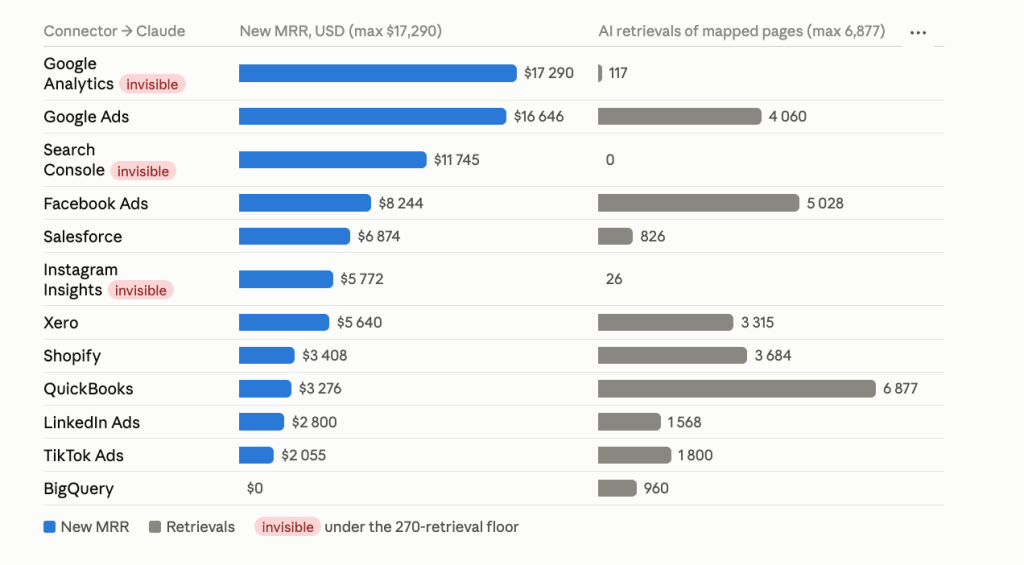
So, does our GEO work? Yes, but not the way our visibility dashboard measured it. The brand gets seen constantly. The revenue comes through routes the dashboard couldn’t see.
How to decide what to work on
This is the part I’d want if I were defending a GEO budget. Once every page is in a group, the priorities mostly sort themselves.
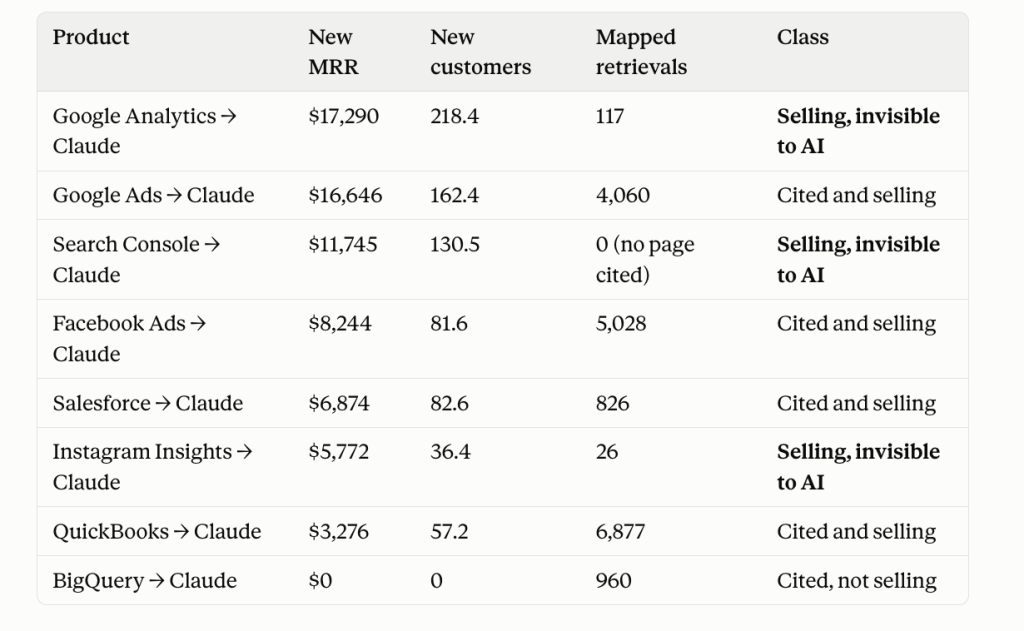
- Leaking pages get retrieved often but send almost no one. Don’t write more of them. Give people a reason to click that the answer can’t replace: a template, a calculator, live data, something they have to come to you for.
- Proven pages get AI visitors who convert. Protect them, keep them up-to-date and build more like them.
- Untracked winners get AI traffic your visibility tool isn’t watching. Add the prompts behind them to your tracking, or you’ll keep optimizing for the wrong slice of demand.
- Product-route traffic that lands straight on sign-up isn’t a content result at all. If it’s a big share of your AI conversions, as it is for us, your in-assistant experience (apps, integrations, connectors) may deserve more investment than another round of articles.

There’s one more group that citation data alone can’t show you: pages where AI engines cite your competitors and not you. We built a second skill for that, which ranks the third-party pages engines retrieve that name competitors but leave you out.
In our data, we were roughly tied with one competitor on how often our sites were used as sources, but they got mentioned in more answers. That gap is where outreach goes next: we found 391 pages in it, 28 of them listicles and comparisons worth pitching.
What the GEO skill can’t tell you
Causation. It shows that a page appears in both the citation data and the revenue data over the same period. It doesn’t prove one caused the other.
Trends from a single snapshot. Citation exports cover a whole period at once, so there’s no week-by-week change to report yet.
The full volume of AI traffic. Visits with no referrer and clicks from AI Overviews mean the skill undercounts, and the report says so.
We haven’t tested data exports from other tools yet. It’s a test build. We’ve run it against Peec AI exports. Other formats are mapped but not yet verified.
Try the GEO skill for free
The skill is available through the Coupler.io connector in Claude and the ChatGPT plugin, as well as over the Coupler.io MCP server if you use other AI tools. Connect GA4, Search Console, and your store, CRM, or billing system, upload your citation exports, and ask whether your GEO is turning into revenue.
Your numbers may look completely different from ours. Whatever they show, you’ll know which stage of the funnel is working, which one is breaking, and where to spend next quarter.


Spot what's growing in your GEO with Coupler.io
Book a consultation