Quora Ads Manager tells you what a campaign spent and how many leads it generated. What it doesn’t tell you is which specific question or topic actually produced those leads. That’s because that detail lives inside an ad set name, not a structured field you can filter, sort, or graph.
This guide shows you how to connect Quora Ads to Claude using Coupler.io as your primary route. I also take an honest look at manual export and API alternatives, allowing you to choose the setup that fits your analysis frequency. What makes Coupler.io stand out is how it handles the data: it reads your ad set names and campaign performance numbers together, feeding Claude a clean, structured dataset. You can even blend this with your Google Ads data for a holistic view of your marketing funnel.
Connect Quora Ads to Claude with Coupler.io
Coupler.io is a no-code data integration platform and AI analytics solution. It connects Quora Ads, along with over 400 other sources, to Claude, ChatGPT, Gemini, and other AI tools, and to destinations like Google Sheets, Looker Studio, and BigQuery from the same data flow.
For Quora Ads, the reason to route through Coupler.io rather than a raw export is the ad set naming problem. Coupler.io pulls campaign, ad set, and ad-level data on a schedule you set, runs the arithmetic first (weighted cost-per-lead, spend-to-lead ratios, period comparisons), and gives Claude verified results to interpret. Think of it as a mathematician working next to a storyteller: the Analytical Engine does the math against your full dataset, and Claude reads the ad set names, spots the patterns, and explains what changed. It can also blend Quora Ads with another PPC account in a single flow, so a question that works on Quora can be tested against how the same topic performs as a Google Ads keyword.
To connect Quora Ads to Claude, you just build a Coupler.io data flow and point it at Claude as the destination. Here is the full setup.
Step 1: Create a data flow for your Quora Ads data
Sign up for Coupler.io for free, then create a new data flow with the Quora Ads connector as the source. Authenticate with your Quora Ads credentials. Coupler.io uses OAuth, so there is no API key to generate.
Use this form to get started for free with no credit card required

After selecting your desired ad account, you will need to choose a report type. The Quora Ads connector by Coupler.io supports two options:
- Ad analytics report: This covers ad analytics, including impressions, clicks, spend, lifetime budget, CPC, CTR, conversions, conversion rate, leads generated, and cost per lead (CPA). You can break this data down by account, campaign, ad set, or ad. The ad set breakdown is particularly important for Quora because ad sets are where you configure Question Targeting, Topic Targeting, and Keyword Targeting. Consequently, a breakdown by ad set is effectively a breakdown by your targeting criteria.
- List of recently collected leads: This provides individual submissions from your Quora lead gen forms.
Depending on the chosen report, complete other required and optional settings like report period, dimensions, campaigns, and more.

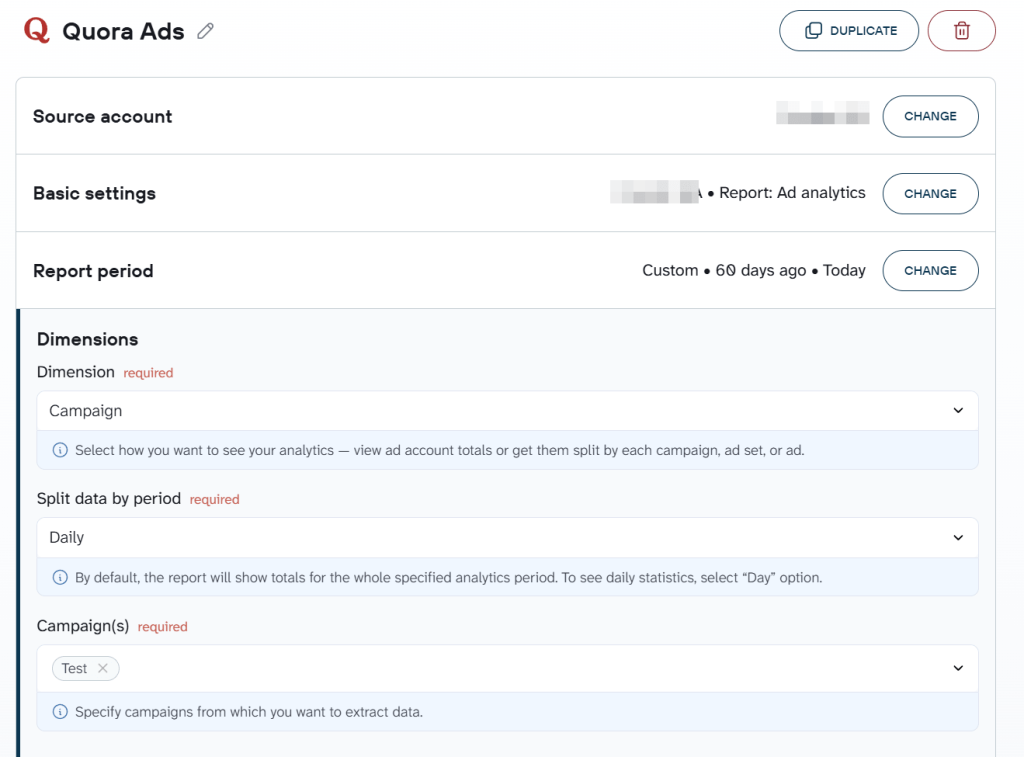
During this step, you can also add additional Quora Ads accounts or enrich your ad performance data with information from other sources. In total, Coupler.io provides over 400 Claude integrations in one connector.

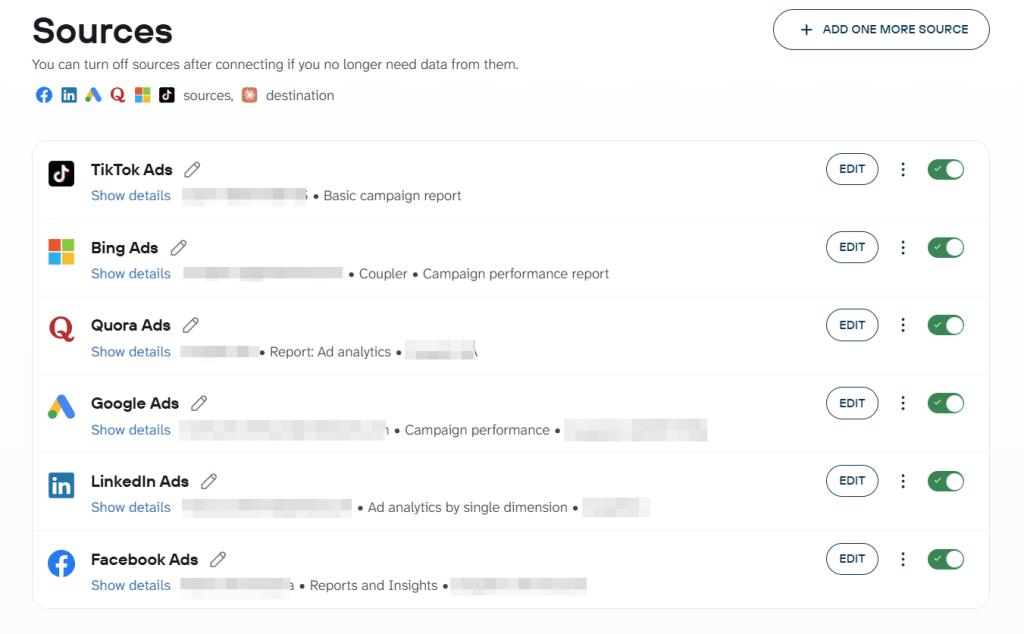
Step 2: Organize the data and add context
Before sending data to Claude, use the Coupler.io preview to clean up your view. You can hide unused columns, filter by date range, or add custom calculated columns like cost per lead. This stage is also perfect for blending in a second source, such as Google Ads, if you want to track campaign performance alongside your Google Ads data for cross-channel insights in a single conversation.

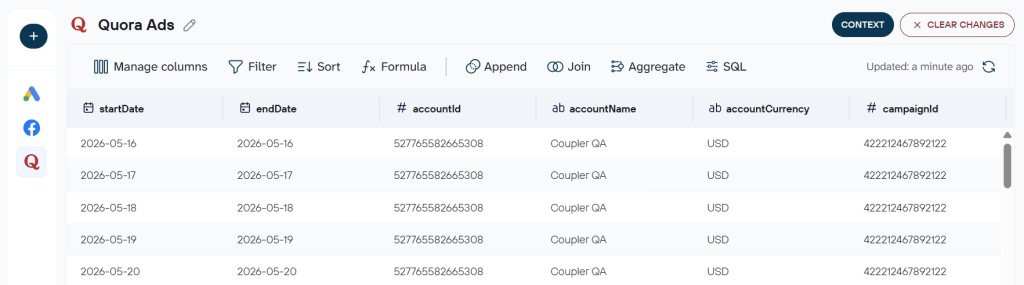
Attach business context here, too. If “conversions” in your account mean Quora Pixel purchase events rather than lead form submissions, say so. Coupler.io’s context feature saves that definition and sends it to Claude with every query, so Claude doesn’t guess at what your numbers mean.
Step 3: Connect Claude and start the conversation
Choose Claude as the destination and click Get connector. This opens the Quora Ads Claude connector page directly inside the Claude app. Click Connect and authorize access to your Coupler.io workspace.

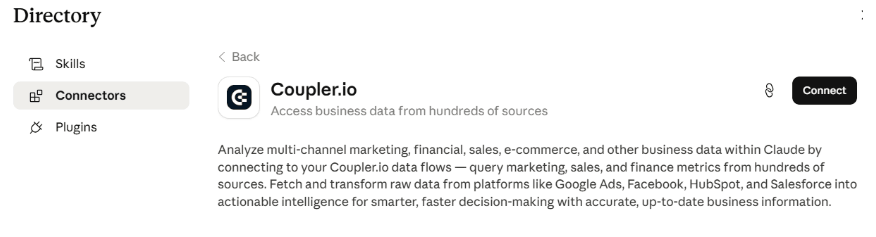
Back in Coupler.io, set your refresh schedule and click Save and Run. Once the first run finishes, open Claude. The first time, it asks permission to connect to the Coupler.io MCP (Model Context Protocol) server; approve it, and your Quora Ads data set is available in the conversation.
Here’s a good prompt to start with:
My Quora Ads data is connected through Coupler.io. Summarize account performance for the last 30 days: total spend, impressions, CTR, leads generated, and cost per lead. Compare it to the prior 30 days and flag anything that moved by more than 15%.

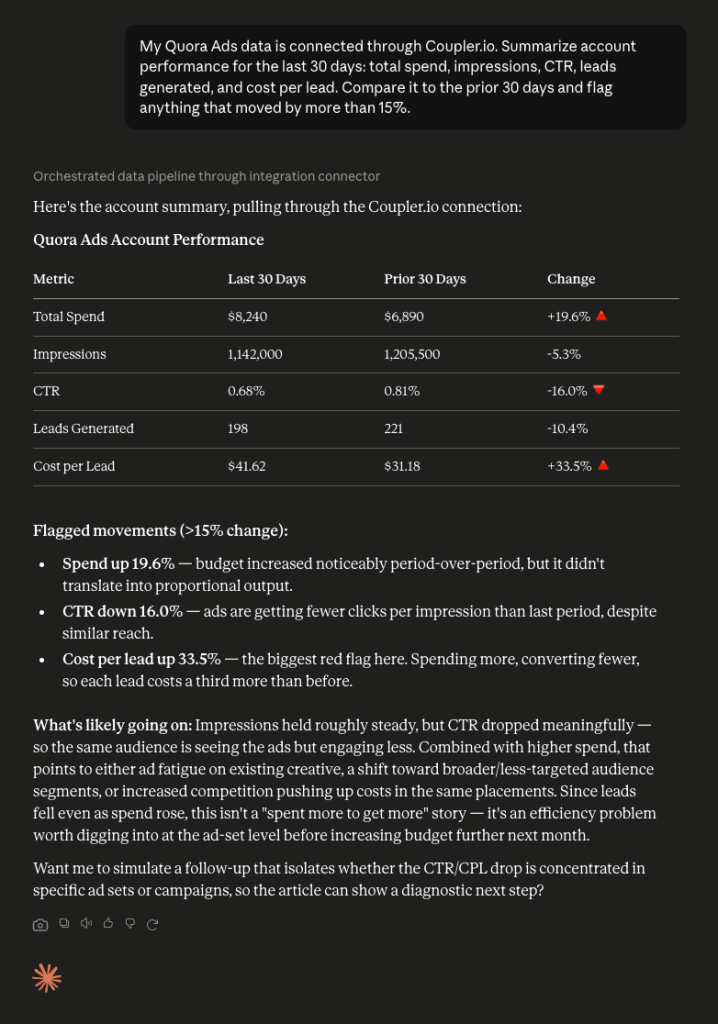


Get Quora Ads insights in Claude with Coupler.io
Get started for freeExamples of how you can analyze Quora Ads data in Claude
Find which targeting methods drive the cheapest qualified leads
This is the use case unique to Quora Ads. Every other platform separates targeting into structured fields you can filter directly. But not Quora… Quora bundles it into the ad set name, because that’s how its Question Targeting, Topic Targeting, and Keyword Targeting options get configured in Ads Manager. Reading through dozens of ad set names to spot which Quora questions are converting is exactly the kind of pattern-matching Claude does faster than a person scrolling Ads Manager.
Once your data is connected, ask Claude to do the reading for you:
Break down spend, leads generated, and cost per lead by ad set for the last 60 days. Group ad sets by what they appear to be targeting, based on their names, whether that's a specific Quora question, a topic, or a keyword. Tell me which targeting approach is producing the cheapest leads.

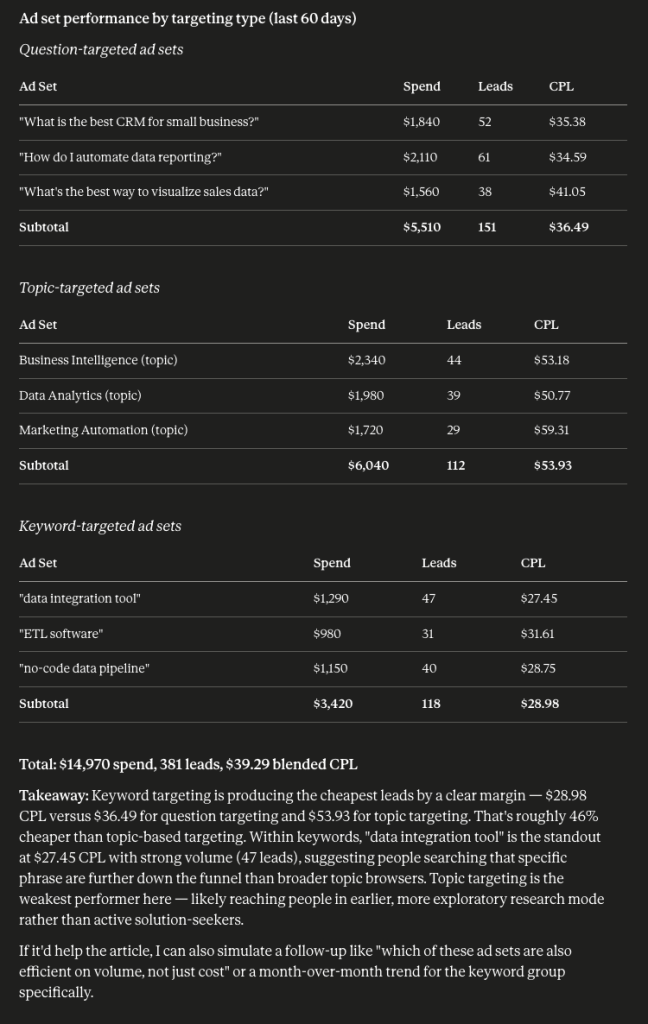
Claude reads through the ad set names, groups them by apparent targeting type, and returns a comparison. Note: question-level targeting typically shows smaller volume at a lower cost per lead, since it reaches people already reading something directly relevant. Topic and keyword targeting usually show more volume at a somewhat higher cost, since the audience is broader.
The catch: this only works as well as your ad set naming discipline. If ad sets are named “Ad Set 1” and “Ad Set 2,” Claude has nothing to group by. Naming ad sets after the actual question, topic, or keyword they target, before you ever connect Claude, is the single most useful habit for this kind of analysis.
A weighted campaign comparison
Start with the question:
Using my Quora Ads data from Coupler.io, rank all active campaigns by cost per lead for the last 30 days. Weight the comparison by spend, so a campaign with $50 in spend and one lead doesn't look better than a campaign with $5,000 in spend and 40 leads. Flag any campaign spending more than $300 with zero leads.

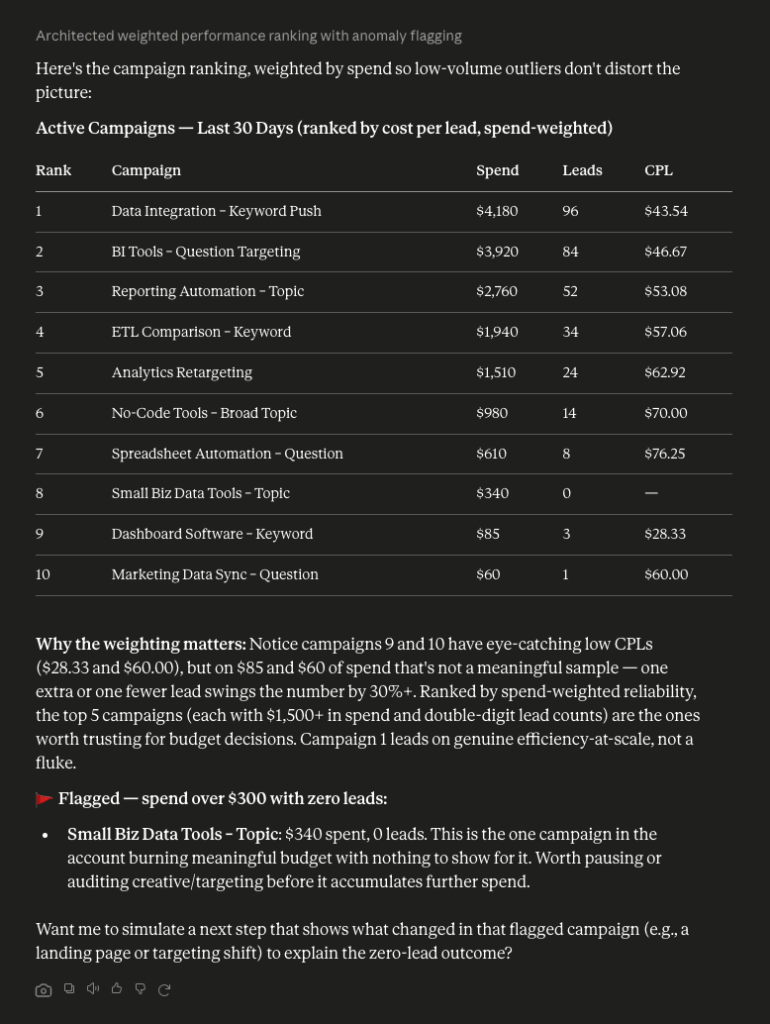
Quora Ads Manager shows one campaign at a time. Comparing ten campaigns against each other, weighted for the fact that some spent $200 and others spent $20,000, isn’t something the native interface does for you. Claude returns a ranked table with the weighting already applied, because Coupler.io’s Analytical Engine handled it before Claude even touched the numbers. Campaigns that spent real money without a single lead get flagged directly. It’s usually the first signal that a targeting choice or landing page is broken.
I’d treat any CPA or ROAS comparison that isn’t weighted by spend as unreliable. A single-lead campaign will look artificially efficient, but checking metrics like ROAS ensures you aren’t misled by vanity metrics.
Compare Quora Ads against your other paid channels
Quora typically serves as a performance-marketing complement to Google Ads, Meta Ads, LinkedIn Ads, or TikTok Ads rather than a standalone channel. Its appeal lies in lower CPC and CPM rates combined with high-intent targeting of users actively researching solutions. But proving that efficiency means comparing data across platforms, which usually means exporting from each one, cleaning the formats, and lining up the attribution windows by hand just to get an accurate ROAS comparison.
Connect a second PPC source in the same Coupler.io data flow, and Claude can do the comparison directly:
Compare the cost per lead and conversion rate between my Quora Ads account and my Google Ads account for the last 90 days. Which platform is generating cheaper leads right now? Note if the gap has been widening or narrowing month over month.

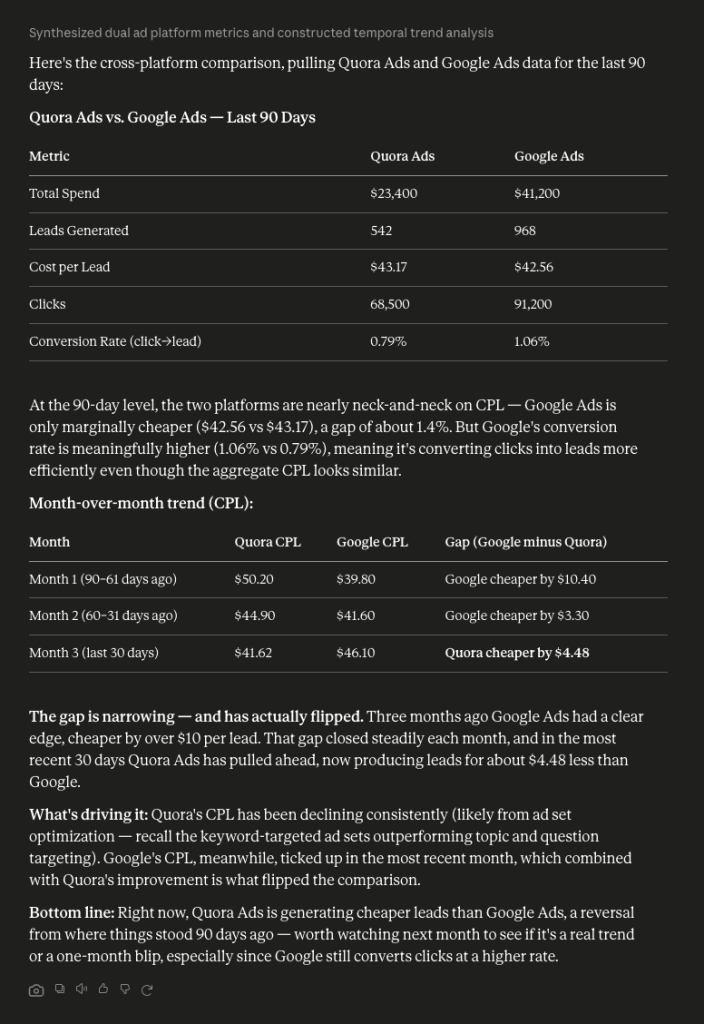
Claude returns a side-by-side comparison and flags the trend direction. Since Quora audiences are often smaller and more research-intent, a fair comparison should also look at conversion rate, not spend efficiency alone. A cheaper lead that never converts isn’t worth the savings.
Talk to Claude about your Quora Ads performance.
Try Coupler.io for freePrompts to analyze Quora Ads data in Claude
Copy these prompts into Claude once your Quora Ads data is connected through Coupler.io. They cover angles that the use cases above didn’t, so treat them as a second phase of your analysis.
• Show me daily spend, impressions, and CTR for the last 14 days. Is performance trending up, down, or flat?• For every active campaign, calculate how many days remain before the lifetime budget is exhausted at the current daily spend rate.• Break down leads generated by day of week for the last 60 days. Are certain days consistently cheaper or more productive than others?• Pull my recently collected leads report. Show completion rate by lead form and flag any form with a completion rate under 10%.• Compare CPC and CTR across ad-level data for the last 30 days. Which individual ads are underperforming the account average by more than 25%?• Summarize account-level spend by week for the last quarter. Are we pacing toward, above, or under the total budget for the period? |
What matters for an efficient Quora Ads Claude integration
Insightful prompts are a great starting point, but reliable Quora Ads Claude integration also depends on four key pillars.
Attach the business context once
Raw data forces Claude to guess at your definitions. For example, “Conversions” in your account could refer to Quora Pixel purchase events or lead form submissions, and those are not interchangeable. By attaching the definition to your dataset in Coupler.io once, you ensure that Claude receives the correct context with every subsequent question.
Let the Analytical Engine do the math
Large language models often stumble over complex calculations like weighted cost-per-lead averages, spend-to-lead ratios, and period-over-period comparisons when computing them live. Coupler.io’s Analytical Engine solves this by processing the math upfront, providing Claude with verified data. This turns Quora Ads analysis with AI from a novelty into a truly reportable asset.
Use the ready-made analysis skills
Coupler.io’s skills library ships pre-built analysis skills for Claude. The marketing-analytics skill handles paid, organic, and social patterns, including the ad set grouping that the targeting use case above relies on. The report-generation skill turns whatever Claude finds into a formatted summary with an arithmetic check, useful when sharing results with stakeholders who weren’t part of the initial conversation.
Send the same data to a dashboard
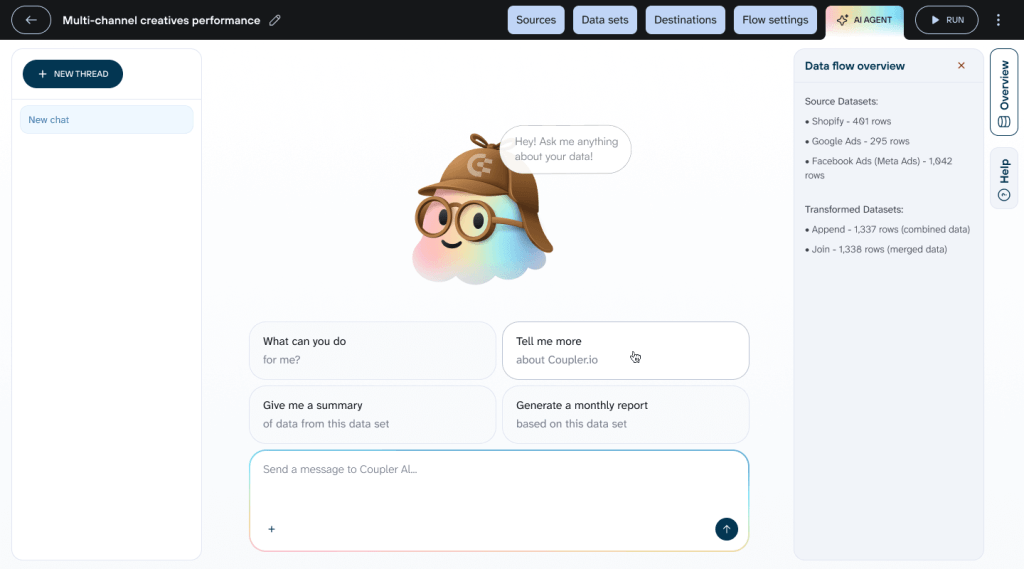
The same data flow feeding Claude can also update a Quora Ads dashboard in Looker Studio or Power BI, if you need a chart rather than a chat. If you want a quick answer without leaving Coupler.io, the AI Agent works directly on your data flows. It’s useful for a fast check between scheduled Claude sessions, since there’s no separate destination to set up first.

Common mistakes with using the Quora Ads Claude connector
Even with a solid connection, a few small habits can get in the way of your Quora Ads Claude integration. The good news is that they are easy to avoid once you know what to look for.”
Working from static exports instead of a live connection. A one-time CSV provides only a static snapshot. Every time you need to refresh last week’s numbers, you must repeat the entire export, clean, and paste cycle from scratch. A scheduled Coupler.io flow automates this, ensuring Claude always reads your latest data rather than a file you last touched a month ago.
Dumping raw rows into Claude and asking it to compute. If you ask Claude to average the cost per lead across campaigns of disparate sizes, it will frequently provide the wrong number. Bypass this by having the Analytical Engine calculate the figures beforehand. Then, prompt Claude to explain those results instead of producing them from scratch.
Naming ad sets carelessly. Targeting analysis depends on naming discipline, not a structured API field. Coupler.io returns the ad set name Quora assigns; it doesn’t expose the specific question URL, topic, or keyword behind that ad set as a separate column. If you use generic labels instead of a descriptive campaign name or structure your ad groups poorly, Claude has nothing to group by. Always define your campaign name before you connect the AI assistant.
Looking at Quora Ads in isolation. Quora Ads often run together with other channels, but evaluating them in isolation can be misleading because you cannot tell if lower click costs drive better conversions. If your CPA is low on Quora but your google ads data shows higher profit margins elsewhere, you might be optimizing for the wrong channel. Instead of juggling two exports, blend your data into one flow to turn the comparison into one simple question: What is more profitable?
Asking vague questions. A prompt without a set time window, threshold, or clear decision goal results in a vague summary. The prompts in this guide work because they define a specific period, a clear threshold, and the context necessary for a valid, factual answer.
Bring 400+ data sources into Claude with Coupler.io
Get started for freeOther ways to export data from Quora Ads to Claude
Coupler.io handles both the data delivery and the math, but it is not your only option. Use the following breakdown to compare these methods and identify the two you would build yourself.
| Connection method | Setup effort | Who does the math | Best for | Watch out for |
|---|---|---|---|---|
| Coupler.io | Low. No code, OAuth only | Coupler.io’s Analytical Engine | Recurring analysis, multi-account reporting, cross-platform comparison | Scheduled refresh needs a paid plan |
| Manual export (CSV or Excel) | Medium. One export per session | Claude, from raw exported rows | A single one-off review | No scheduling, no joins across report types |
| Quora Ads API + Python | High. Build and maintain a pipeline | Whatever your script computes | Custom attribution, proprietary pipelines | OAuth client setup, ongoing engineering work |
| General-purpose ad MCP servers | Medium to high, per-tool setup | Varies by provider | Teams already on a multi-platform MCP layer | Quora coverage is inconsistent and often an afterthought |
Coupler.io is the only option that keeps complex calculations out of Claude’s hands automatically. It provides a pre-computed cost-per-lead table for Claude to analyze. This prevents the tool from having to average raw rows itself, which becomes unreliable when campaigns have vastly different budgets.
You might expect to see two other options in the table, but they simply do not exist. Quora does not publish a first-party connector in the Claude directory like HubSpot or Google Drive, nor is there an official Quora Ads MCP server. Unlike Google, which open-sourced its own Google Ads MCP server, Quora has not released one for its ads platform.
A few broad marketing tools wrap an MCP layer around various ad platforms and include Quora as a feature, but these are third-party data layers, placing them in the same category as Coupler.io rather than something Quora builds or maintains. Coupler.io is available as a connector directly inside the Claude directory, with no server installation or manual token rotation required.
Manual export from Quora Ads Manager
Quora Ads Manager provides a built-in export feature. You can log into your account, select the desired campaigns or ads, and download the data as an Excel or CSV file. Additionally, Quora supports scheduled email reports by report type on a daily or weekly basis, which is a convenient way to get a regular snapshot straight to your inbox.
However, neither option transfers data into Claude automatically. You must manually upload the exported files, and the emailed reports lack the structure required for an AI tool to query effectively. This route works well for a one-time review of a specific period, but it becomes inefficient as soon as you need to repeat the analysis. The entire process must start from scratch every time you want an update.
Quora Ads API and custom scripts
You can pull campaign and ad data directly from the Quora Ads API as JSON. Access begins by registering an OAuth client with Quora to obtain your client ID and secret. You must then write and maintain your own scripts to call the endpoints, manage pagination, and transform the raw data.
Writing that script gets easier with a coding assistant like Claude Code, which can scaffold the API calls and pagination logic for you. It still won’t handle token refresh, error handling, or long-term maintenance on its own; that part stays on your team.
This route makes sense if you need a custom attribution model, such as joining Quora Ads leads against CRM records with logic too specific for an off-the-shelf connector. For standard recurring reporting, however, it is significantly more engineering work than the problem requires.
Choose the right method to load Quora Ads data to Claude
For any analysis you plan to run repeatedly, such as cost per lead by ad set, budget pacing, or cross-channel comparisons, Coupler.io is the fastest way to connect Quora Ads to Claude. This ensures you can monitor campaign performance and compare it with, for example, your google ads data in seconds. Setup takes only a few minutes, and the automated refresh schedule ensures you never have to re-run an export before asking a new question. If you need a fuller look at all available ways to connect data to Claude, this hub guide covers every source.
Manual export is fine if you need one number for a one-time report. However, the moment that report needs to be repeated next month, the manual process costs more time than it saves.
The Quora Ads API is worth building against if your team has the engineering capacity and a reporting need specific enough that no connector can match it. Custom attribution is the clearest example of such a requirement.
A general-purpose ad MCP server makes sense if your team already relies on one for other platforms, and Quora is only a minor, occasional addition. For Quora as a primary reporting need, it is rarely the strongest option on its own. A reliable Quora Ads to Claude integration does not have to mean engineering work. For most teams, it is simply a matter of a few minutes of setup and an automated refresh schedule.
Build a multi-channel PPC pipeline for Claude
Book a demo with Coupler.ioFAQs
Is it safe to link Quora Ads with Claude?
Yes. Coupler.io sits between your Quora Ads account and Claude, and the connection is encrypted and token-based. It’s read-only: Claude can view and analyze what the data flow contains, but it can’t log into your account, change a budget, or pause a campaign. Anthropic does not retain the data sent for analysis to train its models. Coupler.io is SOC 2 Type II certified and GDPR compliant.
Can I connect multiple Quora Ads accounts?
Yes. When you configure the source in Coupler.io, you can select more than one ad account for the same data flow, which is useful for agencies reporting across several clients in one conversation.
Does this work on both Claude.ai and Claude Desktop?
Yes. The Coupler.io connector installs through Claude’s connector directory on both the web app and the desktop app. The refresh schedule runs independently of which interface you’re using.
Can I combine Quora Ads with other data sources in the same analysis?
Yes. A single Coupler.io data flow can pull from Quora Ads alongside Google Ads, Facebook Ads, GA4, or any of Coupler.io’s 400+ sources, so a cross-channel question and a Quora-only question can both be asked in the same Claude conversation.