Marketing analytics in 2026 no longer means exporting CSVs and checking last month’s performance. AI systems scan campaigns in real time, privacy rules force a pivot to first-party data, bots now generate more web traffic than humans, and AI search engines quietly decide which brands appear in front of buyers.
The gap between teams that adapt and teams that don’t is widening every quarter. Do you want to know where to focus your analytics investment this year? Explore the key marketing analytics trends to avoid spending resources on approaches that are already losing ground.
AI-powered marketing analytics: from helper to infrastructure
The first big shift I see in the latest trends in marketing analytics for 2026 is simple: AI is no longer a bolt-on feature in your digital marketing stack. It sits in the middle of the workflow and touches everything from data collection and analysis to activation and decision-making across channels.
Our research shows that AI has already moved past the experiment phase. Industry professionals mainly use it for data collection and processing of large datasets (34%), forecasting and predictive analytics (27%), and real-time insights from complex datasets (19%).
In practice, this means AI now does the heavy lifting in marketing analytics: it keeps data flowing between tools, surfaces changes before people notice them, and turns raw numbers into explanations rather than just charts.
But this shift comes with a catch: as AI takes over execution like building charts and writing queries, the analyst’s role changes fundamentally. Teams that treat AI as a replacement for analysts miss the point. The real value moves from doing the work to providing the context that makes AI output useful.
Ibrahim Elawadi, Global Director at Philips Health System, framed this at Superweek 2026:
For the first time in history, we are outsourcing logic and meaning — something that was very uniquely human. A machine can now mimic it.
This is what is called the Context Floor: AI models are powerful but lack business priorities, external factors, and strategic nuance. The analyst’s new job is to supply that layer. The “why this matters” and “what we’re optimizing for”, so AI-generated insights translate into real decisions, not just faster reports.
Russell McAthy, CEO and Co-Founder of Ringside Data, made the practical implication clear:
If your job is to pull numbers and make a chart, the next thing on your to-do list will be to update your CV. Context is what matters now — you need to provide better context to the LLMs.
AI as a part of analytics workflow
I recommend treating AI as the backbone of your analytics workflow, not as a side project. Here is what it may look like
- Automate the basics: Connect your core channels, such as Google Ads, Microsoft Ads, Meta Ads, TikTok, and web analytics platforms, into Coupler.io and let scheduled data flows handle the routine work. Cleaning, categorizing, and enriching marketing data becomes a background process instead of a monthly spreadsheet chore.
- Use AI to spot trends before they hurt performance. Combine these automated data flows with anomaly detection or alerting. For example, you can use the AI Insights available in the Coupler.io dashboards to catch a sudden drop in mobile conversion rates, a spike in CPA on a single creative, or traffic quality shifts in a specific segment. The goal is to adjust in near real time, not at the end of the quarter.
- Turns queries into conversation: With conversational analytics, you no longer have to dig through dashboards to get actionable insights. You can ask plain-language questions inside Claude, ChatGPT, or the AI Agent inside Coupler.io:
Which marketing campaigns drove the highest conversions from social media last week?
How did our email marketing impact trial-to-paid conversion rates in the U.S.?

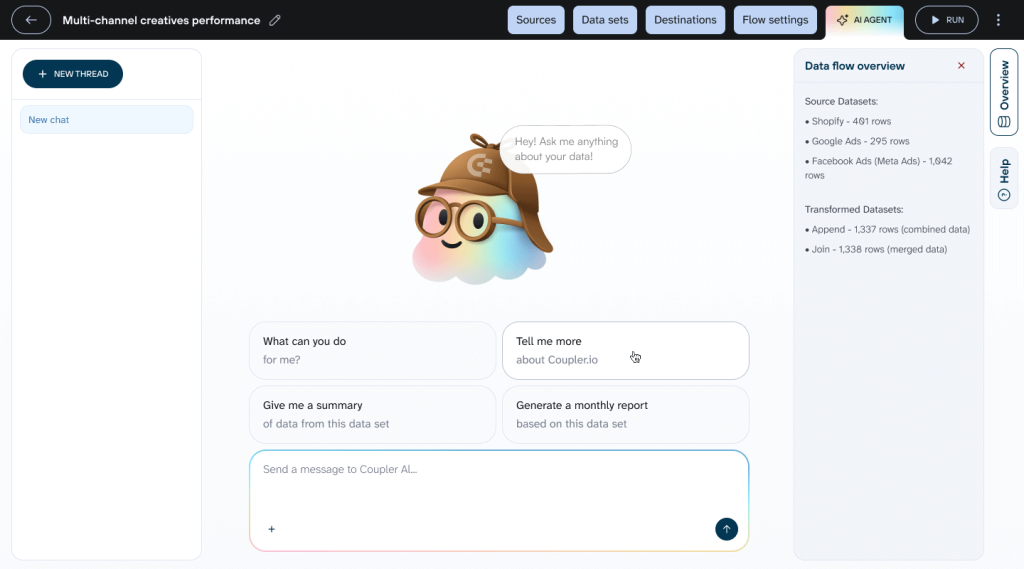
The AI model queries the underlying data platforms, assembles tables and charts, and returns narrative marketing insights. No SQL and no BI training. This radically lowers the barrier for non-technical teams and keeps data analysis close to daily marketing decisions.
Tip: Invest in the Context Floor
As AI handles more execution, redirect analyst time toward providing business context: strategic priorities, competitive dynamics, product launches, and external factors. That context is what turns AI output from generic summaries into actionable strategy.
In our survey on AI-driven marketing strategy, 25% named analytics as their top AI implementation area, ahead of or on par with content (24%), SEO (23%), and paid ads (14%). AI now supports content creation, creative testing, social media optimization, and email marketing, but analytics still anchors the biggest impact.
These numbers align with broader market research by McKinsey, which reports that 42% of companies already use AI in marketing operations, and AI now influences not only execution but also strategic decisions. The net effect: AI-powered marketing analytics stops functioning as “an experiment” and becomes a permanent part of how teams see reality and decide what to do next.
From reactive to proactive: predictive marketing analytics
For a long time, analytics maturity meant explaining the past. Teams pulled last month’s numbers from Google Analytics, built a slide deck, and walked stakeholders through what happened. In my experience, that approach is now one of the biggest constraints on growth. The lag between insight and action leaves budget, conversions, and momentum on the table.
What I see instead, and what defines the next wave of marketing analytics trends, is a shift toward predictive and prescriptive analytics. Analytics no longer waits until campaigns finish. It actively shapes decisions while campaigns are still running.
Our surveys show that:
- 27% of professionals already use AI for predictive analytics and precise forecasting.
- 35% of marketers rely on AI-driven forecasting for campaign and budget decisions.
Salesforce defines predictive marketing as using AI and machine learning to analyze current and historical data to forecast future customer behavior and market trends. So teams can anticipate needs and optimize campaigns ahead of time.
Main predictive marketing clusters
In practice, most of the predictive work I see in marketing analytics clusters into two core areas:
1. Channel-level foresight and decay modeling
On the media side, predictive analytics forecasts when channels will saturate or decay. Models ingest historical performance, reach and frequency data, audience composition, and creative fatigue signals. They then simulate when a given channel’s ROI drops below an acceptable threshold and when a reallocation of spend preserves or increases total return.
I recommend starting small here. Focus on one high-spend channel and model its performance over time against reach, frequency, and creative rotation. Even a basic decay curve monitored weekly improves budget conversations and reduces reliance on instinct when reallocating spend.
Thomas Oldham, Founder of WebMotion Media described this very clearly:
The definitive trend for 2026 is predictive channel decay modeling. Most marketers still react to last quarter’s data, but my team builds models that forecast diminishing returns for specific channels 12 to 18 months in advance.
2. Lifecycle-level predictive decision intelligence
On the lifecycle side, predictive decision intelligence evaluates who is likely to churn, expand, or convert. The key insight is timing. Predictive lifecycle analytics matters most before behavior changes, not after it becomes obvious.
In practice, this shows up in several common applications:
- Routing high-propensity users into tailored email marketing flows.
- Prioritizing sales outreach based on predicted conversion probability.
- Triggering retention messaging when early churn signals appear.
GA4’s predictive audiences and similar features in CRMs and CDPs operationalize this trend. Predictive segments such as “likely 7-day purchasers” or “high churn risk” now plug directly into ad platforms and marketing automation rather than staying in static reports.
Anton Kovalchuk, Founder and CEO at QliqQliq mentioned:
We implemented predictive models that forecast customer churn probability to initiate automatic retention campaigns, resulting in higher revenue growth and improved spending efficiency.
I recommend anchoring lifecycle predictions to one concrete outcome first, such as retention or trial-to-paid conversion. Track how predictive segments perform against baseline cohorts in terms of conversion rates and retention. Once that link is visible in your marketing analytics, expanding predictive use cases becomes easier and more effective.
Privacy-first measurement and the first-party data pivot
Chrome paused its third-party cookies deprecation, but privacy-first measurement does not reverse. Privacy regulations such as GDPR and CCPA, Consent Mode, and rising user expectations show a structural shift toward first-party data, compliant data collection, and transparent customer experience design.
At this point, the first-party data story, being privacy-first, and the AI-analytics story merge into one: AI powered by clean, consented customer data.
A practical first-party playbook sits at the center of this trend:
- Review CRM, ecommerce, subscription, and payment systems and connect them to ad platforms to link demographic and purchase data with campaign performance.
- Add optional onboarding and churn surveys to capture location, role, intent, and discovery channel, and then use these to build richer audience segments.
- Track offline conversions (calls, deals closed in CRM, store purchases) and send them back to digital platforms for better optimization signals.
- Move to server-side tracking so core measurement depends less on fragile browser environments and more on controlled server events.
Research from CustomerLabs confirms that first-party data is more accurate, more reliable, and more privacy-compliant than third-party data, and that it enables stronger personalization and better predictive analytics without the same compliance risk.
I recommend treating privacy-first as a design principle for your analytics stack, not just a checkbox:
- Audit where your key metrics still depend on third-party cookies or opaque audience providers.
- Prioritize replacing those pieces with first-party data flows (CRM, ecommerce, subscriptions, support tools) and use Coupler.io to control integration and storage.
- Make consent and anonymization part of the initial setup for every new analytics tool or AI integration, not an afterthought.
Valentin Radu, Founder of Omniconvert explains why this matters:
With growing regulations such as GDPR and CCPA, and a change in consumer expectations around transparency of the data the company holds, businesses will need to utilize advanced analytics tools that value data anonymization and consent-driven methodologies. The ability to deliver personalized experiences without losing trust will characterize analytics success.
Of all trends in marketing analytics, this one also has a growing geopolitical dimension. At Superweek 2026, speakers highlighted a rising demand for European-based analytics stacks. For instance, tools like Piano and Piwik Pro are driven by strict regional compliance and data sovereignty standards. Beyond tool selection, there is a push to reframe server-side tagging from a vendor-centric model (getting better data back to Meta and Google) to a user-centric model that prioritizes privacy and security by default.
Simo Ahava, Founder of Simmer and a renowned Google Developer Expert, challenged the industry directly at Superweek:
Currently with server-side tagging we are living in a vendor-centric world. I want to switch it around to a user-centric model where users are in the center of it all. We stop talking about how much vendors want it and start talking about it as a way to improve enrichment and security.
Whether you operate in the EU or serve European customers, the takeaway is practical: evaluate whether your analytics infrastructure meets sovereignty expectations, and consider whether your server-side setup serves your users or your vendors.
That same first-party foundation now powers a second, more advanced trend I see emerging: predictive intent modeling built on your own data instead of generic audiences. Once you rely on your own behavioral, transactional, and survey signals, your models understand your customers, not an abstract average user.
Eugene Leow, Director of Marketing Agency Singapore explains this evolution:
We are already seeing clients who build predictive intent models on first-party data achieve up to a 30% lift in qualified traffic conversion.
I recommend that you make predictive intent concrete rather than theoretical:
- Identify the five micro-conversions that precede a high-value outcome for you such as pricing page views, feature use, or webinar registrations.
- Map your existing first-party data against those events and build simple intent segments.
Dashboards that tell stories
Dashboards once existed as static walls of charts: useful, but dependent on an analyst’s time and attention. In 2026, dashboards evolve into storytelling and decision engines.
Coupler.io’s AI-powered dashboards illustrate how this trend works in practice. A multi-channel PPC or all-in-one marketing report centralizes channel metrics from Google, Meta, LinkedIn, TikTok, GA4, email, and social. On top of that, AI Insights reads the data, detects trends and anomalies, and generates narrative explanations and recommendations: shift budget from channel X to Y, fix underperforming creatives, or double down on a rising campaign.

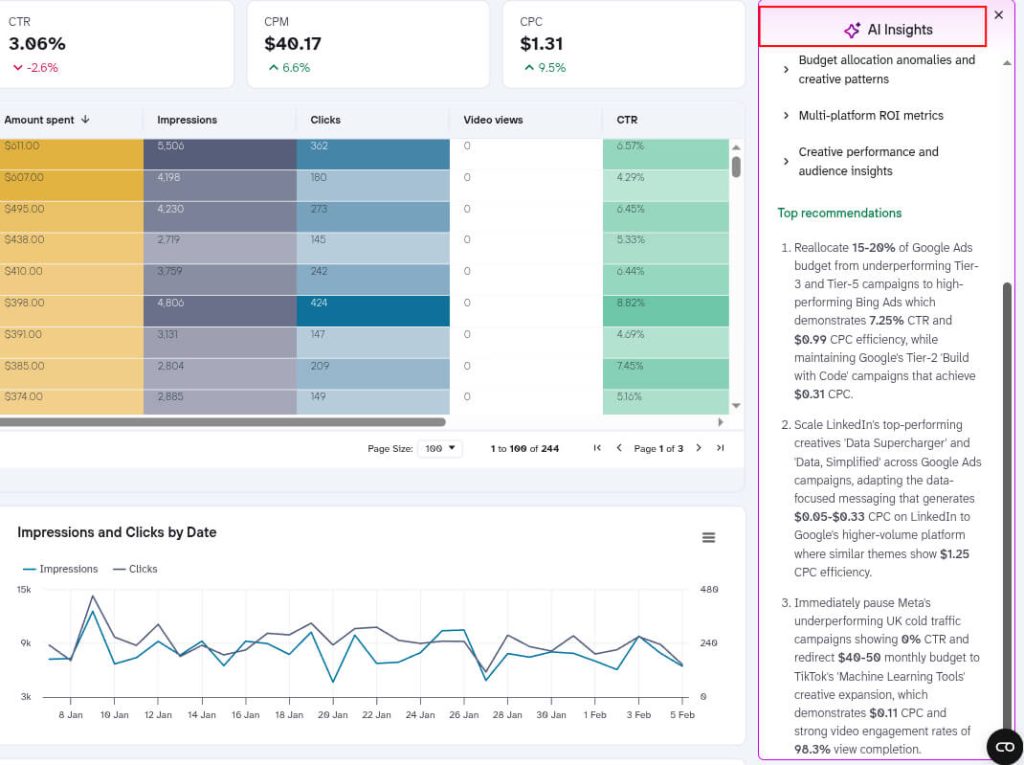
But there is a trap worth flagging here. Aggregated dashboards can look healthy while specific segments fail silently underneath. Siavash Kanani, a data consultant who presented at Superweek 2026, shared a case where a single broken product bundle on a specific landing page was losing $17,000 per week. And nothing in the top-level marketing dashboard triggered an alert because overall revenue stayed high enough to mask the loss.
The fix is automated anomaly detection at the segment level, not just top-line monitoring. New approaches using tools like BigQuery ML with incremental processing can monitor thousands of time-series metrics cost-effectively. This will reduce costs from thousands of dollars per month to under $50, and alert teams only when meaningful deviations occur. As a result, you get an always-on system that catches what dashboards miss.
At the same time, conversational analytics removes much of the friction that used to surround data exploration. AI integrations by Coupler.io enabled marketers to connect their data and ask questions like “Which campaign had the lowest CPA last week?” or “Which are my top 10 products sold over the last year?” and receive direct answers and visualizations.

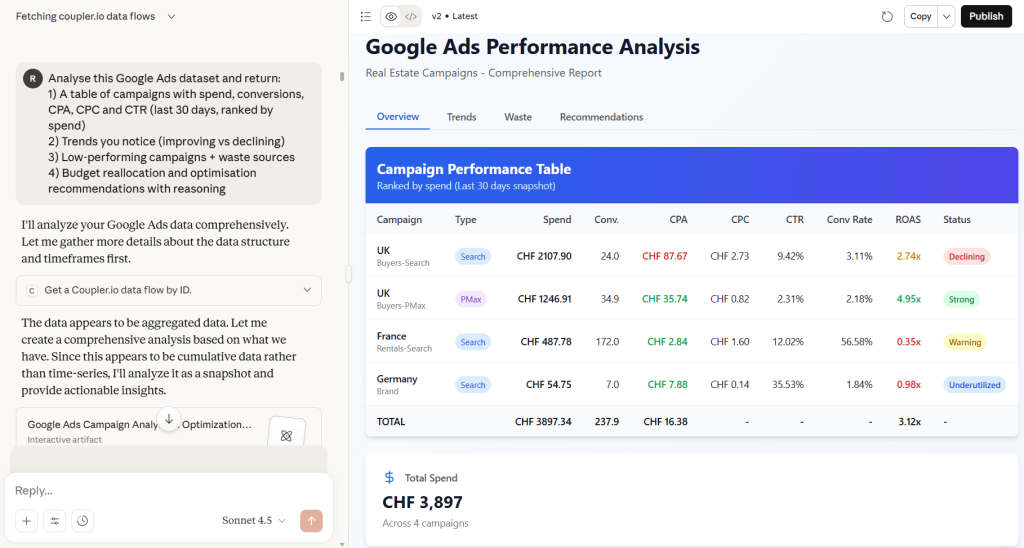
Dimi Baitanciuc, CEO and Co-Founder of Brizy captures this well:
Marketers no longer have time for dashboards that require interpretation. AI will translate first-party data into clear, decision-ready stories inside the tools teams already use, shifting analytics from “what happened” to “what should we do next”.
I recommend that you rethink dashboards as operating systems rather than reports:
- Consolidate all core marketing channels into one dashboard so trends are visible in context, not in isolation.
- Layer in automated anomaly detection at the segment level so you catch silent failures, not just top-line swings.
- Use AI-generated insights to understand why performance changed before reacting.
- Combine dashboards with conversational analytics so questions get answered immediately, without creating new reports.
When dashboards tell stories instead of showing charts, analytics stops being a reporting task and becomes a continuous optimization loop. That is the difference between knowing your numbers and actually using them to move faster.
Unified growth analytics: marketing, product, and revenue on one spine
Another defining marketing analytics trend in 2026: unification of marketing and product analytics into growth analytics.
Historically, marketing owned acquisition dashboards, product owned usage analytics, and finance owned revenue spreadsheets. Each system tracked separate touchpoints and made separate marketing decisions.
Olexander Paladiy, a Product Director at Coupler.io, explores this idea:
AI and vibe coding made engineering teams 10-20x faster. Not just chatting with LLMs. Entire toolchains, workflows, and ways of thinking changed. Marketing can’t catch this speed and becomes the bottleneck.
The smartest teams already merged marketing and product analytics into one discipline. Marketers and product managers sit in the same rooms, share the same funnels, and make decisions together. Now every function needs to adopt the same approaches that made developers unstoppable.
The future belongs to T-shaped specialists who architect business directions, not just run campaigns.
That organizational shift requires a unified data foundation to support it. Modern growth teams no longer operate in silos but use data integration to connect everything:
- Acquisition data from paid, organic, partnerships, and social media marketing.
- Product data from in-app events, activation milestones, feature adoption, and cohort retention.
- Revenue data from subscription changes, expansion, and LTV, often pulled from billing or ERP systems.
Data integration tools provide the infrastructure: they pull data from CRMs, ad platforms, email tools, ecommerce, support systems, and analytics platforms into a single destination and dashboard. That becomes the single source of truth.
Once teams see the full path, from ad click to feature adoption to expansion revenue, every other analytics investment (AI agents, predictive models, MMM, attribution) becomes more accurate and more valuable.
I recommend starting this transition by mapping your customer journey end-to-end and identifying where data still breaks across tools or teams. Use Coupler.io as a data integration layer to connect acquisition, product, and revenue data before adding more advanced analytics on top. When everyone operates from the same growth spine, analytics stops answering departmental questions and starts driving company-wide decisions.
Automate data flows from over 400 business data sources with Coupler.io
Get started for freeMarketing Mix Modeling meets attribution and experiments
Marketing Mix Modeling (MMM) and attribution once felt like rival schools of thought. MMM answered macro questions over long time horizons; attribution answered micro questions about paths and touchpoints.
In 2026, the most mature marketing analytics setups integrate all three: MMM, attribution, and structured experiments.
Research from eMarketer and Snap shows that more than half of US marketers now use MMM, and around one-third rank it as the most effective method for determining what truly drives business value, even above web analytics and third-party attribution solutions.
The deeper shift here is what gets measured. Standard attribution (last-click, multi-touch) studies where the user was before converting. Incrementality flips the subject: it studies the additional sales driven by an investment. The question moves from “which touchpoint gets credit?” to “what is the return on the next dollar spent in this channel?”
Gabriele Franco, Founder at Cassandra, an incrementality and MMM expert who spoke at Superweek 2026, framed this clearly:
Incrementality is a fancy word to say we don’t study where the user was before buying. We study the additional sales driven by an investment. The subject of the study is the budget, not the user.
That reframing matters because it aligns measurement with the decision marketers actually make: where to allocate the next dollar based on Marginal ROI, not which channel “deserves” credit for a past conversion.
At the same time, data analytics teams still rely on multi-touch attribution from tools such as Google Analytics 4, Adobe Analytics, or CRM attribution to steer tactical marketing efforts in paid search, social media, and email marketing.
Data-driven attribution remains critical for optimizing bids, creatives, and audience strategies day to day. Experiments like geo-tests, holdout tests, and A/B tests, validate what both MMM and attribution models suggest and reveal causal impact.
In a privacy-first environment, MMM benefits from aggregated, consent-safe data. AI speeds up MMM re-estimation, runs more scenario simulations (“What if we cut paid social by 20% and add it to CTV?”), and converts statistical outputs into executive-ready narratives.
I recommend treating MMM, attribution, and experimentation as complementary layers rather than competing models. Use MMM to guide long-term budget allocation and strategic planning, rely on attribution to optimize day-to-day marketing decisions across channels, and validate both with structured experiments. When all three draw from the same privacy-safe, unified dataset, you reduce internal debate and replace it with confident, evidence-based decision-making.
The agentic web and non-human traffic
One trend that quietly reshapes every other analytics conversation in 2026 is the rise of the agentic web. It’s a world where AI agents, bots, and automated crawlers generate a growing share of website traffic.
Matteo Zambon, Co-Founder of Analytix School and Lecturer, presented this challenge at Superweek 2026:
By 2024, bots reached 51% compared to 49% human traffic. Traditional tools like GA4 have a blind spot — AI agents browse in headless mode, so for your analytics, that visitor never existed.t
Bot traffic had already surpassed human traffic for the first time, and this is not just about malicious scrapers. Brands are building their own AI agents (support bots, shopping assistants, internal tools), and new AI-powered browsers like ChatGPT’s “Atlas” browse the web on behalf of users with aggressive privacy defaults — automatically rejecting consent banners, which means traditional client-side analytics never registers the visit.
Denis Golubovskyi, Founder of Stape, demonstrated how AI browsers undermine tracking even when scripts load correctly:
Atlas browsers load GA4 requests fine. But the first action of the browser is to close the consent banner — it rejects consent. So scripts load, but you still will not have any tracking.
For marketing analytics, the implications are serious. If a growing share of real interactions never shows up in client-side tools, your traffic numbers, conversion rates, and attribution models all erode quietly.
I recommend treating non-human traffic as a measurement problem, not just a security problem:
- Move toward server-side observation (at the CDN or infrastructure level) to detect and segment bot vs. human traffic that client-side tools miss entirely.
- If you’re building or deploying your own AI agents, design them as self-tracking agents — instruct the AI to emit structured logs of its decisions and tool usage directly to your analytics pipeline, rather than relying on traditional event tracking.
- Factor the agentic web into your data quality audits: understand what share of your traffic is non-human, and ensure your predictive models and attribution are trained on verified human behavior.
The agentic web doesn’t make analytics obsolete — but it makes analytics that ignores non-human traffic dangerously incomplete.
As advertising platforms automate more of bidding, targeting, and audience selection, marketers are losing traditional control levers. Budget is finite. Creative is increasingly commoditized. What remains is the conversion data you send back to the platform — and how you engineer it.
Signal engineering is the discipline of strategically designing the outcome signals you feed to ad algorithms to shape how they optimize. Instead of sending raw revenue as your conversion value, sophisticated teams send net profit or customer lifetime value (CLV). Instead of treating all conversions equally, they apply value multipliers to high-value leads and suppress signals from low-value outcomes (like serial returners) so the algorithm never learns to find more of them.
Gunnar Griese, a Digital Analytics Consultant and signal engineering expert who presented at Superweek 2026, framed this as the last meaningful optimization lever:
Signal engineering is really the only lever we have left. Budget is finite, competitors are doing creatives too. That leaves outcome signals — the conversion data we send to platforms — as the main driver to tell them what good looks like.
The logic is straightforward: ad platforms optimize toward the signals you provide. If you feed them smarter signals, for example, profit instead of revenue, lifetime value instead of one-time purchase, the algorithm finds higher-quality customers. If you suppress negative outcomes, the platform stops optimizing toward users who cost you money.
I recommend treating signal engineering as a core part of your paid media strategy, not just a technical implementation detail:
- Audit what conversion data you currently send to Google, Meta, and other platforms. Are you sending revenue, profit, or just conversion counts?
- Test sending CLV-based or profit-based values instead of raw transaction amounts. Even approximate values improve targeting.
- Identify your worst-performing conversion segments (serial returners, free-trial abusers) and evaluate whether suppressing those signals improves overall campaign quality.
- Treat this as an ongoing optimization loop, not a one-time setup — as your data improves, refine the signals you send.
Signal engineering bridges the gap between your internal analytics intelligence and the black-box algorithms that allocate your ad spend. The better the signal, the better the outcome.
Other predictions and trends in marketing analytics
Emotional analytics and the emotional performance score (EPS)
Clicks, impressions, and even conversions no longer tell the entire story. I believe that brand-level success depends on how campaigns feel to the audience, not just whether they reach them.
Emotion AI and sentiment analysis move into mainstream marketing analytics as tools for understanding emotional impact at scale. A Roots Analysis report projects that the global emotion AI market will grow from about $5.7 billion in 2025 to $38.5 billion by 2035, a CAGR of roughly 21%. Studies of emotional advertising show that emotionally rich creative tends to drive stronger brand attitudes and higher sales response than low-emotion ads, especially when measured with facial coding and sentiment metrics.
In this context, the Emotional Performance Score (EPS) emerges as a new layer in trends in marketing analytics. EPS consolidates:
- Sentiment polarity and intensity across social and UGC.
- Emotion AI classifications (joy, trust, anger, fear, disgust).
- Engagement quality signals such as positive vs negative comments, save and share behavior vs rage-clicks or hate-watching.
EPS ensures that teams distinguish genuine resonance from accidental or hostile engagement, and advocacy and affinity from controversy and backlash. Over time, EPS feeds back into MMM and creative testing. Teams stop asking “Which ad has the best ROAS?” in isolation and start asking “Which ad sustains strong ROAS and a healthy EPS?”
I recommend adding an emotional layer to performance analysis instead of optimizing purely for reach or conversions. Start by pairing traditional performance metrics with sentiment and engagement-quality signals from social media, reviews, and UGC. Track how emotionally positive campaigns perform over time in terms of retention, brand lift, and long-term revenue, not just short-term ROAS.
The role of human-verified data (HVD)
As generative AI floods the internet with synthetic content and bots skew basic metrics, human-verified data becomes the premium input for any serious predictive model. The rise of the agentic web, where bot traffic already surpasses human traffic, makes this even more urgent: if you can’t distinguish human behavior from automated noise, every downstream model suffers.
HVD means behavioral signals that you verify as human:
- Logged-in product activity.
- Real purchases and billing events.
- Verified support and sales interactions.
- Sessions cleared through fraud- and bot-detection systems.
Emotion AI and sentiment research already show how important clean, human-generated signals are for building reliable models; heavily synthetic or mislabeled data erodes model quality and can bias results.
In marketing analytics, this translates into a clear competitive advantage:
- Brands with strong direct-to-consumer relationships and well-governed first-party data get more accurate predictive models, more stable conversion rates, and less noisy attribution.
- Brands that depend on scraped, incomplete, or poorly governed datasets end up training on “statistical ghosts” and misreading their marketing campaigns.
HVD links directly back to your first-party and privacy-first measurement strategy: the better your consented customer data, the stronger your models become, and the more defensible your analytics advantage gets.
I recommend auditing your analytics stack through a human-verification lens. Identify which metrics rely on logged-in users, confirmed purchases, or verified interactions, and prioritize those signals in your dashboards, attribution, and predictive models.
Citation depth and GEO: Analytics for the AI search era
SEO in 2026 no longer focuses only on ranking traditional organic results in Google. AI assistants, generative search experiences, and answer engines already redirect a measurable portion of discovery and evaluation.
Previsible’s 2025 AI Traffic Report shows AI-referred sessions growing 527% in five months, from 17,076 in January to 107,100 in May 2025, across 19 GA4 properties. McKinsey calls AI search “the new front door to the internet” and estimates that generative AI-powered search impacts up to $750 billion in revenue by 2028.
Generative Engine Optimization (GEO) appears as the discipline that responds to this reality. IMD and other analysts define GEO as optimizing content so LLM-based engines such as ChatGPT, Perplexity, and Gemini select it as a trusted citation when composing answers, not just as a ranked result.
This is where the citation depth concept fits: instead of tracking only position 1-3 in Google, teams now also track:
- For each high-value problem query, whether AI models name or link their brand.
- Which competitors appear instead.
- Which internal assets the AI seem to rely on (detailed guides, case studies, data hubs).
Tyler Denk, CEO of beehiv marks this shift clearly:
A key analytics shift is measuring whether AI search tools surface your company when someone asks for a solution to a specific problem. A smaller vendor that clearly describes an exact use case on its site is more likely to be cited than a large platform with broad category content.
I recommend treating AI visibility as a measurable funnel input, not a vague SEO concept:
- Build a list of 25-50 “problem-level” prompts that map to real pipeline (not category terms).
- Track 3 KPIs monthly: AI citation share of voice, AI-referred sessions, and AI-assisted conversions.
This turns GEO into marketing analytics: a repeatable measurement loop that ties visibility inside AI answers to real conversion rates and revenue.
Don’t ignore these marketing analytics trends and predictions
Taken together, these trends in marketing analytics describe a discipline that moves far beyond reporting:
- AI-powered analytics turns into infrastructure that automates, interprets, and recommends — while the analyst’s role shifts to providing the context that makes AI output strategic.
- Predictive models drive channel and lifecycle decisions before performance drops.
- Privacy-first, first-party measurement anchors both trust and effectiveness under strict privacy regulations, with a growing push toward European sovereignty and user-centric server-side tagging.
- Dashboards evolve into storytelling and decision engines with conversational interfaces, AI agents, and automated anomaly detection that catches what top-line views miss.
- Unified growth analytics aligns marketing, product, and revenue around one shared spine.
- MMM, attribution, and experiments integrate into one measurement stack, with incrementality reframing the question from “which channel gets credit” to “where does the next dollar deliver the most return.”
- The agentic web forces teams to measure and segment non-human traffic before it corrupts every downstream model.
- Signal engineering becomes the last meaningful optimization lever in automated ad platforms.
- Emotional analytics and EPS ensure you optimize for real resonance, not only noise.
- Human-verified data becomes the most valuable asset in a synthetic landscape.
- Citation depth and GEO decide whether AI search engines and chatbots bring prospects to your doorstep or send them elsewhere.
AI, predictive analytics, and new measurement methods can feel intimidating at first. I still see teams hesitate because the old setup “works.” But if your marketing analytics still live in spreadsheets, exports, and one-off dashboards, the gap widens every quarter. The teams that win treat analytics as the most reliable system in the business, then let automation, first-party data, and better attribution do the compounding work.
And one more thing: thank you to the experts who contributed practical insights for this piece, including the speakers at Superweek 2026, whose sessions shaped several of these trends. Their perspectives make these marketing analytics trends feel real, grounded, and actionable.