Triple Whale does not publish paid-plan prices. Every quote depends on your store’s annual revenue, your contract length, and how your account is configured, so the bill grows with the store, even when your team uses the product the same way.
I reviewed how Triple Whale pricing 2026 works, plan by plan, so you can judge what to ask for in a quote. If what you mainly need is your ad and store data in one place, a cost based on connected accounts is easier to plan around. That is what Coupler.io provides. It does not replace Triple Whale’s attribution and measurement tools, so I also cover who needs which.
Key takeaways
- Triple Whale does not publish paid-plan prices. Every quote depends on annual GMV, contract length, and account setup.
- The free plan covers 10 users and 12 months of data, with first and last click attribution.
- Enterprise is suggested for brands with at least $10 million in annual GMV, though the help center calls this a recommendation.
- Moby AI usage is capped monthly, and usage-drawing work pauses at 100% until the cycle resets.
- If you mostly need ad and store data in one place with a known monthly cost, Coupler.io is the simpler fit, from $24 a month on annual billing.
How revenue sets the Triple Whale pricing model
Triple Whale’s billing help article says its pricing “is based on your shop’s Order Revenue over the last 365 days.” The plans article adds that the amount “may vary based on annual gross merchandise value (GMV), contract, and account configuration.”

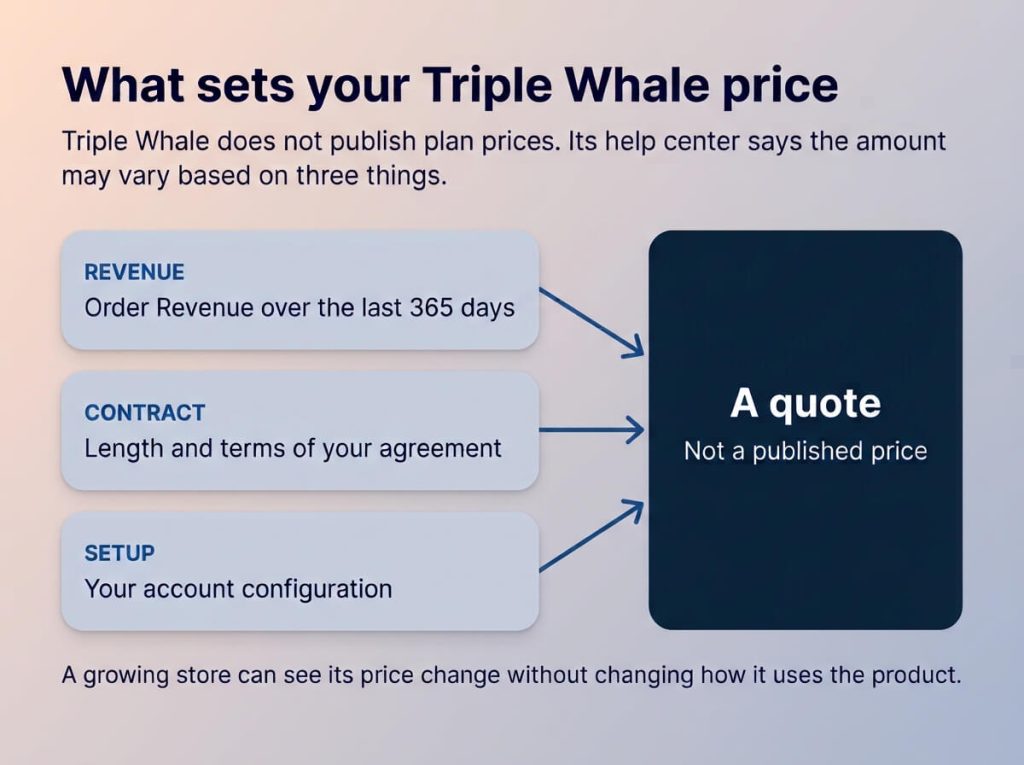
Contract terms matter too. If you sign a 12-month contract, you “will be unable to pause your subscription throughout that duration.” Without a contract, you can downgrade to the free Founders Dash, which keeps your tracked data but limits you to basic dashboards. If you cancel, you keep access until the end of the billing period you are in.
Triple Whale pricing monthly is not published either, so there is no monthly rate to set beside a competitor’s price list. Triple Whale pricing for Shopify brands follows the same rule. The same article describes one pricing basis for every shop and mentions no separate Shopify rate
Coupler.io: a Triple Whale alternative with a price you can forecast
Coupler.io is a reporting automation platform with 400+ integrations for business apps, including ad platforms, Shopify, and analytics tools. It sends that data to Google Sheets, BI tools, data warehouses, and AI assistants.
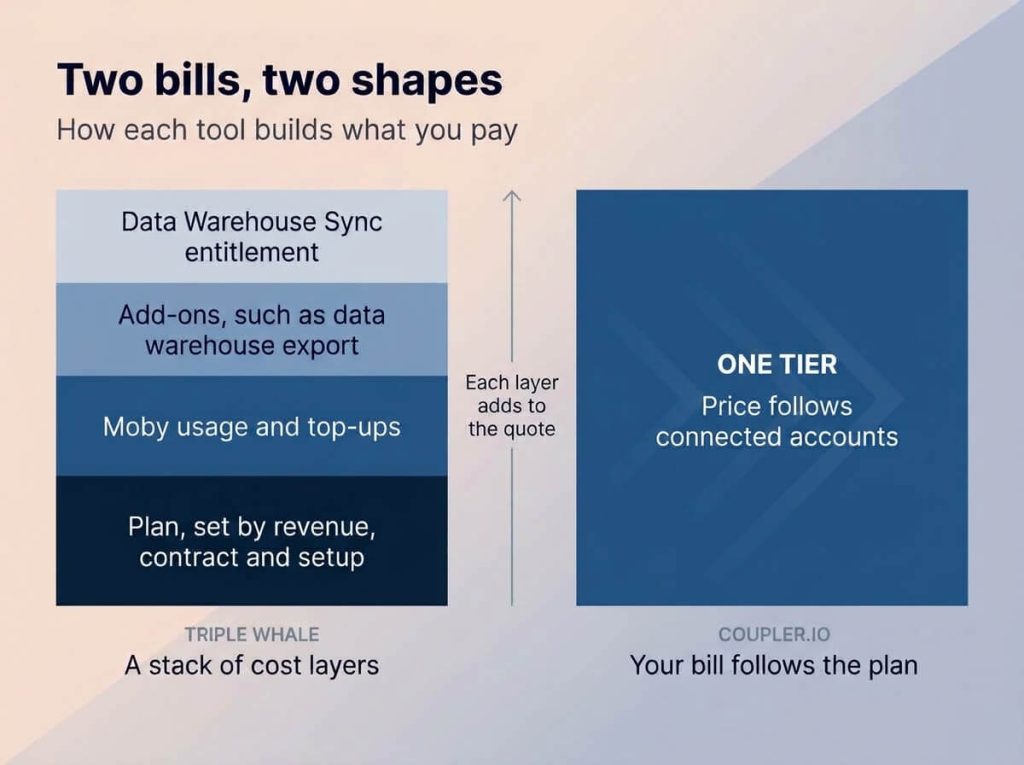
The price follows connected accounts, destinations, and refresh frequency, so you can count your sources and know your cost before you sign up. A Shopify store with a Meta Ads account, a Google Ads account, and Google Analytics 4 has four connected accounts, whatever its revenue.
Paid plans start at $24 a month on annual billing and include between 3 and 50 accounts depending on the plan. Extra accounts cost $4.49 each per month on annual billing. Higher plans include unlimited users, and refresh runs daily or hourly on standard plans. The free plan covers one account with manual refresh. Triple Whale asks you to talk to sales for a price, while our pricing page lists every standard plan with its price and account limit.
Coupler.io does not replace Triple Pixel, Triple Whale’s attribution models, marketing mix modeling, or Moby AI. If those are why you want Triple Whale, a revenue-based bill pays for something we do not offer.
If your main need is reporting, start a 7-day free trial on the full-featured plan to count your sources before you commit.


Price your reporting stack with Coupler.io, not a quote
Book a demoTriple Whale revenue-based pricing vs Coupler.io account-based pricing
Triple Whale’s price follows your revenue. The pricing page shows plan names and features, with “Book a walkthrough” for Foundation and Automate and “Contact sales” for Enterprise, so you cannot compare it with another tool on price until you have spoken to a salesperson. The basis is your Order Revenue over the last 365 days, so a strong sales year changes what Triple Whale looks at, and the amount also varies by GMV, contract, and configuration. A figure you hear from another brand on the same plan tells you little about your own quote. A 12-month contract cannot be paused, so if sales slow down, you cannot stop the subscription and wait it out. I treat the contract length as part of the price.
Coupler.io’s price follows connected accounts. You count the ad, store, and analytics accounts you want to report on, pick the refresh speed and destinations you need, and the pricing page shows what that costs. Revenue never enters the calculation, so a store that doubles its sales pays the same until it adds accounts or needs faster refresh.
Cost in three scenarios: Coupler.io vs Triple Whale
The Coupler.io prices below come from our pricing page and assume annual billing. Triple Whale does not publish prices, so its column says “requires a quote.”
| Scenario | Coupler.io | Triple Whale |
|---|---|---|
| Single-brand Shopify store with 4 connected accounts, 2 destinations, and daily refresh | Active plan, $99 a month | Foundation requires a quote |
| Mid-size DTC brand with 10 accounts and hourly refresh | Pro plan, $199 a month | Automate requires a quote |
| Brand with $10 million or more in GMV that needs MMM and incrementality testing | Does not cover attribution modeling | Enterprise is the fit, with a quote |
In the first two rows, the Coupler.io plan follows the limits on the pricing page: the entry plan covers 3 accounts and 1 destination, and hourly refresh starts on the Pro plan. The third row is where Triple Whale wins. Coupler.io moves your data, but it does not run attribution modeling, MMM, or incrementality tests, so a brand that needs them should request the Enterprise quote.
For ideas on what to build with the data, see our guides to analytics tools for ecommerce and Shopify dashboards.
Triple Whale pricing plans, from Free to Enterprise
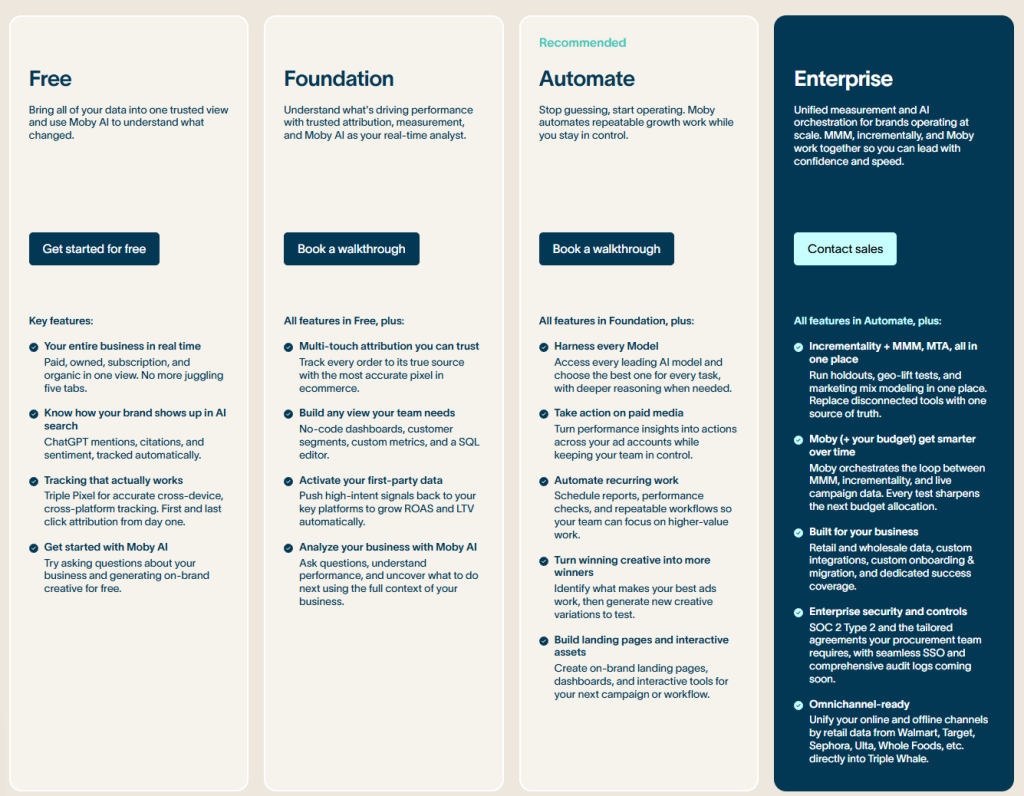
The pricing page lists four plans, and only the first one shows what it costs.
| Plan | Users | Data retention | What the page offers |
|---|---|---|---|
| Free | 10 | 12 months | Free to start |
| Foundation | Unlimited | Unlimited | Book a walkthrough |
| Automate | Unlimited | Unlimited | Book a walkthrough |
| Enterprise | Unlimited | Unlimited | Contact sales |
Triple Whale suggests Enterprise for businesses with at least $10 million in annual GMV. The help center calls that “a recommendation rather than a strict eligibility requirement.”
Triple Whale pricing free plan: what you get
The free plan includes Triple Pixel tracking, first and last click attribution, a single view of paid, owned, subscription, and organic data, AI visibility tracking, and a trial of Moby AI. Triple Whale says the free plan needs no credit card.
Legacy tiers: the Triple Whale pricing advanced plan
You may still run into an Advanced plan or a Starter plan elsewhere. Neither appears among the four plans on the pricing page, and the help center warns that “Legacy plans do not always map feature-for-feature to Foundation, Automate, or Enterprise.”

What each upgrade unlocks: Triple Whale pricing and features
The paid plans stack in three steps, and each plan includes everything in the one below it.
- Foundation covers multi-touch attribution (MTA) with configurable attribution windows, a post-purchase survey, subscription and influencer tracking, no-code custom dashboards, SQL analysis, custom metrics, customer segments, first-party data activation, and Moby AI chat and reports.
- Automate adds Moby Automations with scheduled runs, Moby Actions for paid media, Creative Studio, Shopify-native landing pages, industry and peer benchmarks, and deeper Conversion and Retention capabilities.
- Enterprise adds Compass, which covers marketing mix modeling (MMM), incrementality testing, and GeoLift testing. It also adds retail and wholesale data, multi-brand support, custom integrations, dedicated success coverage, and SOC 2 Type 2 security. The pricing page lists SSO and audit logs as coming soon.
Compare your Triple Whale stack with Coupler.io
Book a demoTriple Whale features pricing beyond the plan: Moby usage and add-ons
What you spend on features also depends on Moby usage. Every paid plan includes daily Moby, and Automate and Enterprise add more capacity. Moby usage works as a monthly allotment, and unused usage “does not roll over into the next billing cycle.”
The Moby usage FAQ says Triple Whale shows a warning banner at 80% of your allotment. At 100%, work that draws on usage pauses until the cycle resets or you add a top-up. It also states that “There is no surprise bill and no silent overage.” That protects your budget, though it means Moby work can stop mid-month if you reach the cap.
The comparison table on the pricing page also marks several items as add-ons on some plans, including data warehouse export, context engineering support, white-glove data science, and parts of Compass, Retention, and Conversion. Data Warehouse Sync is a separate case, because the help center says it is not automatically included with Enterprise. If you plan to send data to a data warehouse, ask about it in your quote.
Who Triple Whale pricing suits, and who it strains
| If your store… | Likely fit |
|---|---|
| Needs multi-touch attribution, MMM, and incrementality testing in one product | Triple Whale, after you get a quote |
| Wants first and last click attribution and a unified view at no cost | Triple Whale free plan |
| Wants ad spend and store data in one dashboard for a known monthly cost | Coupler.io, from $24 a month on annual billing |
| Needs hourly refresh, several destinations, or a warehouse feed across many accounts | Coupler.io, on a higher plan |
| Expects fast revenue growth this year | Ask Triple Whale how revenue changes affect your quote |
Triple Whale suits brands that want attribution, measurement, and AI analysis in one product and are comfortable negotiating the price. It strains stores that need a predictable cost, or whose main need is moving data to the tools they already use.
To test the fit, ask Triple Whale for a quote, then connect one store’s sources in Coupler.io and compare the two.
Plan multi-source ecommerce reporting with Coupler.io
Book a demoFAQ
How much does Triple Whale cost?
Triple Whale does not publish plan prices. The help center says the amount may vary based on annual GMV, contract, and account configuration, so you need a quote. The free plan costs nothing.
What is the Enterprise threshold?
The help center says Enterprise is generally designed for businesses with at least $10 million in annual GMV, and calls this a recommendation rather than a strict eligibility requirement.
What are the free plan’s limits?
The free plan covers 10 users and 12 months of data, with first and last click attribution.
Can Moby usage cause a surprise bill?
The help center says there is no surprise bill and no silent overage. Moby pauses usage-drawing work at 100% of your monthly allotment until the cycle resets or you add a top-up.