Adverity and Fivetran are both data integration platforms on the surface, but they’re built for different jobs.
Fivetran moves data from anywhere into a cloud warehouse. Adverity moves marketing data into dashboards and warehouses with the campaign and account structure already cleaned up.
Fivetran can handle marketing sources, but you may need additional modeling to turn that data into a marketing-ready dataset. Adverity can cover broader enterprise sources, but its main strength is still marketing data operations.
So, picking between Adverity vs Fivetran comes down to the type of data pipeline your team needs.
Key takeaways
- Adverity is the more marketing-focused option, with 600+ connectors and tools built around marketing data operations.
- Fivetran has a broader catalog, with 700+ connectors covering databases, SaaS, finance, marketing, and other business systems.
- Adverity gives you marketing-ready data, while Fivetran often requires additional modeling before the data is ready for analysis.
- Adverity uses custom pricing. Fivetran offers published MAR-based plans, including a free plan.
- Neither platform has fully automated data pipelines with AI yet. Both offer AI features that help with parts of the data workflow.
Side-by-side at a glance
| Dimension | Adverity | Fivetran |
|---|---|---|
| Best for | Marketing data operations teams at mid-market and enterprise | Data engineering teams running warehouse ELT across the organization |
| Catalog philosophy | Marketing-rich with enterprise sources layered in | Warehouse-first across every data category |
| Pricing model | Custom quote, sales-led | Monthly Active Rows (MAR), consumption-based |
| Entry price | Not publicly listed | Free up to 500K MAR; $5/connection base thereafter |
| Data sources | 600+ connectors, marketing-focused | 700+ connectors, broad coverage |
| Destinations | Warehouses, lakes, BI tools, BYO storage | Warehouses, lakes, lakehouses, Activations for reverse ETL |
| Transformations | Harmonization, Transformation Copilot | Fivetran Transformations for dbt Core |
| Marketing data depth | Pre-built schemas, dimension harmonization, campaign normalization | Raw landing with dbt packages for post-load modeling |
| AI capabilities | Enrichment Copilot, Data Conversations, Adverity MCP (beta) | Context Layer, assistants, dbt model runs |
| Security | SOC 2 Type II, ISO 27001, GDPR, HIPAA, CCPA | SOC 1 & 2 Type II, ISO 27001, HIPAA BAA, PCI DSS Level 1, HITRUST |
| Data residency | EU, US; BYO storage option | AWS/GCP regions on Enterprise+, pinned region on Business Critical |
| Primary buyer | Marketing data ops lead | Data engineering lead |
| G2 rating | 4.4 / 5 (326 reviews) | 4.3 / 5 (851 reviews) |
How Adverity vs Fivetran data sources compare
Adverity has a strong focus on marketing sources. Its 600+ connectors cover platforms like:
- Google Ads
- Facebook Ads
- LinkedIn Ads
- TikTok
- DV360
- SA360
- Criteo.
It also connects to web analytics, CRM, SEO, finance, and e-commerce tools.
Fivetran has a broader catalog of 700+ connectors. It covers marketing sources, but also databases such as:
- PostgreSQL
- MySQL
- Oracle
- SQL Server
- MongoDB
- DynamoDB
Its catalog also includes finance, HR, support, product analytics, and other business systems.
Where Adverity vs Fivetran destinations send your data
Fivetran is built around the data warehouse. Its main destinations include:
- Snowflake
- BigQuery
- Databricks
- Redshift
- Synapse
- PostgreSQL.
It also supports data lakes such as Amazon S3, Google Cloud Storage, and Azure Data Lake. Fivetran Activations can send data from the warehouse to other systems for reverse ETL.
Adverity also supports warehouses such as Snowflake, BigQuery, Redshift, and Azure. But it offers more direct options for marketing teams that want to send data to BI tools. These include:
- Data Studio
- Tableau
- Power BI
- Qlik.
A team can send data directly to a BI tool without using a cloud warehouse as an intermediate destination.
| ➡️ The main difference is how each platform fits into the data stack. Fivetran is designed to feed a warehouse or lake that other tools use downstream. Adverity can also feed those systems, but it can send marketing data directly to reporting and BI tools. |
How Adverity and Fivetran differ across marketing and enterprise data
The biggest difference between the two catalogs is where each platform puts its depth.

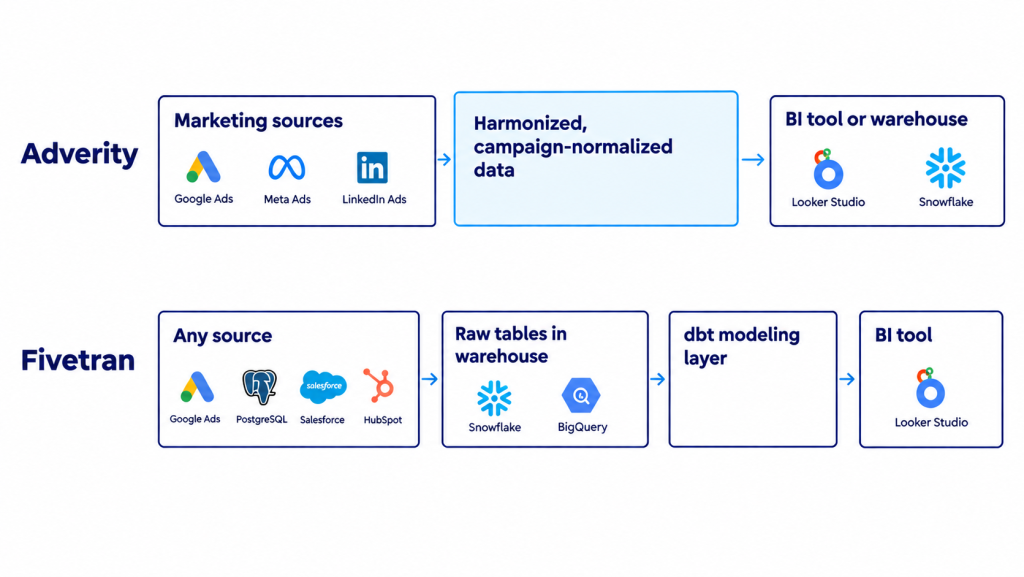
The difference is easier to see with marketing sources. Both platforms connect to Google Ads, Facebook Ads, LinkedIn Ads, and TikTok Ads.
Adverity provides more marketing-specific structure around these sources, including harmonized dimensions and schemas designed for marketing analysis. Daily refresh is standard, hourly on higher tiers.
Fivetran lands source data in warehouse tables, where teams can use dbt or other tools to build the analytics-ready layer. Depending on the connector and plan, users can configure intervals from one minute to 24 hours.
Refresh options and pre-built models also differ by connector and plan. Check the specific connectors your team uses before you commit.
The gap becomes more obvious with non-marketing sources.
Fivetran covers a wider range of enterprise systems, including Salesforce, HubSpot, Workday, and NetSuite. Adverity also supports enterprise sources, but its catalog is more concentrated around marketing and marketing-adjacent use cases.
Adverity vs Fivetran key features and what they mean for your workflow
Adverity vs Fivetran key features follow the same split as the connector catalogs.
Core Adverity features
Adverity’s standout features focus on marketing data operations.
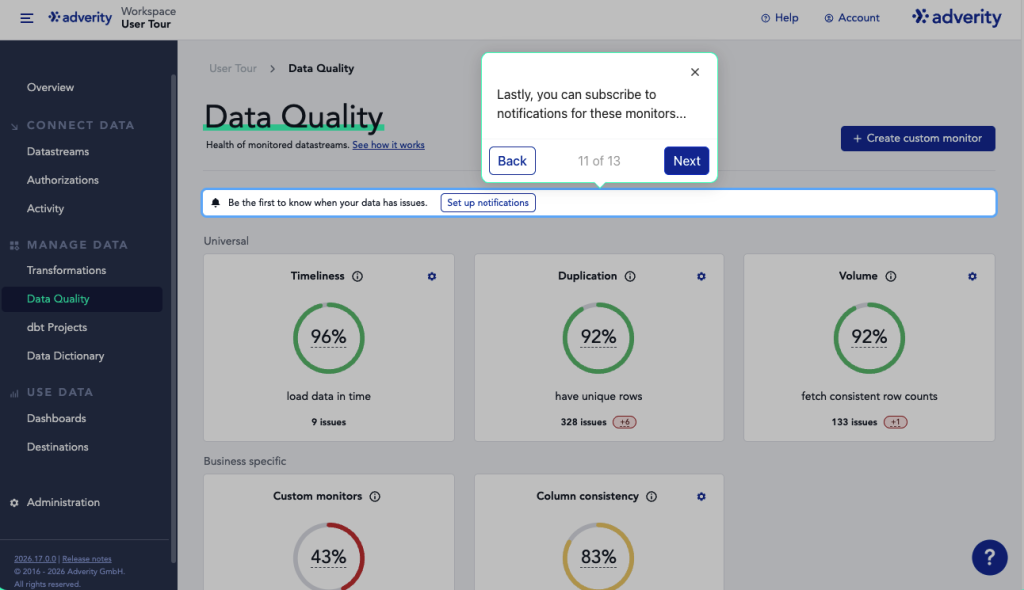
Data Quality Suite is a premium add-on that catches bad data before it reaches your reports. It runs automated checks across every connected source, flagging things like duplicate rows, sudden drops in volume, broken values, or inconsistencies between platforms.

Smart Naming learns the naming patterns in a client’s campaign data and flags any value that doesn’t fit.
The Data Dictionary centralizes every metric and dimension definition, so inconsistent field names across platforms end up mapped to one standard.
Transformation Copilot takes a plain-English prompt and returns the code plus step-by-step instructions, aimed at users who don’t want to touch Python or regex. All three are available in Adverity’s premium tiers.
Core Fivetran features
Fivetran’s features focus on keeping warehouse pipelines reliable at scale.
Automatic schema changes handle upstream API and database changes without breaking anything downstream. If a source adds a column, renames a field, or drops a table, Fivetran detects it and updates the destination to match. The pipeline doesn’t fall over the next time a vendor pushes an update.
Log-based CDC does something similar for databases, reading changes straight from the transaction log instead of hammering the source with queries.
For modeling, Fivetran leans on pre-built dbt packages, Fivetran Transformations, and the newer Context Layer. The dbt packages ship analytics-ready models for common SaaS and database connectors, so teams aren’t rebuilding the same Salesforce or HubSpot joins from scratch.
| In practice, Adverity gives marketing teams more tools for cleaning and standardizing campaign data inside the platform. Fivetran gives data teams more tooling for moving and modeling data inside a warehouse-based stack. |
Adverity vs Fivetran audience profiles
Mapping Adverity vs Fivetran audience profiles starts with who owns the data problem.
Adverity sells to:
- Marketing data operations leads
- Performance analytics directors
- Agency data leaders
- In-house measurement teams.
Its customer base includes mid-market and enterprise brands. G2 segmentation shows around 42% of reviews from mid-market users.
Fortune 500 marketing teams in retail and financial services are also part of its core account profile.
Fivetran focuses on:
- Data engineering leads
- Analytics engineering leads
- Platform owners
- Heads of data.
Its customers include mid-market and enterprise organizations. G2 segmentation shows around 57% of reviews from mid-market users.
The buyer usually owns the warehouse strategy and modeling layer. Fivetran then becomes one part of that wider data stack.
| A simple test helps. If your team mainly owns marketing analytics, Adverity is usually the closer fit. If it owns the central data platform, Fivetran is usually better. |
How Adverity vs Fivetran pricing works
Adverity does not publish pricing. Each quote is custom and depends on data volumes, ad spend, team size, and selected modules.
User reports put typical starting prices in the mid-five to low-six figures annually. Premium connectors sit at higher tiers above the base contract.
Fivetran uses consumption-based pricing through Free, Standard, Enterprise, and Business Critical plans. The Free plan covers 500K connector MAR and 5,000 model runs.
Pricing is based on Monthly Active Rows. Fivetran applies a $5 base charge to paid-plan connections generating between 1 MAR and 1 million MAR in a month. Deletes also count toward paid MAR.
Enterprise contracts remain custom-quoted. Standard and Enterprise tiers still give buyers more visibility into usage than Adverity’s custom pricing.
The better price depends on how your data moves. A few dozen marketing sources running daily can generate a lot of MAR on Fivetran.
Adverity may cost a similar amount or more for that workload. The difference is that its annual cost is harder to see before you enter the sales process.
See Coupler.io vs Adverity, Adverity alternatives, and Fivetran alternatives for another way to compare these models.
💡Adverity’s custom enterprise contracts can take weeks to price. Fivetran’s MAR billing grows with data volume. High-volume marketing data at daily or sub-daily refresh can therefore become expensive quickly.
Coupler.io uses account-based pricing, with plans scaling by the number of accounts, destinations, and data refresh frequency. The Starter plan starts at $24/month when billed annually, while Agency & Enterprise pricing is custom.


Transparent Coupler.io pricing from $24/month billed annually
BOOK A DEMOAdverity vs Fivetran AI capabilities comparison
Neither platform’s AI capabilities automate pipeline work from start to finish.
Adverity has four main AI components.
- Transformation Copilot writes transformation logic from natural language prompts. It uses OpenAI models deployed in-house.
- Enrichment Copilot helps with data cleanup during the flow.
- Data Conversations lets users query marketing data through a conversational interface built on ten specialized AI agents.
- Adverity MCP is in beta. It exposes an MCP server so external AI assistants can query data inside Adverity.
Adverity says customer data is not used to train models. Prompts are generalized before third-party providers receive them.
Fivetran’s AI work centers on Context Layer and assistants for pipeline configuration. Context Layer exposes dataset structure and semantics to downstream AI tools. That gives AI tools more context when working with Fivetran-landed data.
There is not yet an AI agent that builds the whole pipeline for you. Both products still use AI to assist the people managing the data.
For practical buying decisions, treat these as workflow aids rather than replacements for data engineering or marketing data work.
💡 Coupler.io takes a different approach with Coupler AI. Its AI Agent assembles dataflows and surfaces insights from loaded data, meaning you can build, manage, and analyze your data flows with AI.
Let Coupler AI do the data work for you
Tell Coupler AI what you need to know, from which source, and how often. It connects your account, sets up the data flow, keeps it refreshed, and lets you analyze the results inside Coupler.io or another AI tool.
Try for free

AI Integrations and Skills extend that workflow for repeatable analysis across LLMs. The 230+ dashboard templates give teams a working report to start from, not a blank canvas. All of it runs on the same SOC 2 Type II infrastructure as the rest of the platforms. Security doesn’t get a separate AI product to vet.
What Adverity vs Fivetran security & stability deliver
Both clear the enterprise security bar at different depths.
| Area | Adverity | Fivetran |
|---|---|---|
| Audits & certifications | SOC 2 Type II, ISO 27001 (TUV Austria) | SOC 1 Type II, SOC 2 Type II, ISO 27001, ISO 27701, HITRUST |
| Compliance | GDPR, UK GDPR, CCPA, HIPAA | HIPAA BAA, PCI DSS Level 1, GDPR, CCPA |
| Encryption in transit | SSL/TLS | TLS |
| Access control | Role-based | Role-based; customer-managed encryption keys on Business Critical |
| Deployment flexibility | Bring-your-own-storage | Hybrid Deployment on Enterprise+; private networking on Business Critical |
| Data residency | EU, US; BYO storage | AWS/GCP regions on Enterprise+; pinned region on Business Critical |
| Availability target | 99.9%+ | Published SLAs by tier |
Fivetran covers more compliance frameworks overall. Adverity covers the ones that matter most for marketing data operations.
What is it like to use Adverity and Fivetran?
Adverity vs Fivetran ease of use, support, and daily operations differ mainly in how much help teams get during setup.
Adverity takes a high-touch approach. Customers can get dedicated customer success managers and assisted implementation. The Academy provides self-paced training.
G2 reviewers regularly praise Adverity’s support during setup. A first useful pipeline usually takes weeks rather than days. The extra time comes from configuring the harmonization layer.
Fivetran is self-serve by default. Standard-tier customers connect sources through the dashboard, and simple SaaS connectors can land data in minutes.
Database connectors with historical sync can take longer. Enterprise and Business Critical customers get dedicated support and faster SLAs.
Fivetran is designed to reduce ongoing maintenance. Adverity gives marketing teams a more hands-on environment for preparing data.
Is there a better fit for you than Adverity or Fivetran?
If neither tool fits your workload, Coupler.io is worth a look.
Coupler.io is a data integration and AI analytics platform with 400+ data sources. It covers marketing, sales, product, finance, and database systems.
Destinations include major warehouses, BI tools, Google Sheets, Data Studio, Power BI, and more.
It also connects with AI tools through its MCP server and native AI integrations.
It has 230+ ready-to-use dashboard templates. Those templates can reduce the downstream modeling work that Fivetran requires. They can also reduce the custom data operations work that Adverity requires.
Pricing is publicly listed for the self-service plans. Starter starts at $24/month when billed annually ($32 month-to-month) with 3 accounts, 1 data destination, and daily refreshes. Higher plans increase the number of connected accounts, destinations, and refresh frequency. Agency & Enterprise pricing is custom.
Security includes SOC 2 Type II and compliance with GDPR and HIPAA. The platform is hosted on Google Cloud.
The most interesting thing? Coupler AI. It’s the umbrella term for the AI Agent, AI Integrations, and Skills. It runs on the same platform infrastructure and helps users create, manage, and analyze their data flows through conversational language.
Here’s how Coupler.io compares.
| Coupler.io | Adverity | Fivetran | |
|---|---|---|---|
| Pricing transparency | Published self-service pricing; custom Agency & Enterprise | Custom quote only | Published tiers, usage-based |
| Catalog breadth | 400+ across marketing and non-marketing | 600+ marketing-weighted | 700+ warehouse-weighted |
| Warehouse-native tooling | Supported, not required | Supported | Core strength |
| Marketing-ready data output | Dashboard-ready via templates | Fully harmonized | Raw, needs modeling |
| Dashboard templates | 230+ ready to use | Custom build | None shipped |
| AI capabilities | Coupler AI (Agent, Integrations, Skills) | Multiple copilots plus MCP beta | Context Layer, assistants |
| Governance depth | SOC 2 Type II, GDPR, HIPAA | Deep marketing governance | Broadest compliance coverage |
If you’re currently on Fivetran and the MAR costs for marketing workloads have you reconsidering, the Coupler.io team will scope the move. See Coupler.io vs Fivetran for the full head-to-head.
The verdict: your workload decides
✅ Pick Adverity if you run enterprise marketing data operations and need deep harmonization and governance tuned for marketing. An in-house ops team supports it, and procurement can engage a sales-led contract. Fortune 500 brands running marketing data at scale are the sweet spot.
✅ Pick Fivetran if you need warehouse-native ELT across every data category and dbt is already in the stack. There’s a strong data engineering team, and data needs extend well beyond marketing.
✅ Consider Coupler.io if your workload is marketing-heavy with some non-marketing sources. You want dashboard templates to reduce downstream modeling work and transparent self-service pricing without MAR-based billing. Mid-to-upper-market teams tend to land here.
Pull marketing data into a dashboard with Coupler.io, no warehouse needed
BOOK A DEMO