On paper, Adverity vs Improvado looks like a comparison of near-twins. Both load harmonized marketing data into a warehouse, and both sell to enterprise marketing teams.
The real difference is philosophy. Adverity gives data teams a flexible toolkit for their own data operations. Improvado ships ready-made marketing data models, with professional services on its custom plans.
Key takeaways
- Same promise, different approach. Both clean and align marketing data across channels, but they differ on how much of the data model you build yourself.
- Build it or start from templates? Adverity gives your team the tools to shape its own model, from no-code mapping to scheduled dbt runs. Improvado leans on ready-made templates, and its team helps build analysis-ready datasets.
- Price check. Improvado’s cheapest plan with data sync costs $100 a month. Adverity gives a custom quote after a demo, and Vendr puts the median deal at $53,650 a year.
- Weeks or months? Improvado’s own comparison page promises 2–4 weeks to production. G2 reviewers report 3 months on average.
- Security basics are covered on both. Both hold SOC 2 Type II reports and will sign HIPAA Business Associate Agreements.
- The cost of a wrong pick. Choose the wrong fit and you’ll either spend engineering hours on models or work around templates that don’t match your reports.
Side-by-side at a glance
The table below shows how the two platforms compare on pricing, connectors, data models, and security. I checked vendor claims against official pages in October 2026; pricing estimates and review data are attributed to their respective sources.
| Adverity | Improvado | |
|---|---|---|
| Best for | Enterprises with in-house data teams | Marketing teams and agencies |
| Core philosophy | Flexible data operations | Pre-built marketing data models |
| Pricing model | Custom quote only | Usage-based, quote above entry plans |
| Entry price | Custom quote (Vendr median $53,650/year) | $0 Free Limited, $100/month MCP Only; Enterprise “Custom” or from $20K/year (/start page) |
| Data sources | 600+, including finance and ERP | 1,350+, custom builds on request |
| Destinations | 40+, including audience activation | About 20, plus managed BigQuery |
| Pre-built data models | Mapping templates, team-built models | Ready-made models, Recipe Templates |
| Governance & lineage | Full lineage, four quality monitors, Atlas audit trail | Governance rules, audit logs, custom roles |
| AI capabilities | Transformation Copilot, Atlas, MCP | AI Agent, MCP servers |
| Security | SOC 2 Type 2, ISO 27001, HIPAA, EU or US hosting | SOC 2 Type II, HIPAA BAAs, GDPR and CCPA |
Breaking down Adverity vs Improvado key features
Both platforms move marketing data into a governed destination. The difference is how much of the data model comes pre-built.
Adverity Connect includes 80+ Python-based transformation functions, and teams can run and schedule dbt projects. Transformation Copilot turns plain-language requests into transformation scripts. Four quality monitors run on every fetch, and a data dictionary tracks full lineage.
Adverity Atlas sits on top of your warehouse and reads data without copying it. It adds anomaly detection, budget pacing, forecasting, and MMM.
Improvado pairs extraction with a no-code transformation layer. Users join and blend data with visual components. Ready-made models handle cross-channel field mapping and currency normalization. Recipe Templates and the Cross-Channel Wizard guide the setup.
Marketing Data Governance checks campaign naming against your taxonomy rules and alerts owners when something breaks. Measurement comes as paid add-ons, with multi-touch attribution and Creative Analytics from Advanced up. MMM and incrementality testing need Enterprise.
Either way, the first cross-channel report takes setup work. Ready-made dashboard templates show what that report looks like on your own data before you commit to either platform.


Get 200+ dashboard templates with Coupler.io
Start for freePre-built data models vs flexible data operations: two philosophies compared
This difference drives almost everything else in the comparison.
Adverity follows a flexible data operations approach. Your team designs the data model, then configures transformations and quality rules around it. That means more upfront work, although Adverity offers pre-built mapping templates. The payoff is long-term flexibility when the business changes or a new brand joins. It fits best when a data engineer or analytics engineer owns the pipeline.
Improvado follows a pre-built model approach. Its ready-made models already know how to line up spend and conversions across channels. Teams reach standard cross-channel reports with less custom modeling and fewer early decisions. On Advanced and Enterprise plans, Improvado’s professional services team helps with setup. The schema is opinionated, so reports follow the structure Improvado designed. This suits marketing teams without dedicated data engineering.

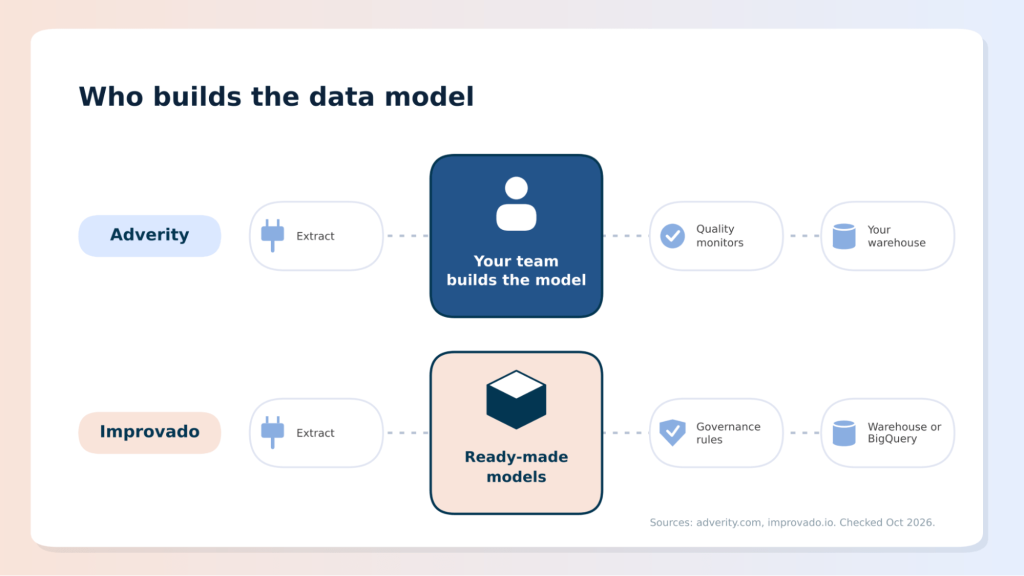
The trade-off is easy to state. Flexibility is a feature only if someone on the team can use it. Pre-built models are a shortcut only if your use case fits their shape. Standard paid media reporting is where Improvado’s models can save weeks. Custom funnel stages or unusual product hierarchies are where Adverity’s toolkit tends to bend further. Ask early who will maintain the pipeline after launch, because that answer often settles the choice.
So which teams end up on which tool? Large brands with centralized data teams tend to pick Adverity for the control. Agencies often lean toward Improvado for faster client onboarding. Its Advanced plan allows up to 50 workspaces, and Enterprise has no limit.
The exceptions matter. Adverity has a strong agency story of its own. Its agency page describes client workspaces and permissions down to a single data stream. Agencies can also clone transformation templates across their client portfolio. Improvado, for its part, builds custom connectors on request and supports custom transformations.
That means a brand with a small data team and standard channels can be well served by Improvado. An agency with complex client data may need Adverity. Company size alone won’t predict the fit.

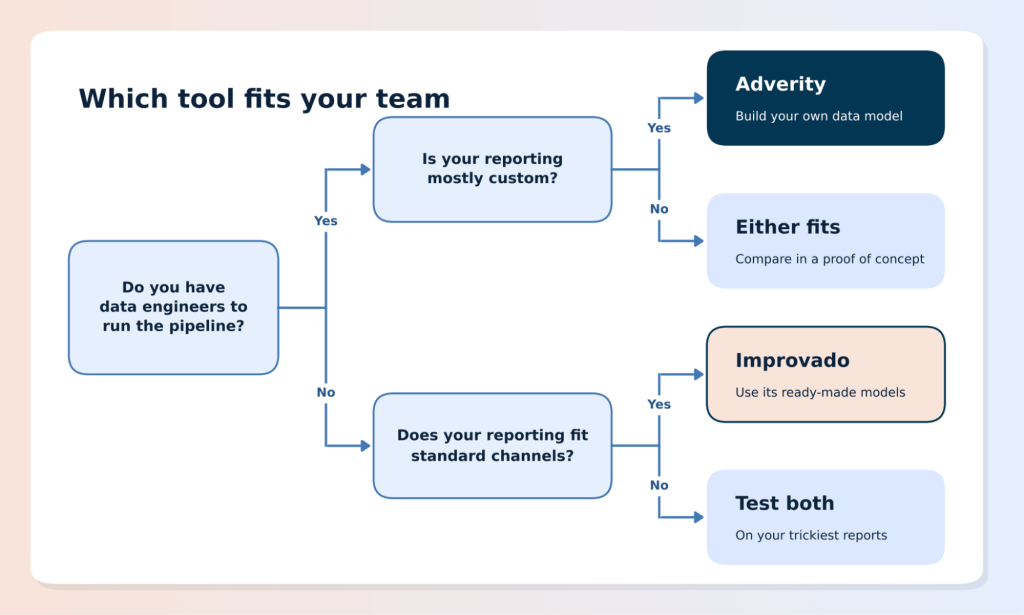
Both approaches also create lock-in once you’re deep in. Leaving Adverity means rebuilding transformations elsewhere. Leaving Improvado means replacing the models your reports depend on. Factor that into contract length and exit planning.
The most useful test is your own data. Ask each vendor to model a few of your trickiest reports during a proof of concept. Watch how much of the work your team does and how much the vendor does.
Mapping Adverity vs Improvado data sources
Adverity lists 600+ connectors. Beyond marketing, it covers CRM tools like Microsoft Dynamics 365 and e-commerce platforms like Shopify. A finance category includes Oracle NetSuite and QuickBooks.
Improvado’s newer product materials cite 1,350+ connectors. Improvado also covers CRM tools like Salesforce and payment systems like Stripe.
Comparing Adverity vs Improvado destinations side by side
Adverity Connect sends one data stream to 40+ destinations, including Snowflake and Power BI. It can also push audiences to ad platforms such as Meta.
Improvado documents about 20 destinations, mostly warehouses such as Snowflake and Databricks. It can also host BigQuery for you.
A closer look at Adverity vs Improvado AI
Most of this AI is new and still changing. Atlas runs agents and an MCP server on warehouse data, with your own LLM provider. Adverity says Atlas sends only query results to the model and redacts PII. Since September 2026, Connect has its own MCP server, with 37 tools for managing pipelines.
Improvado’s AI Agent builds dashboards and answers ad hoc questions. Its MCP server, launched in April 2026, exposes 84 tools to clients like Claude. The company says only metadata, such as column names, goes to the LLM.
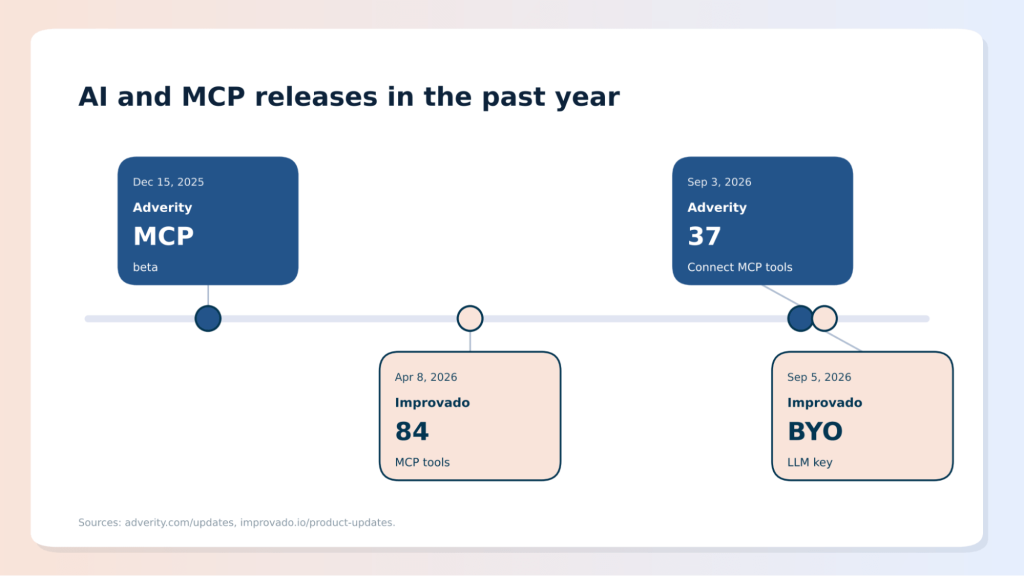
Where AI shows up today. Both vendors ship AI agents and MCP access, and each brings its own model-usage questions. Coupler AI handles data setup and analysis through conversation, in the app or in Claude. Prebuilt Skills and over 200 dashboard templates sit behind it. It runs on the same SOC 2 Type II infrastructure as the rest of Coupler.io.
Let Coupler AI do the data work for you
Tell Coupler AI what you need to know, from which source, and how often. It connects your account, sets up the data flow, keeps it refreshed, and lets you analyze the results inside Coupler.io or another AI tool.
Try for free

What Adverity vs Improvado pricing actually looks like
Adverity quotes every buyer after a demo. Vendr data puts the median contract at $53,650 per year, ranging from $13,090 to $168,420.
Improvado publishes two low-cost entry plans. Free Limited costs $0, with limited AI Agent and MCP access and no data sync. MCP Only costs $100/month and includes 2M unique rows per year. Its pricing page lists Advanced and Enterprise as “Custom.” A separate sales page, improvado.io/start, says Enterprise starts at $20K per year.
A note on pricing transparency. Adverity prices every plan by custom quote, and Improvado does the same for its Advanced and Enterprise plans. Coupler.io publishes self-serve prices, starting at $24/month billed annually. Billing is account-based: accounts set the tier, while destinations and refresh frequency set the plan. Only the top Custom plan needs a quote, so teams can pilot and budget before any sales call. See Coupler.io pricing.
Breaking down Adverity vs Improvado audience profiles
Adverity targets enterprise marketing teams and agencies, with dedicated pages for data analysts and engineers.
Improvado targets marketing teams and agencies that want cross-channel reporting live quickly. Its entry plans also suit smaller teams testing AI analysis.
Get SSO and 15-minute refresh for enterprise reporting
Book a demoWhere Adverity vs Improvado security & stability land
Adverity holds a SOC 2 Type 2 report and ISO 27001 certification. It is HIPAA-compliant and will sign a BAA. Customers choose EU or US storage, or keep data in their own Snowflake or BigQuery.
Improvado holds a SOC 2 Type II report. It offers BAAs and commits to GDPR and CCPA. SSO comes with Advanced and Enterprise plans. Its DPA says EU data residency is available on request.
Both companies date from 2015. Adverity raised a $120M Series D in 2021, and Improvado reports $34M in total funding.
What day-to-day work looks like: Adverity vs Improvado ease of use, support
On G2, both tools score 4.4, from 326 Adverity reviews and 89 Improvado reviews. Improvado leads on support (9.1 vs 8.9), and Adverity on ease of setup (7.6 vs 7.5).
Adverity says onboarding takes 30 to 60 days and every customer gets a dedicated account manager. Improvado says customers can go live in two weeks. G2 reviewers report average implementation times of 2 months for Adverity and 3 months for Improvado.
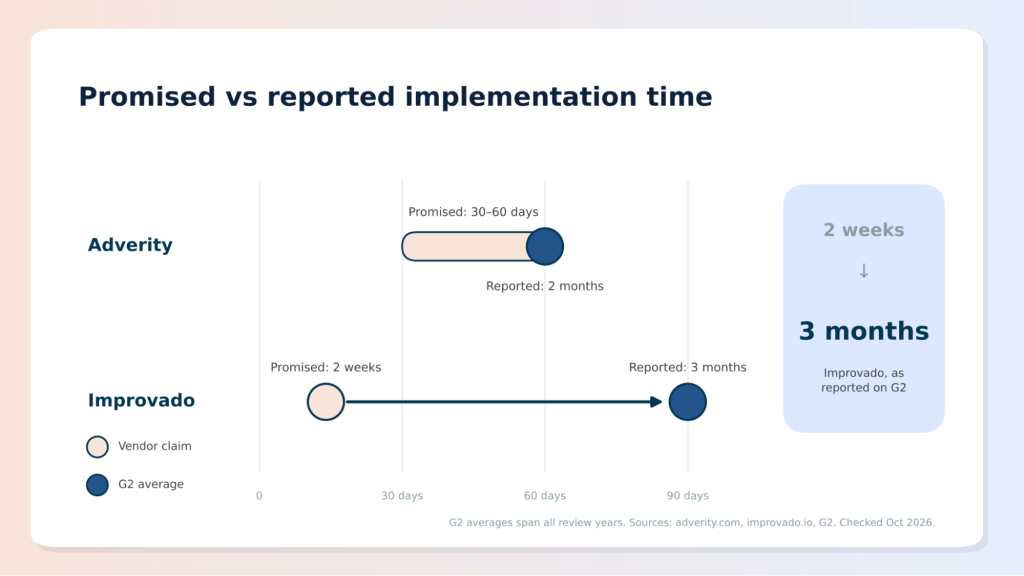
These averages span all review years. In 2026 AWS Marketplace reviews, one Adverity user called onboarding “long and complex” but praised the expert support. No Improvado reviews in the past 12 months mention setup time, so ask the vendor for references from teams similar to yours.
Run AI analysis on 400+ data sources with Coupler.io
Get started for freeLooking beyond Adverity and Improvado
Some teams reach the end of this comparison and find neither approach suits them. Flexibility can feel like too much upfront work, and pre-built models may not match your data. Sometimes the enterprise sales cycle on both is the actual blocker. In that case, Coupler.io is one of the Adverity alternatives worth a look, with a self-serve setup that sits in the capability middle ground.
Coupler.io is a data integration and AI analytics platform. With its ready-to-use dashboards, you don’t need custom modeling in the first place. It connects 400+ data sources across marketing, sales, finance, e-commerce, and project management. Transformations cover joins, appends, aggregations, and calculated columns. Data goes to spreadsheets, BigQuery, Snowflake, Data Studio, Power BI, and AI tools such as Claude or ChatGPT.
The 200+ dashboard templates skip the modeling question for standard reports. Paid plans start at $24/month, billed annually, with a free plan and a 7-day trial. The Custom plan refreshes data as often as every 15 minutes.
Coupler AI works through the in-app AI Agent or through AI Integrations with Claude and ChatGPT. Skills add prebuilt analysis workflows on top. The platform suits mid-market and upper-mid-market teams that need enterprise-grade security without an enterprise sales cycle.
Security covers SOC 2 Type II and compliance, including HIPAA. The platform is also GDPR- and DORA-compliant. Data moves over TLS, and credentials are encrypted with AES-256. SAML SSO on the Custom plan follows your identity provider’s MFA policy.
| Coupler.io | Adverity | Improvado | |
|---|---|---|---|
| Pricing transparency | Public prices, Custom plan by quote | Custom quote only | Two public entry plans |
| Starting path | Free plan, 7-day trial | Sales demo | Free Limited plan or demo |
| Data sources (marketing + non-marketing) | 400+, both | 600+, both | 1,350+, both |
| Pre-built templates / models | 200+ dashboard templates | Mapping templates | Strongest pre-built marketing models |
| Transformation flexibility | Joins, appends, aggregations, formulas | Deepest of the three | No-code layer plus custom work |
| Governance depth | SAML SSO, audit logs on request | Strongest of the three | Governance rules, audit logs |
| AI capabilities | Coupler AI: AI Agent, AI Integrations (MCP server), Skills | Copilot, Atlas, MCP | AI Agent, MCP servers |
Coupler.io fits teams that want enterprise security and broad source coverage without picking a philosophy. For deep custom data operations, Adverity is the stronger call. If Improvado’s models match your data, it should get you to insight faster. Coupler.io doesn’t offer native MMM or multi-touch attribution, and its governance is lighter than both.
If you’re on Improvado or Adverity and the renewal has you reconsidering, the Coupler.io team will scope the move. See Coupler.io vs Improvado and Coupler.io vs Adverity for the full head-to-heads.
Verdict: which should you choose?
Pick Adverity if
You need deep custom data operations, and your data engineers can run them. Flexibility beats speed, and lineage depth or ERP sources like NetSuite matter.
Pick Improvado if
Your reporting fits standard cross-channel shapes, and fast insight matters more than a custom schema. It also suits agencies that need many client workspaces but have little data engineering capacity.
Consider Coupler.io if
You’re a mid-market or upper-mid-market team that wants enterprise security and transparent pricing without the sales cycle. Your data goes beyond marketing, and dashboard templates cover most reporting.
Walk away from all three if
You want pure warehouse-native ELT with Fivetran and dbt, or self-hosted open source like Airbyte. If you only need basic marketing reporting, Supermetrics may be enough.