Running weekly cross-channel reviews across Google Ads, Meta Ads, GA4, and CRM data gets harder as the stack grows. The right AI agents let teams compare channel performance, investigate what moved, prepare the summary stakeholders actually read, and more.
I’ve collected 8 of the best AI agents for multichannel marketing analytics in 2026. Of those, 6 are marketing data and analytics platforms with built-in or connected AI, headed by Coupler.io. Two are external assistants (Claude and ChatGPT) sitting on top of a prepared marketing data layer. Explore each profile to see what the setup covers, how it handles your data, what it costs, and who it fits.
Best AI agents for marketing analytics at a glance
| Agent | Data sources supported | AI capabilities | Pricing |
|---|---|---|---|
| Coupler AI | 400+ apps across ad platforms, web analytics, CRM, ecommerce, and finance | Natural-language Q&A on prepared data, chat-based flow building and adjustment, pre-built analytical Skills (marketing, ecommerce, finance, sales), data preparation for dashboards and exports | Transparent tiered pricing on an account-based model, from $24/mo |
| Improvado AI Agent | 1,400+ sources across paid, organic, CRM, analytics, retail media, and ecommerce | Cross-channel Q&A on modeled data, campaign reporting insights, predictive analytics for budget optimization, campaign optimization, and anomaly detection, MCP endpoint for external assistants | Lightweight MCP tier at $100/mo, or custom quotes for the full managed stack |
| Funnel AI | 600+ connectors with a built-in semantic layer across marketing data | In-product conversational analysis, external AI access via Funnel MCP (Claude and other MCP clients), modeled data for consistent definitions across questions | Plan plus purchased capacity (flexpoints), from $300/mo annual |
| Supermetrics AI | 150+ sources across SEO, paid media, social, analytics, ecommerce, and sales | In-platform Supermetrics Agents (Q&A, anomaly flags, recommendations), Supermetrics MCP to Claude, ChatGPT, Gemini, and Copilot, AI Chats inside external tools, AI data transformations (sentiment, image recognition, text enrichment, translation) | Tiered subscription with AI credits scaling by plan, from $44/mo annual |
| Windsor.ai MCP | 350+ connectors across advertising, analytics, social, CRM, and ecommerce | Read-only querying from Claude, ChatGPT, Gemini, and Perplexity via MCP (Copilot via Power Platform), campaign write actions on Meta, Google, LinkedIn, Microsoft, and TikTok Ads, custom formula fields | Simple tiered pricing with MCP on all paid plans, from $19/mo annual |
| Adverity Atlas | Marketing data stored in Snowflake, BigQuery, Databricks, or Redshift warehouses | Natural-language Q&A on warehouse data, autonomous investigation across platforms, provenance tracking on every answer, bring-your-own LLM (OpenAI, Anthropic, Azure OpenAI, Gemini), governance (PII detection, actor logging, tenant isolation) | Custom enterprise quote on top of your warehouse and LLM costs |
| Claude | Data exposed through Claude Connectors or MCP integrations | Natural-language querying through Connectors or MCP, Projects for separate client or analysis contexts, Artifacts for tables and charts, schema-aware prompts | Stacked costs — Claude Pro from $20/mo plus the data layer you connect |
| ChatGPT | Data accessed through ChatGPT plugins, connectors, and MCP integrations | Natural-language querying through Apps or MCP, chart and summary generation, custom GPTs for saved workflows, admin controls on business plans | ChatGPT Plus from $20/mo on top of a separate data-layer plan |
Claude and ChatGPT sit on top of the platforms above rather than being separate platforms. Their profiles are shorter and cross-reference the setup that does the work.
For this comparison, I evaluated documented data access, preparation, workflow, setup, and cost logic. The guide focuses on reporting and analytics setups that connect marketing data to AI. It doesn’t cover attribution specialists, campaign-management tools, content and copy generators (Jasper, Copy.ai), outreach and workflow builders (Relevance AI, Gumloop), predictive-modeling point products (Pecan AI), or adjacent concepts like AEO content work, server-side tracking, and conversion sync.


Analyze cross-channel marketing with Coupler.io
Start for freeCompare AI agents for marketing
An AI agent runs on an invisible scaffold that engineering teams call the AI harness. The connections, context, runtime, and governance that feed the AI model and shape its answers. How much harness a vendor builds, and what capabilities it exposes, varies widely across what gets labeled an “agent”.

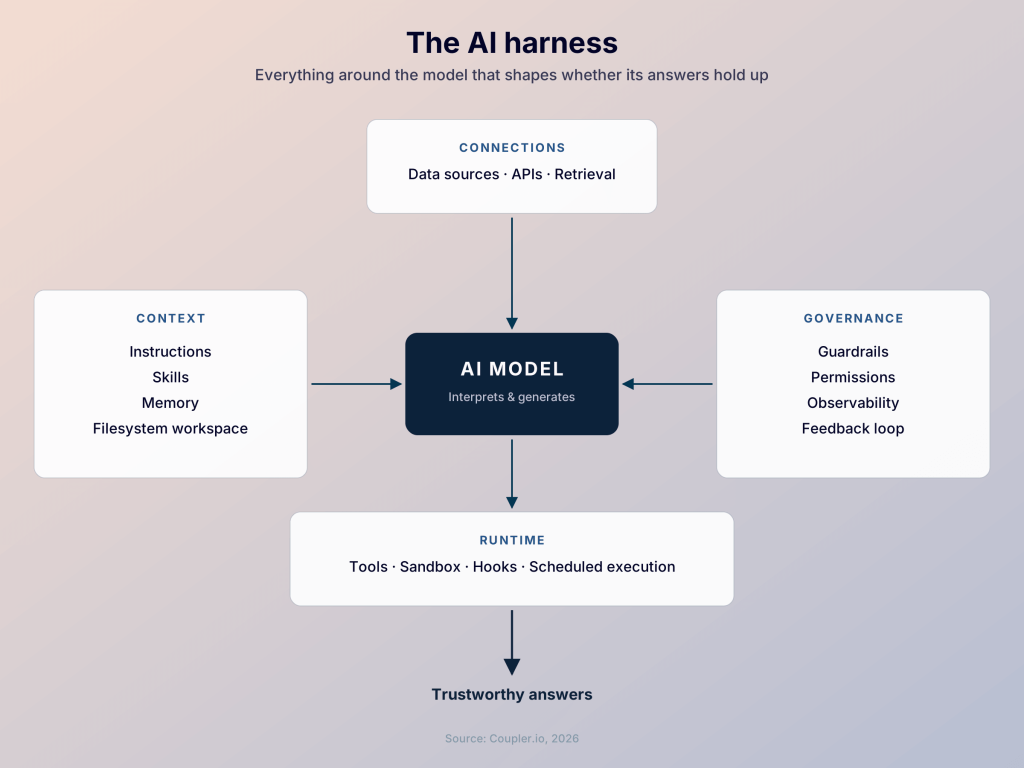
Some products offer conversational Q&A only. Others support multi-step tool use (investigating across sources), reusable analysis workflows (a saved method applied week after week), scheduled execution (the agent runs on a timer, no prompt), or actions that change live campaigns (write operations).
Multi-agent systems add another layer, with one agent orchestrating others. Don’t assume every capability is supported just because the product is called an agent; a reusable Skill isn’t a scheduled job. The eight profiles below compare how AI agents for marketing analytics handle that harness: the data they reach, the capabilities they offer, and what you’ll pay.


Coupler.io: prepare marketing data and analyze it with Coupler AI
Coupler.io is a reporting automation platform for business teams. It collects data from 400+ apps, combines it into prepared datasets, and keeps reports updated on a schedule. For marketing teams, that means bringing advertising, GA4, CRM, and ecommerce data into a shared reporting workflow instead of rebuilding spreadsheets before every review.
Coupler AI adds conversational setup and analysis to that workflow:
- The built-in AI Agent helps users connect sources, build or adjust data flows, prepare data for reporting, and ask questions about the results.
- AI integrations make the prepared data available in external assistants such as Claude and ChatGPT.
- AI skills provide reusable methods for tasks including marketing performance analysis and structured reporting.
For multichannel analysis, the value is moving between an overview and the details behind it. A weekly report might show spend and conversions across Google Ads and Meta Ads. With Coupler AI, a marketer can investigate which campaigns contributed to a CPA increase, compare performance across periods, and prepare a summary for the next client meeting. Adding appropriately mapped CRM data extends the analysis to qualified leads and pipeline rather than stopping at platform-reported conversions.
Data preparation makes those comparisons meaningful. Teams can standardize campaign labels, combine compatible datasets, and calculate metrics before analysis. Context supplies business definitions, such as what counts as a qualified lead or which revenue measure to use. The Analytical Engine executes queries against the prepared dataset; the AI explains the calculated results.


Right Percent reduced PPC reporting time by 60% with AI and Coupler.io
Right Percent is a B2B paid growth agency managing over $1M in monthly Meta ad spend. Using Coupler.io with Claude for daily CPL health checks, weekly reporting, creative fatigue analysis, and forecasting, the team cut analysis and reporting time by 60%. Daily campaign reviews now run in under 10 minutes.
LEARN MORESkills help teams apply a consistent analytical method to subsequent reviews. An agency can reuse a reporting structure across clients while maintaining the appropriate data and definitions for each. The same prepared data can also feed dashboards and spreadsheets, so conversational exploration complements the reports stakeholders already use.
Coupler.io fits SMBs and agencies that want recurring reporting and follow-up analysis in one workflow, with a choice of built-in or external AI interfaces. It does not automatically establish attribution or repair missing campaign mappings: those relationships and business rules must be configured before the resulting analysis can be relied on.
Coupler.io pricing starts at $24/month on the Starter plan with annual billing, with a 7-day trial on the full-featured tier. Billing is account-based. One connected ad account can power unlimited data flows and dashboards. Refresh frequency and destination count also shape the plan you’ll need. All connectors are available on every plan.
Get calculated marketing answers with Coupler.io
Try it free

Improvado AI Agent: investigate cross-channel performance and revenue
Improvado is a marketing analytics platform that collects data from advertising, web analytics, CRM, and other business systems, then transforms it for reporting and analysis. Its AI Agent works on that connected data, letting marketers investigate performance through natural-language questions.
The agent supports cross-channel comparisons, creative and messaging analysis, combined SEO and PPC analysis, and forecasts of spend and ROAS. It can also generate charts and dashboards and deliver reports on a schedule.
For multichannel marketing teams, the value is moving from a blended result to the channels and campaigns behind it. A question such as “Why did acquisition costs increase this quarter?” can lead into channel-level trends, campaign breakdowns, and comparisons with revenue. Creative analysis adds another dimension: teams can examine which formats, placements, or messages perform best across their connected campaigns.
Improvado also supports analysis of prepared multi-touch attribution and marketing mix modeling datasets. That distinction matters: the agent helps explore those outputs; asking an attribution question does not itself create an attribution model.
Improvado fits teams that want conversational investigation, recurring reporting, and deeper marketing measurement within a broader data operation.


Funnel.io is a marketing data platform that collects, organizes, and prepares data for analysis and reporting. Its custom fields let teams establish common metrics and dimensions across sources, giving cross-channel comparisons a consistent foundation.
Funnel AI is the assistant built into that environment. It queries workspace data and returns explanations, charts, and tables. It can use custom fields, persistent workspace instructions, reference documents, and reusable Skills. For calculations such as totals and rankings, it can also run Python against data retrieved from Funnel.
This makes it useful for questions that need consistent definitions across channels: “How did acquisition costs change across paid search and paid social?” or “Which markets account for the largest increase in spend?” Marketers can follow an answer into Data Explorer or save results to dashboards.
Funnel AI also supports scheduled prompts, including conditional notifications, with results delivered through chat, email, or Slack. A weekly comparison can therefore become a recurring review rather than a question someone must remember to ask.
Its scope is one workspace per session. Agencies can organize client analysis within that structure, but should not expect a single conversation to query across subscriptions.

Supermetrics for AI Chats: explore connected marketing data in your assistant
Supermetrics is a marketing data platform that connects advertising, analytics, CRM, and ecommerce sources to reporting destinations. Supermetrics for AI Chats makes that data available inside assistants such as Claude, ChatGPT, Microsoft Copilot, and Gemini Enterprise.
The assistant handles the conversation while Supermetrics supplies authorized data. Existing blends, custom fields, channel groups, and business context help preserve the definitions already used in reporting.
For multichannel analysis, marketers can compare spend and conversions across connected accounts, investigate changes by campaign, and turn the findings into summaries or tables. A team reviewing Google Ads, Meta Ads, and CRM outcomes can ask follow-up questions without rebuilding a separate export for every investigation. Reliable comparisons still depend on compatible metrics and prepared relationships between sources.
Calculations are shared between Supermetrics and the assistant: Supermetrics calculates some metrics before returning data, while the assistant can perform further comparisons and calculations.
Supported campaign-management connections also let teams move from analysis to action, including campaign updates when write access is enabled. That adds an operational use case beyond reporting, although recommendations and account changes require appropriate review and approval controls.


Windsor.ai: query marketing sources and act on campaign findings
Windsor.ai is a data integration platform that connects marketing, analytics, CRM, and other business sources to reporting tools, warehouses, and AI assistants. Its MCP server exposes data-retrieval and campaign-management tools to supported assistants.
For analysis, those tools let the assistant discover connected accounts, inspect available fields, retrieve performance data, and use custom formula fields. Marketers can request cross-channel comparisons, ROAS calculations, or summaries of performance across multiple accounts from the assistant they already use.
A useful workflow starts with a broad question, such as which campaigns have rising acquisition costs. After that, it narrows to the relevant accounts, periods, and metrics. With advertising and CRM sources connected, the assistant can retrieve both sides of the investigation. Linking spend to pipeline or revenue still requires suitable identifiers and attribution rules.
Windsor.ai also supports write actions on selected advertising platforms. After reviewing the analysis, a marketer can use the assistant to pause a campaign or adjust a budget where supported, rather than switching to the native ad interface.
Its appeal is combining data access and supported campaign actions in an external assistant. Shared definitions, repeatable analytical instructions, and approval rules remain important parts of the overall configuration.


Adverity provides marketing data integration and analytics capabilities. Adverity Connect collects and harmonizes source data, while Adverity Atlas adds a marketing knowledge layer over an existing warehouse. Atlas can work independently of Connect.
Atlas combines a governed glossary of fields and calculations with business context and analytical tools. Users ask questions in plain language; Atlas generates SQL, executes it in the warehouse, and returns visual answers. Investigations can include the queries and sources behind the findings.
For multichannel analysis, this helps connect performance figures to both consistent definitions and business events. A team can examine a change in acquisition costs across channels while retaining context about promotions, campaign changes, or budget reallocations. The glossary establishes what metrics mean; business context helps explain what happened around them.
Atlas also supports scheduled analytical workflows. Templates cover tasks such as spend-waste detection, budget anomalies, and creative fatigue. Teams can turn a useful investigation into recurring monitoring instead of rebuilding the analysis each week.
Atlas fits organizations whose marketing, CRM, and revenue data already reside in a warehouse and that want reusable definitions, traceable investigations, and ongoing monitoring across that data.


Claude: turn connected marketing data into an analytical conversation
Claude is a general-purpose AI assistant that can work with information supplied through conversations, files, and connected tools. For ongoing multichannel marketing analysis, a connection to a platform such as Coupler.io gives it access to prepared, refreshed datasets.
That connection changes the workflow from uploading individual exports to investigating connected data through follow-up questions. A marketer can start with a comparison of Google Ads and Meta Ads, ask which campaigns explain a CPA increase, and request a stakeholder summary of the findings.
With Coupler.io, data preparation and business definitions remain in the reporting workflow. Claude requests the relevant analysis, Coupler.io executes the calculation, and Claude explains the returned results. CRM outcomes can be included where the dataset contains the required mappings and definitions.
Claude’s contribution is the conversational investigation and presentation of findings. Projects can organize supporting context, while Artifacts can present outputs such as reports and visual summaries. It fits teams that want to explore marketing questions and prepare explanations in the same assistant, while keeping the underlying data workflow maintained separately.
Explore marketing data in Claude with Coupler.io
Get started for free
ChatGPT: explore cross-channel results and prepare reporting outputs
The ChatGPT setup pattern is nearly identical. It needs a data layer behind it, either through a ChatGPT plugin (Coupler.io is listed in the directory, approved by OpenAI) or an MCP connection.
With ChatGPT connected to marketing data, you can explore prepared advertising, web analytics, and CRM data in one conversation. A review might begin with channel-level spend and conversions, continue into campaigns contributing to a performance change, and finish with a summary of findings and unresolved questions.
The benefit is continuity between analysis and communication. Instead of exporting another report for each follow-up, users can ask for another breakdown, compare periods, or reshape the findings for a client or internal stakeholder. The available analysis depends on the connected data, permissions, and tools.
With Coupler.io supplying the data, transformations, refresh schedules, and business definitions remain reusable outside the conversation. ChatGPT provides the interface for questions and explanations. This configuration fits teams already using ChatGPT that want marketing analysis alongside their other work without making manual uploads the recurring reporting process.
What AI agents for multichannel marketing can analyze
The shortlist answers which setup to buy. The harder question is what you do with it once it’s running.
The AI agent you choose has to carry the recurring work of a marketing week: cross-channel comparisons, movement investigations, client summaries, and decisions about where next month’s budget goes. The shape of that work is the same whether you’re in-house, agency, ecommerce, or B2B. What changes is which data holds the real answer.
What can AI agents do for marketing teams?
Four jobs fill the gap between the data landing on Monday and the decision getting made.
The first job is comparing what each channel actually did. You line up Google Ads and Meta Ads spend against GA4 behavior and flag the metrics that aren’t comparable. Mismatched attribution windows. Click-based figures sitting next to view-based ones. Platform-reported conversions that haven’t been reconciled against anything verified. Once the data is joined and the definitions are set, this moves quickly.
The second job is figuring out why last week moved. A ROAS dip on a brand campaign. A Thursday CPA spike that held through the weekend. A lead-volume figure that doesn’t match the dashboard a stakeholder saw yesterday. The agent breaks the change down by campaign, geo, or audience and separates what the data shows from what you’re assuming. Historical breakdowns, anomaly detection, and other predictive insights earn their keep here. A good agent distinguishes correlation from causation. A human still owns the final read.
The third job is the summary stakeholders actually read. A weekly write-up that uses your definitions, shows the latest refresh time, and flags gaps instead of papering over them. Coupler.io’s Skills are built for this pattern. The same analytical workflow runs week after week, and the output changes because the data changed.
The fourth job is deciding what to try next. Test ideas, budget reallocations, audience changes. The agent proposes, you review. Define approvers and scope before anything can touch a live campaign.
AI agents for marketing agencies
Picture an account lead running five clients, three ad platforms per client, and a Thursday review window that collapses into Thursday morning when something slips on Tuesday. The capabilities that matter are consistent business definitions per client, client data separation, and repeatable analysis workflows.
Look for a data layer that keeps each client’s Context separate, controls who sees what, and reuses Skills or saved analyses across clients without copying definitions by hand. Coupler.io and Funnel both handle this shape. Windsor.ai’s custom formula fields and client-specific connection methods can carry some of this logic, and the exact storage and reuse model is worth verifying.
Budget shape varies across the shortlist. Coupler.io’s account-based pricing, Funnel’s plan-plus-flexpoint model, and Supermetrics’ plan-tier structure produce different cost curves as account counts grow. Model the fully loaded cost against your real client roster, not the starting-tier headline.
How to choose the best AI agents for ecommerce marketing
Platform-attributed ROAS and blended business ROAS tell different stories, and ecommerce is where the gap bites first. The ad platforms report what they can take credit for. Your store and accounting data show revenue, refunds, costs, and margin under your business definitions.
A better setup pulls in store revenue (Shopify, WooCommerce, BigCommerce), returns, AOV, and margin where you have it. For a blended business view, compare total store revenue and total ad spend across the same period. Use campaign-level revenue where a documented attribution method and reliable campaign mapping exist. Before joining campaign revenue to spend, aggregate both datasets to compatible reporting levels and check that the join doesn’t multiply revenue or spend. The payoff is faster multi-channel campaign analysis and data analysis that keeps store signals and ad performance in the same report.
Among the shortlist, Coupler.io, Improvado, and Funnel handle both the ad side and the store side with structured preparation. The external-assistant setups work only when the data layer underneath is prepared this way. Attribution products exist as features in these tools, but their outputs still depend on the rules and assumptions you choose.
What are the best AI agents for B2B marketing?
B2B is CRM-shaped. Sales owns the actual definition of a qualified lead, and if the agent’s answer doesn’t match the sales team’s view of the pipeline, the number is wrong even when the math is right. Ad spend and GA4 are inputs. Qualified pipeline, sales-cycle lag, and closed revenue from HubSpot or Salesforce are outputs. An agent that works for B2B has to combine CRM data with ad platforms and respect your lead qualification rules, lead scoring logic, and predictive lead scoring where you use it, plus the customer engagement signals your sales team already relies on. Generic defaults won’t match what your sales team actually calls a qualified lead.
A CRM connection is not the same as reliable marketing attribution. You still need agreed rules for first-touch vs. last-touch, multi-touch attribution where relevant, sales-qualified lead definitions, and timing windows. HubSpot Breeze, Salesforce Agentforce (with Salesforce Data Cloud for enterprise setups), and other vendor-specific agents built into marketing automation stacks can help inside their own CRMs. A cross-channel setup still needs the ad data and CRM data joined on your side.
My conditional recommendation. Coupler.io or Funnel if you want preparation and conversational analysis in one platform. Supermetrics or Windsor.ai if your existing stack already handles preparation and you just need the AI connection. Adverity Atlas for enterprise teams running a warehouse-first strategy.
Connect 400+ apps to AI with Coupler.io
Sign up freeWhy the marketing data layer for AI agents matters
Pick any of the eight options above and the setup underneath does roughly the same work in some order. The model on top is the headline. The layer underneath is what makes next week’s question answerable the same way as this week’s. Engineering teams sometimes call that surrounding setup (connections, context, calculation, controls) the AI harness. Whatever you call it, it’s the layer that decides whether the answers hold up.
The clearest way to see it is to compare a one-off upload to an assistant with a maintained connection:
| Static CSV upload | Connected marketing data layer |
|---|---|
| A snapshot at the moment of export | The dataset after its latest refresh |
| Definitions supplied with the file or maintained separately | Metric formulas and business terminology defined once in Context |
| Repeated export, upload, re-ask cycles | A maintained data flow the AI reads from |
AI tools can run arithmetic from a pasted file using code tools, and modern assistants have made real progress. The meaningful difference isn’t that “the model can’t do math from a CSV.” It’s that a connected setup gives you a maintained connection, reusable business definitions, and a repeatable execution workflow, which is what makes the next question (and the one after that) actually work.
A useful evaluation follows these stages: connect sources, prepare the data, define business terms, run the calculation, and let the AI explain. The listed products implement each stage differently.

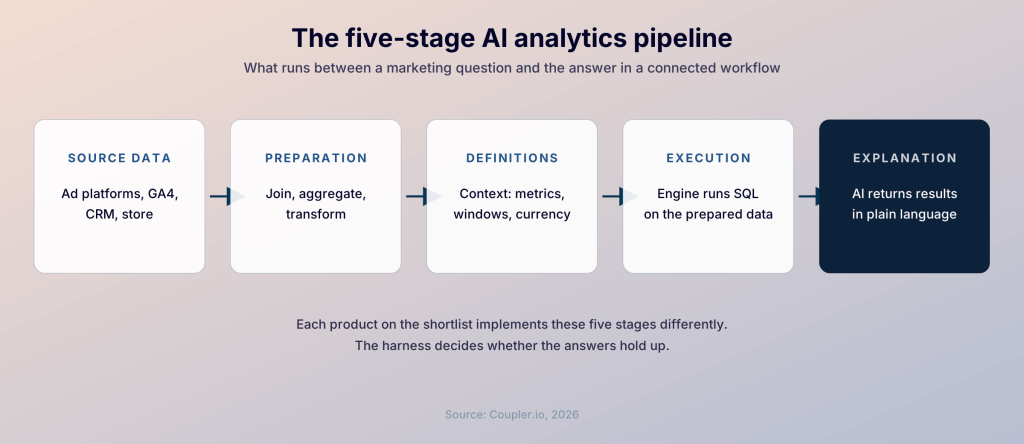
Coupler.io’s Analytical Engine is the explicit name for this split: the AI model interprets while Coupler.io calculates. Adverity Atlas plays a similar role for teams with an existing data warehouse. Improvado and Funnel bundle a lot of this into modeled data. Windsor.ai leans on connector reach plus write actions. Among the best AI agents for marketing 2026, the ones that handle this layer explicitly answer repeat questions reliably.
A few cross-channel rules that pay off whatever platform you choose. Blended ratios should be calculated from compatible underlying totals, not averaged from platform ratios. Don’t add platform-attributed conversions across sources and label the sum unique customers. The overlap is real and often large. Agree on date windows, currency, time zone, revenue definitions, lead-quality rules, and joining keys up front. Those definitions are the business context the agent needs, and they live better in Context than in individual prompts.
Security is practical. Choose which datasets the agent sees. Exclude fields you don’t want exposed (customer PII, cost rates). Keep client data separate. Decide read-only versus write access per surface. Review the assistant’s privacy and training-data settings. Governed AI agents for marketing teams are the ones where this is explicitly configured. Compliance claims (SOC 2, GDPR, HIPAA, DORA) should be verified per vendor rather than assumed across the category.
How much do AI agents for marketing teams cost?
Cost logic beats a plan-tier table because the shape of the bill differs across options.
Data platforms with built-in AI are driven by connected accounts, destinations, refresh frequency, and AI usage allowances where they apply. Coupler.io bills on account and destination counts, with plans from $24/month. Funnel adds flexpoint capacity on top of the plan. Supermetrics is subscription-based with AI Chats included on the right destination. Improvado offers a $100/month MCP-only tier alongside quote-based managed plans.
For managed or enterprise deployments (Improvado managed-data plans, Adverity Atlas), confirm whether onboarding, implementation, support, warehouse usage, and LLM usage are included or charged separately. External assistant setups (Claude or ChatGPT with Coupler.io, Supermetrics, Funnel, Windsor.ai) may involve separate data-platform and assistant charges, depending on plan eligibility and existing subscriptions.
A platform’s lowest advertised price rarely matches the cost of the full workflow. Price your actual sources, destinations, and refresh frequency, not the starting-tier headline.