AI agents answer business questions straight from your data warehouse, but they only know what your tables tell them. If you don’t tell an agent how your company counts revenue or what an active customer means for your business, it guesses. The wrong answer looks just as confident as the right one.
Semantic layer tools define each metric once and serve that definition to every BI tool and agent. The best semantic layer tools of 2026 differ in where they run, who maintains them and how agents reach them. This guide compares seven of them to help you pick the one that fits your stack, or decide you don’t need one yet.
Key takeaways
- AI agents writing text-to-SQL get metrics wrong without governed definitions. A semantic layer stops that at the source by defining each metric once for every tool that reads it.
- The seven tools in this guide fall into two camps. Native layers (Snowflake Semantic Views, Databricks Metric Views) work only inside their own platform. Universal layers (dbt, Cube, AtScale, Honeydew) serve many tools, and Looker/LookML sits between them.
- Most choices come down to where your data already lives, how many tools consume your metrics, and how AI agents query the layer.
- Every semantic layer here assumes prepared data already sits in your warehouse. If your sources are still scattered across SaaS apps, ingestion belongs in the same decision.
- Coupler AI covers the narrower path when AI analysis on business data is the main job and company-wide metric governance isn’t the priority yet.
What a semantic layer does, and why AI agents need it
A semantic layer stores business definitions once, for example, what “revenue” or “active customer” means, and every BI tool and AI agent reads that same definition. A semantic layer sits between the data warehouse and the BI tools and AI agents that read from it, and holds the joins, metric formulas, dimensions and access rules.
“Revenue” then means the same thing in Power BI, Tableau and Claude, and every metric has a single source of truth.
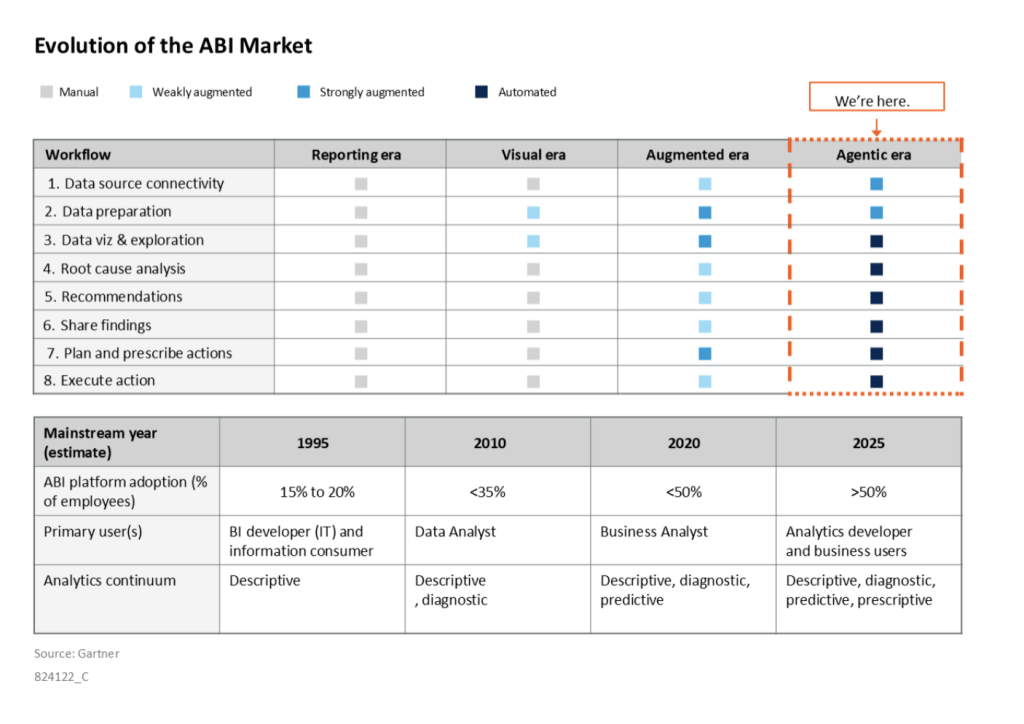
AI agents are the reason semantic layers are a “hot topic” right now. Gartner’s view of the analytics market shows agents automating almost every step of analysis, from exploring data to recommending actions. They predict that by 2028, 60% of agentic analytics projects relying solely on MCP will fail for lack of a consistent semantic layer.

Without a semantic layer, a large language model (LLM) writing text-to-SQL guesses things like:
- which column holds revenue, and whether it already excludes refunds
- whether to exclude test accounts and internal users
- what “active customer” means for your team
In a 2026 benchmark by dbt Labs, which sells a semantic layer, Claude Sonnet 4.6 answers 90% of questions correctly with its own SQL and 98.2% through a semantic layer.
Still, a semantic layer is the foundation, not the whole answer. It knows your formulas, but not that you changed pricing in March or paused a campaign for two weeks. That business context sits on top, in what some vendors call a context layer.
Get reliable AI answers with Coupler.io
Coupler AI gives Claude and ChatGPT your metric definitions through Context, and runs the math on your connected data. You get the governance an LLM needs on business questions, scoped to your AI workflow.
Try for free
Semantic layer tools comparison
These top semantic layer tools fall into two groups:
- Native to one platform: Snowflake Semantic Views and Databricks Metric Views are free add-ons, but they only work inside their own platform.
- Standalone: dbt, Cube, AtScale and Honeydew sit on top of one or more warehouses and serve many tools. Looker is in between, because its semantic layer comes inside a BI tool.
| Tool | Type | Where it runs | Main consumers | AI access | Pricing model |
|---|---|---|---|---|---|
| dbt Semantic Layer (MetricFlow) | Metrics layer inside dbt | dbt platform; queries run in your warehouse | Tableau, Power BI, Google Sheets, Excel, Hex | dbt MCP server | Per seat on paid plans, with a monthly cap on queried metrics |
| Cube | Universal, headless semantic layer | Self-hosted Cube Core or managed Cube | BI tools, embedded analytics, your own apps | Hosted MCP server, built-in AI agent | Free tier; paid plans per developer |
| AtScale | Universal semantic layer with a cube-style interface | Your cloud, on Kubernetes | Excel, Power BI, Tableau | MCP server | Quote-based, per deployed semantic object |
| Snowflake Semantic Views | Native semantic layer | Inside Snowflake | Cortex Analyst, Snowflake agents, SQL, Sigma | Cortex Analyst, Snowflake-managed MCP server | No separate fee; compute and Cortex credits |
| Databricks Metric Views | Native semantic layer | Inside Databricks, in Unity Catalog | AI/BI dashboards, Genie, SQL, notebooks | Genie | No separate fee found; Databricks compute |
| Looker / LookML | BI platform with a built-in semantic model | Google Cloud; queries your database live | Looker, plus Tableau and Power BI connectors | Gemini in Looker, MCP server (Preview) | Annual contract, price on request |
| Honeydew | Semantic layer for AI and BI | Managed service on Snowflake, Databricks or BigQuery | Power BI, Tableau, Excel, AI agents | MCP server, built-in agents | Per user, plus a platform fee |
What are the best semantic layer solutions?
Here is a curated list of semantic layer tools for consistent metrics across BI and AI. Each review covers what the tool does, who it suits, where it falls short and how it’s priced.
dbt Semantic Layer (MetricFlow)
dbt is the tool most data teams use for data modeling: cleaning and reshaping raw data inside the warehouse. The dbt Semantic Layer adds one more step to that work. Next to the cleaning rules, your team defines metrics like revenue or churn in the same project, and MetricFlow, the engine behind it, turns every request for a metric into SQL and runs it in your warehouse.
If your team already works in dbt, this is the shortest path to governed metrics, because the definitions live right next to the models they depend on.
Once a metric is defined, every tool reads the same version of it. Tableau, Power BI, Google Sheets, Excel and Hex connect through native integrations, other tools through JDBC, GraphQL or Python, and AI agents through the dbt MCP server. It works with Snowflake, BigQuery, Databricks, Redshift, Postgres and Trino.
MetricFlow itself is free: dbt Labs open-sourced it in October 2025, and in June 2026 the company merged with Fivetran. With the free dbt Core, you can define metrics, but you need a paid dbt plan (formerly dbt Cloud) to serve them to BI tools and agents. The Starter plan costs $100 per user per month and includes 5,000 queried metrics.
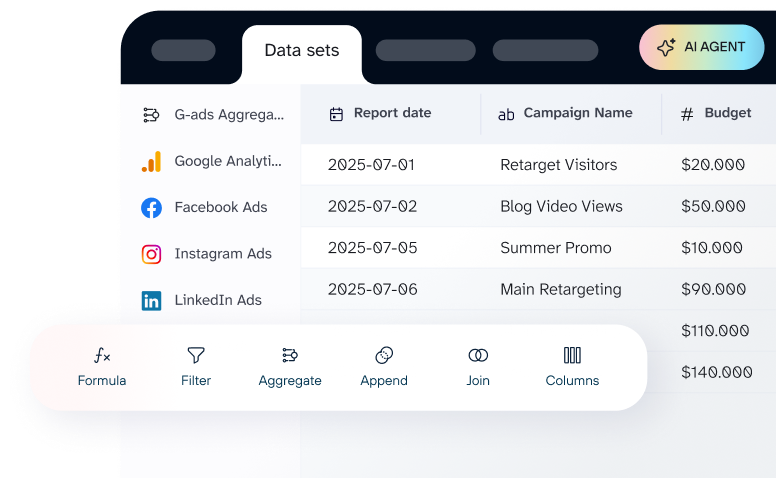
Like every semantic layer here, dbt works on data that’s already in your warehouse. If your sales, billing or ad data still lives in HubSpot, Stripe or Google Ads, Coupler.io pulls it from those apps, cleans it and loads it into the warehouse on a schedule, so dbt always has fresh tables to model:
Business apps → Coupler.io → warehouse → dbt Semantic Layer → BI tools and AI agents


Prep business data for AI and your semantic layer
Start free with Coupler.ioCube
Cube is a semantic layer built to serve many tools at once: your internal dashboards, analytics embedded in your own product and AI agents. It’s headless, which means it has no interface of its own. Your data engineers define metrics and the joins between tables in YAML or JavaScript files, keep them in Git, and every tool connects to Cube through an API.
Cube Core is the free, open-source version you host yourself, and the managed version, formerly Cube Cloud, now just goes by Cube.
Because Cube speaks several query languages, almost any tool can read from it: SQL for most BI tools, REST and GraphQL for your own apps, MDX for Excel and DAX for Power BI.
Pre-aggregations, summary tables Cube builds and refreshes in the background, keep dashboards fast on large datasets. For AI, every plan includes Cube’s MCP server, with 30 tools that let agents like Claude search your model and run queries.
Keep in mind that Cube Core leaves out the AI chat, the interface and the BI integrations, so the open-source version isn’t the full product. On the paid side, the Power BI connection, Tableau sync and SSO only come with Enterprise. The free tier allows 1,000 requests a day, Starter costs $40 per developer per month, Premium $80, and Enterprise has custom pricing.
Cube makes sense when many teams, tools and agents need the same governed metrics.
If you need something narrower, like reliable answers from Claude or ChatGPT about your business data, Coupler AI handles that without a separate semantic layer. You describe your fields, metric formulas and business terms once in Context, and the Analytical Engine runs the calculations instead of the LLM. You won’t get Cube’s governance across BI tools and apps, but many teams don’t need that yet.
AtScale
AtScale is one of the best semantic data layer tools for enterprise teams that report mostly in Excel and Power BI. Those tools see AtScale as a classic OLAP cube, so analysts keep building pivot tables over MDX or DAX. AtScale translates each query into SQL and runs it in the warehouse without copying data.
Models use SML, AtScale’s open-source, YAML-based modeling language, which handles hierarchies and measures that don’t add up simply over time, such as account balances. For query optimization, AtScale builds aggregate tables from real query patterns.
It also applies row-level security and exposes models to AI agents through an MCP server. It works with Snowflake, Databricks, BigQuery, Redshift and PostgreSQL, among others.
You will need Kubernetes to run AtScale, which gives your team one more system to deploy and maintain.
AtScale charges per deployed semantic object, not per user, query or AI agent interaction, so heavy agent use doesn’t raise the bill. The free Developer Edition allows 500 queries a month on one data source.
Snowflake Semantic Views
If all your data lives in Snowflake, try semantic views before buying anything else. A semantic view is a Snowflake object that defines tables, relationships, dimensions and metrics right next to the data. You create one with SQL, YAML or the Snowsight interface, and Semantic View Autopilot suggests metrics from your query history.
Semantic views matter most for AI. Cortex Analyst, Snowflake’s natural language query service, uses them to write accurate SQL, and so do the agents in Snowflake Intelligence (renamed Snowflake CoWork in June 2026). A Snowflake-managed MCP server opens them to external agents such as Claude.
They only cover data stored in Snowflake. Power BI doesn’t query them natively, so Power BI teams keep a second model. You also can’t edit the tables or metrics of an existing view; you redeploy it instead.
Semantic views carry no separate fee. Queries use your normal warehouse compute, and Cortex Analyst costs 67 credits per 1,000 messages through its API.
Getting data into Snowflake is still your team’s job. Coupler.io collects data from business apps, transforms it and loads it into Snowflake on a schedule, and the semantic view applies your metric definitions on top:
Business apps → Coupler.io → Snowflake → Semantic Views → BI tools and AI agents
Databricks Metric Views
Databricks Metric Views are the Databricks counterpart to Snowflake’s semantic views, built for teams that run their data on Databricks with Unity Catalog. A metric view is a Unity Catalog object, written in YAML or SQL, that keeps measures separate from dimensions. Unlike a normal SQL view, it lets you pick the grouping at query time and still calculates each measure correctly.
Metric views belong to Unity Catalog Business Semantics, which reached general availability in April 2026. They feed AI/BI dashboards, notebooks and Genie, Databricks’ natural language assistant. Synonyms and display names in the YAML help Genie read what each field means, and materialization, still in preview, pre-computes aggregates for faster queries.
Outside Databricks, they’re harder to use. They require Unity Catalog, and external BI tools query them with a special MEASURE() function in custom SQL. Analysts manage that, but business users in Power BI or Tableau find it clumsy.
Databricks lists no separate price for metric views. They run on the Databricks compute you already pay for.
Looker / LookML
Looker is Google Cloud’s enterprise BI platform, and LookML is the modeling language behind it. It suits companies with a data team that writes LookML, especially on BigQuery. Developers describe tables, joins, dimensions and measures in Git-versioned LookML files, and Looker turns each question into SQL that runs live on your database.
Looker connects to BigQuery, Snowflake, PostgreSQL, Redshift and Databricks, among others. Gemini in Looker answers natural language questions, and a Looker MCP server, still in Preview, lets agents query models with each user’s own permissions. On BigQuery, Looker also generates a starting LookML model from the dataset’s schema.
Most of Looker’s openness depends on BigQuery: its SQL interface and Tableau connector only work with models built on a BigQuery connection. LookML also needs developers who know it, and Gartner’s 2026 Critical Capabilities report names data preparation as Looker’s biggest gap.
Looker sells Standard, Enterprise and Embed editions on annual contracts, each with 10 Standard users and 2 Developer users included.
Coupler.io covers that data preparation gap. LookML defines business logic over the databases Looker connects to. When that data starts in business apps, Coupler.io collects it, transforms it and loads it into BigQuery, Snowflake, PostgreSQL or Redshift, and LookML models those prepared tables for consistent analysis in Looker:
Business apps → Coupler.io → BigQuery, Snowflake, PostgreSQL or Redshift → Looker and LookML
Don’t confuse Looker with Looker Studio, Google’s free dashboard tool, which Google renamed back to Data Studio in 2026. Data Studio doesn’t use LookML.
Give your AI agents trustworthy business data with Coupler.io
Start for freeHoneydew
Honeydew puts AI agents first and BI second, so it suits teams whose main consumers are agents rather than dashboards. You define entities, metrics and domains in YAML stored in Git, and Honeydew’s semantic compiler turns each request into SQL that runs in your warehouse. It started as a Snowflake Native App, backed by Snowflake Ventures, and added Databricks and BigQuery in January 2026.
Of the semantic layer tools for AI-driven analytics in this list, Honeydew goes furthest:
- its MCP server works with Claude, Cursor, Snowflake Cortex and Databricks Genie
- it handles AI governance by giving each agent scoped access and logging every question, plan and SQL query
- Context Management pulls business knowledge from Notion and Confluence into the model
- BI users still connect from Excel over XMLA and from Power BI over DirectQuery
Cost and plan limits hold it back. Honeydew offers no free tier, only a 14-day trial. Lite costs $20 per user per month plus a platform fee from $500 a month and allows one BI integration. Standard costs $30 per user plus a platform fee from $2,000 a month. Both plans cap out at 50 users, and Enterprise is custom.
Honeydew and Coupler AI share one idea: both give the AI business context alongside the data. Honeydew applies it through a governed semantic layer across your warehouse, BI tools and agents.
Coupler AI works at a smaller scale: you add Context to each dataset in Coupler.io, and the Analytical Engine calculates the answers your AI tools explain. If you need reliable AI analysis rather than company-wide metric governance, the smaller setup may be enough.
Where Coupler.io and Coupler AI fit in a semantic layer stack
Coupler.io isn’t a semantic layer. It prepares and connects business data, and plays one of two roles depending on what you build.
Coupler.io together with a semantic layer
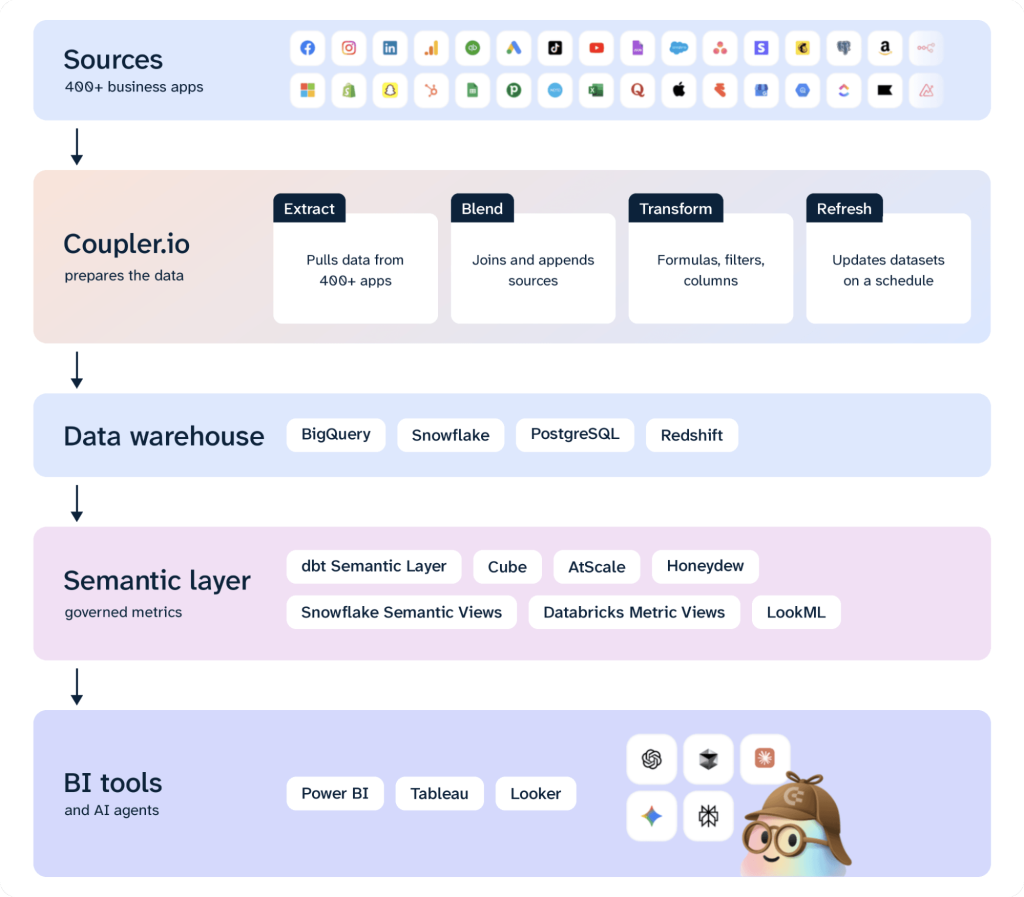
Every semantic layer in this list assumes the data already sits in the warehouse. Coupler.io handles the work before that:
- extracting data from 400+ business apps
- combining sources and transforming the data
- refreshing datasets on a schedule
- loading prepared data into BigQuery, Snowflake, PostgreSQL, Redshift and other destinations
The semantic layer then applies your governed metrics and definitions. Coupler.io doesn’t replace it. It keeps the semantic layer supplied with fresh, prepared data.

Coupler AI for AI analytics without a dedicated semantic layer
Some teams don’t need company-wide governance yet. They need Claude or ChatGPT to answer questions about business data correctly. Coupler AI covers that job in four ways:
- Coupler.io combines your sources into prepared datasets before the AI sees them.
- The Analytical Engine runs the calculations, so the LLM explains numbers instead of computing them.
- Context stores field descriptions, relationships between datasets, metric formulas and business glossaries for each dataset.
- AI Agent inside Coupler.io and AI Integrations with Claude, ChatGPT and other tools all read the same prepared data.

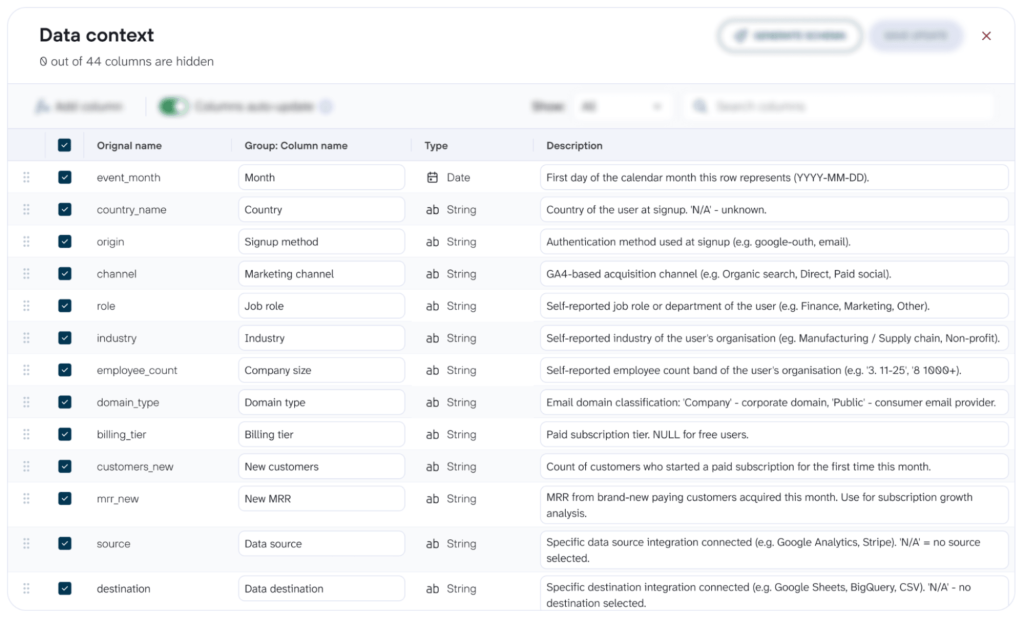
This also addresses Gartner’s MCP warning. The AI gets your definitions and verified calculations along with access to the data.
A dedicated semantic layer still wins when the same governed metrics, dimensions, relationships and access policies serve many teams and applications. Coupler AI fits when the main problem is getting reliable business data and context into AI analysis.
| Main requirement | Better-fit approach |
|---|---|
| Centrally governed metrics reused across many BI tools and applications | Semantic layer |
| Shared dimensions, relationships, permissions, and metric definitions | Semantic layer |
| Business data is fragmented across SaaS applications | Coupler.io first |
| Data needs to be collected and prepared before entering a warehouse | Coupler.io |
| Claude or ChatGPT needs persistent metric definitions and business terminology | Coupler AI Context |
| Calculations should not be left to the LLM | Coupler AI Analytical Engine |
| Both governed semantics and automated data collection are needed | Coupler.io + semantic layer |
Get accurate AI answers on business data in minutes
Start free with Coupler.ioHow to choose a semantic layer
Start with whether you need a semantic layer right now. Gartner calls semantic layers, knowledge graphs and ontologies foundational for AI analytics, but advises investing in them selectively, where the benefit justifies the cost. If one team uses one BI tool, that tool’s built-in model may be enough for now.
If you do need one, these are the evaluation criteria for semantic layer selection I’d go through, in this order:
- Where your data lives: Data that sits entirely in Snowflake or Databricks points to the native semantic layer platforms. Data spread across several warehouses points to a universal layer such as Cube, AtScale or dbt.
- How many tools read your metrics: One BI tool for self-service analytics is a very different job from BI, embedded analytics and AI agents at once. The more tools you serve, the more a headless layer pays off.
- How AI agents query it: Check for an MCP server, natural language query and reliable text-to-SQL. Several of the MCP servers above are still in preview.
- Data governance: Look for row-level security, audit logs and a connection to your data catalog.
- Who maintains the model: dbt, Cube and LookML expect engineers working in code and Git. AtScale and Honeydew offer more visual tooling.
- Portability: Apache Ossie (formerly the Open Semantic Interchange, or OSI) is an open standard for metric definitions. dbt Labs, Snowflake, Salesforce, Cube, Honeydew, Databricks and AtScale all back it, which makes your definitions less dependent on one vendor.
- What sits below the semantic layer: Every tool here assumes prepared data in the warehouse, and Gartner lists data source connectivity and data preparation among the must-have capabilities for AI analytics. If your data still lives in SaaS apps, plan ingestion and refresh as part of the same decision, for example with Coupler.io.
Which semantic layer tool fits your stack
| Your situation | Start with |
|---|---|
| Everything is in Snowflake | Snowflake Semantic Views |
| Everything is in Databricks | Databricks Metric Views |
| Your team already models data in dbt | dbt Semantic Layer |
| You need one layer for BI, embedded analytics and AI agents | Cube |
| Excel and Power BI drive most reporting in a large enterprise | AtScale |
| You already use Looker on BigQuery | Looker / LookML |
| AI agents are the main consumers | Honeydew |
| You mainly want reliable AI answers on business data | Coupler AI, without a semantic layer |
Pick the layer that matches your stack, then feed it
The best semantic layer tools for AI agents solve the same problem: every tool that asks gets one definition of each metric. The right one depends on where your data lives and how many tools read it.
Native semantic layer platforms cost nothing extra on Snowflake or Databricks, while universal layers pay off when many tools share the same metrics.
Any semantic layer is only as good as the data underneath it. Coupler.io keeps that data collected, prepared and refreshed in your warehouse. If AI analysis is your main goal, start with Coupler AI and add a semantic layer once governance across teams becomes the problem.