Claude has grown from a well-regarded ChatGPT alternative into a tool that a measurable share of businesses now run their data workflows on. These numbers matter if you’re deciding which AI assistant to build around, tracking where the analytics software market is heading, or just wondering why Claude keeps showing up in places it didn’t a year ago.
What do 18.9 million monthly users actually do with Claude? Most coverage stops at user counts and funding rounds. This article goes further and dwells on how organizations are actually building analytics workflows with it, based on behavioral data from hundreds of real deployments.
Key Claude statistics for 2026
Here are the headline numbers before we dig in:
- Claude reached approximately 18.9 million monthly active website users worldwide as of early 2025, up from 4 million in December 2023.
- Claude’s mobile app had 2.9 million monthly active users as of January 2025, ranking it 86th among AI apps globally.
- Claude app downloads peaked at 800,600 installs in November 2024.
- Coding and software development account for 35% of all Claude.ai conversations.
- Long-tenure Claude users have a 10% higher conversation success rate than new users (AI proficiency compounds over time).
- Anthropic reached a $30 billion annualized revenue run rate by April 2026, up from $9 billion at the end of 2025.
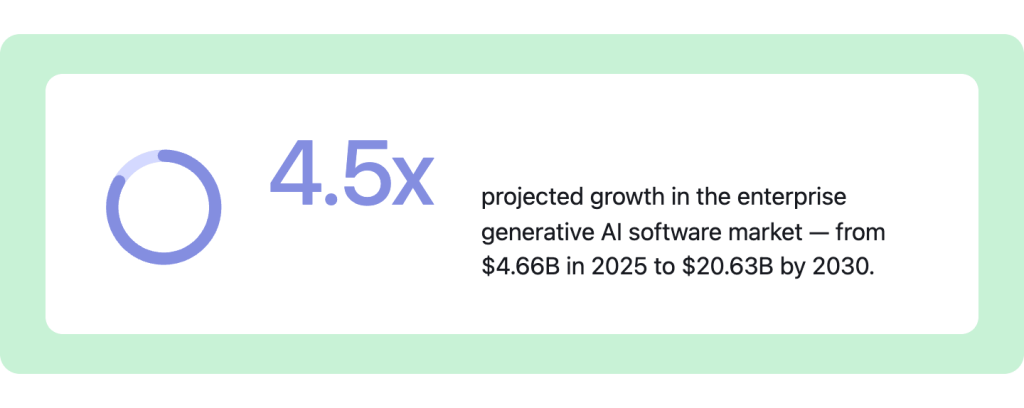
- The enterprise generative AI software market is projected to grow from $4.66 billion in 2025 to $20.63 billion by 2030.
- Banner Health reports 85% of its 55,000+ employees see time savings with Claude; Carta Healthcare cut clinical data abstraction time by 66%.
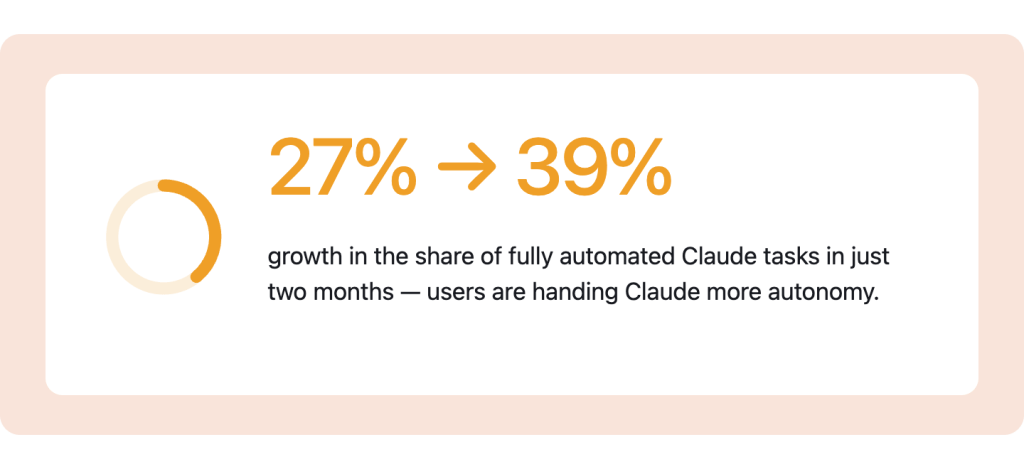
- The share of fully automated Claude tasks rose from 27% to 39% in just two months. Users are giving Claude more autonomy over time.
- 88% of organizations use AI in at least one business function; 70% specifically use generative AI.
- 60% of SMBs using AI name data analysis and reporting as their top use case, ahead of content creation, customer service, and inventory.
- 84% of data leaders say their data strategy needs a complete overhaul before their AI ambitions can succeed, and over 26% of organizational data is rated untrustworthy.
- Worldwide AI spending will hit $2.52 trillion in 2026, up 44% year over year.
- MCP SDK downloads grew 970× between November 2024 and March 2026; 78% of enterprise AI teams now run at least one MCP-backed agent in production.
- Claude grew 19× as a data analytics destination between August 2025 and March 2026, while ChatGPT’s analytics usage peaked and declined over the same period.
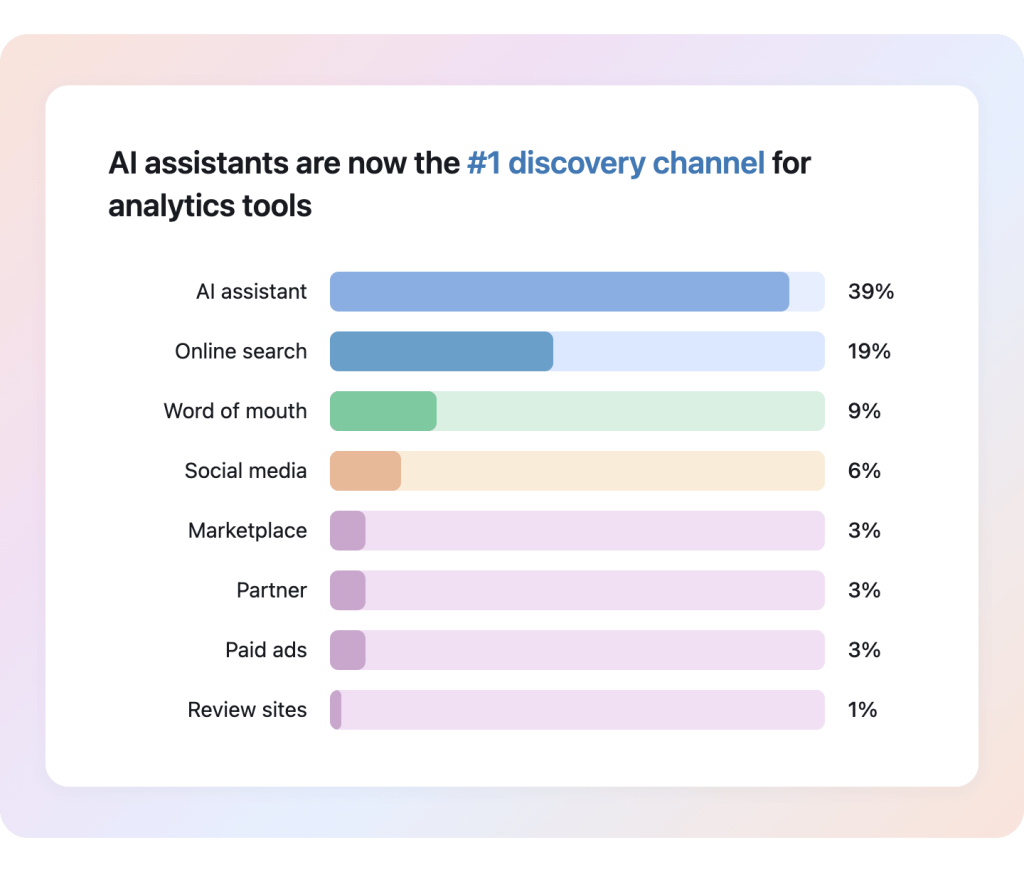
- 39% of analytics users say an AI assistant recommended their data tool to them, which is bigger than word-of-mouth, social media, and paid ads combined. Here’s what it looks like in percentage:

Sources:
[1] https://backlinko.com/claude-users
[2] https://www.aicpb.com/ai-rankings/products/apps
[3] https://land.appfigures.com/rise-of-ai-apps-report-2025
[4] https://www.anthropic.com/research/economic-index-march-2026-report
[6] https://www.anthropic.com/customers
[7] https://hai.stanford.edu/ai-index/2026-ai-index-report
[8] https://www.mckinsey.com/capabilities/quantumblack/our-insights/the-state-of-ai
[10] https://www.digitalapplied.com/blog/mcp-adoption-statistics-2026-model-context-protocol
Claude user statistics
Claude’s user base has grown faster than almost any other AI product in history. The numbers below cover website traffic, app downloads, geographic spread, and demographics.
How many people use Claude?
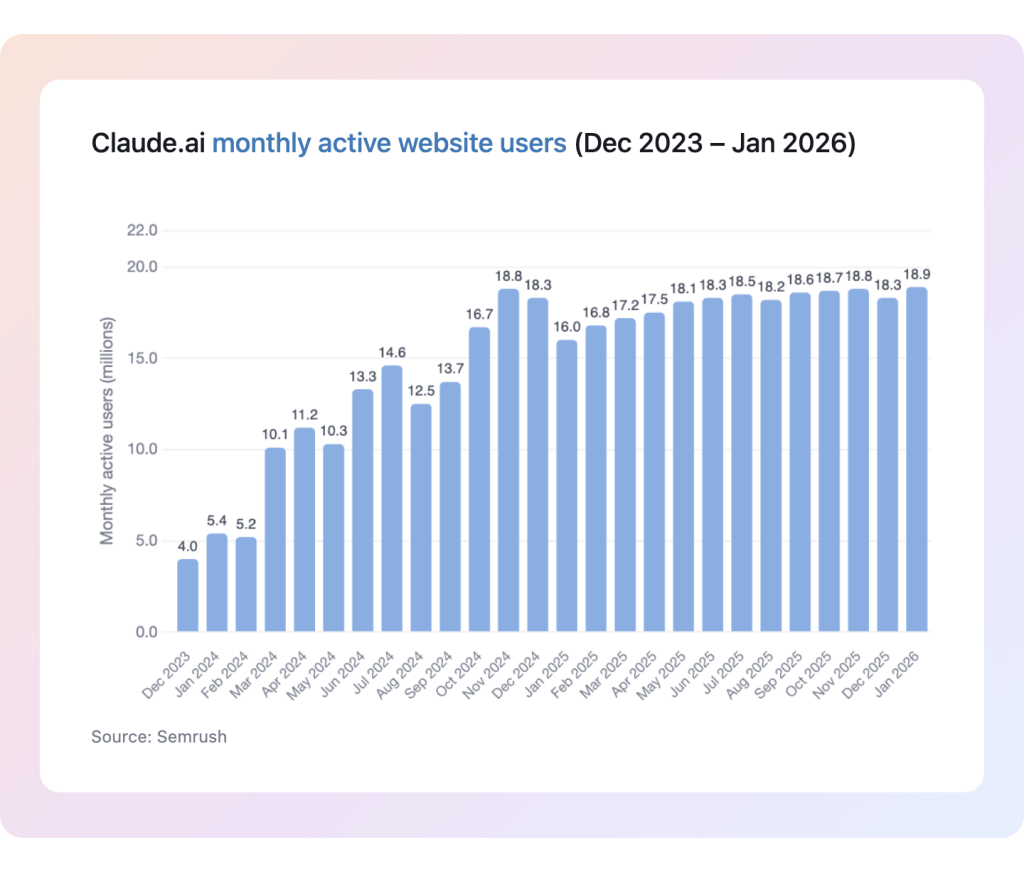
Claude reached approximately 18.9 million monthly active website users worldwide. That’s a significant climb from 4 million in December 2023. Growth was driven by expanding capabilities and, frankly, by a broader shift toward AI assistants that wasn’t slowing down.
Here’s how that web traffic has evolved since late 2023:
The Claude mobile app tells a similar story. As of January 2025, Claude had an estimated 2.9 million monthly active app users, ranking it 86th among AI apps globally. This number likely understates actual usage, given that Claude is accessed through the API rather than the consumer app.
Pro tip
Don’t feed Claude yesterday’s data. When you connect your platforms to AI via Couper.io instead of uploading CSVs, Claude always works with fresh, accurately calculated numbers. This way, your analysis becomes a live pulse on your business. Connect your first data source to Claude via Coupler.io and see the difference on day one.
Where Claude users come from
The US and India together account for about a third of Claude’s total web user base. Here’s the full breakdown of the top 10 countries:
| Country | Monthly active web users |
|---|---|
| United States | 3.2 million |
| India | 2.1 million |
| Japan | 692,200 |
| South Korea | 556,700 |
| Kenya | 523,600 |
| United Kingdom | 516,800 |
| Germany | 491,100 |
| Indonesia | 453,500 |
| Israel | 329,200 |
| Brazil | 327,600 |
A few things worth noting here. Kenya’s presence in the top five, ahead of the UK and Germany, reflects patterns also visible in the Anthropic Economic Index data. It shows AI adoption spreading well beyond the obvious enterprise markets. The top 20 countries account for 48% of Claude usage per capita as of March 2026, and that concentration is still increasing, according to the Anthropic Economic Index.
Within the US, though, the opposite is happening: the top 5 states’ share of per-person Claude usage fell from 30% to 24% between August 2025 and February 2026. Usage is spreading out geographically.
Claude user demographics
Claude skews young and heavily male, at least on the web. 77.1% of Claude website users are male, and 51.88% are between 18 and 24 years old, according to Semrush data.
| Age group | Share of users |
|---|---|
| 18–24 | 51.88% |
| 25–34 | 25.00% |
| 35–44 | 11.88% |
| 45–54 | 8.13% |
| 55–64 | 2.21% |
| 65+ | 1.14% |
The concentration in the 18–34 bracket aligns with what Anthropic’s own data show: the average Claude.ai conversation is associated with a US occupation paying $47.90/hour, well above the US median, according to the Anthropic Economic Index. Claude is, at the moment, a tool for higher-wage, higher-education knowledge work, and that skews young.
There’s also a notable pattern in how usage matures over time. Long-tenure Claude users (those who signed up at least 6 months prior) have a 10% higher conversation success rate than newer users, are 7 percentage points more likely to be using Claude for work rather than personal tasks, and bring queries that require almost a full year more of formal education to understand. The demographic snapshot above captures the entry point, not where users end up.
Pro tip
Over half of Claude’s users are 18–34, and most of them started using it on their own, without anyone telling them to. If you run a marketing or data team, that’s a useful signal: the person already asking Claude questions about campaign performance is probably the same person who’ll get the most out of automated data pipelines. Start there, not with a top-down rollout.
Claude app downloads
Downloads of the Claude app across Google Play and the App Store:
| Quarter | Total downloads |
|---|---|
| Q2 2024 | 0.6 million |
| Q3 2024 | 2.1 million |
| Q4 2024 | 2.6 million |
| Q1 2025 | 3.2 million |
| Q2 2025 | 4.1 million |
| Q3 2025 | 3.9 million |
| Q4 2025 | 4.8 million |
November 2024 was the peak month in this window at 800,600 installs. The January 2025 rebound to 769,600 after a December dip suggests the audience isn’t seasonal. People are finding Claude through ongoing word-of-mouth and increasingly through AI assistant recommendations.
Anthropic revenue and business stats
Anthropic reached a $30 billion annualized revenue run rate by April 2026, up from $9 billion at the end of 2025, according to Reuters. For context, the enterprise generative AI software market as a whole is projected to grow from $4.66 billion in 2025 to $6.52 billion in 2026, and $20.63 billion by 2030, according to Research and Markets. Anthropic closed a $30 billion Series G funding round in February 2026 at a $380 billion post-money valuation, with enterprise API customers accounting for an estimated 80% of revenue.

Here’s what Claude delivers in practice, according to Anthropic’s own customer case studies:
- NBIM (Norway’s $1.7 trillion sovereign wealth fund) deployed Claude Enterprise to 600+ employees and reports 20% time savings per employee.
- Banner Health (55,000+ employees) says 85% of users see time savings, with a target to cut administrative tasks by 50% by 2029.
- Carta Healthcare reports a 66% reduction in clinical data abstraction time using Claude, while maintaining 98–99% data quality.
- Chronograph, a portfolio monitoring platform, reports 100% adoption across 150+ employees with 80% daily active usage. New-hire time-to-productivity dropped from “2+ months” to “Week 2.”
What people actually do with Claude
Coding dominates. Computer and Mathematical occupations account for 35% of all Claude.ai conversations, and software development is the most common task in almost every US state and country worldwide, per the Anthropic Economic Index.
But the use-case distribution is spreading. Over 3,000 unique work tasks have now been observed in Claude.ai. In February 2026, the top 10 tasks made up only 19% of conversations, which is down from 24% in November 2025. That’s a meaningful shift. Claude is becoming less of a “coding assistant with other uses” and more of a general-purpose work tool.
Pro tip
Cut your reporting time by 60% as Gabe Soderberg from Right Percent did. Whatever data you work with, connect your sources to Claude via Coupler.io, let the Analytical Engine handle the calculations, and get answers in minutes.
A few other patterns worth knowing:
- 57% of Claude usage is augmentation (collaborative back-and-forth); 43% is automation (Claude performs the task directly). The automation share is growing fast on the API side.
- The share of fully automated tasks rose from 27% to 39% between January and March 2026. Users are giving Claude more autonomy over time.
- 42% of Claude.ai conversations are for personal use, 12% are coursework, and the rest is work .
- Among paying users, 51% of usage goes to the Opus model class. For coding tasks specifically, that reaches 55%.

AI adoption and the market Claude operates in
A few numbers that explain why analytics teams are paying attention to Claude in particular:
- 88% of organizations now use AI in at least one business function.
- 70% specifically use generative AI.
- 62% are at least experimenting with AI agents.
- Global AI spending will reach $2.52 trillion in 2026, which is a 44% year-over-year increase, the largest single-year acceleration in enterprise tech investment history.
- AI infrastructure investment alone will grow 49% in 2026, adding $401 billion in spend.
Among small and mid-size businesses (where, as we’ll see, most Claude analytics adoption is currently happening), the picture is similar:
- 71.4% of small businesses report using AI tools in some capacity, and 60% of those who’ve adopted AI identify data analysis and reporting as a top use case.
- Adoption is highly size-stratified: 73% of midsize businesses (100–1,000 employees) use AI, compared to 54% of small businesses and just 35% of very small businesses under 20 employees.
- 58% of SMBs plan to increase AI spending in 2026.
- A separate eMarketer survey of SMBs in February 2026 found that 37% are specifically experimenting with AI for data analysis.
For marketing teams specifically, AI has crossed from “experimenting” to expected. HubSpot’s 2026 State of Marketing report found that 86% of marketing teams now use AI in at least a few areas, with a growing share embedding it into campaign automation and analytics workflows.
There’s a significant caveat running through all of this: 84% of data leaders say their data strategies need a complete overhaul before their AI ambitions can succeed, and organizations estimate that over 26% of their data is untrustworthy. The adoption curve is steep. The readiness curve is not.
The MCP protocol: why Claude’s analytics integrations work the way they do
Model Context Protocol (MCP) is less visible than Claude itself, but it’s what makes the analytics use cases in the next section possible. A quick primer:
- MCP launched as an Anthropic standard in late 2024 and has since grown to 9,400+ public servers.
- MCP SDK downloads grew 970× from November 2024 to March 2026, reaching 97 million monthly downloads by December 2025.
- 78% of enterprise AI teams now run at least one MCP-backed agent in production.
- Every major AI provider now ships MCP support: Claude (native), ChatGPT, Google Gemini, Microsoft Copilot, AWS Bedrock agents.
- Average integration time for a new SaaS tool connection dropped from 18 hours to 4.2 hours with MCP (a 76% reduction).
- 67% of CTOs name MCP their default agent-integration standard.
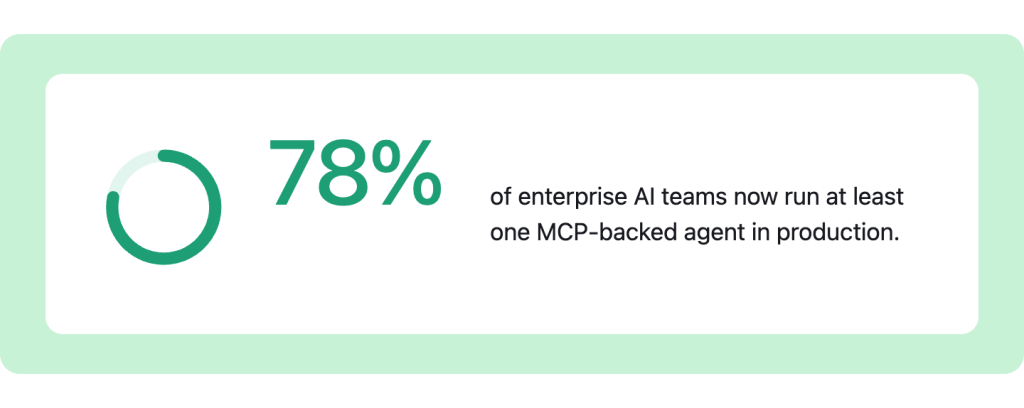
The practical effect: tools no longer build separate Claude integrations and ChatGPT integrations. They ship one MCP server and reach every AI assistant at once. That’s why Claude’s analytics connectivity expanded so quickly: the protocol did most of the work.
Pro tip
Connect your live business data to Claude and eliminate manual exports. Coupler.io’s MCP-based AI integrations give Claude structured access to your actual numbers with the business context it needs to interpret them correctly and no risk of hallucinated figures. Additionally, you can connect your custom LLMs or agents to your data with the custom MCP server in minutes without coding skills.
Claude for analytics: what the data shows
General adoption surveys tell you how many organizations say they use AI. They don’t tell you how an analytics workflow with Claude is actually constructed: what data sources connect, how often pipelines run, or who’s building them. But some experts are happy to share their experience.
Gabe Solberg, a growth performance marketer at Right Percent, has built an entire PPC reporting process on Claude. He connected his data from Meta Ads to Claude via the Coupler.io connector. The LLM queries structured data enriched with the appropriate business context, which eliminates the hallucination risk that plagues most AI analytics setups. The same analysis runs on a fresh data pull every time, so there’s nothing to rebuild.

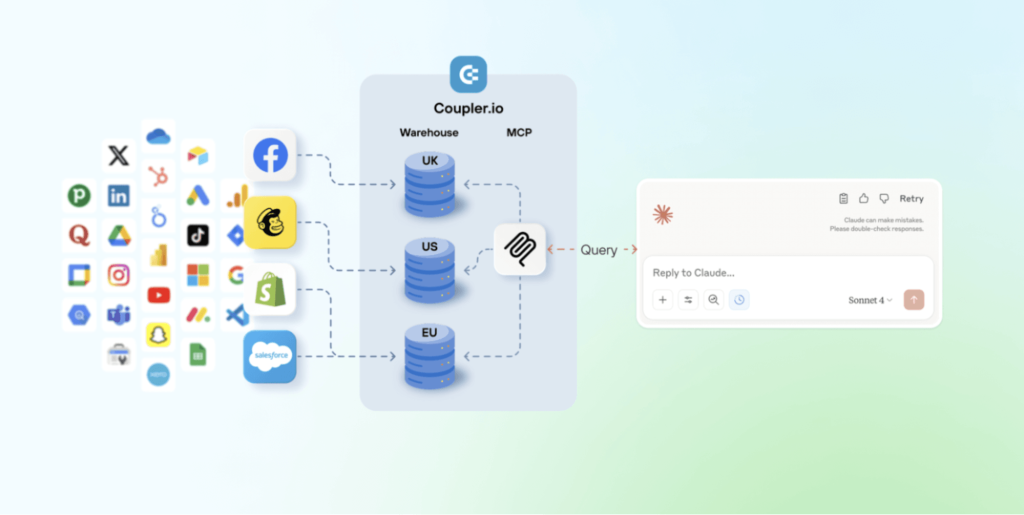
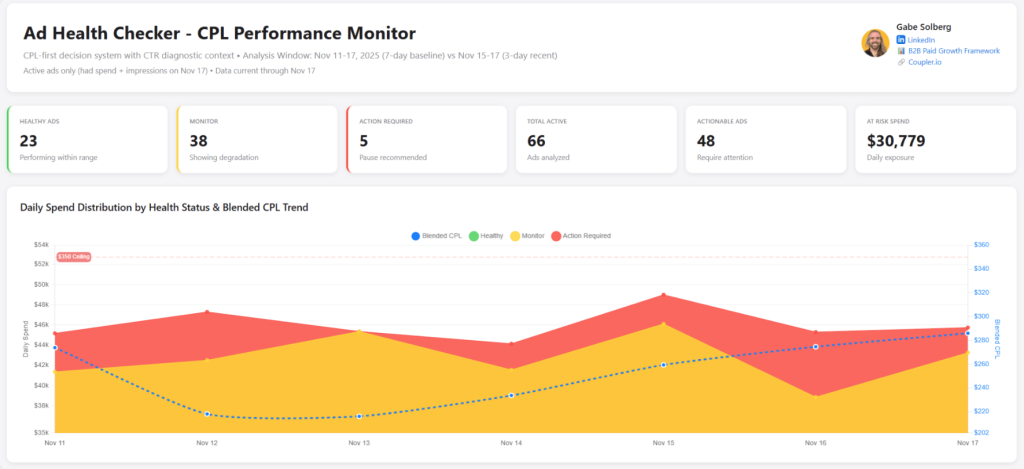
The result: 60% less time on reporting, with daily campaign reviews down to under 10 minutes without data team or custom code. This is what Gabe now sees every morning instead of a spreadsheet:
With Coupler.io, you can connect over 400 business sources to Claude, ChatGPT, Gemini, and other tools and agents, including custom ones. You control what data the AI will query and which context your data has. The AI conversational analysis will always be reliable, since AI only interprets the calculations performed by the Coupler.io Analytics Engine.


Power your Claude analysis with verified data
Try Coupler.io for freeClaude vs. ChatGPT as an analytics destination
The growth curve here is striking. According to Coupler.io data, Claude, as an analytics destination, grew approximately 19× between August 2025 and March 2026. Over the same period, ChatGPT’s usage as an analytics destination peaked in February 2026 and has declined every month since.
Among organizations routing business data to an AI assistant, roughly 78% are now doing it with Claude. About 22% use ChatGPT. The gap has widened every month since mid-2025.
This isn’t the pattern you’d predict from general user statistics, where ChatGPT still holds a larger overall user base. It suggests Claude has developed a real advantage, specifically in structured, data-heavy workflows.
Pro tip
Before switching your analytics workflow from ChatGPT to Claude (or vice versa), run the same question on both using identical data and compare the outputs side by side. Pay attention to whether the answer explains why a metric moved, not just what it is. That’s where the real difference between models shows up in practice, and it’s a faster evaluation method than reading benchmark comparisons.
It’s also worth noting that the organizations routing data to AI assistants as a direct destination are outnumbered roughly 3-to-1 by those connecting via the MCP API (a separate, larger population running more programmatic, agent-driven workflows). The direct-destination group captures the more structured, BI-style use case; the MCP-API population skews toward fully automated pipelines.
What data flows into Claude
Among organizations using Claude as an analytics destination, Coupler.io data shows the top data sources are:

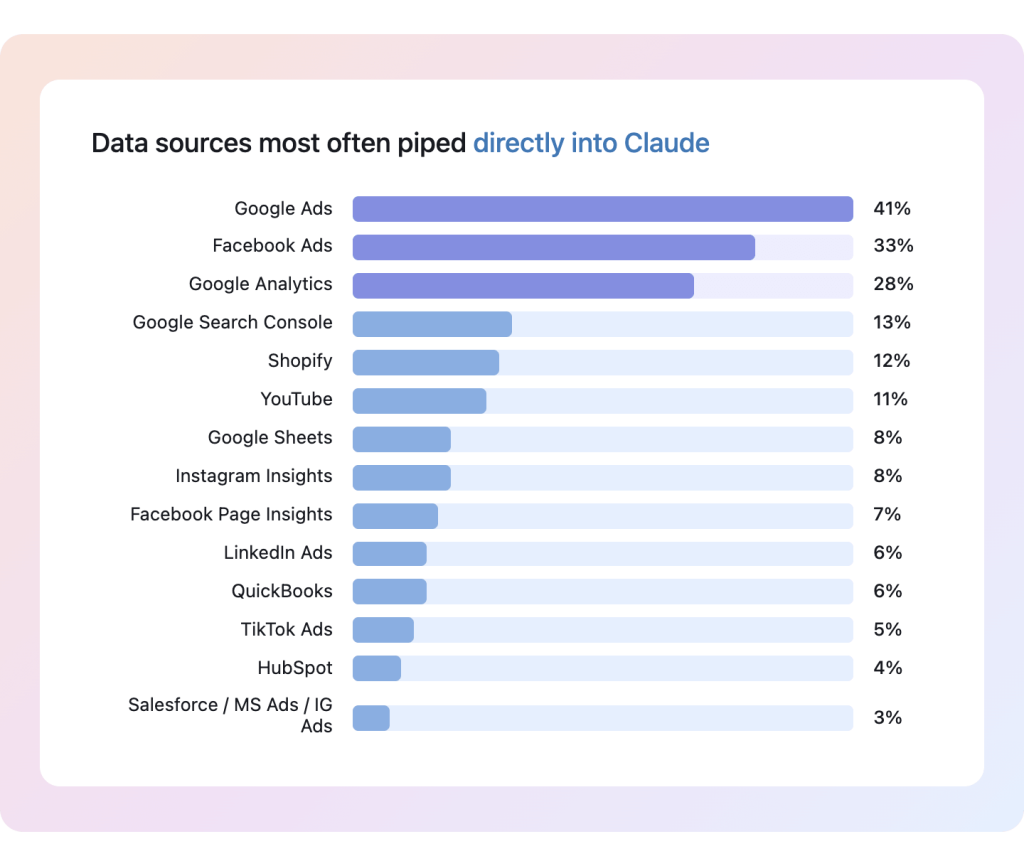
By category, 57% connect at least one advertising platform, 41% connect a marketing analytics source, and 13% connect either social media data or e-commerce data. CRM and accounting sources each appear in about 10–12% of deployments.
Most Claude analytics users connect more than one data source. The median deployment connects 2 distinct sources, and about 47% connect exactly 2. Around 28% connect 4 or more, and those are multi-channel reporting workflows, not one-off queries.
The most common source pair (roughly 1 in 5 Claude analytics deployments) is Facebook Ads plus Google Ads simultaneously. Other frequent combinations: Google Ads plus Google Analytics (16% of deployments), Facebook Ads plus Google Analytics (12%), and Google Analytics plus Search Console (10% — the SEO/content reporting signature).
Cross-channel paid marketing analysis is the single most common use case, ahead of SEO reporting, e-commerce analytics, and other use cases.
It’s a pipeline, not a chat session
Most people assume Claude analytics means typing questions into a chat window. The reality, based on Coupler.io’s behavioral data, looks quite different:
- About 82% of Claude analytics users actively call MCP endpoints from within Claude rather than just configuring a destination.
- Roughly 71% schedule automated, recurring data updates into Claude rather than running manual refreshes.
- Around 62% apply formula-based transformations (calculated columns, ratios, derived metrics) before the data reaches Claude.
- About 49% apply aggregation operations (sums, averages, group-bys) before sending data.
- 40% use append operations to combine multiple datasets into a single feed.
- 39% also actively use a natural-language AI agent alongside Claude in the same workflow.
- 26% sort, 25% filter, and 25% perform joins between datasets before the data reaches Claude.
- 18% also visit visual dashboards during the same workflow.
The typical Claude analytics deployment looks much more like an ETL workflow than a conversation. Data comes in on a schedule, gets transformed, and hits Claude as a structured feed. That context matters when you evaluate Claude against BI tools. Claude isn’t replacing analysts. It’s cutting out the time between data being ready and someone actually acting on it.
Who uses Claude for analytics, and why it’s mostly SMBs
The industry breakdown across named-industry deployments looks as follows:

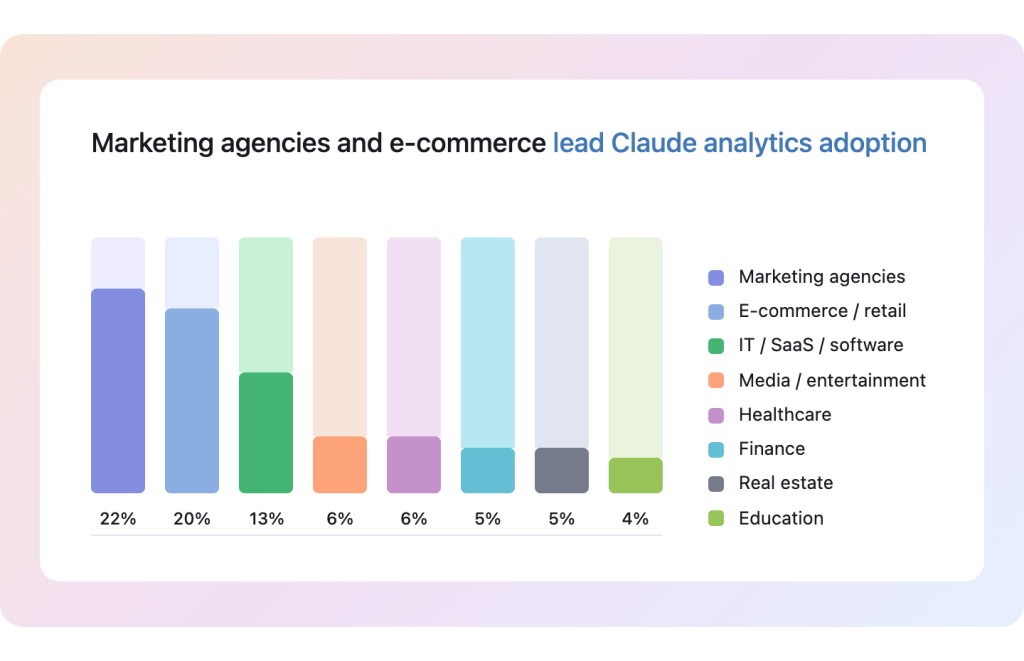
The role breakdown is equally telling. About 29% of Claude analytics users are business owners or founders. Another 34% are in marketing roles (analysts and managers). Only 8% are in dedicated data roles.
The data source mix shifts noticeably by industry. Among marketing agencies, 58% pipe in Google Ads, 44% Facebook Ads, and 30% Google Analytics. E-commerce companies lead with Facebook Ads (50%) and Google Ads (48%), followed by Shopify (42%). IT and SaaS companies are about 1.7× more likely than the average Claude analytics user to connect spreadsheet-based custom data, and 14% connect Google Sheets as a source. Healthcare companies show the highest single-source concentration of any industry, with 46% connecting Google Ads. Finance users are roughly 3× more likely than average to connect QuickBooks.
Most strikingly: 58% of Claude analytics deployments are at companies with 10 or fewer employees. This is a bottom-up adoption pattern. Small teams are wiring up Claude analytics workflows long before enterprise procurement gets involved. It matches the ECI data showing that 71% of SMBs use AI tools and data analysis as their top use case.
The enterprise surveys make AI for analytics sound like a CIO-led initiative. The behavioral data suggests it’s being driven, right now, by a solo founder or a two-person marketing team who got tired of switching between ad platforms.
A few more profile data points worth noting: 80% of Claude analytics users authenticate via Google OAuth, 14% via email and password, and 3% via Microsoft OAuth. About 58% use a corporate email address; 42% sign in with a personal one (another signal that a large share of this adoption is individual-led).
Claude often stands alone, not stacked on top of BI
About 72% of Claude analytics users currently have Claude set up as their only analytics destination, according to Coupler.io behavioral data. That doesn’t necessarily mean they’re abandoning BI tools elsewhere in the business. Many small teams may not have had a formal BI setup to begin with, or are using Claude for specific workflows alongside their existing stack. But it does suggest that, for the use cases people are wiring up first, Claude is doing the job on its own.
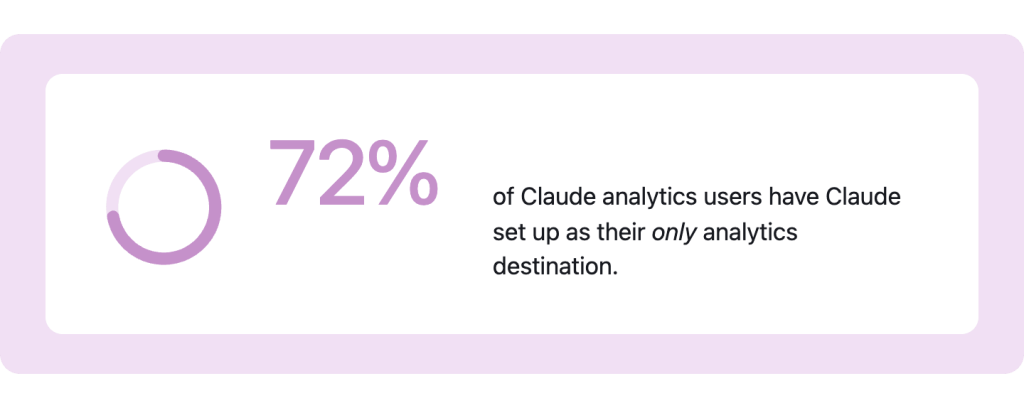
For the 28% who do route data to multiple destinations, the most common companions are native dashboards, Google Sheets, and Looker Studio (Data Studio). Only around 3% of Claude analytics users also pipe to ChatGPT in the same deployment.
The Claude landscape in 2026: what to watch
Let’s explore the top three Claude trends that can shape how you build, buy, and analyze with AI this year:
- Claude is becoming the default for technical and analytical work. Coding tasks already account for 35% of Claude.ai conversations, and as more organizations move from chat-based prompting to API-driven, agentic workflows, the gap between Claude and general-purpose chatbots is widening. If your team’s AI strategy still treats all assistants as interchangeable, you’re leaving capability on the table.
- MCP is making AI integrations cheap and portable. 78% of enterprise AI teams already run at least one MCP-backed agent in production, and connecting a new data source now takes about 4 hours instead of 18. In practice, that means any tool that ships an MCP server works with Claude, ChatGPT, Gemini, and Copilot out of the box, no separate integrations needed. The tool you pick matters less than making sure your data flows are set up correctly.
- AI assistants are the new search engine for B2B tools. When 39% of analytics users discover their tools via an AI recommendation, visibility inside Claude, ChatGPT, and other assistants becomes a meaningful go-to-market channel in its own right. Brands that get cited as the answer to “what should I use for X” are quietly winning a discovery channel that didn’t exist three years ago.
Key sources
Semrush — Claude website traffic and demographic data
Anthropic Economic Index, January 2026 — Economic primitives
Research and Markets — Enterprise Generative AI Software Market Report 2026
ECI Software Solutions — SMB AI Readiness Report 2026
Salesforce — State of Data and Analytics 2026
Bredin — SMB AI Trends Report 2026
HubSpot — State of Marketing 2026