Fivetran and Skyvia both move data from one place to another. But beyond that, they serve different needs.
Fivetran focuses on ELT for data teams that already use Snowflake or BigQuery. Since its June 2026 merger with dbt Labs, it also owns the transformation layer many of those teams run. Skyvia offers a modular SaaS platform for SMB operations teams. It covers ETL, reverse ETL, replication, and backup without requiring a specialist.
The right choice depends on who will manage the work and how your workload affects the bill. Pricing is often where the Fivetran vs Skyvia comparison gets tricky, so let’s start there.
Key takeaways
- Fivetran prices by MAR, or Monthly Active Rows. You pay for active rows across all connectors, with lower rates at higher volumes.
- Skyvia has modular, tiered pricing. Integration, Automation, Backup, Query, and Connect are billed separately, and each plan has record limits.
- Fivetran has 700+ connectors, with strong coverage of enterprise databases and ERPs. Skyvia has around 200+ connectors and focuses more on CRMs.
- Skyvia covers ETL, ELT, reverse ETL, replication, and backup in one platform. Fivetran focuses on ELT, with reverse ETL available as a separate add-on.
- Fivetran is aimed more at mid-market and enterprise teams. Skyvia is aimed more at SMB and mid-market teams.
- G2 ratings: Fivetran 4.3 (900+ reviews) and Skyvia 4.8 (300+ reviews).
Side-by-side at a glance
Verified as of October 2026.
| Fivetran | Skyvia | |
|---|---|---|
| Best for | Enterprise ELT into cloud warehouses | SMB and mid-market multi-workflow integration |
| Pricing model | MAR (Monthly Active Rows) | Modular tiered plans with record limits |
| Entry price | No fixed price | $79/month per module (billed annually) |
| Data sources | 700+ connectors | 200+ connectors |
| Destinations | Snowflake, BigQuery, Redshift, Databricks, Postgres, SQL Server, S3 | Cloud warehouses, SQL Server, MySQL, PostgreSQL, Oracle, file storage, SaaS targets |
| Workflow coverage | ELT (reverse ETL via Activations add-on) | ETL, ELT, reverse ETL, replication, Data Flow pipelines, automation, backup, SQL query, OData/MCP endpoints |
| Transformations | dbt, in-house since the June 2026 dbt Labs merger | No-code and SQL-based |
| AI capabilities | dbt Wizard, Agent Context MCP (preview), Agents Schema | MCP endpoints via Skyvia Connect |
| Security | SOC 2 Type II, ISO 27001, HIPAA, GDPR (PCI DSS L1 and HITRUST on Business Critical only) | SOC 2, GDPR, HIPAA, Azure encryption (hosted in West US) |
| Deployment | SaaS, Hybrid (Enterprise+), Self-hosted (HVR) | SaaS only |
| G2 rating | 4.3 (900+ reviews) | 4.8 (300+ reviews) |
Unpacking Fivetran vs Skyvia pricing models
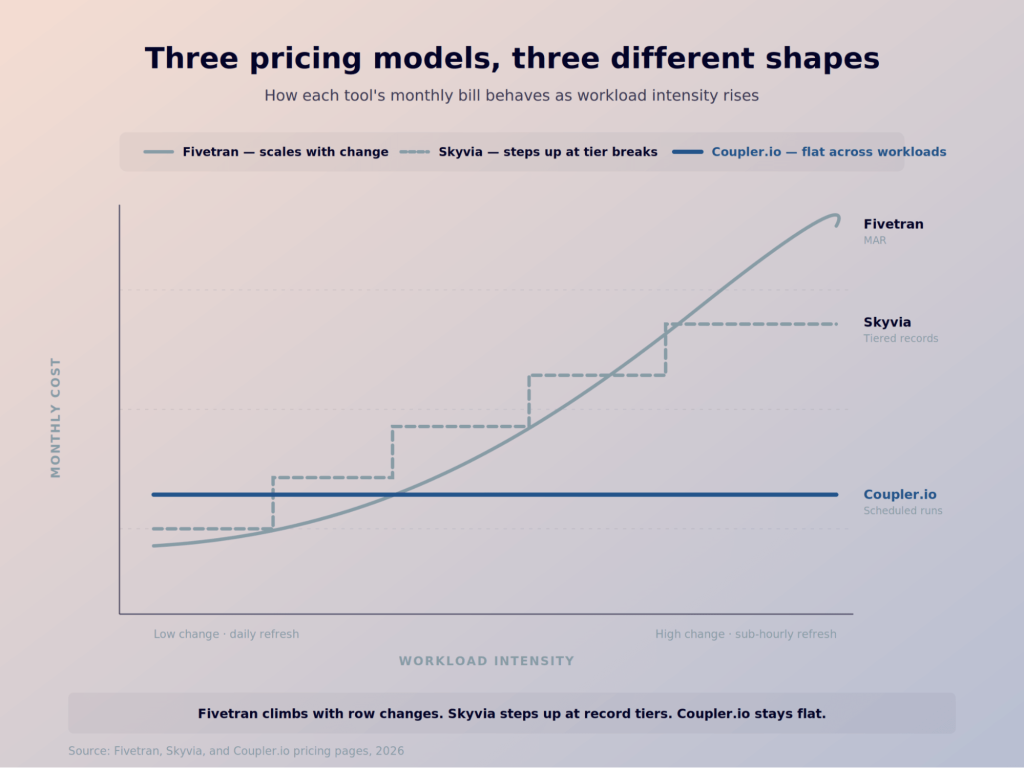
Pricing often decides the choice. Both platforms charge to move data, but they measure usage differently. If your workload doesn’t fit the pricing model, the bill can become a problem within a quarter.

How Fivetran MAR billing works
Fivetran charges by MAR, or Monthly Active Rows. A row counts as active in a month if it is inserted, updated, or, starting in January 2026, deleted. A million-row table that stays unchanged costs nothing, while a 10,000-row table where most rows change each month will cost more.
Rates decline as volume increases. You pay more per 1,000 rows at low volumes and less as you move into higher tiers. Starting in January 2026, paid plans also have a $5 minimum per connection. That affects teams running many small connectors.
In Fivetran pricing, MAR can be predictable when connectors are simple, and tables change little. Costs can rise on high-change workloads, such as event streams or CRMs with frequent updates.
How Skyvia’s tiered record billing works
Skyvia uses tiered plans with record limits. Each plan (Basic, Standard, Professional, and Enterprise) includes a monthly record allowance. Extra records are billed in blocks.
The platform is modular. Integration, Automation, Backup, Query, and Connect each have their own plans. If you only use ETL, you pay for one module. If you use ETL and Backup, you pay for both.
Each time a row syncs, it counts as a record operation. That means refresh frequency directly affects the bill. Free and Basic plans limit daily syncs to once a day. Higher tiers in Skyvia pricing offer faster schedules.
What each tool costs in three common setups
Small team, 5 connectors, daily refresh, 100K rows per connector.
Fivetran’s Free tier includes 500K MAR. That can cover this setup if the data changes only a little. If monthly active rows exceed the Free plan’s 500,000-MAR limit, the team moves to Standard, where pricing is usage-based by MAR and each qualifying connection carries a $5 monthly minimum. Skyvia Basic, at around $79 per month (billed annually), includes a selected monthly record allowance; additional records are billed in blocks.
Mid-market, 15 connectors, hourly refresh, reverse ETL needed.
On Fivetran, hourly syncs don’t move the bill much on their own. MAR counts a row once a month, however often it changes. What adds up is 15 connectors’ worth of changing rows, plus Activations for reverse ETL as a separate line. Skyvia Standard covers this setup at $159/month billed annually ($199 monthly). That includes hourly refresh, 50 scheduled integrations, and reverse ETL. The catch is records. Standard includes 5 million a month, and extra records cost $0.06 per 1,000. Professional costs $399 a month annually and includes 10 million. So once you’re about 4 million records over Standard’s limit, moving up is the cheaper option.
High-volume marketing analytics, sub-hourly refresh, event-heavy sources.
This is a difficult setup for Fivetran’s MAR model. Event streams and product analytics generate frequent changes, which can push MAR up quickly. Teams in this category report bills rising by 40 to 70 percent after the 2025-2026 pricing updates. Skyvia can also become costly because record counts rise with sync frequency. Sub-hourly refreshes on high-volume sources may push a team into Enterprise pricing discussions.
Honest take
Fivetran’s MAR model works well for simple workloads with low change rates. Costs rise when sources change often or when you run many small connectors under the new $5 minimum. Skyvia can cost less when refreshes are less frequent and you need several workflows in one platform. But when operation counts rise, working out the extra charges across separate modules takes effort.
💡 A third pricing model you should know about. Coupler.io prices its plans by connected source accounts and destination limits, with refresh frequency and other limits set by plan tier. Not per row, per operation, or per credit. For teams whose workload doesn’t fit MAR or tiered record pricing cleanly, this model is often the easiest one to budget.


Transparent Coupler.io pricing, no MAR or record overage math
BOOK A DEMOFivetran vs Skyvia audience: who each tool is built for
Fivetran targets data engineering teams at mid-market and enterprise companies. Its typical customer uses Snowflake, BigQuery, Databricks, or Redshift, transforms data with dbt, and has at least one engineer responsible for pipelines.
Skyvia targets operations leads, BI analysts, and small IT teams at SMB and mid-market companies. Many use Salesforce or HubSpot as their main system of record. They want to move data into SQL Server or a cloud warehouse without hiring a dedicated engineer. Skyvia is designed for self-service use.
G2 reviewer data reflects this split. Around 57% of Skyvia reviewers are from small businesses. Fivetran reviewers lean more toward mid-market and enterprise companies.
If your team shape and workload don’t match the product’s strengths, friction shows up fast. Fivetran may be too much for a two-person operations team. Skyvia may lack the features a data platform team needs for complex transformations at scale.
Overlap and gaps in Fivetran vs Skyvia data sources
Both platforms connect to common SaaS apps and databases. The differences are in connector count, depth, and the categories each platform focuses on.
Fivetran lists more than 700 connectors. Its strong areas include:
- Enterprise databases such as Oracle, SQL Server, and MongoDB
- ERPs like SAP, NetSuite, and Workday
- Event platforms such as Segment, Kafka, and Kinesis.
If you need log-based CDC from a production PostgreSQL cluster, Fivetran’s High Volume Agent is one of the more mature options on the market.
Skyvia lists around 200 connectors. It has strong coverage of:
- SaaS CRMs such as Salesforce, HubSpot, Dynamics 365, Zoho, and Pipedrive
- e-commerce platforms like Shopify, BigCommerce, and WooCommerce
- Standard databases and warehouses.
Reviewers also rate its Salesforce integration well.
Both cover major sources such as Salesforce, HubSpot, Snowflake, BigQuery, PostgreSQL, and Google Sheets. If your stack uses these tools, either platform may work.
Differences show up with more specialized needs. SAP S/4HANA ingestion with transaction consistency is more Fivetran’s territory. A point-and-click Salesforce-to-SQL-Server replication job that you can set up in an afternoon is more Skyvia’s.
Comparing Fivetran vs Skyvia destinations
Fivetran supports a focused set of destinations by design.
Its main targets are cloud warehouses such as Snowflake, BigQuery, Databricks, Redshift, and Azure Synapse, along with PostgreSQL, SQL Server, and S3. The idea is to bring data into a warehouse first, then transform it there with dbt. Reverse ETL is available through Activations as a separate paid feature.
Skyvia supports more destination types because it offers workflows beyond ELT.
Along with cloud warehouses, it supports SQL Server, MySQL, PostgreSQL, Oracle, and SQL Azure. File storage options include FTP/SFTP, OneDrive, Dropbox, and S3. It can also send data back to Salesforce or HubSpot through reverse ETL.
💡 If your destinations are all cloud warehouses, Fivetran’s narrower range may be enough. If you need a warehouse for BI and SQL Server for a legacy app, Skyvia covers more ground without requiring another vendor.
Main differences between Fivetran vs Skyvia key features
Below are the main things each platform is built to do.
Fivetran’s core features
➡️ Automatic schema changes handle upstream API and database changes without breaking pipelines. If a source adds a column, renames a field, or drops a table, Fivetran detects the change and updates the destination to match.
➡️ Log-based CDC reads changes straight from the transaction log for major databases, including Oracle, SQL Server, PostgreSQL, and MongoDB. That means replication without hammering the source with queries, which matters a lot for production databases where sync load is a real concern.
➡️ dbt, now in-house. Fivetran merged with dbt Labs in June 2026, so transformation is part of Fivetran’s own roadmap. Modeling stays in the warehouse where data engineers already work, and pre-built dbt packages save teams from rebuilding the same Salesforce or HubSpot joins. The merger also brought dbt Wizard, an AI agent that writes and fixes dbt models. Agents Schema came with it too: an open standard for giving AI agents context from the warehouse.
Skyvia’s core features
➡️ Several products in one platform. Data Integration covers ETL, ELT, reverse ETL, sync, and replication, plus Data Flow, a visual pipeline builder. Around it sit Automation (no-code workflows), Backup, Query (a web-based SQL editor), and Connect (OData, SQL, and MCP endpoints). For teams that would otherwise license three or four separate tools, bundling matters for both the bill and the vendor management overhead.
➡️ No-code transformations with SQL as a fallback. The visual builder covers common ETL work like mapping, filtering, and joining without needing a code editor. When logic gets too complex for the visual builder, you drop into SQL. That mix suits operations analysts who don’t want to pick between no-code limits and raw code.
➡️ Prebuilt templates for Salesforce and HubSpot workflows. Replication jobs, backup schedules, and sync pipelines that would take afternoons to configure arrive ready to run. Reviewers consistently rate the Salesforce integration as one of the stronger ones on the market.
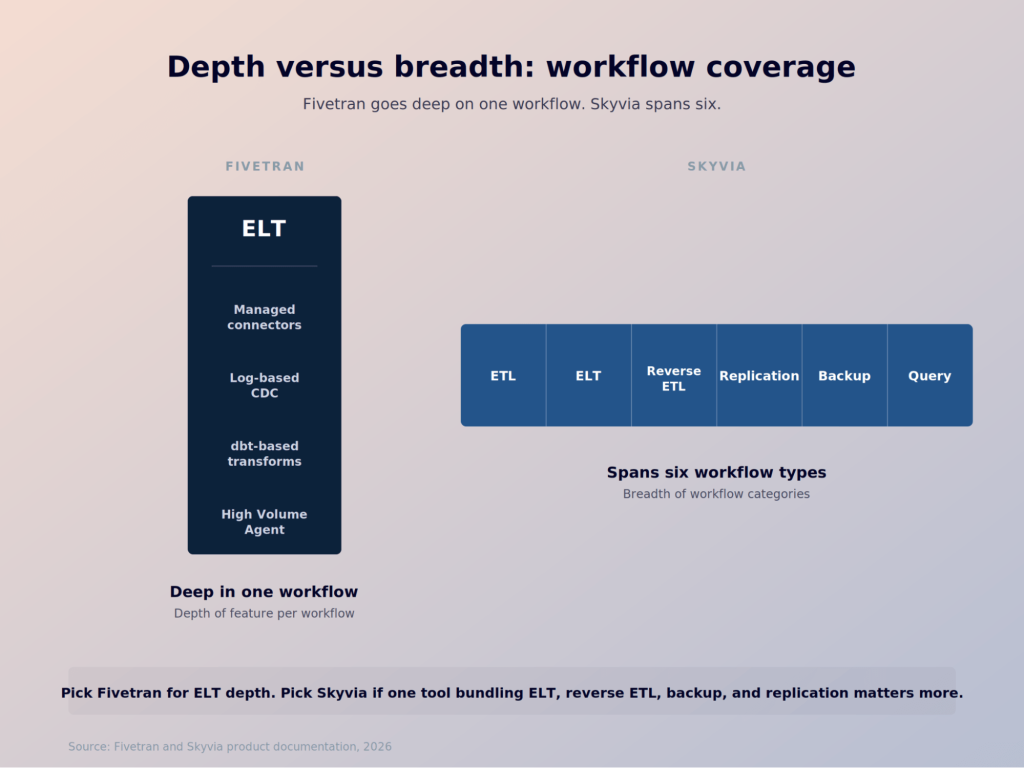
The main difference is depth versus breadth. Fivetran goes deep on the warehouse stack: ingestion first, then dbt transformation on top. Skyvia covers more types of workflows, but doesn’t go as deep on each one.
Fivetran vs Skyvia AI: what each tool can do
Fivetran’s AI changed in 2026 with the dbt Labs merger. dbt Wizard writes and fixes dbt models using your project’s lineage and tests. Agent Context MCP, in preview, feeds your business context to Claude, ChatGPT, Cursor, and Codex. Agents Schema keeps that context as open tables in your warehouse.
Skyvia’s AI centers on MCP. Skyvia Connect turns a connected source into an MCP endpoint without code, so assistants like Claude can query and act on that data in plain language.
Both now let AI work with your data through MCP. The difference is where it sits: Fivetran’s assumes a warehouse and usually a dbt project, while Skyvia’s connects AI straight to your apps. Neither one sets up the ingestion pipeline for you from a plain-text request.
💡 Coupler.io takes a different route by bringing AI into the pipeline itself. Its AI Agent assembles dataflows and finds insights in loaded data, supported by AI Integrations, Skills, and 230+ dashboard templates. It means you can create, manage, and analyze your data flows through conversational language, just by describing what you need.
Let Coupler AI do the data work for you
Tell Coupler AI what you need to know, from which source, and how often. It connects your account, sets up the data flow, keeps it refreshed, and lets you analyze the results inside Coupler.io or another AI tool.
Try for free

Certifications and uptime: Fivetran vs Skyvia security & stability
Fivetran has a broader set of compliance certifications:
- SOC 2 Type II
- ISO 27001
- HIPAA BAA
- GDPR
PCI DSS Level 1 and HITRUST are only available on the top-tier Business Critical plan, along with customer-managed encryption keys (CMEK) and private networking. If you need PCI compliance, budget for Business Critical from the start. Hybrid deployment, available from the Enterprise plan up, helps teams whose data residency rules block a fully SaaS setup.
Skyvia runs on Microsoft Azure and offers standard enterprise security, including:
- SOC 2
- GDPR
- HIPAA
- Encryption in transit and at rest
Skyvia is SaaS-only and hosted in Microsoft Azure’s West US data centers. For EU buyers or anyone with data residency rules, that’s often the stopping point, so confirm where your data gets processed before committing.
Both platforms publish status pages and have established uptime records. Fivetran incidents can affect enterprise database CDC connectors. Skyvia incidents can affect specific SaaS connectors when upstream APIs change.
Fivetran vs Skyvia ease of use, support: setup and daily use
Fivetran is easier to manage once it’s set up, but setup itself can be more demanding. Connector configuration assumes some technical knowledge of authentication, warehouse schemas, and sync behavior.
Its documentation is thorough and support options depend on the plan.
Skyvia is easier to get started with. Setup wizards guide users through source and destination settings. Prebuilt templates can handle common Salesforce-to-warehouse jobs in minutes. Its documentation is aimed at SMB users.
Daily use depends on your team’s skills. Data engineers may prefer Fivetran’s controls. Operations analysts may find Skyvia’s visual builder quicker to use without help from engineering.
G2 reviews reflect this difference. Fivetran reviewers praise reliability and connector depth but criticize unpredictable costs. Skyvia reviewers praise ease of use and value but mention occasional support delays with complex issues.
Coupler.io as an alternative to MAR and tiered pricing
Fivetran and Skyvia both work well for their target users. The question is what happens when your workload or team shape doesn’t fit either box cleanly.
Coupler.io is a data integration platform and AI analytics solution with a different pricing model.
It supports 400+ data sources, including the SaaS tools, databases, and marketing platforms many teams use. Destinations include BigQuery, Snowflake, Redshift, BI tools, Google Sheets, Data Studio, AI tools, and APIs for custom endpoints.
Coupler.io charges by plan tier, not MAR, operation credits, or record counts. This can be easier to budget for teams with operation-heavy workloads or unpredictable change rates. Pricing starts at $24 per month with annual billing.
Its workflows go beyond ELT. Coupler.io loads data into warehouses, refreshes dashboards, and keeps BI tools supplied with current data. Its 230+ dashboard templates can reduce the need to invest in separate BI tools.
Security includes SOC 2 Type II, TLS, AES-256, GDPR, and MFA. Coupler AI uses an AI Agent to assemble dataflows and find insights in loaded data.
Let Coupler AI build the pipeline for you
Book a demoHow the three tools compare:
| Coupler.io | Fivetran | Skyvia | |
|---|---|---|---|
| Pricing model | Tiered plans by connected accounts and destinations | MAR (Monthly Active Rows) | Modular tiered plans |
| Entry price | $24/month (annual) | No fixed price | $79/mo (annual) |
| Data sources | 400+ | 700+ | 200+ |
| Workflow coverage | ELT, dashboards, reporting, BI refresh, AI-assisted analytics | ELT + dbt transformation (reverse ETL as add-on) | ETL, ELT, reverse ETL, replication, automation, backup, query |
| Dashboard templates | 230+ | None | None |
| AI capabilities | Coupler AI (AI Agent builds dataflows + surfaces insights, Business and Data Context, Skills, MCP) | dbt Wizard, Agent Context MCP (preview) | MCP endpoints |
| Deployment | SaaS | SaaS, Hybrid (Enterprise+), Self-hosted (HVR) | SaaS only |
If you’re currently on Skyvia and your workload has shifted into operation-heavy territory, the Coupler.io team will scope the move. See Coupler.io vs Skyvia for the full head-to-head.
Verdict: which should you choose?
🎯 Pick Fivetran if you run warehouse-native ELT at mid-market or enterprise scale, and your data team can own pipeline ops. dbt is already in your stack, or you’d like ingestion and transformation from one vendor. MAR works for your workload if sources are stable or change rates are predictable.
🎯 Pick Skyvia if you’re in SMB or mid-market with a tighter budget and want ELT, reverse ETL, replication, and backup bundled under one vendor. The tiered record math favors your workload: lower refresh frequency and lighter operation counts, with Salesforce or HubSpot as the main source. For a broader survey, see Skyvia alternatives and Fivetran alternatives.
🎯 Consider Coupler.io if pricing-model fit is a real blocker on both Fivetran and Skyvia. You want dashboard templates that reduce separate BI tooling investment. Your workload doesn’t fit MAR or tiered record economics cleanly, and you need coverage beyond pure ELT including dashboard refreshes and BI reporting.