Fivetran vs Supermetrics looks like a simple either-or choice, but the two tools mostly serve different buyers. Data teams use Fivetran to pull data from databases and business apps into a warehouse they can model and query. Marketers use Supermetrics to build campaign reports in Google Sheets or Data Studio without a warehouse.
So the real question is which team you are buying for. Pricing makes that choice harder. Fivetran added a $5 base charge per connection in 2026, and Supermetrics sells extra destinations and users as add-ons.
Below is how to tell which side of the split you sit on, and what to do if you already run both.
Key takeaways from Fivetran vs. Supermetrics
- Fivetran suits data teams with a warehouse. Supermetrics suits marketers and agencies who report in Sheets, Data Studio, or Power BI.
- Coupler.io gives both teams one reporting platform at a monthly cost you can forecast, with every data source included on every plan.
- Fivetran loads a warehouse, so you need a BI tool on top. Supermetrics sends data straight to your reporting tool.
- Fivetran charges for usage on each connection. Supermetrics sells plans that cap sources, accounts, users, and destinations. Coupler.io bills by connected account instead of row volume or plan caps, so marketers and the data team share one reporting platform at a predictable monthly cost.
- Fivetran aims its AI at data teams, and Supermetrics aims its AI at marketers.
Fivetran vs Supermetrics: side-by-side at a glance
| Fivetran | Supermetrics | |
|---|---|---|
| Best for | Data teams loading many sources into a warehouse | Marketers and agencies reporting in Sheets, Data Studio or Power BI |
| Pricing model | Usage-based, billed on monthly active rows per connection | Plans that cap data sources, accounts, users, and destinations, plus paid extras |
| Entry price | Pay as you go, plus a $5 base charge per connection. Annual contracts start at $12,000 | Starter from $44 a month billed yearly ($55 monthly), with 1 core destination and 3 data sources |
| Free plan | Free plan up to 500,000 MAR a month | 14-day free trial. No free plan |
| Data sources | 700+ connectors across databases, SaaS apps, files, and ERPs | 170+ connectors focused on marketing |
| Destinations | Warehouses, databases, and data lakes | One core destination on Starter and Growth (Sheets, Data Studio, Excel, Power BI or AI chats). Warehouses on Enterprise |
| AI capabilities | Context Layer and Agent Context MCP, both in public preview | Supermetrics Studio, AI chats and an MCP server |
| Security certifications | SOC 1 and SOC 2, ISO 27001, GDPR, CCPA, HIPAA BAA, HITRUST i1 | SOC 2 Type II, GDPR, CCPA. ISO 27001 shown on its site |
Fivetran vs Supermetrics audience: two different buyers
The quickest way to tell these tools apart is to look at who opens each tool every day.
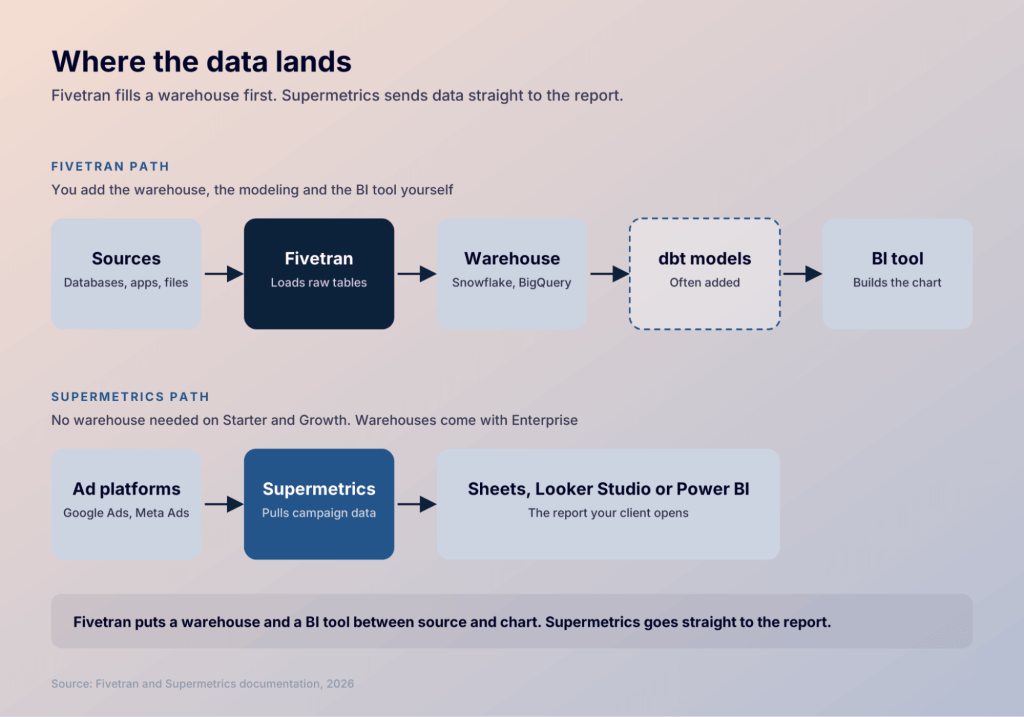
Fivetran is built for data and analytics engineers. They run a warehouse such as Snowflake or BigQuery, and Fivetran fills it with raw tables from databases, business apps, and files. Modeling happens afterward, often in dbt, with a BI tool on top.
Supermetrics is built for marketers and agencies. They want campaign numbers in Google Sheets, Data Studio, or another reporting tool, without running a warehouse.
The trouble starts when a tool lands with the wrong team. Marketers handed a warehouse tool wait on engineers for new reports. Data teams handed a reporting tool lack the raw tables they model from.
Not sure which side you are on? Find the setup closest to yours below.
| You are | Lean toward | Why |
|---|---|---|
| Data team with a warehouse | Fivetran | Loads many source types into the warehouse and connects to dbt |
| Marketer or agency reporting in Sheets, Data Studio, or Power BI | Supermetrics | Sends campaign data straight to those tools, with no warehouse |
| Marketing team weighing its first warehouse | Depends on the destination | A warehouse points to Fivetran. Sheets or Data Studio points to Supermetrics |
| Mid-market team running both | Both, for now | Each tool fits one team’s job, so merging has trade-offs |
Two common use cases below show how this plays out in practice.
| Weekly client report | Nightly multi-source load for dbt models | |
|---|---|---|
| Who runs it | Agency account manager or marketer | Data or analytics engineer |
| Data in | Last week’s Google Ads and Meta Ads results | Ads, CRM, and product data from several sources |
| Where it lands | A Data Studio report or Google Sheet | A warehouse such as Snowflake or BigQuery, then dbt models |
| Tool that fits | Supermetrics | Fivetran |


Serve both buyers from one Coupler.io account
Book a demoWhat each team connects: Fivetran vs. Supermetrics data sources
Fivetran has the wider catalog, with 700+ connectors that span databases, business apps, files, and ERPs. Supermetrics has 170+ connectors, mostly for marketing data such as paid media, SEO, social media, ecommerce, and email. Some premium connectors, such as Salesforce and The Trade Desk, are sold through its sales team.
So a raw count tells you little. Data teams need ad data to land next to CRM and product tables, so they want many kinds of sources in one place. For a marketer, the exact ad metrics clients ask for matter more.
Before you decide, list the sources and metrics your team reports on each week. Then check that each connector exists, carries those fields, and is not a premium one.
Where Fivetran vs Supermetrics destinations split: warehouse or spreadsheet
Fivetran delivers to cloud warehouses, databases, and data lakes, such as Snowflake and BigQuery. It does not list spreadsheets or BI tools as destinations, so you add a BI tool on top to build a chart.
Supermetrics goes the other way. Starter and Growth plans include one core destination (Google Sheets, Excel, Data Studio, Power BI, or an AI chat). Extra destinations are paid extras, capped at two in total. Warehouses such as BigQuery and Snowflake come with the Enterprise plan.
So Supermetrics is the short path from a connector to a chart, while Fivetran adds a warehouse and a BI tool in between.

Why Fivetran vs Supermetrics pricing surprises buyers differently
The two tools charge for different things, so each one surprises a different buyer.
Fivetran bills for activity. Each connection is billed on its monthly active rows, meaning the distinct rows added, changed, or deleted in a month. Supermetrics bills for capacity. Each plan caps data sources, accounts, users, and destinations, and passing a cap means a paid extra or a bigger plan.
| Fivetran | Supermetrics | |
|---|---|---|
| What you pay for | Monthly active rows on each connection | Plan caps on sources, accounts, users, and destinations |
| Starting point | Pay-as-you-go, plus a $5 base charge per connection | Starter at $44 a month billed yearly, Growth at $177 |
| What makes it jump | More connections, and more rows changing, including deleted rows | Passing a cap, such as a second destination or another user |
| Where the big money sits | Higher plans, plus transformations billed by model run | Warehouses, API access, and transformations on Enterprise, which is sold by quote |
Both vendors changed their pricing in 2026. Fivetran began counting deleted rows toward paid usage on January 1, 2026. Supermetrics raised Starter from $37 to $44 a month in May 2026. For the plan-by-plan numbers, see a full breakdown of Supermetrics pricing.
Each audience hits a different wall. As platforms keep updating numbers, and Fivetran’s docs say ad connectors can re-fetch earlier data during a conversion window so those rows can count towards usage. Marketers on Fivetran can see the bill grow even when the client list does not. Data teams on Supermetrics find that warehouse destinations, API access, and transformations are all on Enterprise, which is sold by quote.
A note on predictable pricing: Coupler.io keeps your monthly cost predictable, which is harder with either model above. It prices by connected accounts, and every plan includes all 420+ data sources. Plans start at $24 a month billed annually. See Coupler.io pricing.
Skip MAR math and plan caps with Coupler.io
Get a demoPipeline engineering vs. reporting speed: what each tool is built to do
Fivetran is built to keep pipelines running with little hands-on work. It adjusts to schema changes in your sources automatically and supports dbt Core for modeling after the data lands. Syncs can run as often as every 15 minutes on Standard or every minute on Enterprise. That suits data teams, because raw tables arrive ready to transform.
Supermetrics is built to get a report running fast. Its connectors deliver data to your reporting tool on a schedule, and the plans include reporting templates. Custom metrics and data blending need the Enterprise plan. That suits marketers because this week’s numbers reach the client report with nothing else to set up.
How Fivetran vs Supermetrics AI shows up in each tool
Fivetran’s AI is built for data teams and is still in public preview. Its Context Layer keeps your business definitions and metrics in one place for AI tools to read. MCP is a standard way to connect AI tools to your data. Fivetran’s Agent Context MCP server uses it to let assistants like Claude and ChatGPT read that layer. A separate Fivetran MCP server helps you manage pipelines in plain language.
Supermetrics’ AI is built for marketers, and it is available now. In Supermetrics Studio, you describe a dashboard in plain language, and it builds one. Its AI chats link your marketing data to Claude, ChatGPT, Copilot, and Gemini Enterprise, so you can ask questions about campaigns. Teams that build their own workflows can also use its MCP server. It requires API access, which is included in the Enterprise plan.
Pick Fivetran if your AI work starts in the warehouse, and Supermetrics if it starts with campaign numbers.
Where Coupler AI fits: Both vendors use AI to help you ask questions about your data. Coupler AI starts earlier, with the setup. It assembles the data flow from your request. Then it answers follow-up questions about the loaded data through the AI Agent. AI Integrations make the same data available in Claude or ChatGPT, and Skills add reusable analysis workflows. If you would rather start from a ready-made report, there are 200+ dashboard templates to choose from.
Let Coupler AI do the data work for you
Tell Coupler AI what you need to know, from which source, and how often. It connects your account, sets up the data flow, keeps it refreshed, and lets you analyze the results inside Coupler.io or another AI tool.
Try for free

Fivetran vs Supermetrics security & stability
Both vendors list the standard certifications. Fivetran lists SOC 1 and SOC 2 Type II, ISO 27001, HITRUST, GDPR, and CCPA, and it signs HIPAA agreements. Supermetrics lists SOC 2 Type II, GDPR, and CCPA, and its site also shows ISO 27001.
The differences are in the plans. Fivetran puts private networking and PCI DSS Level 1 on Business Critical, and user provisioning on Enterprise. Supermetrics puts SAML single sign-on and data residency controls on Enterprise.
Stability is harder to compare. Fivetran publishes an uptime promise. On Standard and higher plans, it guarantees its core services are available at least 99.9% of the time. It also says syncs resume where they left off after an interruption. Supermetrics’ pricing page lists no uptime figure, but on Enterprise, Supermetrics Storage is meant to protect reports from unexpected API outages. Before signing up for either, ask for its uptime record, since a certification does not promise uptime.
Supermetrics vs Fivetran in setup time and support: who can run each tool without help
Both start the same way: a free 14-day trial, with no credit card needed and no sales call.
After that, the work differs. Fivetran usually connects a source in minutes once a warehouse is ready, but turning raw tables into reports takes SQL and dbt skills. Supermetrics is built so a marketer can set up a report alone.
Support also differs by plan. Fivetran adds priority support on Enterprise. Supermetrics includes support by ticket, chat, and email on every plan, and adds a customer success manager on Enterprise. Here is a how reviewers rate both.
| Fivetran | Supermetrics | |
|---|---|---|
| G2 overall | 4.3/5 (800+ reviews) | 4.4/5 (800+ reviews) |
| G2 ease of use | 9.0/10 | 8.2/10 |
| G2 quality of support | 8.5/10 | 7.8/10 |
Fivetran scores higher on G2 for ease of use and support. The reviewers differ, though. Most Fivetran reviews come from mid-market companies, and most Supermetrics reviews come from small businesses. Use the scores as a guide and not a ranking.
Fivetran vs Supermetrics consolidation: what changes if you run both
A common setup goes like this. Marketing uses Supermetrics to send ad numbers to Data Studio, then the data team adopts Fivetran and loads the same ad platforms into the warehouse. Leadership asks why the company pays twice.

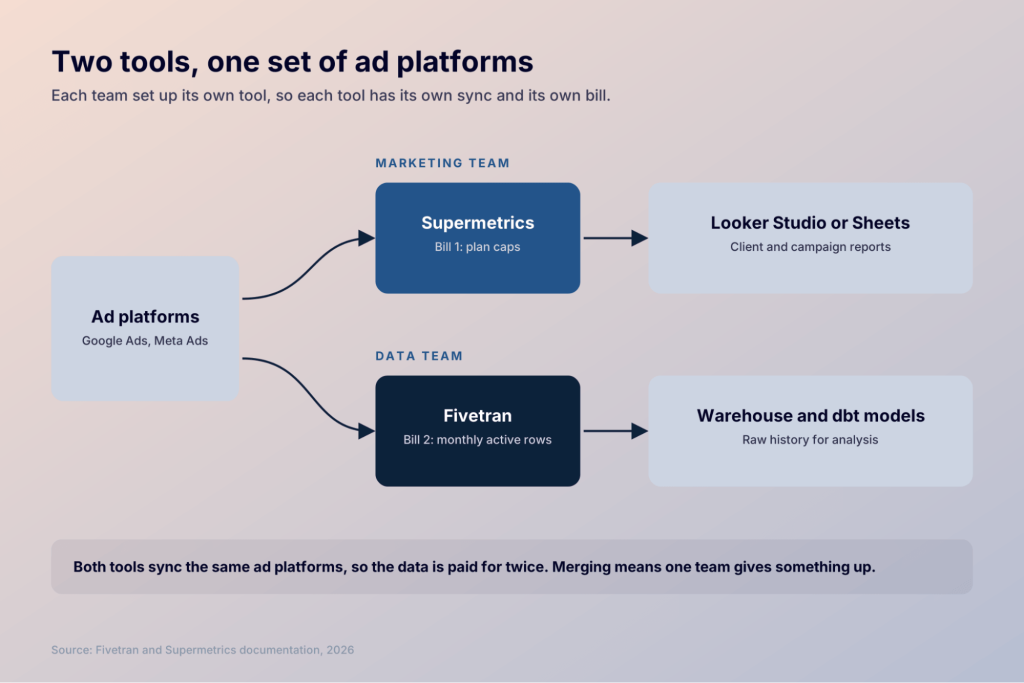
Merging them sounds simple, but each tool is wrong for the other team’s job. Fivetran has no Data Studio or Sheets destination, so marketers would wait on a warehouse and a BI layer. Supermetrics does not store your data by default, so data teams lose the raw history they model from unless they pay for Enterprise storage.
That leaves four ways forward.
| Option | What do you keep | What do you give up |
|---|---|---|
| Keep both | Each team’s own workflow | Double pulls from the same ad platforms, and two bills |
| Move marketing onto Fivetran | One vendor and one warehouse | Direct reports in Sheets and Data Studio |
| Move data onto Supermetrics with a warehouse | One vendor for ad data | Fivetran’s wider catalog and dbt integration, plus an Enterprise quote |
| Use a third tool for both | One tool for both jobs | Some of each tool’s specialist features |
These four checks should help you choose.
- List the sources both tools pull, because those are paid for twice.
- Decide who owns metric definitions, so spend and conversions mean the same thing in a dashboard and in the warehouse.
- Check whether marketers need Sheets or Data Studio, since that rules out a warehouse-only setup.
- Ask whether the data team needs raw history for dbt, since that decides whether Supermetrics can serve it.
If none of these fits cleanly, a third tool built for both teams is worth a look. Check out Fivetran alternatives.
Coupler.io: one platform for both teams, beyond Fivetran vs Supermetrics
Coupler.io gives marketers and the data team one platform, at a monthly cost you can forecast. It is a reporting automation platform for business teams. Coupler.io collects and blends data from 420+ apps and keeps it up to date for your reports and AI.
Every plan includes all of the sources. Data can go to Google Sheets, Excel, Data Studio, and Power BI, or to warehouses such as BigQuery and Snowflake. Every plan is SOC 2 Type II and GDPR compliant.
Here is how the three compare.
| Coupler.io | Fivetran | Supermetrics | |
|---|---|---|---|
| Primary buyer | Marketing, finance, sales, and agency teams | Data teams | Marketers and agencies |
| Pricing model | Connected accounts, with plan limits on destinations and refresh speed | Monthly active rows per connection | Plan caps on sources, accounts, users, and destinations |
| Warehouse support | BigQuery, Snowflake, Redshift, PostgreSQL, and Supabase | Widest range, including Databricks and Azure Synapse | Enterprise plan only |
| Sheets and Data Studio | Yes, within the plan’s destination limit | Not listed as destinations | Yes, as the core destination |
| Dashboard templates | 200+ | None listed | Reporting templates, plus AI-built dashboards in Studio |
| Transformations | Formulas, plus append, join, and aggregation on paid plans | dbt integration for full modeling | Enterprise plan only |
| AI capabilities | Coupler AI: AI Agent, AI Integrations, Skills | Context Layer and MCP, in public preview | Studio, AI chats, and an MCP server |
Coupler.io fits a team where marketers want self-serve reports, and the data team wants a feed into the warehouse, all from one tool.
If you use Fivetran mainly to feed marketing reports, the Coupler.io team can scope a move. See Coupler.io vs Fivetran for the full comparison.
Send marketing data to multiple destinations with Coupler.io
Get a demoVerdict on Fivetran vs Supermetrics: which should you choose?
Consider Fivetran: you are a data team moving large operational loads into a warehouse, with dbt in your stack. It has the wider connector catalog and warehouse range, and its Enterprise plan offers one-minute syncs and hybrid deployment.
Consider Supermetrics: you are a marketer or agency who needs ad data in Sheets, Data Studio, or Power BI, with no warehouse or engineer. You can try it free for 14 days, but watch the plan caps as your client list grows.
Pick Coupler.io: your reporting spans both worlds. Marketers want self-serve reports in Sheets or Data Studio, and the data team wants the same sources in a warehouse. If you are still comparing options, see the best Supermetrics alternatives.