What is TikTok Ads to PostgreSQL integration?
Imagine a TikTok Ads campaign wraps up, and someone on the team logs into Ads Manager to pull a spend report. That report gets downloaded as a CSV, reformatted so it matches last month’s tabs, and finally pasted into whatever tool the team uses for tracking. Multiply that across three ad accounts, and the export alone eats up time that could go toward analysis.
TikTok Ads to PostgreSQL integration is a direct connection from your TikTok Ads accounts to a PostgreSQL database, so campaign, ad group, and ad-level metrics land in queryable tables on their own. A way to set it up while avoiding any coding or maintenance work is to use Coupler.io’s TikTok Ads PostgreSQL connector. It brings TikTok Ads numbers to Postgres on schedule and keeps it updated without manual effort on your end.
Automate TikTok Ads to PostgreSQL data flow using Coupler.io
Coupler.io is a no-code data integration platform and AI analytics solution that lets you connect TikTok Ads to PostgreSQL with no engineering skills required. You pick the TikTok Ads report you need, name a table in PostgreSQL, choose how often it should refresh, and from that point forward, the sync runs itself.
There’s also a faster path if you don’t want to configure fields by hand. Use Coupler.io’s AI Agent, or an outside AI tool connected through MCP, to build the flow for you based on a plain-language request, such as sync my TikTok Ads campaign spend into PostgreSQL every hour.
Let Coupler AI do the data work for you
Tell Coupler AI what you need to know, from which source, and how often. It connects your account, sets up the data flow, keeps it refreshed, and lets you analyze the results inside Coupler.io or another AI tool.
Try for free

For those who prefer to see and adjust every setting themselves, here’s how to connect TikTok Ads to PostgreSQL in Coupler.io step by step.
Step 1: Collect data from TikTok Ads
First, click Proceed on the form below, with TikTok Ads already set as the source and PostgreSQL as the destination:

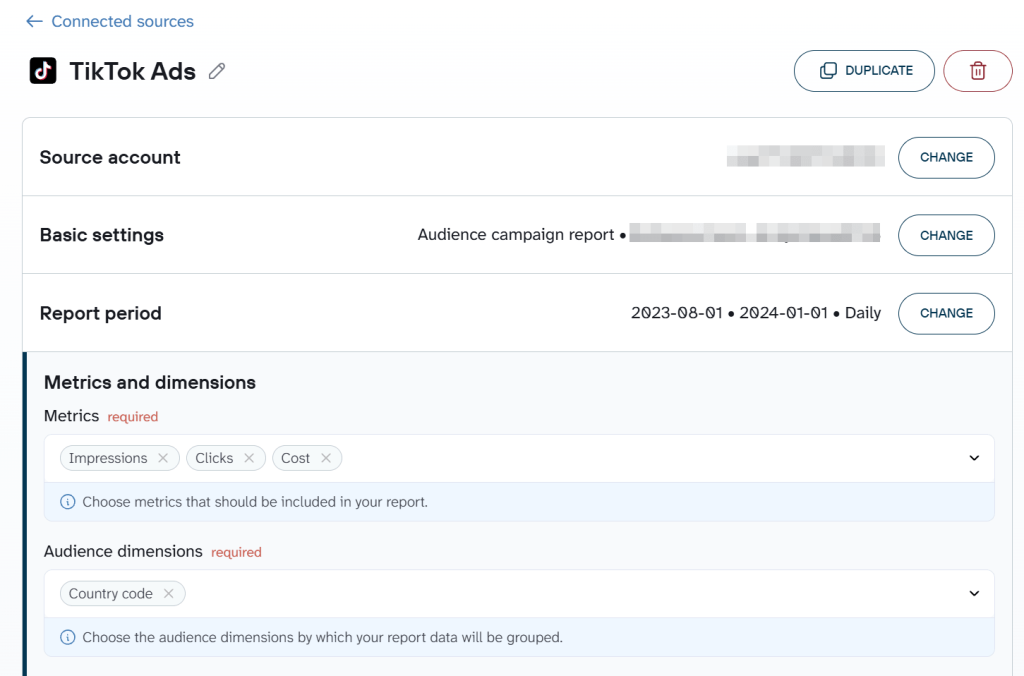
Create a Coupler.io account (no card required). Authorize your TikTok Ads account, select which ad account(s) to pull from, and choose the specific report type you need. Then set the report period and choose the metrics and dimensions the flow should include.

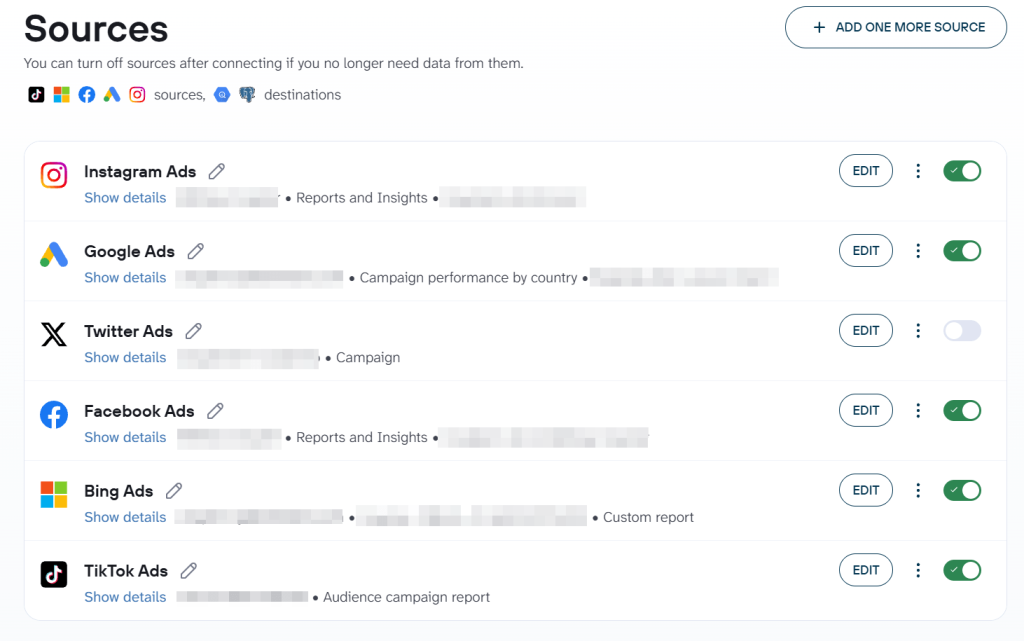
Before you move to the next step, you can choose from 400+ Coupler.io data sources to add to this same flow. Connect your TikTok Ads data along with other report types or accounts, or a completely different app, so all your data ends up in a single pipeline.

Step 2: Organize your TikTok Ads dataset (optional)
A raw export from TikTok Ads is built for TikTok’s own interface. Expect advertiser and campaign IDs you’ll never query directly, dimension columns you don’t need for a given report, and field names that don’t match your existing schema. Coupler.io lets you fix all of that before it ever reaches PostgreSQL, so you’re not repeating the same cleanup every time.
Available adjustments include:
- Hide or remove unwanted columns, such as advertiser IDs or dimension breakdowns you’re not reporting on right now.
- Rename or reorder columns to fit your table layout, for example, changing
spendtoAd Spendand pullingcampaign_nameto the front. - Filter and sort rows to keep only active campaigns or sort by spend to identify where budget is going.
- Aggregate data to sum spend and conversions by campaign or count live ads per ad group.
- Add calculated fields, like a CPA column built from spend divided by conversions.
- Blend in data from other apps to join TikTok Ads spend with CRM records or stack it against Google Ads and Meta figures.

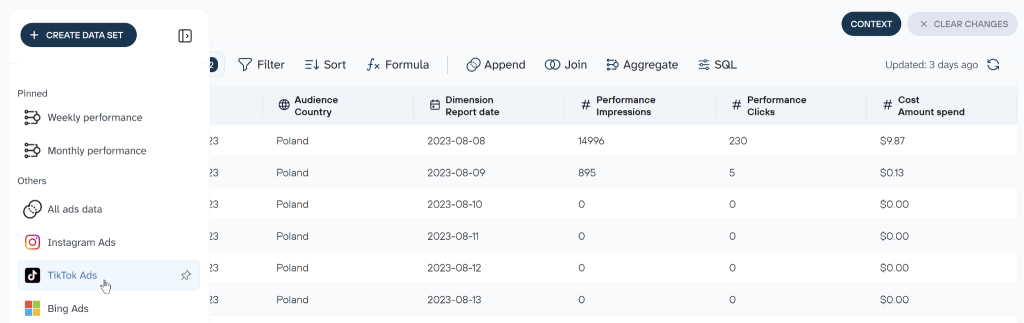
If you need to connect the same dataset to AI for analysis, you can also attach business context to it. For example, how your team defines a “qualified conversion,” so the definition doesn’t need to be retyped into every new AI conversation.
Once everything looks the way you want, proceed to send the dataset on to PostgreSQL.
Step 3: Load data to PostgreSQL
To import data into PostgreSQL, enter your connection details: host, port (5432 is the default), database name, username, and password. Your data stays secure with Coupler.io, which is SOC 2-certified and compliant with GDPR, HIPAA, and DORA.

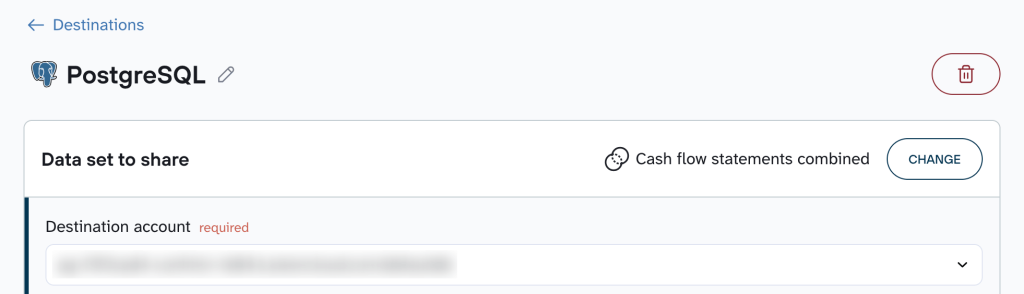
Name the target table and schema, then decide how new data should be imported. Replace clears the table and reloads it fresh each run. Append keeps historical rows while adding new ones.
Hit Save and run to integrate business data with PostgreSQL and the flow goes live.
From here, your TikTok Ads data is sitting in PostgreSQL, ready for whatever comes next:
- TikTok Ads data analytics
- automated TikTok Ads reporting
- tracking TikTok Ads metrics, and more.
PostgreSQL doesn’t have to be the only destination, either. Add Excel, Power BI, or an AI tool into the same flow, and Coupler.io pushes the data to each one without you rebuilding anything. That matters if, say, your analysts query PostgreSQL directly while the marketing lead just wants a spreadsheet or dashboard to skim.
One setting left: enable automatic refresh, from every 15 minutes for nearly real-time TikTok Ads PostgreSQL sync to once a month, depending on how often the report actually gets checked.

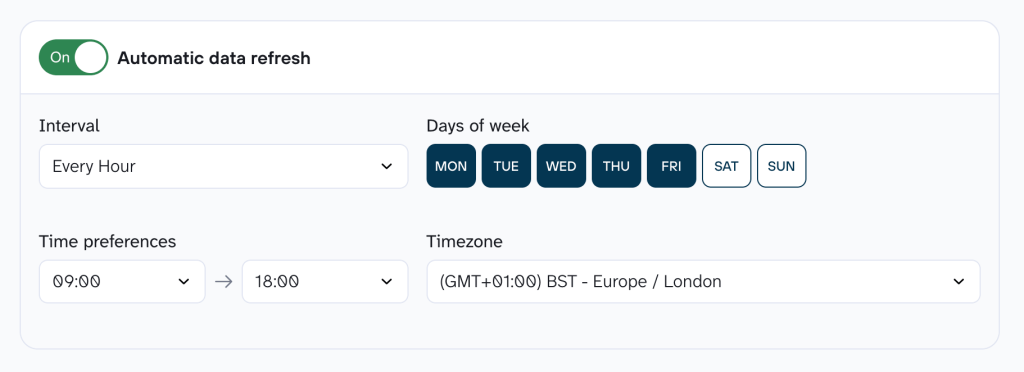
Save and run one more time, and that’s the point where Coupler.io starts to load data from TikTok Ads to PostgreSQL following the schedule you set.


Automate data flow from TikTok Ads to PostgreSQL
Get started with Coupler.io for freeBonus: Coupler AI Agent
Sometimes you don’t want a full PostgreSQL report but just an answer. Coupler AI Agent handles that inside the same flow you already set up. It lets you analyze your TikTok Ads campaigns and get a response without opening a query tool or waiting for the next scheduled load. Since it’s built for quick AI insights on data you’ve already connected, no separate setup is needed.
Behind the scenes, the AI Agent relies on Coupler.io’s Analytical Engine to do the actual math. Ask for average cost per conversion by ad group, for instance, and Coupler.io pulls the TikTok Ads numbers, runs the calculation, and then passes a verified result to the AI model to explain. That’s a meaningfully different process from feeding a spreadsheet into a chatbot and trusting its arithmetic, and it matters most when the question involves a formula rather than a lookup.
What data can you load from TikTok Ads
I’ve already covered how to export data from TikTok Ads with Coupler.io, but what exact data types are available in the connector? Here is a list of what you can get:
- Basic campaign report: spend, impressions, clicks, and conversions rolled up by campaign
- Basic ad group report: performance broken down by ad group, useful for comparing targeting or bidding setups
- Basic ad report: metrics at the individual ad level, including creative-specific results
- GMV Max campaign report: performance figures for TikTok’s automated shopping campaigns
- Campaigns: a structural list of campaigns with names, statuses, and budgets
- Ads: a list of individual ads with statuses and parent ad group references
- Basic advertiser report: account-wide totals across every campaign under an advertiser
- Audience campaign report: campaign results segmented by audience traits like age, gender, or location
- Audience advertiser report: account-level results segmented by the same audience traits
- Audience ad report: ad-level results broken down by audience segment
- Audience ad group report: ad group results by audience segment
- Playable Ad report: metrics specific to interactive, playable ad formats
- Playable Ad report by country: the same playable ad metrics split by country
- Dynamic Showcase Ads (DSA) campaign report: campaign-level results for dynamic showcase ads
- Dynamic Showcase Ads (DSA) report: performance data for individual dynamic showcase ads
- Dynamic Showcase Ads (DSA) advertiser report: account-wide totals for dynamic showcase ad activity
- Dynamic Showcase Ads (DSA) ad group report: ad group-level results for dynamic showcase ads
Where else can you pull TikTok Ads data apart from PostgreSQL?
PostgreSQL is just one of many destinations available, and the rest break down roughly like this:
- Spreadsheets – Google Sheets or Microsoft Excel – for teams that want a quick, editable view of campaign numbers before a meeting.
- BI tools, including Power BI, Google Data Studio, Tableau, and Qlik, if you’re building dashboards on one of these and need TikTok Ads feeding in alongside other channels.
- Data warehouses and databases, like BigQuery, Snowflake, Redshift, and Supabase, if PostgreSQL isn’t your primary warehouse or you’re evaluating options.
- AI tools, such as Claude, ChatGPT, Gemini, Perplexity, and Copilot, for cases where you’d rather ask questions about campaign data in plain language than write a query.
Send TikTok Ads data to an AI tool, and Coupler.io’s Analytical Engine still calculates results before the model explains them – the same mechanism covered above.
There’s also a growing set of AI Agent skills built specifically for ad platform data. So a repeated question doesn’t need to be rebuilt from scratch every time you ask it.
What you gain by using Coupler.io to connect TikTok Ads to PostgreSQL
The real payoff of TikTok Ads data in PostgreSQL comes from using it for analysis. Here’s how Coupler.io lets you get value from your dataset before and after it arrives in the destination:
Bring multiple TikTok Ads accounts and reports into one view
Agencies and larger marketing teams rarely run just one TikTok Ads account. So building a separate PostgreSQL table for each one turns basic TikTok Ads reporting into a maintenance project nobody signed up for. Coupler.io’s Append and Join features solve this before the data lands in your database. Append stacks the same report type from multiple accounts into one table, while Join combines datasets based on a shared column.
Imagine an agency handling TikTok Ads for five different clients. Instead of pulling five separate exports and merging them by hand every week, you select the Basic campaign report from all five accounts. Then you append them into a single table and send that TikTok Ads campaign data to PostgreSQL. The reconciliation work disappears, and the same approach scales whether you’re consolidating five accounts or fifteen.
Blend TikTok Ads figures with data from other business apps
Spend and clicks only tell half the story. Pair them with what happened after the click – a lead, a sale, a signup – and the same numbers start explaining whether the budget worked. Since Coupler.io reaches into more than 400 apps, you can combine data from different sources inside the same flow that already pulls from TikTok Ads.
Some ways teams use this in practice:
- Combine TikTok Ads spend with Google Ads and Meta Ads spend to get a blended CAC across paid channels, instead of relying on each platform’s self-reported number.
- Join TikTok Ads click and conversion data with HubSpot or Salesforce records to see which leads turned into closed deals.
- Match TikTok Ads conversion events against Shopify order data to confirm reported purchases line up with what shipped.
- Compare TikTok Ads campaign data with Google Analytics 4 sessions to check how TikTok-attributed traffic stacks up against what GA4 independently tracks.
None of these blends require a second tool or a separate data pipeline. They run inside the same flow you already built for TikTok Ads, and the combined result lands in the same PostgreSQL table.
Filter TikTok Ads numbers before they go to PostgreSQL
Not every dimension breakdown generated in TikTok Ads deserves a permanent home in your database. Coupler.io lets you filter by campaign status, date range, account, or virtually any other field, before the load runs. A typical filter setup for PPC reporting: keep campaigns with prospecting in the name, drop anything tagged as a test, or only load campaigns above a minimum spend threshold.
That way, PostgreSQL holds the campaigns you’re actually reporting on, and you avoid a growing archive of one-off test runs that nobody remembers to clean out. Smaller tables also mean faster queries, which matters once a dashboard is pulling from months of daily history.
Aggregate TikTok Ads raw data into custom metrics
Coupler.io can run sum, average, count, min, and max calculations on TikTok Ads data before it reaches the destination. So PostgreSQL receives finished metrics rather than rows you’d still need to run through aggregation with SQL afterward.
As one example, you can roll spend, impressions, and conversions up to the campaign level to immediately see where budget is concentrated and what it’s returning, without writing a single query.
Or go a layer deeper: average CPC by ad group and week to catch bid drift before it gets expensive, or total conversions by audience segment to find which age or gender groups are converting. Since this happens before the load, the numbers in the PostgreSQL table already match what your PPC review requires.
Get a clean TikTok Ads report with Coupler.io data set templates
Beyond building a flow from scratch, Coupler.io also offers ready-to-use data set templates for TikTok Ads. Each one arrives with the underlying data already structured and, where it makes sense, joined across report types. So it’s ready to analyze the moment it reaches PostgreSQL or any other destination.
Examples from the available templates include:
- TikTok Ads creative performance: breaks down creative results by ad format and time period, so you can see which creative styles are worth repeating.
- PPC campaign performance: combines TikTok Ads with Microsoft Ads, Quora Ads, Google Ads, Facebook Ads, and LinkedIn Ads to compare impressions, clicks, and spend side by side.
- Multi-channel geo performance: lines up TikTok Ads against Google Ads, Facebook Ads, X Ads, and Microsoft Ads by geography, showing which countries deliver the strongest results.
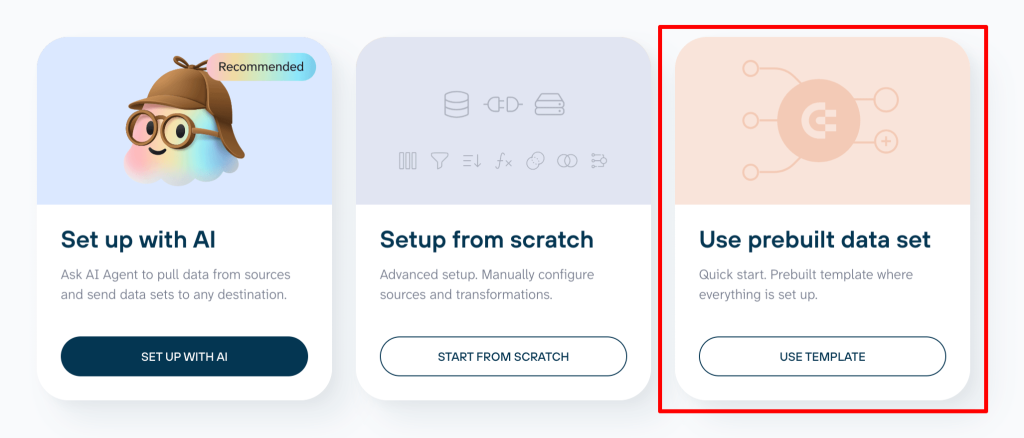
To use this, begin creating a new flow in Coupler.io and choose Use prebuilt data set. If needed, you can adjust the fields later before you export TikTok Ads data to PostgreSQL.

Derive up-to-date TikTok Ads insights from ready-made dashboards
If you’d rather not build charts on top of your PostgreSQL table, Coupler.io provides TikTok Ads report templates in Google Sheets, Google Data Studio, Power BI, Tableau, or Coupler.io itself.
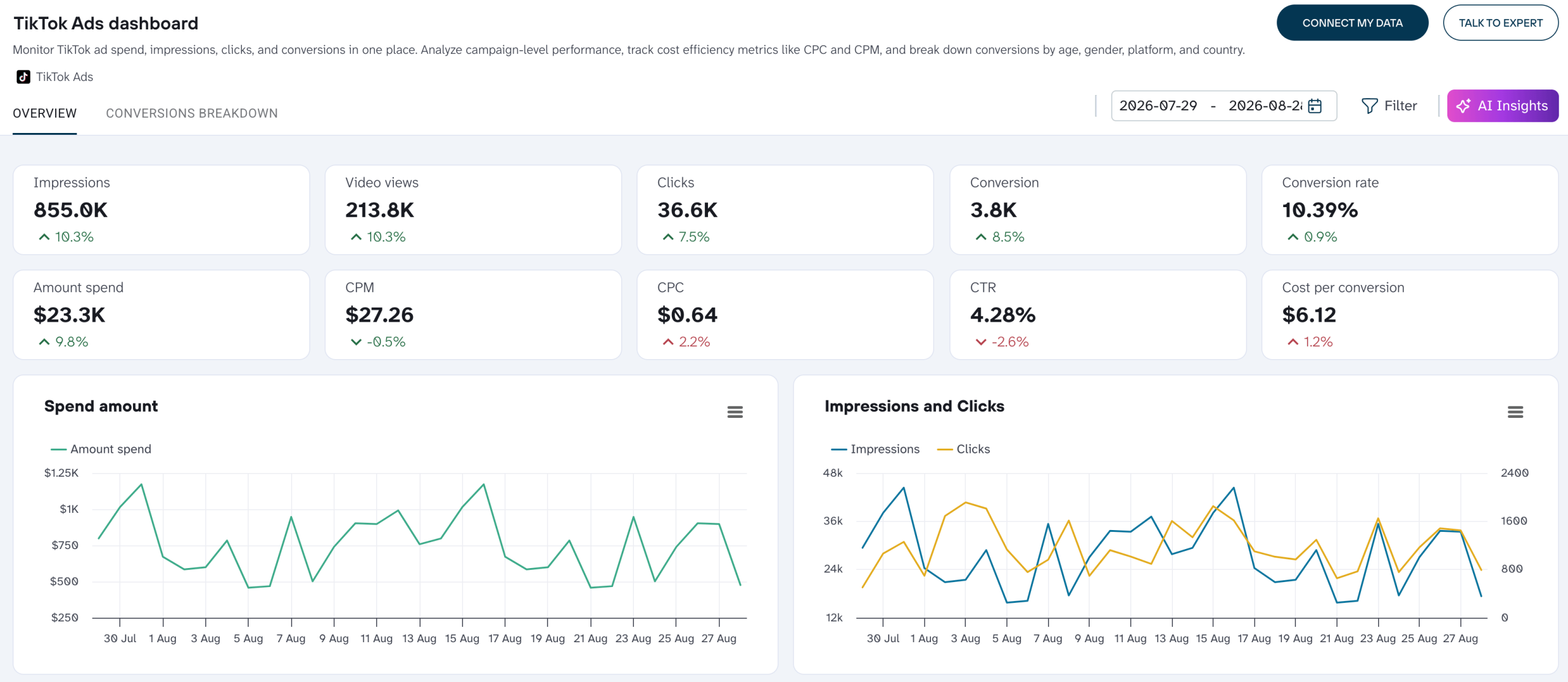
For example, the TikTok Ads dashboard lets you explore spend, impressions, clicks, reach, conversions, CPM, CPC, and average video playtime from multiple accounts in one view. Additionally, identify countries where budget is converting versus where it’s mostly disappearing with little to show for it, as well as performance by audience segments.

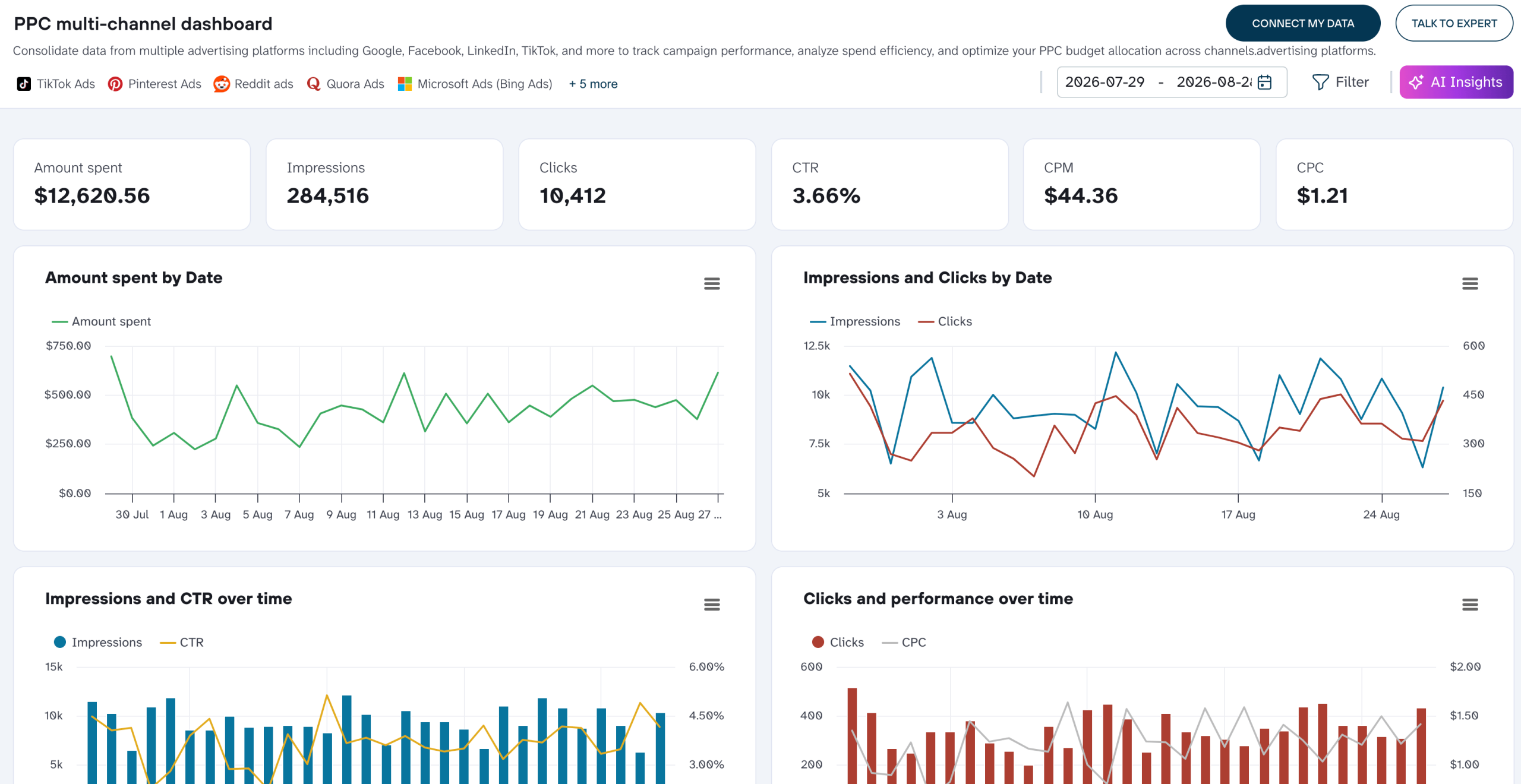
Running TikTok Ads next to other paid channels? With the PPC multichannel dashboard, you can track campaign performance, analyze spend efficiency, and optimize your budget allocation across TikTok, Microsoft, Google, Facebook, LinkedIn, X, Snapchat, Pinterest, Reddit, and Quora Ads.

Browse the complete set of TikTok Ads dashboards if none of these fit exactly.
Conduct AI-powered PPC analysis via Coupler.io AI
For questions that come up between scheduled reports, Coupler.io’s AI integrations let you talk to your TikTok Ads data through AI tools like Claude, ChatGPT, Gemini, Perplexity, or Copilot. They are connected via MCP and operate independently from the PostgreSQL flow. Together with the AI Agent and Analytical Engine described earlier, these integrations make up the Coupler AI layer.
While AI integrations are for informal questions that don’t warrant a full report, PostgreSQL remains where your analysts work. Anyone auditing the figures later can go for the structured, verifiable version of TikTok Ads campaign data in Postgres.
Analyze TikTok Ads performance with Coupler AI
Get started for freeOther ways to get data from TikTok Ads to PostgreSQL
Coupler.io is specifically suited for connecting data from TikTok Ads on one side to PostgreSQL on the other, without any manual work. That said, if your team has engineering resources or you’re simply curious about the DIY route, the two methods below cover manual file exports and a custom API integration.
Manual file export
This makes sense for a single, historical pull rather than something you plan to repeat weekly. All manual file export requires is to download a CSV/Excel document from TikTok Ads Manager, clean it, and upload it into Postgres. But someone has to remember to re-export, clean the file again, and rerun the import every time the numbers need refreshing. Plus, TikTok occasionally changes its export column layout, which can quietly break whatever script handled last month’s file.
Coupler.io lets you automate TikTok Ads to PostgreSQL reporting, on the schedule you pick, with no file to re-download by hand and no rebuild every time the export format shifts.
Custom API integration
Building directly against the TikTok Marketing API makes sense if a developer on your team is willing to own the pipeline long-term. Custom API integration buys you full control: exactly which fields you extract, how you transform them, and how they map into PostgreSQL. The cost of that control is ongoing maintenance, expiring access tokens, rate limits that show up fast once you’re pulling several accounts, and API changes that TikTok can introduce with relatively short notice.
With Coupler.io, nobody on the team has to track the API changelog as a recurring task, and the TikTok Ads PostgreSQL pipeline keeps working the same way whether it’s syncing one account or fifteen.
Challenges in TikTok Ads to PostgreSQL data flow
Five TikTok Ads accounts, one PostgreSQL table
To manage TikTok Ads across multiple accounts, whether for different clients, regions, or brands, you normally need to pull five separate exports and manually reconcile them into one report. That reconciliation step is where mismatched column orders or naming differences slip errors into the final numbers.
Coupler.io’s Append feature lets you select the same report type across all accounts and stack them into a single table before the load runs. As a result, PostgreSQL receives one consolidated dataset instead of a few spreadsheets someone had to merge by hand.
TikTok gives you spend and clicks, but not the metric you need
If you just replicate TikTok Ads data to PostgreSQL, the metrics you receive will be impressions, clicks, spend, conversions, and the like. These are useful numbers, but rarely the ones your PPC review is built around, such as CPA, ROAS, or a blended CAC across channels. To get there, you need to export the raw figures and rebuild the formula in a spreadsheet every single time.
With Coupler.io, you add a calculated column, say CPA from spend divided by conversions, before the data arrives in PostgreSQL. So the table you query already contains the metric you actually report on.
Columns from TikTok don’t quite match the table you already built
If PostgreSQL has a schema with its own naming conventions, TikTok’s default export fields, advertiser_id or campaign_name, often fail to line up cleanly with what’s already there. Left alone, that mismatch either breaks existing queries or forces a manual rename pass after every single load.
Coupler.io allows you to handle the renaming and reordering before the load happens, so the table structure in Postgres matches what your existing queries expect from the start.
The report was accurate yesterday, then nobody touched it again
A TikTok Ads report someone builds manually is correct on the day it’s built. A week later, spend has shifted, and new campaigns have launched, but the numbers in PostgreSQL stay frozen until someone remembers to re-export.
Automatic refresh in Coupler.io keeps that from happening. Set a frequency from every 15 minutes to monthly, and TikTok Ads data sync to PostgreSQL runs on its own, whether or not anyone checks in on it.
Automate TikTok Ads to PostgreSQL reporting
Get started for free