Polar Analytics pricing is tied to how much your store sells rather than how much reporting you need. Grow your GMV, and the monthly cost goes up with it, even if your dashboards, data sources, and reporting frequency don’t change. Below are my findings on how Polar calculates fees, what the Core and Custom plans include, and what a comparable reporting setup costs with Coupler.io.
Key insights
- Pricing model: Polar Analytics starts at $750 per month for brands below $5 million in annual impacted GMV. Monthly pricing follows trailing 12-month GMV, while annual contracts rely on the GMV basis agreed at the start, subject to the contract terms and cap.
- What’s included: The Core plan bundles Business Intelligence, AI Agents, and Data Activations, with Polar’s terms also listing products such as Klaviyo Audiences and Advertising Signals. Confirm the exact package in your order form, as Polar’s pricing materials differ on some product entitlements.
- What may cost extra: Incrementality Testing is priced per test. Custom connectors, demographic enrichment, Snowflake credit overages, and AI-agent token overages can add to the bill. Published materials also conflict on whether some BI features are included or sold separately.
- Alternative pricing model: Coupler.io bases subscription costs on connected accounts, destinations, and refresh frequency rather than store GMV. Its plans include Starter at $24/month, Active at $99/month, and Pro at $199/month (billed annually), with a Custom plan for specific data requirements.
- How to choose: Polar Analytics fits brands looking for custom ecommerce analytics, attribution, and activation capabilities tied to their store data. Coupler.io suits teams that need to move data from Shopify and other business apps into reporting destinations at a predictable price based on their setup.
How Polar Analytics sets your bill
Polar’s default pricing model relies on impacted GMV. The current terms and official pricing calculator say month-to-month pricing revolves around trailing 12-month GMV. Meanwhile, yearly pricing is based on the last-12-month GMV figure locked for the annual contract, subject to the applicable cap and order-form terms.

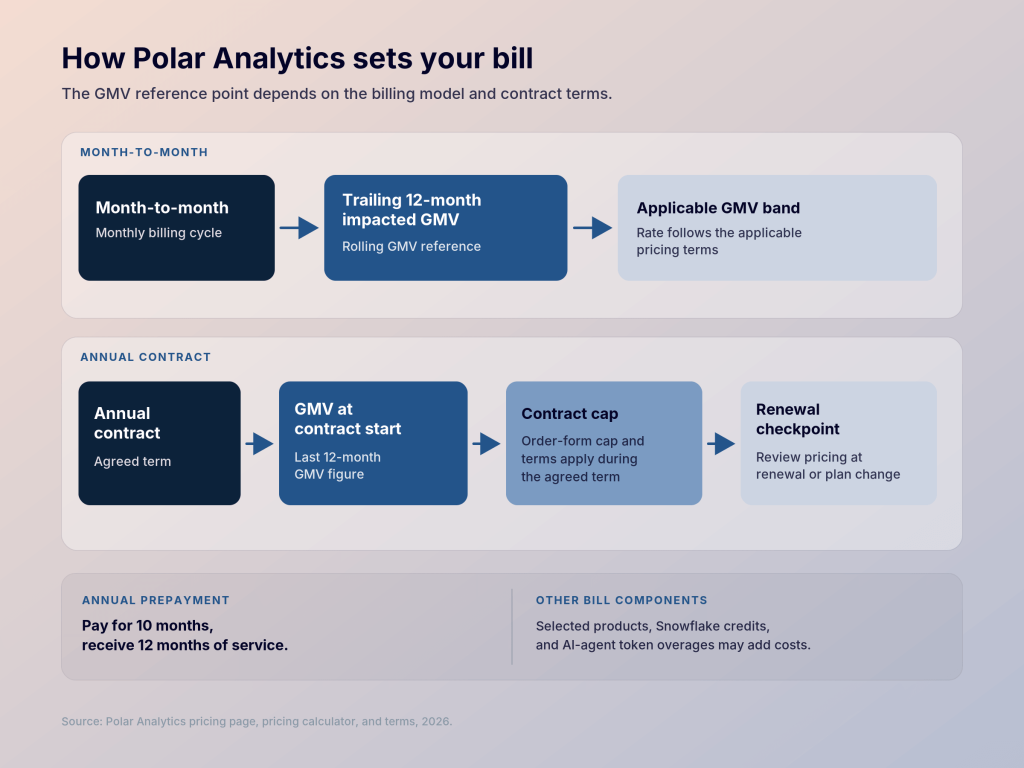
Impacted GMV doesn’t always mean all company sales. According to Polar’s terms, when you use the product only for online data, pricing is based on online GMV, even if you also have substantial retail or other offline revenue. Estimate a package against annual GMV using the pricing calculator, then verify the scope with Polar.
However, the full bill isn’t necessarily GMV-only. The calculator also shows separate Snowflake-credit and AI-agent token allowances, along with overage rates for the package range it displays. Those usage charges need to be checked alongside the base plan.
The terms also allow Polar to offer a contract-specific flat fee based on a committed total GMV amount, with any true-up mechanism recorded in the order form. That is a negotiated contract structure rather than a published flat price available to every account.
Note: Polar’s annual prepayment terms state that customers pay for 10 months and receive 12 months of service.
The financial trade-off of using Polar: By default, as sales grow and move into a higher GMV bracket, your cost increases, while usage-based overages, selected products, and contract terms add to the bill.
Polar Analytics pricing plans: Core vs Custom explained
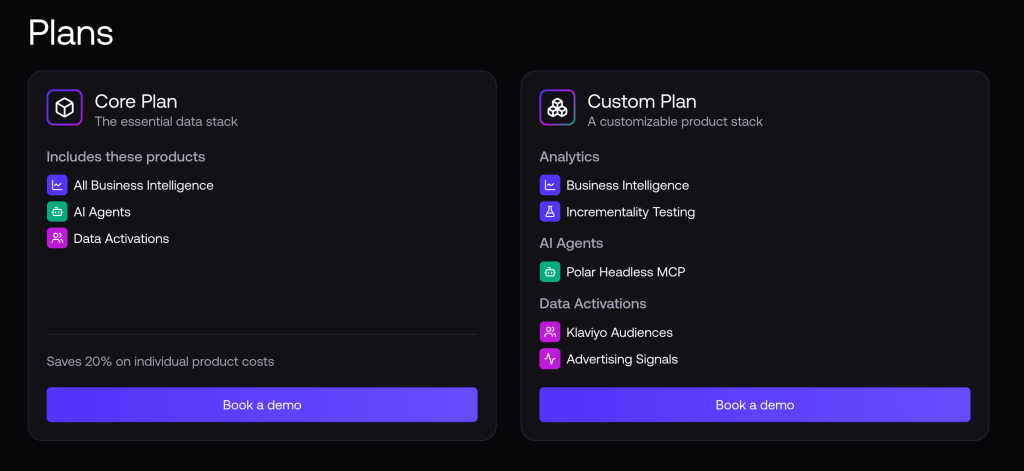
Polar’s pricing page presents two plan choices, Core and Custom, on top of the GMV model, with the product bundle changing between them. The latest pricing calculator also displays additional package labels. So use the public page to compare the broad plans and the calculator to see the latest product packaging.

Core plan
Core is Polar’s bundled option for brands that want analytics and activation products together. The public pricing page groups Business Intelligence, AI Agents, and Data Activations in this plan and says it saves 20% compared with the individual product costs. The current terms also list Polar Headless MCP, Klaviyo Audiences, and Advertising Signals among Core products.
Business Intelligence covers dashboards, custom reporting, multi-touch attribution through the Polar Pixel, Ask Polar AI, goal tracking, alerts, and scheduled reports. Data Activations add capabilities such as recovering missed Klaviyo audiences and sending enriched conversion events to ad platforms.
The Core plan suits teams that expect to use several parts of Polar’s stack rather than buying a narrow reporting layer.
Custom plan
The pricing page presents five product choices within Custom: Business Intelligence, Incrementality Testing, Polar Headless MCP, Klaviyo Audiences, and Advertising Signals. As per the vendor’s terms, recurring components of selected Custom products use GMV-based pricing, while Incrementality Testing is priced per test. Choice of fewer recurring products therefore doesn’t remove the GMV basis. The per-test model is the important exception because testing volume adds a separate usage-based charge.
Custom is more suitable when a brand needs a selective stack, such as BI without the full activation bundle, or specialist incrementality measurement. That flexibility affects the product bundle, but the quote still needs to identify GMV basis, included platform capabilities, support tier, add-ons, and any usage caps.
Can you get the needed marketing data setup at a lower price?
Polar’s published entry price is $750/month for brands below $5 million in annual impacted GMV. Higher GMV bands have different rates, but when and how pricing changes depend on the billing model and contract terms.
If this doesn’t quite fit your needs, consider a Polar Analytics alternative with a different pricing model. Coupler.io is a data integration and AI analytics platform that pulls data from 400+ sources, with Shopify and Klaviyo included, lets you prepare reports, and brings them to the reporting tools you already use.
Here’s what you get with Coupler.io:
- 230+ dashboard templates. Start with ready-made dashboards in Google Sheets, Data Studio, Power BI, or right in Coupler.io, such as for Shopify orders, Shopify store traffic, Shopify marketing funnel, and more.
- 100+ data set templates. Build reports using pre-built datasets, like Shopify orders with COGS, top-selling products, inventory stockout forecasts, combined Shopify and GA4 performance views, etc.
- Data transformations. Filter records, join or append sources, aggregate metrics, add calculated columns, and use SQL transformations when your reporting model requires more complex data preparation.
- Multiple types of destinations. Send data to spreadsheets (Google Sheets and Excel), BI tools such as Power BI and Tableau, data warehouses like Snowflake and Redshift, or AI tools, including Claude, ChatGPT, and others.
- Coupler AI. Use the built-in AI Agent to ask questions about connected data and work with your data flows, AI Integrations to fetch prepared data to AI tools, and AI Agent Skills to run repeatable analytical workflows.
- Near-instant refreshes. On the Custom plan, scheduled data refreshes are possible as often as every 15 minutes.
Regarding the scope, Coupler.io covers the data-delivery and reporting layer of Polar’s bundle. It moves Shopify, Klaviyo, and other data into the BI tool, warehouse, spreadsheet, or AI tool of your choice. But it’s not an alternative for Polar’s Pixel-based attribution, managed ecommerce semantic layer, dedicated Snowflake environment, Incrementality Testing, or activation products like Klaviyo Audiences. If these Polar-specific capabilities are the reason you use Polar, this isn’t a like-for-like replacement.
Below, I compared Polar Analytics pricing 2026 against Coupler.io across account limits, destination count, and refresh frequency.
| Plan and listed price | Connected accounts | Users | Destination count | Refresh frequency | Main price driver |
|---|---|---|---|---|---|
| Polar Analytics Core, from $750/month, includes Business Intelligence, AI Agents, and Data Activations | Not account-based, priced by GMV | Unlimited | Not destination-based, package scope applies | 15-minute intraday refresh is listed in terms | Impacted GMV, plus applicable add-ons or usage charges |
| Coupler.io Starter, $24/month billed annually | 3 | 1 | 1 | Daily | Accounts, destinations, and refresh tier |
| Coupler.io Active, $99/month billed annually | 15 | Unlimited | 3 | Daily | Accounts, destinations, and refresh tier |
| Coupler.io Pro, $199/month billed annually | 50 | Unlimited | Unlimited | Hourly | Accounts, destinations, and refresh tier |
| Coupler.io Custom, flexible annual price | Custom | Unlimited | Custom | Every 15 minutes | Configured data setup and service requirements |
Comparison verified as of October 2026. Pricing and features may change.
Side-by-side cost example
Consider a Shopify brand with around $4 million in annual impacted GMV. It runs paid acquisition on Meta Ads, Google Ads, and TikTok Ads, tracks website performance in GA4, and uses Shopify as its commerce platform. The team sends reports to Data Studio and keeps a backup in BigQuery. That means five connected accounts, two destinations, and an hourly refresh requirement.
Using Polar’s published Core starting price of $750 per month for brands below $5 million in annual impacted GMV, compared with Coupler.io Pro at $199 per month on annual billing, the difference is $551 per month, or $6,612 per year. Coupler.io Pro supports 50 connected accounts, unlimited destinations, and hourly refresh, so this reporting setup fits within its published limits.
Now suppose the same brand grows from $4 million to $8 million in annual impacted GMV without changing its reporting setup. A month-to-month Polar subscription moves into a higher GMV pricing band as trailing 12-month impacted GMV increases, although Polar doesn’t publish an exact price for the $8 million scenario. Annual contracts retain the agreed starting GMV basis and cap during the contract term, with pricing changes considered at renewal or upgrade. Coupler.io Pro remains at $199 per month on annual billing because the five connected accounts, two destinations, and hourly refresh requirement haven’t changed.
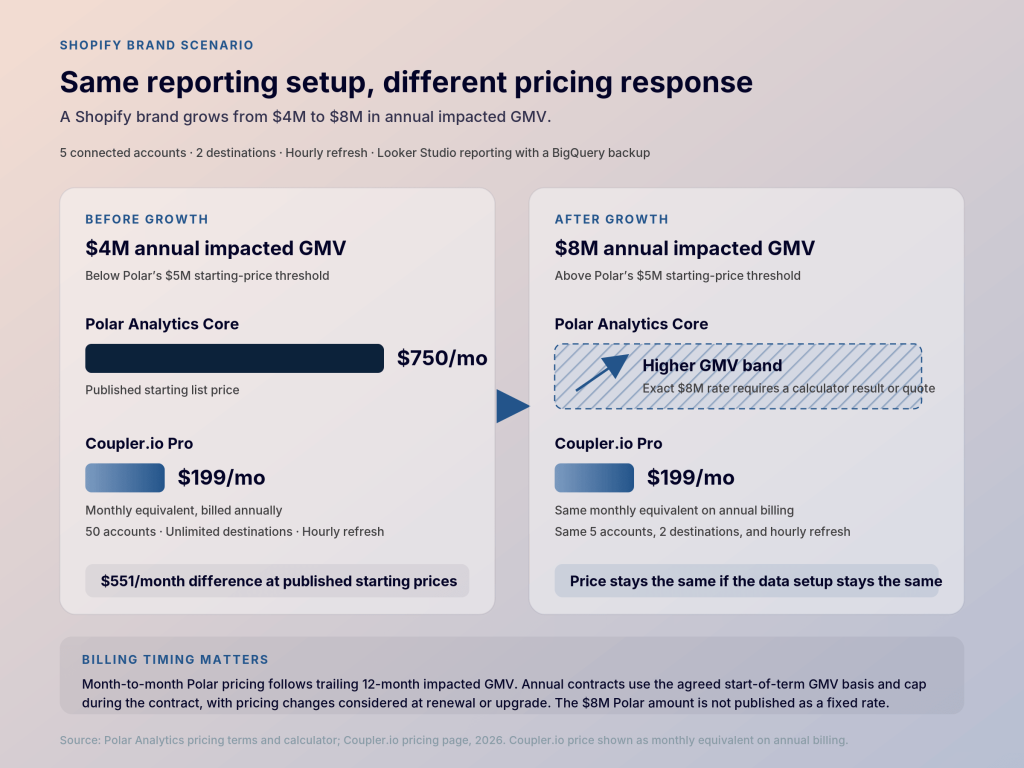
These are illustrative list-price comparisons, not like-for-like product equivalents or custom quotes. The actual Polar price depends on the selected products, billing model, contract cap, and order-form terms.


Compare your reporting requirements and costs with Coupler.io
Book a callPolar Analytics features pricing: What adds to the bill
Besides the base GMV price as only one part of the cost review, I researched BI add-ons, data enrichment, Incrementality Testing, and usage allowances separately. Polar’s pricing materials don’t describe every product consistently, and some add-on prices aren’t publicly displayed. So I’d recommend using the latest terms and the order form to decide which line items apply.
Business Intelligence add-ons
The Business Intelligence section of Polar’s pricing page lists intraday refresh, demographic enrichment, SQL access to the warehouse, Google Sheets mirroring, and custom connectors as add-ons. However, the terms updated on October 22, 2026 list 15-minute intraday refresh, SQL access, and Google Sheets mirroring as part of the Polar Data Platform. The pricing calculator also lists intraday refresh as included in every plan. These official pages conflict on packaging, so don’t assume those three capabilities are extra or included without confirming the order form.
Custom connectors are clearer. The terms identify them as optional Data Platform add-ons available on any plan, priced through a one-off custom quote based on total plan value. Demographic enrichment appears in the pricing calculator and Personas product page, with continuous monthly enrichment listed at $500 per month for up to 50,000 active customers, or one-off enrichment at $0.10 per customer enriched. The calculator describes enrichment as including lifecycle traits and syncing to Klaviyo and Meta. Verify the customer-volume tier and whether the offer fits the selected plan.
Polar’s calculator also shows separate usage limits for Snowflake credits and AI-agent tokens for the displayed GMV range. It lists a 540 million annual Core agent-token cap, token overage at $3.33 per million tokens per month, and Snowflake credit overage at $4 per credit. There’s also a $250 per month Snowflake credit add-on with 70 credits. These are usage-related costs, separate from the GMV basis, and you should make sure there’s the applicable allowance for the selected product and contract.
Incrementality Testing
This product estimates which marketing activity drives additional sales. Polar describes a dedicated data scientist, lift tests across Meta, Google, TikTok, and TV campaigns, impact testing across Shopify, Amazon, and retail channels, and reports with recommendations. The terms say the service is available to brands above $10 million in annual GMV and price it per test. The pricing calculator labels Causal Lift as available for $10M+ GMV, so the exact threshold at $10 million is unclear. Check eligibility with Polar before budgeting for tests.
The pricing page separates first-test pricing, each subsequent test, and quarterly testing, but the public page doesn’t expose readable rates for those lines. The Causal Lift product page shows $5,000 per test for a $50 million brand when bundled with the Polar Data Platform, versus $20,000 for the standalone product. Those amounts are examples for that stated GMV and packaging rather than universal rates. Request a quote for the intended cadence and package. Since the component is priced per test, a quarterly testing plan and several individual tests shouldn’t be assumed to cost the same amount.
Klaviyo Audiences
Klaviyo Audiences targets shoppers that native Klaviyo tracking misses. It identifies missed browse-abandonment and add-to-cart events so a brand can re-engage net-new shoppers and use existing automations to generate more email revenue. Polar lists the capability within the Core data activation bundle and as a product choice in Custom packaging. Make sure of its exact entitlement in the order form rather than assuming it always appears as a separate line item.
Advertising Signals
Users work with Advertising Signals to send conversion events to Meta Ads and Google Ads through their Conversion APIs, including custom event configuration. This product’s positioning is a CAPI enhancer for ad conversion signals. Polar’s terms list Advertising Signals as included in Core and available as a Custom plan add-on for qualifying brands with $10 million or more in annual GMV. The CAPI enhancer product page describes the conversion-event workflow. The main pricing page doesn’t publish a separate add-on price, so learn about eligibility and any quoted fee directly.
Polar Headless MCP
Model Context Protocol (MCP) exposes the Polar warehouse and ecommerce semantic layer to compatible AI tools. The product page specifies a dedicated Snowflake warehouse, 400+ pre-built ecommerce metrics, an MCP-native interface for Claude, ChatGPT, Lovable, and other tools, 40+ connectors plus Polar Pixel attribution, custom metrics and dimensions, and 15-minute refresh. The current terms describe the MCP layer as part of Core and also list it as a product in Custom. Explore the selected package for the precise scope.
The pricing calculator lists Polar MCP under the Ultimate tier label, which disagrees with the Polar’s terms, so it’s better to see the included product in their order form.
Coupler AI covers three capabilities: AI Agent for conversational analysis of your data, AI Integrations into AI tools (ChatGPT via its official App listing + MCP, Claude/Gemini/Perplexity/Cursor via MCP, plus a Custom MCP destination for anything else), and a Skills library of reusable AI workflows. Unlike Polar’s MCP tier, you get these on any paid plan rather than as a separately priced product.
What a Polar Analytics bill actually looks like by GMV band
Polar’s main pricing page lacks a complete static GMV-to-price grid. But there’s the pricing calculator using annual GMV to show applicable products and pricing.
It currently displays several product packages for the under-$5-million GMV range: MCP / Data Platform at $500 per month, BI / Insights at $625 per month, and Core / Insights & Actions at $750 per month. It also displays GMV-capture percentages alongside those packages. These calculator options use labels that differ from the main pricing page’s Core and Custom framing, so treat them as live calculator outputs rather than a complete public rate card for every GMV band.
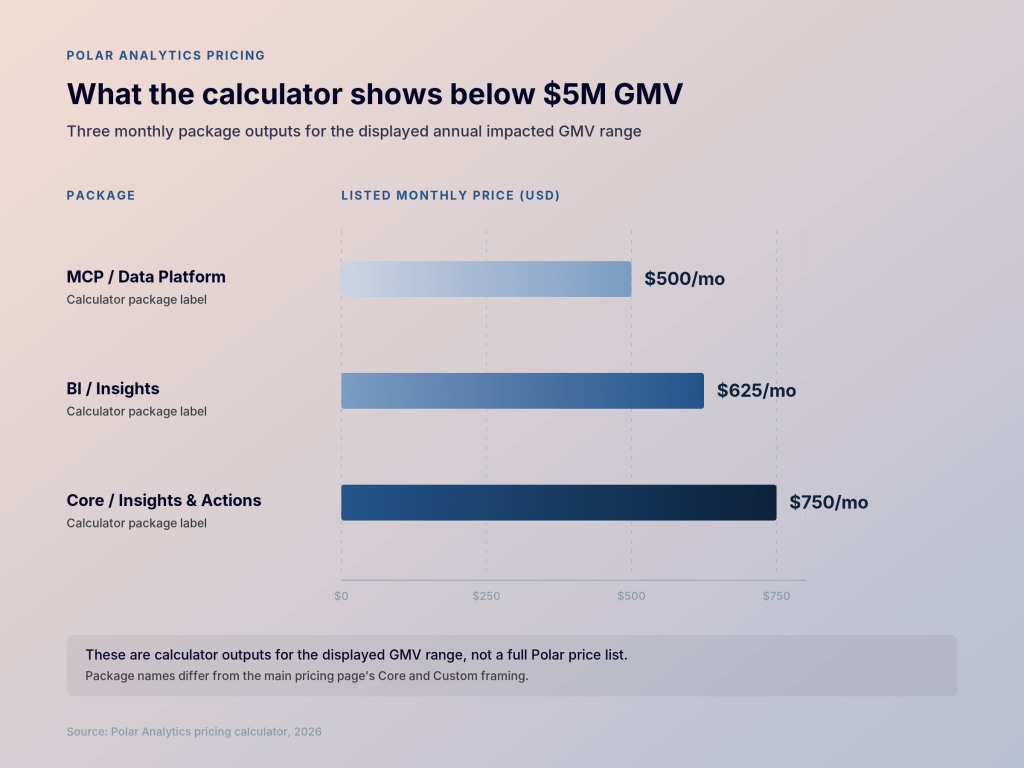
The public information is enough to establish the pricing principle, but not enough to calculate every bill from GMV alone. Product selection, usage allowances, custom connectors, Personas enrichment, incrementality tests, support tier, and the terms of the order form are likely to change the total. For a higher-GMV store, use the calculator and obtain a written quote.
Polar Analytics Shopify pricing: Why growth hurts the most
The issue with Polar Analytics pricing isn’t the use of GMV by itself but recurring cost rising without adding reporting value, as you often don’t need to change your setup at all.
Imagine a Black Friday and Cyber Monday period, a new product launch, or a new acquisition channel can increase trailing 12-month GMV. For monthly customers, the GMV basis updates with that rolling period and moves the account into another price bracket under the rate card. For annual customers, the initial GMV figure and contract cap apply during the agreed term, with new pricing considered at renewal or a plan change under the relevant terms. That difference affects budget forecasting.
In contrast, Coupler.io’s subscription cost grows when you change the data setup, such as by adding connected accounts or by choosing a different plan.
There is one contract caveat: As already stated above in the article, Polar’s terms permit a flat fee based on a committed total GMV amount, with a true-up mechanism if the order form specifies one. It’s better to compare the actual commitment and cap with the forecasted GMV path instead of assuming every Polar contract reprices monthly in the same way.
Which pricing model fits your Shopify brand?
Polar Analytics fits if you want managed ecommerce BI, a dedicated Snowflake database, a semantic layer with commerce metrics, first-party attribution, and connected audience or conversion activation. Its GMV-based pricing makes sense when those capabilities replace multiple specialist products and the brand accepts that the recurring price is linked to impacted GMV. You should still double-check which platform features and support levels are included in their signed package.
Coupler.io is a more suitable choice if you need to collect records from Shopify and more business data sources, transform them, and load them into other apps used for reporting. It links cost to the shape of the data setup rather than to the store’s revenue. Depending on your plan, you’ll use a fixed set of connected accounts to supply data to the available number of destinations at the refresh frequency allowed.
For a wider view of data and marketing platform pricing, compare our breakdowns of Funnel.io pricing and Supermetrics pricing.
A practical test is to list the outputs your team actually uses. If you need a managed ecommerce semantic layer, multi-touch attribution, and activations tied closely to customer behavior, evaluate Polar’s bundle and contract terms. If the main requirement is reliable scheduled data delivery to reporting destinations, compare the account-based setup in Coupler.io pricing before paying for a GMV-based analytics suite.
Review your Polar Analytics switch plan with Coupler.io
Book a demoFAQ
How much does Polar Analytics cost per month?
Polar Analytics lists a Core starting price of $750 per month for brands below $5 million in annual impacted GMV. The final amount depends on the applicable GMV bracket, selected products, add-ons or usage charges, support tier, and contract terms. The annual prepayment option provides 12 months of service for 10 months of payment when applicable.
Does Polar Analytics pricing increase automatically as my store grows?
No, this crossed threshold doesn’t mean the invoice must increase at the next billing cycle. Monthly pricing uses trailing 12-month GMV and follows the applicable rate card. Annual contracts use the GMV basis at the start of the contract, subject to the agreed cap and term. Pricing may change at renewal or upgrade, and the terms also allow a negotiated flat fee with a GMV commitment and any specified true-up.
What’s included in every Polar Analytics plan, regardless of GMV band?
The pricing page lists a Snowflake database, ecommerce semantic layer, first-party Pixel, custom roles and permissions, unlimited users, and unlimited historical data. Polar Analytics terms include live chat and in-app helpdesk for all customers. They set annual contract value thresholds for a dedicated Success Manager, a Slack channel, and a Solution Engineer, though the pricing calculator displays different thresholds. So confirm those support items in the order form. Public pages also differ on whether intraday refresh, SQL access, and Google Sheets mirroring are add-ons or included platform features.
Does Polar Analytics publish its full GMV pricing?
No. The main pricing page doesn’t show a complete static GMV-to-price table. Polar’s pricing calculator estimates prices from annual GMV and currently displays several package outputs for the under-$5-million range. For other GMV bands and product combinations, request a quote based on the intended scope and contract.
Can Coupler.io replace Polar Analytics?
Coupler.io replaces the data delivery and dashboarding layer. It brings your data into spreadsheets, BI tools, data warehouses, and AI tools, and its pricing is tied to accounts rather than GMV. However, it doesn’t have capabilities equivalent to Polar’s Pixel-based attribution, managed Snowflake warehouse, semantic layer, or activation products like Klaviyo Audiences. If your Polar bill is going mostly to reporting rather than those bundled products, Coupler.io covers the same job for a lot less.