Whatagraph vs Funnel.io looks like a match between two tools that do the same job. Both pull data from ad platforms like Google Ads and Meta. Both sell yearly plans to agencies and in-house marketing teams.
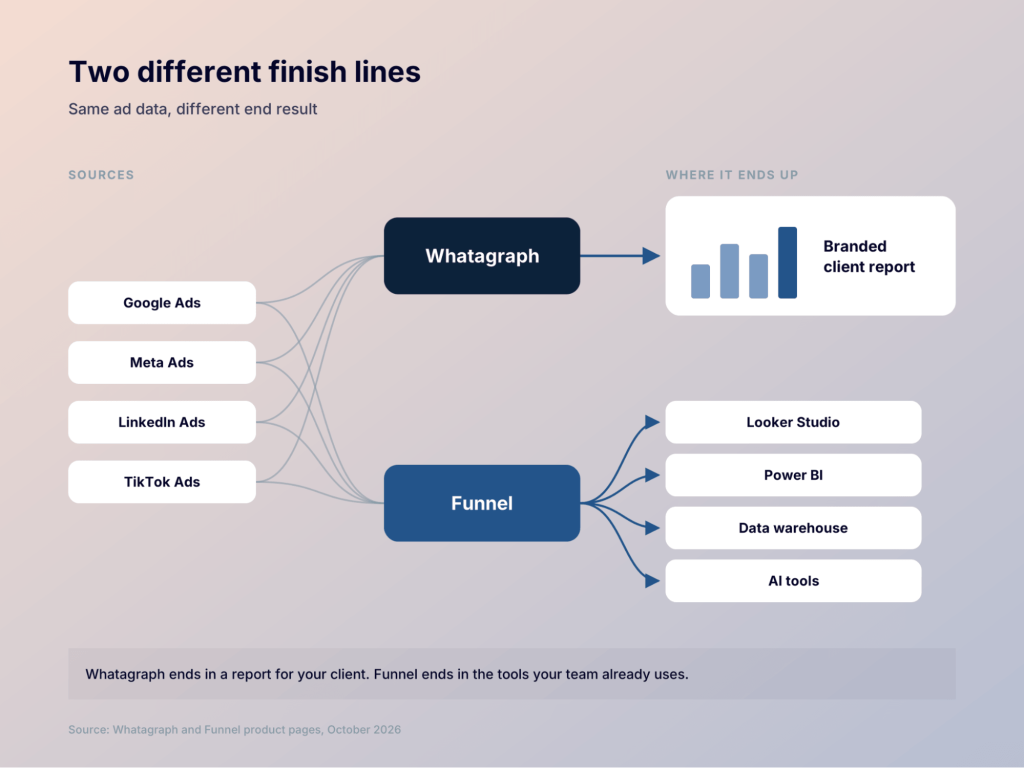
But they finish the job differently. Whatagraph turns your data into branded reports that you send to clients. Funnel.io collects and cleans your data, then sends it to other tools, like Data Studio or a data warehouse. A data warehouse is a big database where companies keep all their data in one place.
Key takeaways:
- Different end results. With Whatagraph, you end up with a client report. With Funnel.io, you end up with clean data in the tool your team already uses.
- Starting price. Whatagraph Max starts at €699 a month, paid yearly. Funnel.io Starter starts at $300 a month, paid yearly.
- Free trials. Whatagraph gives new accounts a 14-day trial of its Max plan. Funnel.io offers a 30-day trial, and you don’t need a credit card.
- Number of connectors. Funnel.io connects to 117 sources on Starter and 600+ on Enterprise. Whatagraph connects to 60+ sources, and you can add others through its API or Google Sheets.
- AI helpers. Whatagraph has 13 ready-made AI agents that build and fix reports. Funnel.io AI is a chat where you ask questions about your data.
- Security checks. Funnel.io has passed both SOC 2 and ISO 27001 audits. Whatagraph has ISO 27001 but doesn’t mention SOC 2.
The Whatagraph and Funnel.io comparison table
This table shows how the two tools compare on the questions buyers ask first. The facts come from each company’s own website as of October 2026. The ratings come from G2, a software review site.
| Whatagraph | Funnel.io | |
|---|---|---|
| Best for | Agencies that send branded reports to clients | Teams that need one central home for marketing data |
| Main result | Reports and dashboards inside Whatagraph | Clean data sent to other tools |
| How you pay | Credits for each connected account, plus AI agent use, paid yearly | Flexpoints (units of capacity), paid yearly |
| Starting price | Max from €699/month | Starter from $300/month |
| Free trial | 14-day Max trial | 30-day trial, no card needed |
| Data sources | 60+ connectors, plus custom API | 117 on Starter, 600+ on Enterprise |
| Where data can go | AI tools on all plans, Data Studio and BigQuery on Prime | 13 to 47 places, depending on the plan |
| Users | Unlimited | Unlimited |
| AI tools | IQ Agents, Whatagraph IQ, Whatagraph MCP | Funnel.io AI, Funnel.io MCP |
| Measurement | Not listed on the pricing page | Marketing mix modeling and more (Funnel.io Measure add-on) |
| Security | ISO 27001, GDPR, EU hosting | SOC 2 Type 2, ISO 27001, GDPR, CCPA |
| G2 rating | 4.5 (286 reviews) | 4.5 (293 reviews) |
Whatagraph vs Funnel.io key features and what each one is built to do
Whatagraph is a reporting tool first. You build reports by dragging charts and tables onto a page. It has 20+ chart and table types and ready-made templates. Each report can show your client’s logo and colors instead of Whatagraph’s. You can send reports as live links with a password or as PDF emails on a schedule. Whatagraph says that if you change one chart in a shared template, the change can show up in 50 client reports at once. You can also clean up messy data without writing code. For example, you can fix campaign names or create your own metrics, like return on ad spend across all channels.
Funnel.io is a data hub first. It keeps a copy of the original data from every source. So when you change a rule for cleaning your data, the change applies to all your past data too. You don’t have to download anything again. Funnel.io can also check that campaign names follow your naming rules. It can link each campaign to its budget and goals. Funnel.io has its own dashboards and client portals too. A client portal is a page where a client logs in to see their numbers. Starter includes 1 portal, and Business includes as many as you need.

Funnel.io goes further when it comes to measuring results. Funnel.io Measure is a paid add-on for Business and Enterprise plans. It includes marketing mix modeling, which estimates how much each channel adds to sales. It also includes tests that show how many sales your ads actually caused. For a company spending $500K to $1M a month on ads, Funnel.io lists this add-on at $2,250 a month, paid yearly. Whatagraph lists goals and alerts for your key numbers, but nothing like this.
Whatagraph vs Funnel.io audience across agencies and brand teams
Whatagraph says more than 1,000 agencies and brands use it. It is built around client work. Agencies can set up a separate space for each client, with no limit on users or reports. Both Whatagraph plans also come with a dedicated customer success manager, a person who helps you get the most out of the tool.
Funnel.io says more than 3,000 companies use it, mostly medium-sized and large ones. On G2, most of its 293 reviews come from medium-sized and small companies, in almost equal numbers. Funnel.io works best for teams that want all their marketing data in one shared place, where analysts and reporting tools can use it.
If your team falls somewhere between these two, it helps to see a few ready-made reports before you sign a yearly contract.


Get a multi-client dashboard built around your data
Book a demoWhatagraph vs Funnel.io pricing under two annual contracts
Whatagraph has two plans, and both are paid yearly in euros. Max starts at €699 a month. It includes unlimited users and reports, and at least 50 credits. One credit lets you connect one account, such as one Facebook Ads account. You can buy more credits until you reach the next plan level, but Whatagraph doesn’t show the price for them. Prime is the bigger plan. Its price comes from the sales team, and it adds Data Studio exports and premium integrations, among other extras.
The second part of a Whatagraph bill is how much work you give its AI agents. A basic amount comes with every plan. It covers report tasks and the connection to AI tools like Claude. Two higher levels, Mid and Heavy, add more agent time and features such as browser use and video ads. Whatagraph shares the price for these on a sales call.
Funnel.io works differently. You buy capacity in units called Flexpoints. Each thing you connect uses some of them:
- One data source, like Google Ads, uses 50.
- One ad account uses 5.
- One reporting tool, like Data Studio, uses 150.
- One data warehouse uses 300.
Dashboards you build inside Funnel.io don’t use any. Every plan needs at least 400 Flexpoints, and you add more in packs of 100. Funnel.io doesn’t show the price of a pack. Starter starts at $300 a month and Business at $600 a month, both paid yearly. Funnel.io doesn’t charge extra for the amount of data you move.
Ten clients on each contract
Let’s look at an agency with 10 clients. Each client runs ads on Google, Meta, LinkedIn and TikTok. That adds up to 40 ad accounts. The agency wants a branded dashboard for every client.
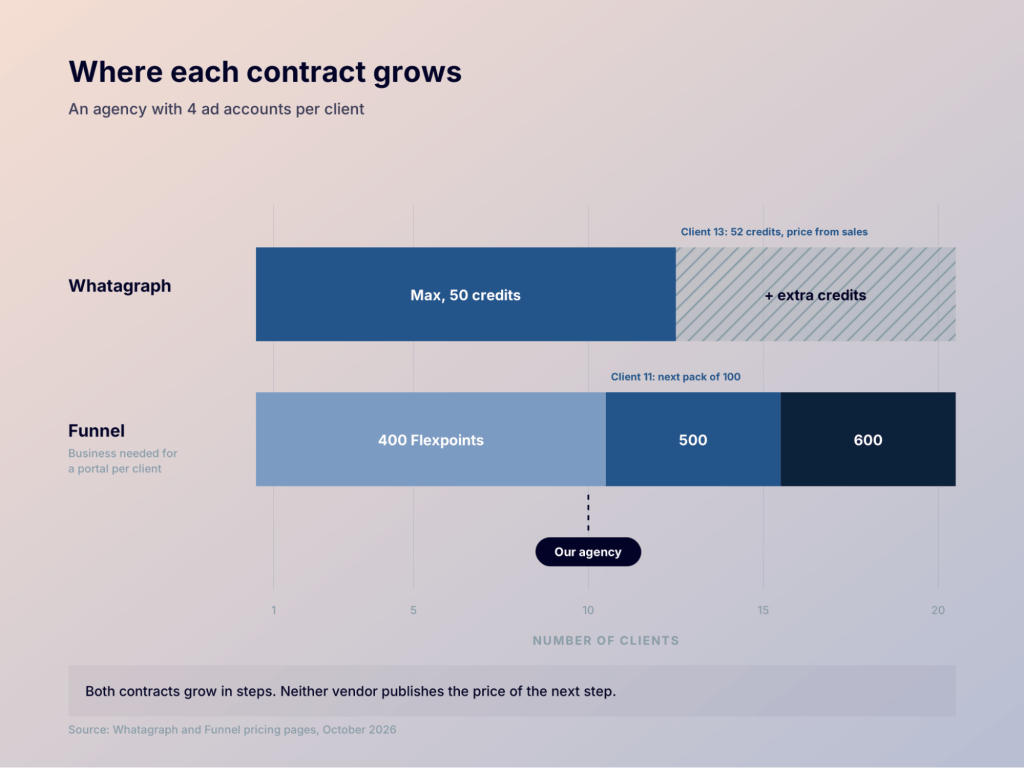
Whatagraph. The Max plan works for now. The 40 accounts use 40 of its 50 credits, and branded reports are included. The 13th client brings the total to 52 credits. From then on, the agency has to buy extra credits, and it must ask sales for that price. If the team relies more on the AI agents, the bill goes up too.
Funnel.io. Four data sources use 200 Flexpoints. Forty accounts use another 200. That’s exactly the 400-point minimum. Dashboards inside Funnel.io are free, but Starter only includes one client portal. To give all 10 clients their own portal, the agency needs Business. Each new client adds 20 Flexpoints, so the 11th client pushes the agency into the next pack of 100.
Neither company shows enough prices to compare the two final bills. Ask both for a written quote.
Before you sign a yearly contract. Both companies show a starting price and leave the rest to their sales teams. That makes it hard to know what you’ll pay once your client list grows, so it helps to compare against a tool that shows full prices. Clear pricing is one of the biggest differences in a Coupler.io vs Funnel.io comparison, while measurement is where Funnel.io does more. You can see how published plans look on the Coupler.io pricing page.
Whatagraph vs Funnel.io data sources and how far each catalog reaches
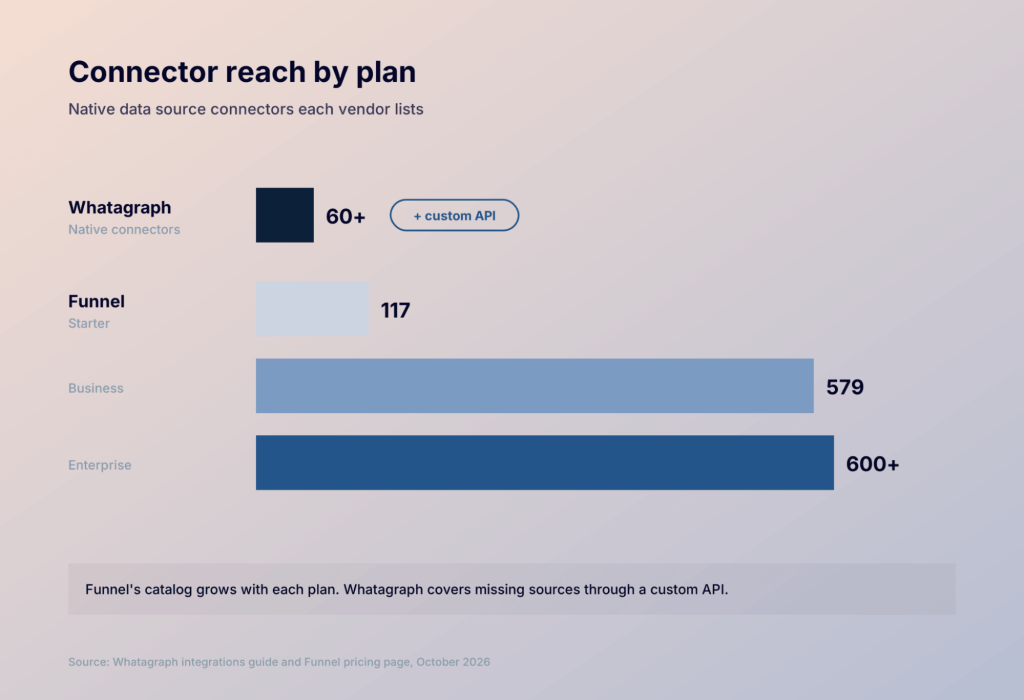
Whatagraph’s guide to its integrations, updated in October 2026, lists 60+ connectors. They cover ads, social media, email, analytics, sales tools, SEO and online stores. If a tool has an API, you can connect it as a custom source. An API is a way for two apps to share data. You can also bring in data from Google Sheets, BigQuery or Snowflake. Some premium connectors are only on the Prime plan. Teams that use less common channels may need the custom API option or one of the Whatagraph alternatives with more connectors.
Funnel.io’s list depends on your plan. Starter includes 117 connectors, Business includes 579, and Enterprise includes 600+. Funnel.io says it will build a connector for any source it doesn’t support yet. A custom connector uses 50 Flexpoints.

Whatagraph vs Funnel.io destinations once the data leaves the app
A destination is where your data goes after the tool collects it. Whatagraph is built to keep your reports inside its own app, so it has few destinations. On Max, your data reaches people through reports, shared links, and PDF emails. It can also reach AI tools through the Whatagraph MCP server. MCP is a standard way to connect data to AI assistants like Claude. Exports to Data Studio start on Prime, and exports to BigQuery cost extra on Prime.
For Funnel.io, destinations are the main point. Starter includes 13, such as Data Studio and Google Sheets. Business includes 46 and adds Power BI, Tableau and Google Analytics 4. Enterprise includes 47, including Snowflake. Funnel.io can also send conversion data, like sales and sign-ups, back to ad platforms.
Whatagraph vs Funnel.io AI agents and chat assistants
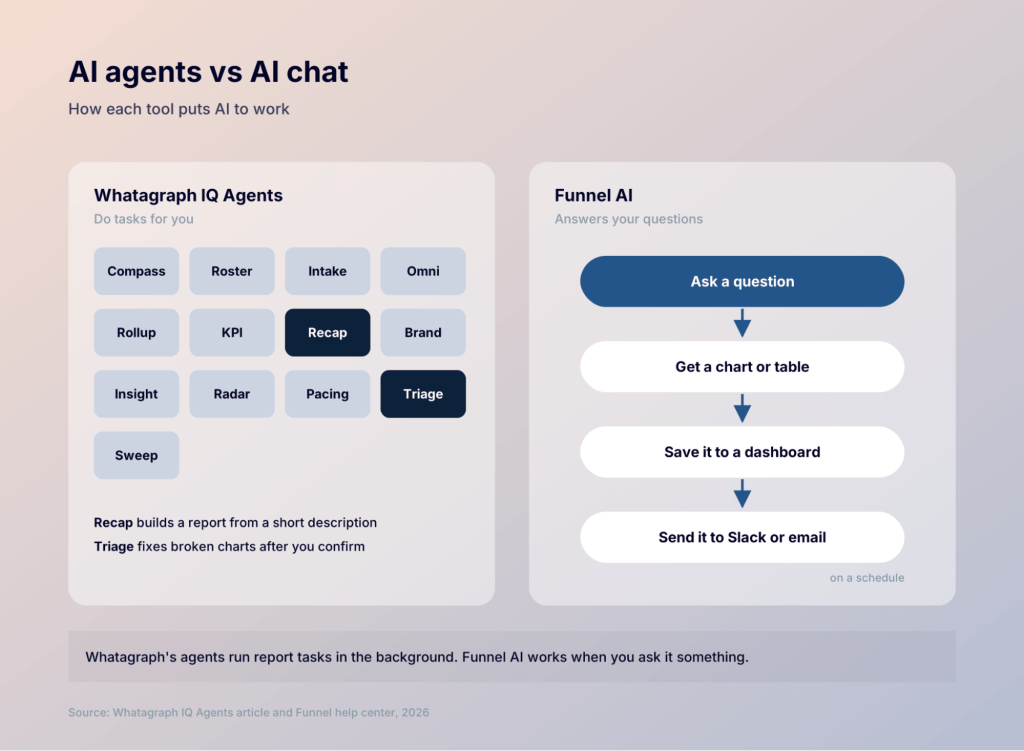
Whatagraph has gone further with AI agents. An AI agent is a helper that does tasks for you, not just answers questions. Whatagraph has 13 ready-made agents, called IQ Agents. They work in the background on a schedule or when something happens. For example, one agent named Recap builds a report from a short description. Another, named Triage, finds broken charts and fixes them after you say yes. Whatagraph says its agents run on Google’s Gemini 3.8 Flash model. For now, only admins and managers can use them. Whatagraph also works inside Claude as an official connector. Its MCP server lets AI tools read your data but not change it.
Funnel.io AI comes with every Funnel.io plan. It works like a chat. You ask a question about your data and get a chart or table back. Then you can save the answer to a dashboard. You can also tell it to run the same question on a schedule and send the answer to your email or Slack. Funnel.io MCP connects your Funnel.io data to AI tools like Claude, ChatGPT and Cursor. Funnel.io Measure customers can ask about their measurement results through it too.

Where Coupler AI differs. Both companies point their AI at marketing data stored in their own tools. Coupler AI works with data from all 400+ Coupler.io sources. You can also use it to connect sources and build reports just by chatting. The AI Agent answers questions inside the app. AI Integrations bring the same data into Claude and ChatGPT. AI Skills add ready-made ways to analyze your data.
Let Coupler AI do the data work for you
Tell Coupler AI what you need to know, from which source, and how often. It connects your account, sets up the data flow, keeps it refreshed, and lets you analyze the results inside Coupler.io or another AI tool.
Try for free

Whatagraph vs Funnel.io: security & stability for vendor reviews
Security certificates show that an outside auditor checked how a company protects your data. Whatagraph holds ISO 27001, a well-known security certificate, and follows GDPR, the EU’s privacy law. Its security policy says your data is processed in the EU on Google Cloud and Amazon Web Services. Stored data is protected with AES-256 encryption, and data on the move uses TLS 1.2 or higher. Whatagraph uses four user roles to control who can see and change what. On Max, people log in with Google. Company-wide single sign-on (SAML) costs extra on Prime. None of the Whatagraph pages we checked mention a SOC 2 report, another common security audit.
Funnel.io has passed a SOC 2 Type 2 audit and holds ISO 27001. It also follows GDPR and CCPA, California’s privacy law. Funnel.io’s pricing page lists an EU data center option on Enterprise only, so Starter and Business don’t include it. On Starter and Business, people log in with Google. Advanced login options, such as SAML, need Enterprise.
Funnel.io started in 2014. It says it has more than 300 employees and has raised more than $100 million. Neither company shares an uptime number on its security page. Both offer an enterprise service-level agreement (SLA) on their top plans.
If your company’s buying team asks for a SOC 2 report, ask each vendor what it can share before you book a demo.
Run reporting on SOC 2 Type II infrastructure with Coupler.io
Try Coupler.io for freeHow Whatagraph vs Funnel.io ease of use, support scores stack up on G2
Both tools get 4.5 out of 5 stars on G2. Whatagraph has 286 reviews and Funnel.io has 293. Whatagraph scores higher on ease of use, 8.9 out of 10 against Funnel.io’s 8.6. Funnel.io scores higher on the other three. The biggest gaps are in ease of admin (9.0 against 8.7) and quality of support (9.2 against 8.9). Ease of setup is close, at 8.6 against 8.4.
The two companies handle support in different ways. Every Whatagraph plan includes live chat and a personal customer success manager. Prime adds onboarding built around your team. Funnel.io offers in-app support on Starter and faster in-app support on Business and Enterprise. Getting started is similar. Whatagraph gives new accounts a 14-day Max trial and asks you to book a call at the end to pick a plan. Funnel.io lets you try its tool for 30 days.
Where Coupler.io fits if neither tool matches
Some teams want Whatagraph’s ready-made reports without its price. Others want Funnel.io’s long list of connectors without counting Flexpoints. Coupler.io sits between the two.
Coupler.io is a data integration and AI analytics platform. It connects to 400+ data sources for marketing, sales, finance, and online stores. It can send data to Data Studio, Google Sheets, Excel, Power BI, BigQuery, Snowflake and AI tools like Claude. Its 200+ dashboard templates cover common marketing reports. Paid plans start at $24 a month, paid yearly. There’s also a free plan and a 7-day trial. The Pro plan updates data every hour, and the Custom plan can update it every 15 minutes.
On security, Coupler.io has SOC 2 Type II and follows GDPR, HIPAA and DORA. It encrypts data as it travels and protects saved logins with AES-256 encryption.
The table below compares all three tools on the points where they differ most.
| Coupler.io | Whatagraph | Funnel.io | |
|---|---|---|---|
| Prices shown online | Every plan except Custom | Starting price for Max only | Starting prices for Starter and Business |
| Starting price | $24/month, paid yearly | €699/month, paid yearly | $300/month, paid yearly |
| Free option | Free plan, 7-day trial | 14-day Max trial | 30-day trial |
| Data sources | 400+, marketing and beyond | 60+ connectors | 117 to 600+, depending on the plan |
| Ready-made reports | 200+ dashboard templates | Branded reports and templates | Dashboards and client portals |
| AI tools | Coupler AI: AI Agent, AI Integrations, Skills | IQ Agents, Whatagraph IQ, MCP | Funnel.io AI, Funnel.io MCP |
| Security | SOC 2 Type II, GDPR, HIPAA | ISO 27001, GDPR | SOC 2 Type 2, ISO 27001 |
Coupler.io is a good fit for teams that want ready-made dashboards, lots of data sources and clear prices. Agencies whose main job is sending branded client reports will find more of that built into Whatagraph. That’s the first thing to think about in a Coupler.io vs Whatagraph decision. Teams that need marketing mix modeling should look at Funnel.io Measure.
A free trial is still the fastest way to see if a tool works for your client reports.
Build your first client dashboard in Coupler.io
Try for freeWhatagraph or Funnel.io, depending on your team
Whatagraph makes sense if
You run an agency, and your main product is a branded report for each client. The AI agents can take over routine report building. Unlimited users let your whole team work in one place.
Funnel.io makes sense if
Your data needs to go to several reporting tools or a data warehouse, and you want one clean history behind all of them. Funnel.io is also the better pick if you want measurement tools from the same company. If Flexpoints get too costly as you add clients, compare prices with some Funnel.io alternatives.
Coupler.io makes sense if
You want dashboards that combine marketing data with sales or finance data, and you’d like to see full prices before talking to sales.
Look elsewhere if
Your data team builds its own data models in a warehouse with tools like dbt. Fivetran is a better match there. If you only need to move ad data into one spreadsheet, a simpler tool like Supermetrics may cost less.