AI marketing tools now cover everything from content creation and ad optimization to analytics and competitive intelligence. This guide breaks down over 30 of the best options available today, with features, use cases, and pricing for each, so you can find the right mix for your workflow.
Best AI marketing tools from data analytics to image generation
Coupler.io


Coupler.io is a data integration platform and AI analytics built for marketers who want to move from scattered data to clear, actionable insights.
Most tools on this list help you create content or run campaigns. Coupler.io works at a different level: it collects, organizes, and analyzes the marketing data that those tools generate. If you’re pulling numbers from Google Ads, Meta Ads, GA4, HubSpot, and Shopify into separate spreadsheets and manually stitching reports together, that’s the problem Coupler.io eliminates.
The platform connects 400+ data sources to spreadsheets, dashboards, data warehouses and AI tools. The AI layer is what we need from the perspective of AI marketing. Coupler.io integrates with Claude, ChatGPT, Gemini, and Perplexity, and includes a native AI Agent. Instead of staring at dashboards, you can ask questions about your data in plain language and get answers.

Features
- 400+ data connectors: Import data from tools like Google Ads, Meta Ads, GA4, HubSpot, Shopify, and more into destinations like Google Sheets, Excel, Looker Studio, Power BI, and BigQuery.
- No-code data transformation: Clean, join, filter, and aggregate data without writing SQL.
- AI integrations (MCP): Connect your data to ChatGPT, Claude, Gemini, and Perplexity for natural language analysis.
- Native AI Agent: Analyze your marketing data conversationally using Coupler.io’s built-in AI.
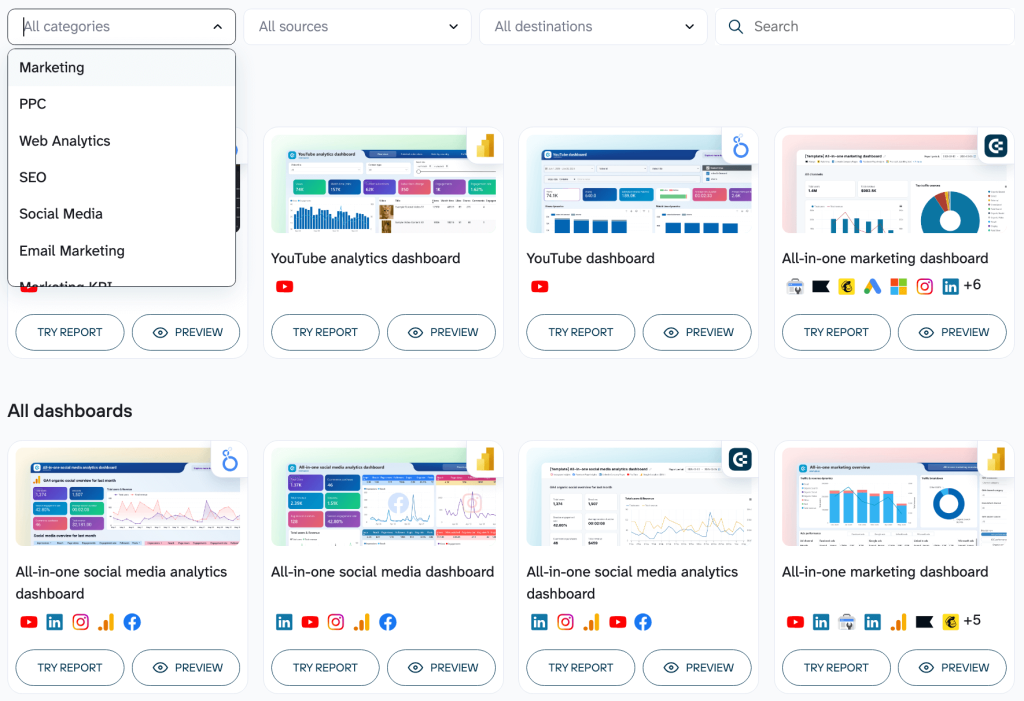
- Dashboard templates: Use ready-made templates for Looker Studio, Power BI, and Google Sheets.
- Automated refresh: Schedule data updates as frequently as every 15 minutes.
Use cases
Coupler.io is strongest where marketing data is scattered across platforms and teams spend too much time assembling reports manually. Performance marketing teams use it to unify ad spend, conversion, and revenue data from multiple channels into a single dashboard that updates itself. Agencies managing 10+ clients rely on it to automate reporting workflows without duplicating effort across accounts. Ecommerce businesses connect Shopify or WooCommerce data alongside ad platform metrics to see the full picture of acquisition cost vs. revenue. And with MCP-based AI integrations, any of these teams can go further, asking Claude or ChatGPT to analyze trends, compare periods, or flag anomalies directly from their Coupler.io data.
Pricing
Coupler.io has a free plan for basic usage and a 7-day free trial that gives full access to the Pro tier. Paid plans start at 24/month and scale based on the number of data connections, users, and refresh frequency. All sources and destinations are available on every plan, so you’re not paying extra for specific connectors.
Jasper


Jasper is a content platform built for marketing teams that need consistent, on-brand output across campaigns and channels. As content production scales across contributors, maintaining a unified voice becomes a real challenge. Jasper addresses this by combining AI generation with brand voice controls and structured workflows, so teams can collaborate without losing consistency.
Unlike general-purpose tools like ChatGPT, Jasper is designed specifically for marketing teams, with templates and guardrails that keep content aligned with brand standards across every contributor.
Features
- Brand voice and style controls: Maintain consistent tone and messaging across all generated content.
- Marketing content workflows: Create structured workflows for generating ads, emails, blogs, and landing pages.
- Team collaboration features: Support multi-user environments with shared assets and workflows.
- Template-driven generation: Use pre-built templates for common marketing use cases.
- Scalable platform tiers: Expand capabilities as team size and content needs grow.
Use cases
Jasper fits best in organizations where multiple people produce content and brand consistency is non-negotiable. Marketing teams use it to generate campaign assets (ads, emails, landing pages) from shared templates with built-in brand voice controls. It’s also useful for agencies that manage content for several clients and need to switch between brand guidelines quickly. Teams that treat content as a coordinated function rather than isolated outputs will get the most from it.
Pricing
Jasper’s Pro plan starts at $59/month per seat when billed annually. A Business tier with custom pricing is available for larger teams that need advanced collaboration, brand controls, and dedicated support. A free trial is available to explore the platform before committing.
MarketMuse


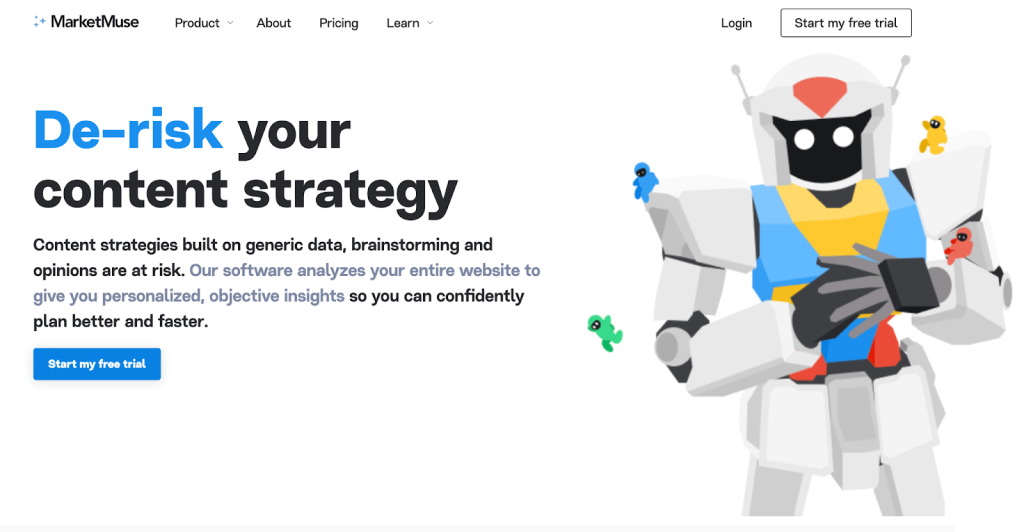
MarketMuse is an AI-driven content strategy and optimization platform for teams that want to move beyond publishing volume and start building real topical authority. As content libraries grow, deciding what to create next, what to update, and how everything fits together becomes harder. MarketMuse solves this by analyzing your entire content inventory against search demand, identifying gaps, overlaps, and high-impact opportunities.
Rather than focusing on content generation, it emphasizes planning, research, and structured workflows, making it especially valuable for teams that prioritize long-term SEO performance.
Features
- Content inventory analysis: Evaluates your existing content to uncover gaps, redundancies, and missed opportunities.
- Topic clustering and authority planning: Groups related topics to help you build stronger SEO authority across key themes.
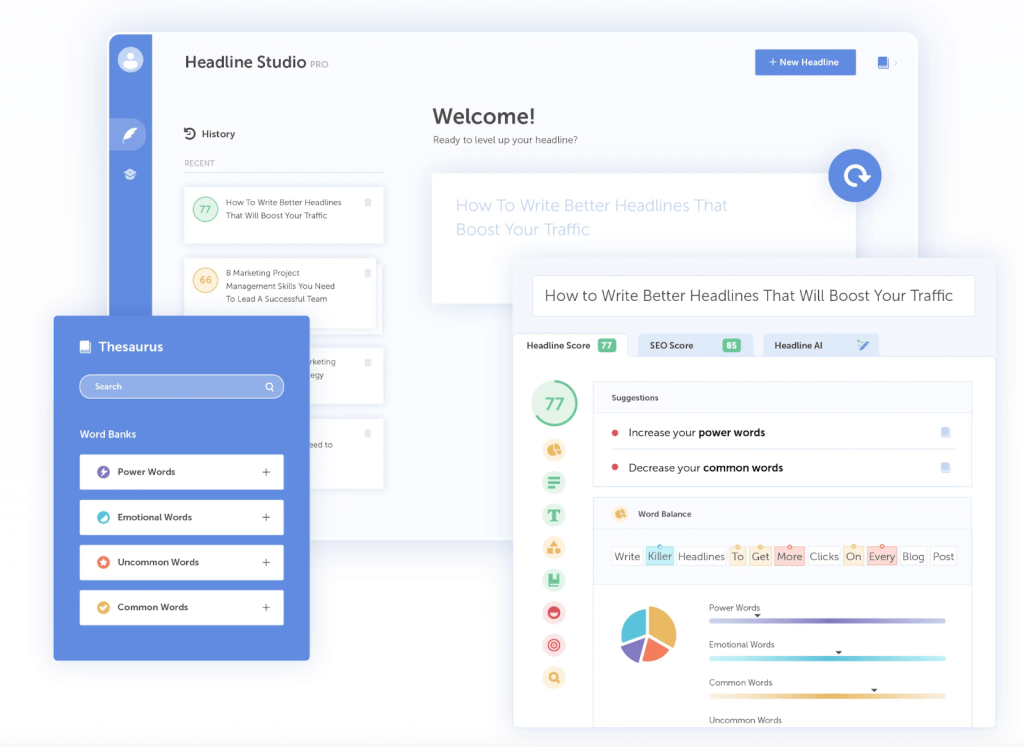
- AI-generated content briefs: Creates structured briefs with topics, questions, and guidance for writers.
- SERP and keyword research: Analyzes search results and keywords to identify what content is needed to compete.
- Workflow management: Helps teams assign tasks, track progress, and manage content production within one system.

Use cases
MarketMuse is a good fit for teams with established content libraries that need strategic direction rather than just more output. SEO-focused teams use it to plan content clusters, prioritize which topics to target first, and build authority in specific subject areas. It’s also valuable for content refresh workflows: the platform identifies which existing pages are underperforming and where quick updates can improve rankings. Teams that are just starting a blog from scratch will get less value, since most suggestions rely on existing content data.
Pricing
MarketMuse offers a free tier with limited queries for individuals with low content volume. Paid plans scale across three tiers (Optimize, Research, Strategy) based on tracked topics, content briefs per month, and strategy documents. Fixed pricing is not prominently displayed on the site, so you may need to contact the vendor for current rates.
CoSchedule


CoSchedule is a marketing calendar and social publishing platform built for teams that struggle more with coordination than content creation. As efforts expand across channels, the real challenge often becomes managing timelines, approvals, and consistency. CoSchedule acts as a central hub for planning, scheduling, and executing marketing activities, with AI layered into the workflow to speed things up.
Rather than focusing purely on writing, it positions itself as an execution and coordination tool, making it especially useful for teams that need visibility and control over their entire marketing calendar.
Features
- Marketing calendar: Serves as a single source of truth with multiple calendar views, permissions, and team collaboration features.
- Social publishing tools: Enables best-time scheduling, automation (ReQueue), bulk posting, and performance tracking.
- AI assistant and prompt library: Includes built-in AI tools and ready-to-use prompts to speed up content creation and planning.
- Workflow and approvals: Supports structured workflows with approvals, role-based access, and collaboration features.
- Agency capabilities: Offers white-labeling and client-friendly views for agencies managing multiple accounts.

Use cases
CoSchedule works best for teams that already know what to say but need help getting it out the door on time. Social media managers use it to plan, schedule, and track content across profiles from one place. Agencies rely on the client-facing calendar views and white-labeling to manage approvals across multiple accounts. It’s also a fit for marketing teams that run cross-channel campaigns (blog, email, social) and need a single view of what’s going live and when.
Pricing
CoSchedule has a free calendar tier for individuals (1 user, 1 social profile, up to 15 scheduled messages). The Social Calendar starts at $19/user/month billed annually and adds advanced scheduling and automation. The Agency Calendar is $59/user/month with client management features. A Content Calendar and Marketing Suite are available at custom pricing through sales.
Lempod


Lempod is a LinkedIn engagement tool built around the concept of “pods”; groups of users who automatically like and comment on each other’s posts to increase visibility.
While the idea is simple, its relevance has become more nuanced in recent years. As LinkedIn continues to prioritize authentic engagement and tighten platform policies, tools like Lempod sit in a gray area between growth tactics and platform risk.
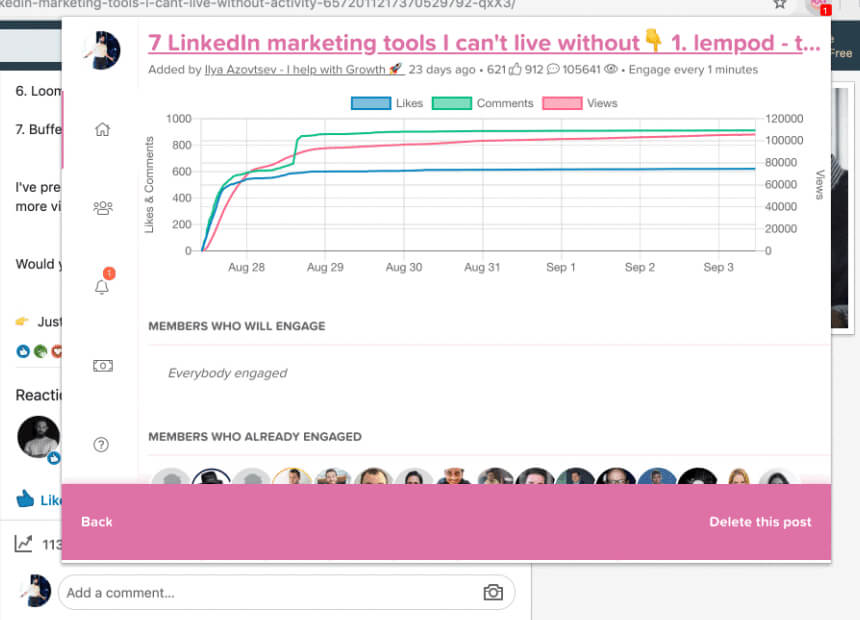
Unlike traditional LinkedIn pods, where only a small percentage of members engage with your post, Lempod automates the entire process using AI. This ensures that every member in the pod automatically engages with your post within the crucial first 30 minutes, boosting your visibility and helping you leverage the CFBR or Commenting For Better Reach strategy on LinkedIn.
It can still be useful in specific scenarios, but it’s no longer a straightforward “best practice” for most marketing teams.
Features
- Pod-based engagement system: Join niche-based pods where members support each other’s posts with likes and comments.
- Category-based targeting: Select pods based on industries, roles, or interests to match your audience.
- Browser extension setup: Requires manual installation via extension (ZIP + developer mode).
- Tiered pod access: Different plans unlock more pods, higher limits, and additional support.

Use cases
Lempod is primarily used to boost LinkedIn engagement by increasing early interaction on posts, which can improve visibility in the feed. It also allows users to participate in niche engagement pods, helping align interactions with specific audiences or industries.
Pricing
Lempod follows a subscription-based pricing model, with plans structured around the number of pods, post limits, and level of support required. Pricing typically starts at around $9.99 per pod per month, though the total cost can vary depending on usage and selected tiers.
Limitations
Lempod comes with notable tradeoffs. As LinkedIn continues to prioritize authentic engagement, pod-based strategies may become less effective over time. The setup process also requires manual installation of a browser extension, which can create friction for teams. Additionally, it is not well suited for long-term, scalable marketing strategies compared to content-driven or data-focused tools.
ChatGPT

ChatGPT is a general-purpose AI assistant that has become a daily tool for many marketers, covering everything from content creation to research, analysis, and workflow automation. It now acts as a flexible AI layer across marketing operations, combining writing, ideation, data analysis, image generation, and agent-like task execution in a single interface.
When connected to external tools and data sources, it becomes significantly more useful for marketing-specific tasks.
Features
- Multi-modal capabilities: Works across text, files, and images, allowing marketers to analyze documents, generate visuals, and create content in one place.
- Deep research and agent mode: Advanced capabilities for structured research and task execution, typically available in higher-tier plans.
- Projects, tasks, and custom GPTs: Enables users to organize workflows, automate tasks, and build custom assistants tailored to specific use cases.
- AI integrations (ChatGPT MCP): Connects with tools and data sources to analyze marketing performance and generate insights using natural language.
- Business workspace features: Includes admin controls, shared workspaces, connectors, and privacy controls for teams and organizations.
Use cases
ChatGPT’s strength is versatility. Content teams use it to draft blog posts, ad copy, and email sequences, then repurpose that content across channels. It’s also widely used for research and planning: summarizing competitors, building marketing briefs, and brainstorming campaign angles. When connected to business data via MCP, it becomes a quick analysis tool for querying campaign metrics and generating insights. Larger teams use Business or Enterprise tiers with shared workspaces and custom GPTs to standardize processes across the organization.
Pricing
ChatGPT offers a free tier with basic access. Paid plans for individuals start at $8/month (Go) and go up to $200/month (Pro) for the most advanced models and capabilities. Team plans start at $25/seat/month billed annually. Enterprise pricing is custom and includes advanced security, admin controls, and higher usage limits.
Perplexity


Perplexity is an AI-powered answer engine designed for research workflows. It focuses on sourcing, synthesizing, and presenting information with citations, which makes it different from tools like ChatGPT or Claude that optimize for generation and reasoning.
As marketers increasingly need data-backed content and defensible insights, the challenge shifts from generating ideas to verifying them. Perplexity addresses this by combining AI responses with cited sources.
Features
- Source-backed answers: Generates responses with citations, helping validate claims and insights.
- Pro search capabilities: Performs deeper, multi-step research queries for more comprehensive results.
- Advanced AI models: Access higher-quality outputs and reasoning through upgraded tiers.
- File and content analysis: Upload and analyze documents as part of research workflows.
- Collaboration and enterprise features: Higher tiers include team access, security, and workspace capabilities.
Use cases
Perplexity is most useful for marketers who need to research quickly and cite their sources. Content teams use it to build article outlines, gather supporting data, and validate claims before publishing. It’s also helpful for competitive and market analysis, where you need to summarize trends or competitor positioning with verifiable references. If your work requires accuracy and supporting evidence more than creative generation, Perplexity fits better than general-purpose AI tools.
Pricing
Perplexity Pro starts at $17/month billed annually for individuals. Enterprise tiers scale from $34/seat/month to $271/seat/month depending on team size, model access, and advanced controls. A free tier is available with limited search capabilities.
Claude


Claude is a conversational AI platform designed for reasoning-heavy tasks, long-form writing, and structured research workflows. As AI becomes more embedded in marketing, the need shifts from quick outputs to deeper thinking and organization. Claude focuses on high-quality reasoning, document handling, and team-based workflows, making it especially useful for complex writing and research.
It stands out for handling longer context, structured projects, and collaborative use across teams. Compared to Perplexity (which optimizes for sourced research), Claude is better suited for synthesizing complex ideas into structured outputs.
Features
- Advanced reasoning and writing: Strong performance in long-form content, structured outputs, and complex problem-solving.
- Projects and collaboration: Organize work into projects with support for multi-user collaboration in team plans.
- Research and web capabilities: Access web search and advanced research features depending on plan tier.
- Multiple model access: Higher tiers provide access to more capable models and expanded limits.
- Enterprise-grade controls: Includes SSO, role-based access, audit logs, and connectors for team workflows.
Use cases
Claude works well for marketers who produce long-form content, strategy documents, or detailed research. Content teams use it to write in-depth blog posts, reports, and guides that require coherent structure over thousands of words. It’s also a fit for research-heavy workflows where you need to synthesize large amounts of information into clear takeaways. Teams on higher-tier plans use Projects to organize ongoing work and share context across collaborators.
Pricing
Claude offers a free tier with basic access. The Pro plan is $20/month (or $17/month billed annually), and Max starts at $100/month for individuals who need higher usage limits and advanced models. Team plans start at $20/seat/month billed annually, with a premium tier at $100/seat/month for expanded capabilities.
Storydoc


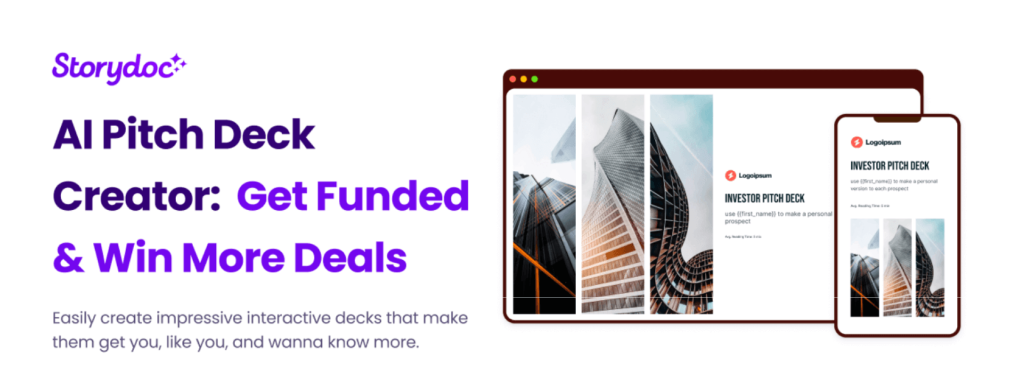
Storydoc is an AI-native platform for creating interactive business documents like presentations, proposals, and reports that are designed to engage and convert.
Instead of static slides, Storydoc focuses on turning documents into dynamic, trackable experiences. It’s especially useful for teams that rely on storytelling, personalization, and data-backed engagement to stand out.For marketers and sales teams creating marketing decks, it offers a faster way to produce high-impact, interactive content without needing design or development support.
Features
- AI document generation: Create structured presentations, proposals, and reports in seconds without design skills
- Interactive elements: Embed videos, forms, CTAs, calendars, and dynamic content directly into documents
- Personalization and automation: Generate tailored documents at scale using CRM data and dynamic fields
- Deep analytics: Track opens, clicks, scroll behavior, and engagement across each document
- Collaboration workflows: Manage feedback, approvals, and content across teams in one place
- Centralized document management: Store and organize all business documents while maintaining brand consistency

Use cases
Storydoc is best suited for teams that rely heavily on presentations and documents to drive results. It’s widely used for pitch decks, proposals, reports, and sales collateral where engagement and storytelling matter.
Marketing teams can use it to create interactive campaign decks and reports that go beyond static slides, while sales teams benefit from personalized proposals that track how prospects interact with content. It’s also useful for agencies and founders who need to stand out with polished, high-converting documents without investing in design resources.
Pricing
Storydoc offers both monthly and annual pricing, with discounts for annual billing. The Starter plan begins at $19.80/month (billed annually) or $33/month, making it suitable for individual professionals. The Pro plan is priced at $36/month (annual) or $60/month and includes higher limits on documents, AI credits, analytics, and templates.
For teams of five or more users, Storydoc offers a Teams plan with extended capabilities and custom limits. A free plan is also available to get started, with optional upgrades as usage scales.
AmpiFire


AmpiFire is a content distribution platform that turns one topic into eight content formats, then publishes all of it to 300+ sites without any paid ad spend.
Most marketing tools help you create one piece of content faster. AmpiFire skips that limit: give it one topic, and it builds articles, videos, podcasts, and social posts, then pushes each format to the platforms where buyers already search, watch, and listen.
Features
- 8-format content generation: Turns a single topic into news articles, blog posts, social posts, reels/shorts, infographics, interview podcasts, flipbooks, and long-form videos.
- 300+ site distribution: Publishes to YouTube, Spotify, Google News, Apple Podcasts, Fox affiliate news sites, Pinterest, LinkedIn, and more, all in one pass.
- AI voices and video: Includes 20+ AI voices for podcasts and video, plus vertical reels sized for TikTok, Instagram, and YouTube Shorts.
- AI citation building: Positions your brand as a source referenced inside ChatGPT, Gemini, and Google AI answers.
- Direct social posting: Connects to Facebook, Instagram, and LinkedIn to publish automatically without manual uploads.
Use cases
AmpiFire fits brands that want to show up across search, social, video, podcast, and news without buying every click to get there.
E-commerce brands use it to reach shoppers at each stage of research, since most buyers check multiple channels before purchasing. Health and fitness companies use it to build a traffic asset that keeps working after a campaign ends, instead of resetting with every new ad budget.
Agencies resell the content and distribution to clients without hiring a production team, and multi-location businesses use it to keep consistent coverage across search, social, and news for every location. Brands already running paid ads use it to raise conversion rates on those same ads, since buyers who see a brand across organic channels first tend to convert better once the ad reaches them.
Pricing
AmpiFire offers several services with different pricing. DIY AI content creation is $97/month, while syndication and distribution to 300+ platforms runs $497 per campaign. The full agency package starts at $3,599/month or more, depending on volume.
Influencity


Influencity is an influencer marketing and social media intelligence platform built to manage the full lifecycle of influencer campaigns; from discovery to reporting.
Unlike basic influencer tools that focus only on outreach, Influencity combines influencer discovery, relationship management, campaign execution, and social listening into one system. This makes it especially useful for brands and agencies running ongoing, data-driven influencer programs.
Features
- Influencer discovery: Search across 200M+ creators globally to find influencers aligned with your audience and campaign goals
- Influencer relationship management: Build and manage a centralized influencer database with contact details, activity tracking, and audience insights
- Campaign management: Plan, execute, and scale influencer campaigns while automating workflows like outreach, product seeding, and payments
- Campaign reporting: Generate real-time reports to track performance, ROI, and campaign outcomes
- Social media management: Manage content, approvals, and publishing across platforms from a unified dashboard
- Social listening: Monitor brand mentions, competitors, and trends across millions of sources with AI-powered insights
Use cases
Influencity is best suited for brands and agencies that treat influencer marketing as a core growth channel rather than a one-off tactic.
Marketing teams can use it to run end-to-end influencer campaigns with better visibility into performance, while agencies benefit from managing multiple clients, campaigns, and influencer relationships in one place. It’s particularly valuable for ecommerce and consumer brands that rely on creator partnerships to drive awareness and conversions at scale.
Pricing
Influencity offers three main pricing tiers designed for different levels of usage. The Professional plan is aimed at businesses running consistent influencer campaigns, while the Business plan supports brands and agencies managing multiple campaigns and sharing reports across teams.
For larger organizations, the Enterprise plan provides a fully customizable setup with features like unlimited searches, advanced workflows, and flexible campaign management capabilities. A free trial is available, but detailed pricing is provided upon request based on your needs.
Madgicx


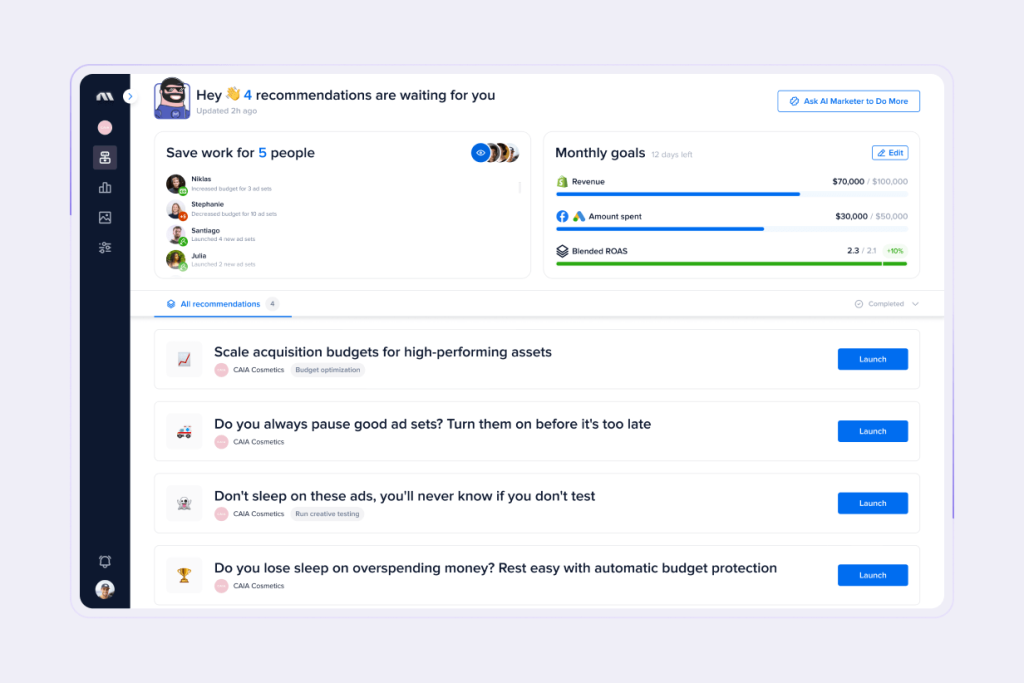
Madgicx is an AI-powered Meta ads platform focused on optimization, creative workflows, and performance analysis. For most ecommerce teams, the bottleneck is not launching campaigns but keeping up with constant testing, creative fatigue, and budget allocation. Madgicx automates that layer while still giving teams visibility into what is actually driving results.
Features
- Ad optimization and analytics: Provides performance insights, ad analysis, and fatigue detection to improve campaign efficiency.
- AI creative workflows: Includes tools like the AI Ads Generator to help produce and test ad creatives faster.
- Creative performance insights: Identifies which elements in ads drive engagement and conversions to guide future creatives.
- Attribution and tracking (Tracking Pro): Offers server-to-server tracking and improved conversion tracking for better data accuracy.
- Cross-account management: Supports managing multiple Meta ad accounts with centralized insights and workflows.

Use cases
Madgicx is built for teams that run Meta ads at scale and need to stay on top of creative refresh cycles. Ecommerce businesses use it to manage frequent ad iterations, identify winning creatives, and reallocate budget automatically based on performance. Agencies handling multiple client accounts benefit from the centralized management and repeatable workflows. The Tracking Pro add-on is useful for teams that have lost visibility due to iOS privacy changes and need better attribution data.
Pricing
Madgicx uses a variable pricing model based on your ad spend, with full pricing visible inside the platform after setup. The Tracking Pro add-on starts at $49/month. A free trial is typically available to explore the platform before committing.
BrandWell (formerly Content at Scale)


BrandWell is the rebranded evolution of Content at Scale, now positioned as an intent-led go-to-market platform rather than just an AI writing tool. While earlier versions focused on generating long-form SEO content, BrandWell expands into pipeline generation by combining intent data, audience targeting, and programmatic content workflows. It helps teams not only create content but also identify who to target, when to reach them, and how to convert attention into pipeline.
Features
- Intent and visitor identification: Identifies high-intent visitors and maps stakeholder audiences for targeting across platforms like Meta, Google, and LinkedIn.
- RankWell content workflow: Generates and scores content based on brand voice and SEO performance before publishing.
- Programmatic SEO engine: Creates large volumes of pages using structured data (CSV, APIs) with automated publishing workflows.
- AI assistant (AIMEE): Provides guidance across content creation, optimization, and GTM workflows.
- GTM feature integration: Combines content production with lead generation features like form enrichment and ad audience syncing.
Use cases
BrandWell is a better fit for B2B teams that want to connect content with revenue, not just traffic. Companies use the intent data features to identify high-intent accounts and target them with content and retargeting campaigns across channels. The programmatic SEO engine is useful for building large-scale page sets from structured datasets to capture long-tail search traffic. Agencies managing multiple client projects benefit from the scalable content and targeting workflows.
Pricing
BrandWell’s pricing reflects its evolution into a GTM platform. Plans start at $999/month (Growth) and scale through Scale ($1,499/month), Agency ($1,999/month), and DFY ($3,999/month). Pricing may vary depending on commitment length and add-ons like additional content bundles or intent data categories.
Albert

Albert is an autonomous AI marketing platform designed to manage and optimize paid media campaigns across multiple channels.
Modern advertising involves managing multiple audiences, creatives, and platforms at once, which makes scaling performance difficult without increasing headcount. Albert addresses this by acting as an “AI media buyer” that continuously tests, learns, and optimizes campaigns within defined goals and constraints.
Rather than being a lightweight tool, it is positioned as an enterprise-grade automation layer that plugs into your existing stack and handles execution at scale.
Features
- Autonomous campaign orchestration: Manages and optimizes paid media campaigns across channels with minimal manual input
- Continuous testing and optimization: Runs multivariate tests across creatives, audiences, and strategies
- Cross-channel execution: Coordinates campaigns across multiple platforms for consistent performance
- Performance insights and reporting: Generates data-driven insights based on campaign outcomes
- Cloud-based integration: Connects with existing tools to enhance your current workflow
Use cases
Albert is best suited for organizations running large-scale paid media programs that require constant optimization. It is particularly valuable for teams that want to scale campaign performance without hiring additional media buyers, as well as for brands managing complex, multi-channel campaigns with many variables.
It also fits enterprise environments where continuous testing, optimization, and performance tracking are essential to maintaining efficiency across high-budget advertising operations.
Pricing
Albert follows a customized pricing model based on your advertising scale, campaign complexity, and overall requirements. Pricing is not publicly listed, and businesses are required to submit details such as their annual ad spend to receive a tailored estimate.
LocalImpact

LocalImpact (formerly ReviewsOnMyWebsite) is a review management and reputation platform built for local businesses and agencies that want to collect, manage, and showcase customer reviews at scale.
Rather than acting as just a review inbox, LocalImpact focuses on turning customer feedback into social proof that drives visibility, trust, and conversions. It automates review collection and makes it easy to display high-impact testimonials directly on your website.
Features
- Automated review collection: Send email requests and text message automation campaigns to consistently collect Google and Facebook reviews
- Centralized review management: Monitor and respond to all reviews from a single dashboard
- Review widgets and display tools: Showcase top reviews on your website to build trust and improve conversions
- AI-powered responses: Generate replies to customer reviews quickly while maintaining consistency
- Multi-platform integrations: Import and manage reviews from 30+ platforms in one place
- White-label capabilities: Manage multiple clients and offer review services under your own brand
Use cases
LocalImpact is best suited for local and service-based businesses that rely heavily on reputation and trust to drive growth. It is commonly used to automate review collection after customer interactions, manage responses efficiently, and display testimonials on websites to improve conversion rates.
Agencies can also use it to manage reviews for multiple clients while offering white-labeled services as an additional revenue stream.
Pricing
LocalImpact offers a 14-day free trial with no credit card required.
Pricing is divided into three main tiers based on business size and needs. The Essentials plan starts at $19 per month and includes core review management features for one location, with additional locations available at $5 each.
The Growth plan, priced at $49 per month, builds on this by adding automation features such as email and SMS review requests, AI-powered replies, sentiment analysis, and integrations.
For agencies and multi-location businesses, the Agency plan starts at $99 per month and includes support for multiple locations, white-label dashboards, client management tools, and advanced reporting capabilities. Additional locations can be added at $15 each.
This tiered structure makes LocalImpact suitable for both small businesses getting started with review management and agencies scaling across multiple clients.
Coassemble


Coassemble is an AI-powered course creation and training platform designed to turn existing knowledge into engaging, shareable learning experiences.
Instead of starting from scratch, Coassemble focuses on transforming documents, presentations, and internal knowledge into structured courses that can be distributed across your existing tools. It combines AI with learning design principles, making it especially useful for teams that need to scale training without adding complexity.
Features
- AI-powered course creation: Convert documents, handbooks, and existing materials into structured courses quickly
- Interactive learning formats: Add quizzes, multimedia, and dynamic content to improve engagement
- Flexible content delivery: Share courses via links, embed them in tools, or export to SCORM-compatible systems
- Built-in insights: Track learner engagement, progress, and performance with clear analytics
- Personalization and localization: Customize branding, tone, and language to suit different audiences
- Team collaboration: Enable multiple creators to build and manage training content together
Use cases
Coassemble is best suited for teams that need to scale knowledge sharing across their organization. It works particularly well for onboarding, compliance training, and internal enablement programs where content needs to be updated and distributed quickly.
It’s also valuable for sales enablement and customer education, where turning existing materials into structured, easy-to-consume training can improve adoption and consistency across teams.
Pricing
Coassemble offers a free plan with one creator, unlimited course creation, access to all AI tools, and unlimited learner views, making it accessible for individuals and small teams.
The Team plan starts at $50 per month (billed annually) and includes up to five creators, along with features like learning paths and detailed learner insights.
For larger organizations, the Enterprise plan provides custom pricing with advanced capabilities such as localization, SCORM exports, and scalable creator limits tailored to global teams.
Writesonic


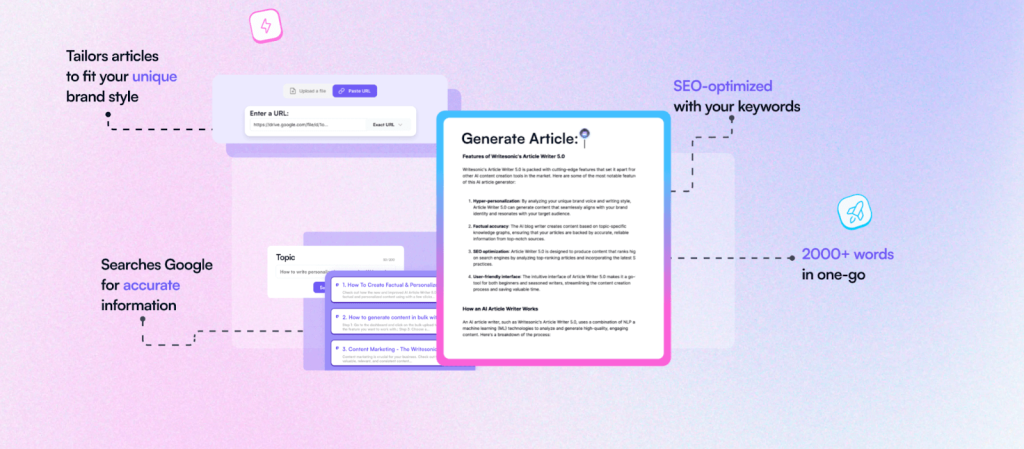
Writesonic has evolved from a traditional AI copywriting tool into a broader SEO and AI search visibility platform. As search behavior shifts toward AI-generated answers, marketers now need to think beyond rankings and consider how their brand shows up inside tools like ChatGPT, Gemini, and other AI platforms. Writesonic addresses this by combining content generation with SEO workflows and AI visibility tracking in a single platform.
Features
- AI search visibility tracking (GEO): Monitors how your brand appears across AI platforms and prompts, with actionable recommendations.
- SEO audits and optimization: Provides site audits and content optimization tools to improve search performance.
- AI content generation: Creates blog posts, landing pages, and marketing copy aligned with SEO requirements.
- Unified SEO + content workflow: Combines keyword research, content creation, and optimization into a single platform.
- Action center recommendations: Suggests improvements based on performance and visibility data.

Use cases
Writesonic is best suited for teams that want to consolidate multiple SEO and content tools into one system. The GEO (Generative Engine Optimization) feature is particularly useful for brands that want to track and improve how they appear in AI-generated search results, not just traditional Google rankings. Content-driven growth teams use it to scale blog and landing page production while maintaining optimization standards. It’s less of a fit for teams that only need basic copywriting assistance.
Pricing
Writesonic’s pricing reflects its shift toward a full SEO platform. The Basic plan starts at $249/month ($199/month billed annually), and the Growth plan is $499/month ($399/month billed annually). Enterprise pricing is available through sales. This is a significant increase from its earlier per-word pricing model.
GrowthBar


GrowthBar is an SEO-focused tool that historically combined AI content generation with keyword research and competitive analysis. However, the platform has been acquired by SEOptimer and is being merged into its broader SEO toolkit. Because of this, GrowthBar is no longer evolving as a standalone product.
Features
- AI content and SEO workflows: Previously combined content generation with keyword research and optimization tools.
- Keyword and competitor analysis: Provided insights into rankings, backlinks, and competitive gaps.
- Content planning tools: Helped structure blog content and identify ranking opportunities.
- Suite integration (via SEOptimer): Features are being consolidated into SEOptimer’s broader SEO platform.
Use cases
GrowthBar is now primarily relevant for teams already using SEOptimer or evaluating it as part of a unified SEO suite. As a standalone product, it’s in transition, and new users should evaluate it within the context of SEOptimer’s broader offering rather than as an independent tool.
Pricing
GrowthBar’s pricing is now tied to SEOptimer’s platform. Current pricing reflects the ongoing consolidation of features. Check SEOptimer’s site for the latest plans.
Algolia

Algolia is an AI-powered search and retrieval platform designed to power fast, relevant on-site search and product discovery experiences. Unlike most tools on this list that focus on content or campaigns, Algolia operates at a deeper layer: it improves how users find information across your website, app, or catalog. With the addition of semantic search and generative AI features, it’s increasingly used to build “Ask AI” style experiences that combine traditional search with conversational interfaces.
Features
- API-driven search engine: Supports both keyword and semantic search (NeuralSearch) for more relevant results.
- AI ranking and personalization: Adjusts search results based on user behavior, preferences, and intent.
- Typo tolerance and synonyms: Handles misspellings and language variations to improve search accuracy.
- Search analytics: Provides insights into user behavior, queries, and performance to optimize results.
- Generative AI experiences: Enables “Ask AI” and conversational search interfaces built on your data.
Use cases
Algolia is primarily used by ecommerce teams to improve product discovery and increase conversion rates through better search relevance. SaaS companies use it to power help centers and documentation search, reducing support load. More recently, marketing teams are building AI-driven conversational experiences on top of their content or product catalogs using Algolia’s generative features.
Pricing
Algolia offers a free Build tier for development and testing. The Grow plan includes 10,000 search requests/month with usage-based pricing beyond that (~$0.50 per additional 1,000 requests). Grow Plus adds AI capabilities at higher per-request rates. The Elevate tier is custom-priced through sales.
Tidio


Tidio is a customer communication platform that combines live chat, help desk ticketing, and an AI agent to automate conversations without losing the human touch. As customer expectations shift toward instant responses, especially in ecommerce, businesses need to handle high volumes of conversations without scaling support teams linearly. Tidio blends automation with real-time support, allowing teams to capture leads, resolve queries, and drive conversions through chat.
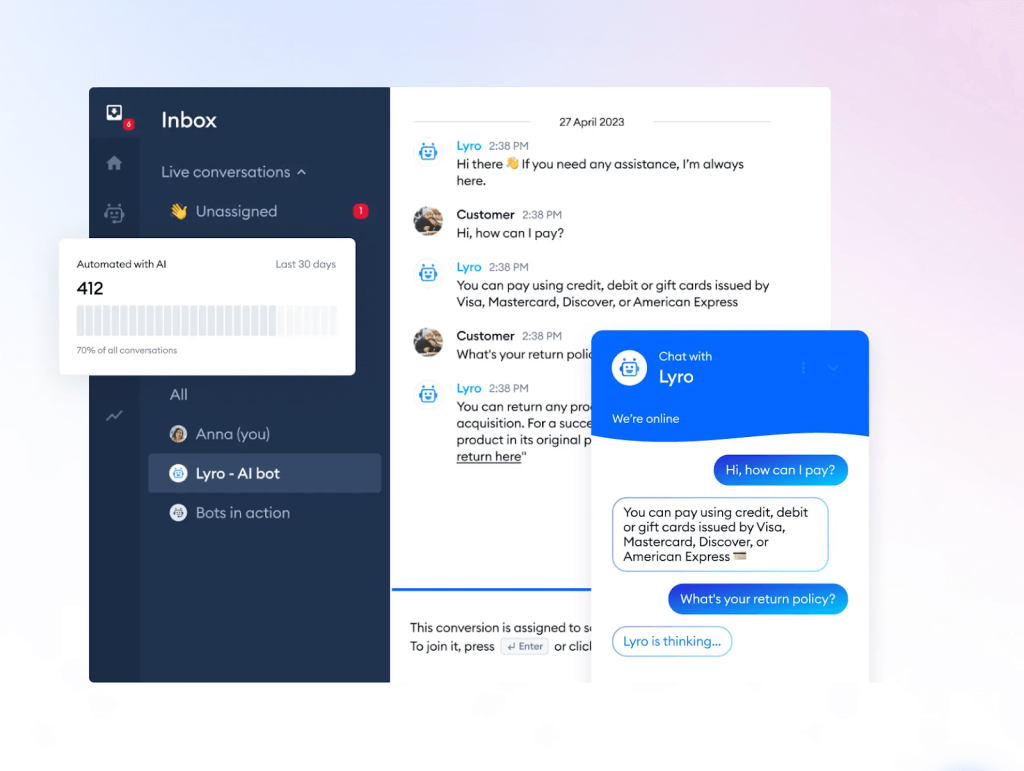
Its AI agent, Lyro, is central to this, designed to handle common questions automatically while handing off complex interactions to human agents.
Features
- Lyro AI agent: Automates customer conversations using knowledge from your website, FAQs, or imported data sources.
- Live chat and ticketing: Combines real-time chat with support ticket management in a single interface.
- Automation flows: Builds proactive workflows for sales and support, such as triggered messages based on user behavior.
- Lead capture tools: Collects visitor information and qualifies leads directly through chat interactions.
- Integrations: Connects with platforms like Shopify and WordPress for seamless data and workflow integration.

Use cases
Tidio works well for ecommerce stores that need to engage visitors in real time and guide them toward purchase decisions. Support teams use Lyro to handle repetitive questions (shipping, returns, order status) automatically, freeing up agents for more complex issues. It’s also useful for businesses that want to maintain responsiveness outside of working hours without hiring overnight staff.
Pricing
Tidio has a free plan with basic chat functionality. Paid plans start at $24.17/month (Starter) and scale through Growth ($49.17/month), Plus ($749/month), and Premium (custom pricing). The jump between Growth and Plus is significant, reflecting the shift from SMB to enterprise-level capabilities.
Chatfuel


Chatfuel is a chatbot automation platform focused on business messaging, especially across WhatsApp, Instagram, and Facebook Messenger. As more customer interactions shift from websites to direct messaging, businesses need a way to manage conversations at scale. Chatfuel enables automated chat flows for lead qualification, bookings, and basic support without heavy engineering resources.
It works best for businesses that rely on messaging channels. Outside of those environments, its capabilities are more limited compared to broader customer engagement platforms.
Features
- Omnichannel chatbot support: Deploy chatbots across WhatsApp, Instagram, Facebook Messenger, and websites.
- Automation builder and templates: Create structured conversation flows for sales, support, and lead generation using pre-built templates.
- Lead capture and qualification: Collect and qualify leads directly through messaging interactions.
- Integrations: Connect with CRM systems and other tools to sync customer data and workflows.
- Messaging broadcasts: Send updates, offers, and campaigns to users within messaging platforms.
Use cases
Chatfuel is a practical choice for businesses where customer conversations happen primarily in DMs. Service-based businesses (salons, cleaning services, consultancies) use it to automate appointment booking and handle FAQs through WhatsApp or Messenger. Ecommerce brands use it for order tracking, product recommendations, and post-purchase follow-up. It’s less of a fit for businesses that need a full customer support suite with ticketing and help desk features.
Pricing
Chatfuel starts at $69/month for the core plan. Additional costs may apply depending on usage, channel count, or advanced features. There’s no free tier, but the single-plan structure keeps things straightforward.
Crayon


Crayon is a competitive intelligence platform that helps teams track, analyze, and act on competitor activity. In fast-moving markets, especially SaaS and B2B, occasional competitor checks are not enough. Crayon provides continuous visibility into messaging shifts, product launches, and go-to-market changes, turning raw signals into actionable insights.
Its AI capabilities, like Sparks, take this further by transforming large volumes of competitive data into structured deliverables like summaries, reports, and battlecards.
Features
- Automated competitor monitoring: Tracks changes across websites, pricing, messaging, and other competitive signals with real-time alerts.
- Sparks AI research: Analyzes large volumes of competitive data and generates actionable insights and deliverables.
- Competitive alerts and reporting: Notifies teams of important updates and compiles insights into usable reports.
- GTM enablement tools: Supports creation and distribution of battlecards and competitive insights across teams.
Use cases
Crayon is most valuable for product marketing and sales teams in competitive markets. Product marketers use it to monitor competitor positioning, messaging changes, and feature launches to refine their own strategy. Sales teams rely on auto-generated battlecards to handle objections and close deals with up-to-date competitive context. It’s also useful for market trend tracking, helping leadership stay informed about broader shifts in the landscape.
Pricing
Crayon uses a tailored pricing model based on your competitive intelligence program and team needs. Pricing is not publicly listed and requires contacting sales for a custom quote.
Smartly


Smartly.io is an AI-powered advertising platform designed to unify creative production and media activation at scale. When campaigns expand across markets, formats, and audiences, creative management becomes a major operational challenge. Smartly connects creative workflows directly to media performance, allowing teams to produce, test, and optimize large volumes of ads in one system.
Features
- Unified ad creation and activation: Create, launch, and optimize campaigns across channels from a single platform.
- Creative collaboration and variant management: Manage large volumes of ad creatives and variations using built-in creative tools.
- AI-driven optimization: Continuously improves campaign performance based on real-time data and signals.
- Intelligence and reporting suite: Provides forecasting, planning, and performance insights to guide decision-making.
- Cross-channel campaign management: Supports coordinated campaigns across multiple platforms and markets.
Use cases
Smartly is built for enterprise advertising teams that manage high volumes of ad creatives across multiple markets and formats. It’s particularly useful when the bottleneck is not strategy but production: getting hundreds of ad variants created, tested, and optimized efficiently. Agencies running complex, multi-channel paid social programs use it to align creative output with media performance in a single workflow.
Pricing
Smartly uses an enterprise pricing model and does not publish standard pricing. Quotes are typically based on media spend and usage scope. Contact their sales team for details.
Flick Social

Flick is an AI-powered social media platform that combines content ideation, scheduling, and performance tracking in a single workflow. Organic social success rarely comes from just posting more. It comes from consistency and iteration. Flick focuses on giving marketers a system to plan, publish, and improve content without juggling multiple tools.
Features
- Social media scheduling: Plan and publish content across profiles with support for bulk scheduling (plan-dependent).
- Hashtag research and tracking: Discover and track hashtags to improve reach and engagement; still one of Flick’s core strengths.
- Performance analytics: Track post performance and account growth to refine your content strategy.
- Multi-profile management: Manage multiple social accounts within a single platform.
- AI tool for content creation: Flick helps you with content ideation and writing. Just specify your topic, and Flick’s AI social media tool will come up with ideas on what to post about. In addition to this, it can write tailored captions according to your brand guidelines.
Use cases
Flick is a strong fit for individuals, small teams, and agencies that manage organic social workflows. Social media managers use it to handle content creation, scheduling, and analytics from one place. Agencies managing multiple client profiles rely on multi-account management to streamline publishing. It’s particularly strong for Instagram, where the hashtag research and tracking tools give a real edge on reach and engagement. Larger enterprises with complex cross-channel orchestration needs will likely need a more robust platform.
Pricing
Flick offers straightforward pricing billed annually. The Standard plan is £24/month with profile and user limits, and the Agency plan is £55/month. A 7-day free trial is available to explore the platform.
If you are a social media manager or looking to become one, you should definitely add Flick Social to your tech stack. We’ve also included Flick AI in our list of Instagram marketing tools.
Midjourney

Midjourney is an AI image generation platform known for producing highly distinctive, high-quality visuals from text prompts. As visual content becomes core to marketing (ads, social, brand identity), teams need tools that generate creative assets quickly without relying entirely on design resources. Midjourney stands out for artistic quality and style, making it especially useful for concept development and creative exploration.
Features
- AI image generation: Create high-quality visuals from text prompts with strong stylistic control.
- GPU-based rendering system: Usage is based on GPU time, allowing flexible scaling depending on output needs.
- Relax Mode: Available from the Standard plan, enabling unlimited image generation with slower processing.
- Stealth Mode: Offers private image generation (Pro and Mega plans), useful for client or confidential work.
- Multiple subscription tiers: Provides different levels of usage, performance, and privacy based on plan.

Use cases
Midjourney is widely used by marketing teams for generating campaign visuals, ad concepts, and brand imagery that require a more unique or stylized look. Designers use it for rapid concept exploration and mood boards before committing to final creative direction. Content teams generate blog and social media imagery without waiting for design resources. The Stealth Mode on higher plans makes it practical for agencies working on confidential client campaigns.
Pricing
Midjourney starts at $10/month for the Basic plan with limited GPU time. Standard ($30/month) adds Relax Mode for unlimited generation. Pro ($60/month) and Mega ($120/month) add Stealth Mode and significantly more GPU time. Annual discounts are available across all tiers.
Pollo.ai


Pollo.ai is an AI-powered video generation platform focused on turning text prompts, images, and existing footage into short-form videos and animations. It is designed for creators, marketers, and businesses that want to produce visual content quickly without traditional video editing workflows. The platform combines multiple AI video models like GPT Image 2 and creative tools into a single interface, making it easier to generate social media clips, product visuals, animated scenes, and stylized videos at scale.
Features
- Text to video: Create short AI-generated videos from written prompts for marketing, storytelling, and social content.
- Image to video: Turn images to videos and animated clips with motion, camera effects, and cinematic transitions.
- Multiple AI model support: Access different AI video generation models within one platform for varied visual styles and outputs.
- Style and effect templates: Apply anime, cinematic, 3D, realistic, and artistic styles to generated videos.
- Video enhancement tools: Includes upscaling, motion effects, and AI editing utilities to improve generated outputs.


Use cases
Pollo.ai is commonly used by creators and marketers who need high volumes of visual content without a full production workflow. Social media teams use it to generate short promotional videos, animated product showcases, and trend-based content quickly. E-commerce brands can create motion-based product visuals from static images, while agencies use it for concept testing and rapid creative ideation.
Content creators also use Pollo.ai to experiment with visual storytelling styles, AI animations, and cinematic scenes that would otherwise require advanced editing or motion graphics software. For smaller teams, it can significantly reduce the time and cost involved in producing lightweight marketing videos.
Pricing
Pollo.ai offers a free plan with limited credits for testing. Paid plans start at $15/month and include more credits, higher resolutions, faster processing, premium AI models, and commercial usage rights. Enterprise plans offer expanded limits and team features.
Photoroom


Photoroom is an AI-powered image editing platform focused on creating fast, commerce-ready visuals for marketing and product listings. For teams that need consistent, repeatable image workflows across large product catalogs or campaigns, Photoroom automates tasks like background removal, batch editing, and asset generation.
Features
- AI-powered background removal: Instantly remove and replace backgrounds to create clean, professional product images.
- Batch editing and exports: Process multiple images at once, ideal for scaling product catalogs or campaigns.
- Templates and editing tools: Use ready-made templates and tools to create social media posts, ads, and product visuals.
- API for automation: Integrate image editing workflows into your systems with API-based processing.
- Commerce-focused outputs: Optimize images for marketplaces, ads, and ecommerce platforms.


Use cases
Photoroom is primarily used by ecommerce businesses that need to produce polished product images at scale without professional photography for every SKU. Marketing teams use it to create ad creative variations quickly, testing different backgrounds and layouts. The API is useful for businesses that want to automate image processing as part of a larger content pipeline. It’s less relevant for teams that need complex graphic design or brand illustration work.
Pricing
Photoroom offers consumer subscription plans (Pro and Max) with pricing that varies by region and billing frequency. API pricing is usage-based, with startup-level plans around $2,000/month for approximately 100,000 images. Enterprise pricing is available for larger-scale usage. Check the official pricing page for current rates.
Durable


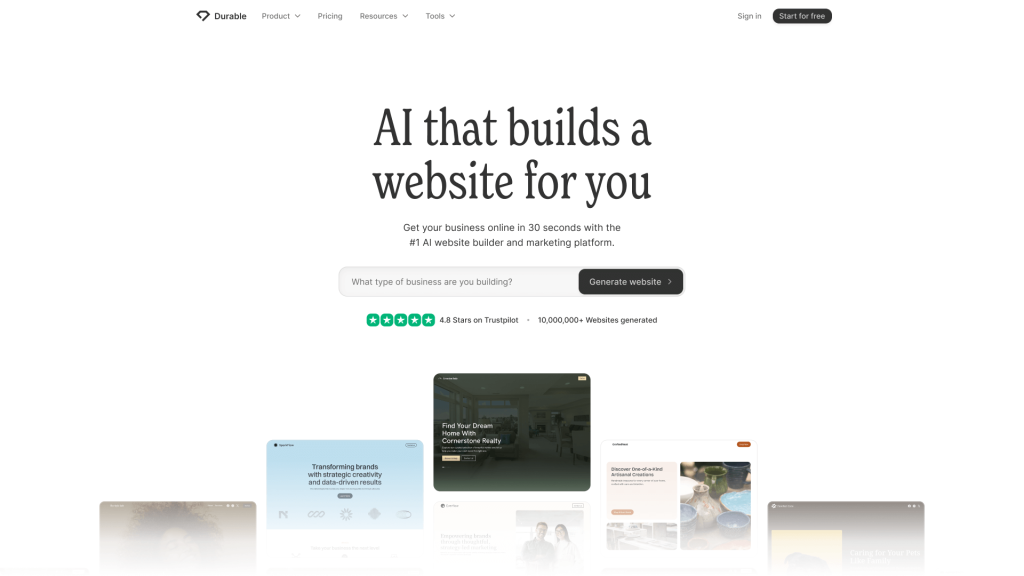
Durable is an AI-powered website builder focused on helping small businesses get online as quickly as possible. For founders and local businesses, the biggest challenge is often not marketing strategy but getting a functional website live without delays or technical complexity. Durable generates a complete site along with essential business tools in minutes.
It’s best suited for speed and simplicity. Teams that need deep customization, advanced integrations, or highly tailored user experiences will likely outgrow its capabilities.
Features
- AI website builder: Instantly generates a complete website based on basic business inputs.
- AI content and images: Creates website copy and visuals tailored to your business.
- AI chat assistant: Provides a chatbot that understands your business and can interact with visitors.
- AI visibility features: Includes positioning around improving how your business appears in AI-driven discovery.
- Integrated business tools: Combines website, basic CRM, and payments into a single platform.

Use cases
Durable works best for solopreneurs and small businesses that need to establish an online presence fast, without hiring a developer or designer. It’s practical for local businesses (restaurants, salons, contractors) that need a professional-looking site with contact forms and basic CRM. It’s also useful as a quick landing page builder for testing a new business idea before investing in a full website. For businesses with growing marketing stacks, it serves as a starting point rather than a long-term solution.
Pricing
Durable has a free plan with limited access to core features. Paid plans start at $25/month (Launch) and go up to $99/month (Grow). The pricing is straightforward with no per-seat or usage-based components.
FreJun

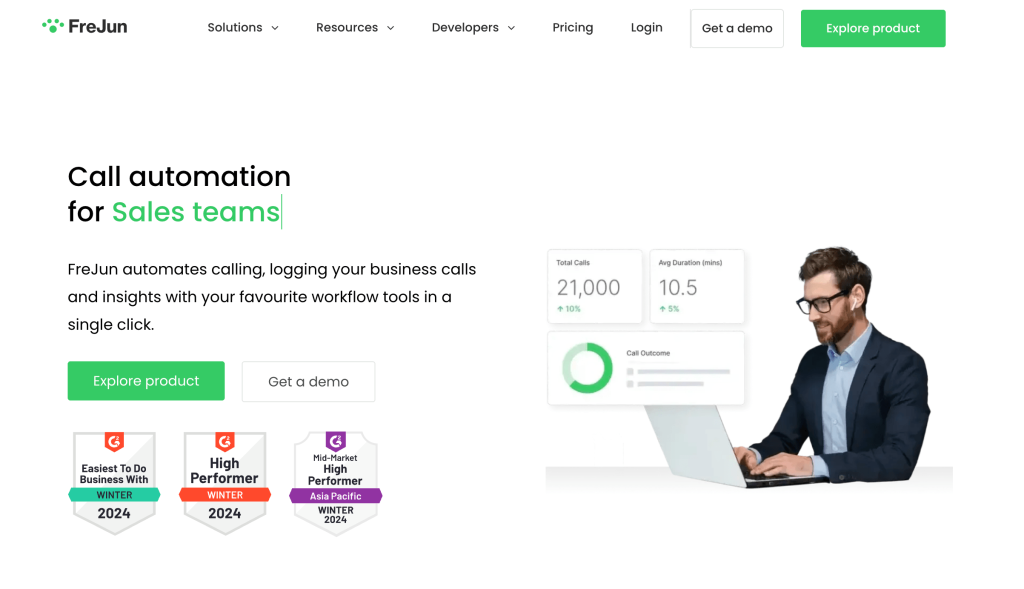
FreJun is an AI-powered voice infrastructure platform that automatically captures, transcribes, and analyzes sales calls to surface actionable insights. Teams can review conversations, monitor agent performance, and identify patterns in customer interactions without manual effort. By combining call automation with AI-driven analytics, FreJun helps sales and support teams make data-informed decisions directly from their call data.
Features
- Automatic transcription and recording: Captures every call for review, coaching, and training purposes.
- Agent performance tracking: Monitors call volume, response patterns, and individual agent metrics from a centralized dashboard.
- AI-powered call routing: Routes incoming calls intelligently to the right agent or department based on context.
- CRM integrations: Syncs call data automatically with HubSpot, Salesforce, and Pipedrive.
- Analytics dashboard: Provides a team-wide view of call activity, trends, and performance in real time.

Use cases
FreJun is strongest for sales and support teams that rely heavily on phone conversations and need structured insight into what’s working and what isn’t. A sales manager investigating a drop in conversion rates, for example, can pull up transcripts from low-converting calls, identify recurring objection patterns, and use those insights to update the team’s pitch in the next training session. It’s also valuable for contact centers that need to monitor agent performance and maintain quality at scale.
Pricing
FreJun offers two main plans. The Standard plan is $16.99 per user per month, and the Pro plan is $19.99 per user per month. AI Insights, which includes transcription and call summaries, is available as an add-on at $0.009 per minute.
Synthesia

Synthesia is an AI video platform for businesses that need professional videos at scale without traditional filming. For many teams, producing consistent video content is less about creativity and more about logistics, cost, and time. Synthesia turns scripts into avatar-led videos, making repeatable video production much simpler to manage.
Features
- AI avatar video generation: Create videos by turning scripts into presentations delivered by AI avatars.
- Multilingual voice support: Generate videos in multiple languages with AI voices for global audiences.
- Templates and collaboration tools: Use ready-made templates and collaborate across teams for consistent output.
- Custom avatars: Create branded or personalized avatars for business use.
- Usage-based plans: Paid tiers provide higher video minute limits and team features.


Use cases
Synthesia is heavily used for internal content: employee onboarding, training videos, product walkthroughs, and compliance training. Marketing teams use it for product demos, explainer videos, and sales enablement content where a consistent, professional look matters more than cinematic production. The multilingual support makes it especially useful for companies with global audiences that need to deliver consistent messaging across regions without separate production efforts for each language.
Additionally, using their free browser screen recorder can further enhance their content by capturing live demonstrations or step-by-step processes seamlessly.
Pricing
Synthesia offers a free plan with up to 10 minutes of video per month using stock avatars. The Creator plan is $89/month billed monthly. Enterprise pricing is custom and available through a demo. The free tier is enough to test the platform before committing.
Crystal Knows

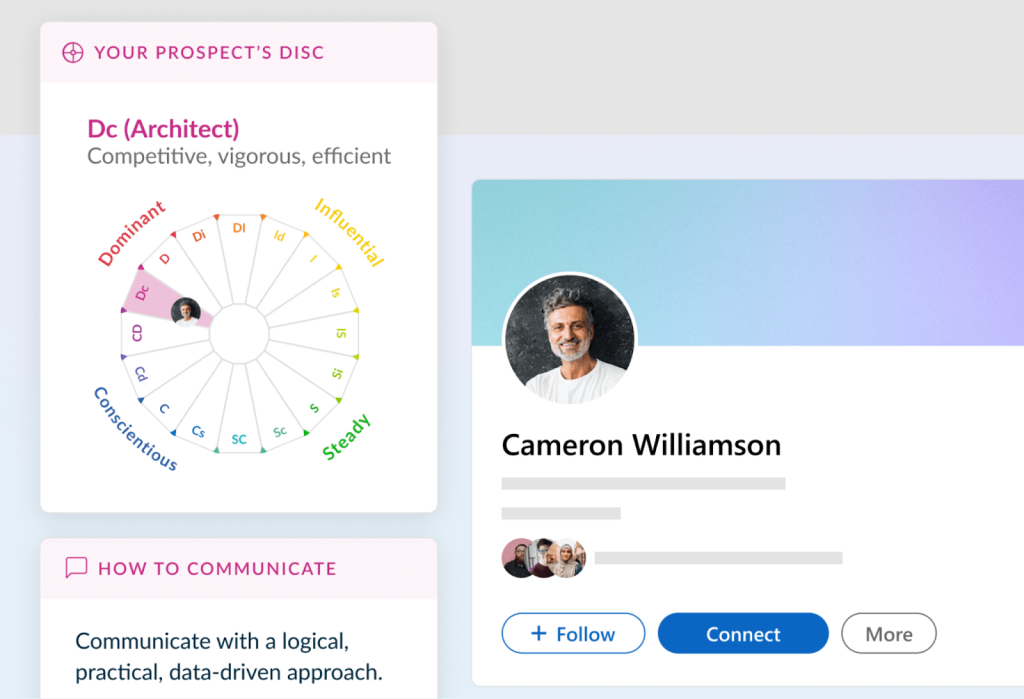
Crystal Knows is a personality insights platform that helps teams tailor communication based on individual behavioral traits. In outbound and account-based marketing, how you communicate can matter as much as what you say. Crystal analyzes personality signals and provides guidance on tone, messaging style, and communication approach for each individual.
Features
- Personality insights engine: Generates personality predictions based on available data to guide communication style.
- Communication recommendations: Provides tailored suggestions on tone, phrasing, and messaging for different individuals.
- Profile-based usage limits: Access to personality profiles and insights depends on plan tier and usage quotas.
- Integration into workflows: Can be used alongside email, CRM, and outreach tools to enhance personalization.

Use cases
Crystal Knows is most useful for sales and ABM (account-based marketing) teams that rely on personalized outreach. Sales reps use it to customize their sales pitches, adjust email tone, and call approach based on a prospect’s predicted communication style. It’s also helpful for partner and stakeholder communication, where getting the tone right can make a difference. Team leads sometimes use it to understand working styles across a team and improve internal collaboration. It’s less relevant for broad-audience marketing activities.
Pricing
Crystal Knows Premium starts at $59/month billed monthly and includes up to 20 personality profiles per month. Higher tiers are available for teams with larger outreach volumes. A limited free version offers a small number of predictions to test the platform.
Trustmary

Trustmary is a customer feedback and testimonial platform that helps businesses collect, manage, and display social proof. As conversion increasingly depends on trust signals, especially on landing pages and product pages, teams need more than scattered reviews. Trustmary turns customer feedback into structured, reusable assets that can directly influence buying decisions.
Features
- Survey-based feedback collection: Gather reviews, testimonials, and NPS/CSAT data through customizable surveys.
- Testimonial management system: Organize and manage collected feedback for reuse across marketing assets.
- Social proof widgets: Embed testimonials on websites, landing pages, and product pages to boost credibility.
- Automated collection workflows: Trigger feedback requests after key events like purchases or onboarding.
- Quota-based plan structure: Plans are built around survey responses and widget views.
Use cases
Trustmary works well for ecommerce stores and SaaS businesses where reviews directly impact purchasing decisions. Marketing teams use it to automate testimonial collection after transactions or onboarding, building a steady pipeline of fresh social proof. The widget system makes it easy to deploy testimonials on high-traffic pages (pricing, product, landing pages) to improve conversion rates. It’s a practical fit for any business that wants to systematically collect and display customer feedback rather than relying on ad-hoc review requests.
Pricing
Trustmary uses a flexible “build your plan” model starting at approximately $26/month. Pricing scales based on usage quotas like survey responses and widget views, so costs depend on volume rather than a fixed tier structure.
ElevenLabs
ElevenLabs is a modern AI voice platform that enables high-quality text-to-speech, voice design, and audio production. As video, podcasts, and audio content become core parts of marketing, teams need scalable ways to produce voiceovers without traditional recording setups. ElevenLabs generates natural-sounding speech that can be used across ads, product demos, and localized content.
Features
- Text-to-speech generation: Convert written scripts into realistic voiceovers with natural tone and pacing.
- Speech-to-text and audio tools: Transcribe and process audio as part of broader content workflows.
- Voice design and cloning: Create custom voices for branding or specific use cases.
- Studio projects: Manage and produce audio content within a dedicated workspace.
- Multi-tier plans: Scale usage across creator and business needs with flexible plans.
Use cases
ElevenLabs is useful for marketing teams that produce video or audio content regularly. Ad teams use it to generate voiceovers for paid ads and product demos without booking talent or studio time. Content teams convert blog posts and scripts into podcast-style audio for distribution across channels. The multilingual support makes it practical for companies that need to localize campaigns across regions. Voice cloning is useful for brands that want a consistent branded voice across all audio content.
Pricing
ElevenLabs has a free tier for basic usage. Paid plans start at $5/month (Starter) and scale through Creator ($11/month) and Pro ($99/month). Each tier increases character limits and adds features like voice cloning and priority processing.
Brand24


Brand24 is a social listening and media monitoring platform used to track brand mentions, keywords, and sentiment across the web and social media. As online conversations shape brand perception, marketers need real-time visibility into how their brand, competitors, and campaigns are being discussed.
Features
- Keyword and mention tracking: Monitor brand names, products, and topics across social media, forums, and web sources.
- AI sentiment analysis: Classifies mentions as positive, negative, or neutral to help prioritize responses.
- Real-time monitoring and alerts: Stay updated with changes in conversation volume and sentiment.
- Multi-user collaboration: Supports team workflows with shared dashboards and access controls.
- Flexible data tiers: Plans vary by mention volume, update frequency, and feature access.
Use cases
Brand24 is primarily used by marketing and PR teams that need to monitor brand reputation in real time. It’s useful for tracking campaign impact, measuring PR mentions, and identifying engagement spikes as they happen. Competitive analysis teams use keyword tracking to compare brand visibility against competitors. It’s also helpful during product launches or crisis situations, where fast awareness of sentiment shifts matters. Teams that only need occasional brand checks may find it more than they need.
Pricing
Brand24 starts at $249/month for the Individual plan ($199/month billed annually). The Team plan is $349/month ($299/month billed annually). Additional tiers are available for larger monitoring needs. A 14-day free trial is available.
Hypotenuse AI


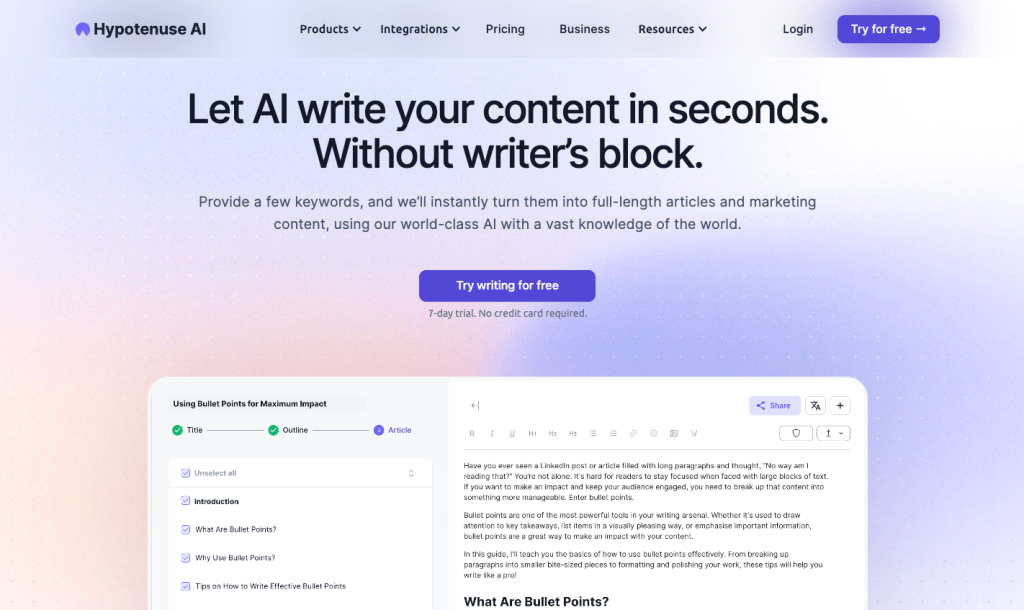
Hypotenuse AI is a content generation platform built specifically for ecommerce workflows, focusing on product data enrichment and large-scale content production. As catalogs grow, managing thousands of product descriptions, metadata, and category pages becomes a major operational challenge. Hypotenuse automates content creation at scale while maintaining consistency through brand voice controls and structured data inputs.
Features
- Bulk content generation: Create product descriptions, titles, meta tags, and category content at scale.
- Brand voice governance: Enforce tone, style, and terminology with rules for consistent output.
- Product data enrichment: Pull and structure product data from sources like web pages, UPCs, and images.
- API integration: Connect content generation directly into ecommerce platforms and workflows.
- SEO content optimization: Generate and refresh metadata and category pages as inventory evolves.

Use cases
Hypotenuse AI is a practical choice for ecommerce businesses with large catalogs that need consistent product content across marketplaces and their own stores. Product teams use it to generate and update descriptions for hundreds or thousands of SKUs without writing each one manually. It’s also useful for localization, ensuring brand-consistent content across regions. SEO teams use it to refresh product and category metadata as inventory changes. Teams that primarily need blog or campaign content will find other tools on this list a better fit.
Pricing
Hypotenuse AI starts at $29/month for the Entry plan ($19/month billed annually). The Essential plan is $87/month ($56/month billed annually) with more capacity and features. Enterprise pricing is custom and available through sales.
Fields to use AI marketing tools
AI is now embedded across nearly every part of modern marketing, from planning and execution to analysis and optimization. Rather than being limited to a single function, AI tools are used across multiple areas of marketing to improve speed, accuracy, and outcomes.
In ecommerce, AI helps personalize shopping experiences, optimize product listings, and forecast demand. Tools can analyze customer behavior, recommend products, and support inventory planning, allowing businesses to respond quickly to changing trends.
In customer engagement and support, AI-powered chat and messaging tools like Tidio and Chatfuel handle inquiries, qualify leads, and assist users in real time. This enables businesses to provide consistent support while also improving conversion rates.
For content marketing, platforms such as MarketMuse, Jasper, and Writesonic help teams plan, generate, and optimize content. These tools support everything from topic research and briefs to full campaign assets, helping marketers scale content without sacrificing quality.
In social media marketing, AI tools streamline scheduling, audience targeting, and performance tracking. Platforms like CoSchedule and Flick allow teams to plan, publish, and analyze content more efficiently across multiple channels.
For creative production, AI tools like Midjourney make it easier to generate visuals at scale. Combined with voice tools like ElevenLabs, marketers can produce multimedia assets without traditional production workflows. For ad-specific creative, tools like AI ad studio go a step further, generating multiple ad variations ready to test directly in paid campaigns.
Finally, in the data and analytics layer, platforms like Coupler.io bring everything together by collecting and analyzing data from multiple sources. With AI-powered analysis, marketers can move beyond dashboards and start asking questions directly, gaining faster insights into campaign performance.
Manage and analyze your marketing data with Coupler.io
Most AI marketing tools help you create faster. But if your data is scattered, you’re still making decisions based on incomplete information.
Coupler.io solves this by bringing your marketing data into one place, so you can move from fragmented reports to clear, actionable insights.
Instead of manually pulling data from multiple platforms, you can automatically collect, transform, and analyze everything in a single workflow. No more switching between tools, no more outdated spreadsheets, no more guesswork.
What you can do with Coupler.io:
- Unify your data: Connect 400+ tools like Google Ads, Meta Ads, GA4, HubSpot, and Shopify into one destination.
- Transform without code: Clean, join, and structure your data without SQL or engineering support.
- Automate reporting: Schedule refreshes as often as every 15 minutes so your dashboards stay up to date.
- Analyze with AI: Connect your data to tools like ChatGPT, Claude, or Gemini and ask questions in plain English.
- Build dashboards fast: Use ready-made templates or connect to BI tools like Looker Studio and Power BI.
When your data is centralized and structured, every AI tool in your stack becomes more effective. You move from reacting to results to understanding what’s working and why.
The benefits of using AI-based marketing tools
AI tools help marketers work faster, understand their audience better, and make decisions based on data rather than instinct. Here are three areas where the impact is most visible.
Improved efficiency and productivity
AI helps marketing teams automate repetitive work and reclaim time for strategy and creative thinking. Instead of manually managing campaigns, analyzing performance, or creating content variations, AI tools handle these processes in the background.
For example, email platforms with AI can automatically trigger campaigns based on user behavior, like sending follow-ups after cart abandonment or re-engaging inactive users. Content and ad tools can generate, test, and optimize variations without constant manual input.
As adoption grows, it becomes important to establish clear governance. Without oversight, teams risk issues like shadow AI, where unapproved tools are used without visibility or control. Setting guidelines helps ensure AI is used effectively while maintaining data security.
Deeper customer insights and personalization
AI can process large volumes of behavioral data and turn it into targeted, personalized experiences. Personalization platforms analyze real-time customer activity and adjust content, recommendations, and messaging accordingly.
For example, if a user has been browsing running shoes on an ecommerce site, AI can customize the page to feature those products and suggest complementary items. This level of personalization improves the shopping experience and increases conversion rates, and it happens automatically at a scale that would be impossible to manage manually.
Data-driven decision-making
Advanced algorithms and machine learning allow AI to predict trends and anticipate customer behavior with greater accuracy. This shifts decision-making from intuition to evidence.
AI marketing reporting tools like Crayon help teams track competitor activity and respond to changes in real time. Analytics platforms, such as Coupler.io, collect and unify data from multiple sources, giving teams a clear view of what’s performing and why. It also offers AI integrations that let you analyze marketing data through Claude, ChatGPT, or Gemini, turning raw numbers into actionable insights.
When your data is centralized and your analysis is AI-powered, every part of your marketing stack becomes more effective.

FAQ
What is an AI marketing tool?
An AI marketing tool is a software or platform that uses artificial intelligence to automate, analyze, and improve marketing activities.
These tools go beyond simple automation. They process large volumes of data, identify patterns, and generate insights that help marketers make better decisions and execute faster. Many tools can also create content, optimize campaigns, and personalize customer experiences in real time.
AI marketing tools help reduce manual effort by handling repetitive tasks like reporting, segmentation, and content optimization, allowing teams to focus on strategy and growth.
An AI marketing tool typically does some or all of the following:
- Automation: Automates repetitive tasks like sending emails, managing campaigns, or updating reports.
- Data analysis: Processes large datasets to uncover trends, track user behavior, and measure performance across channels.
- Predictive analytics: Uses historical data to forecast outcomes such as conversions, engagement, and campaign performance, helping marketers make proactive decisions.
- Personalization: Delivers tailored messages, recommendations, and experiences based on user behavior, preferences, and intent.
Finally, AI marketing tools enhance a marketer’s capabilities and are there for you every step of building and executing your marketing strategy. Whether it’s an AI checker or a versatile marketing platform, it will help you automate redundant and time-consuming tasks to focus on more important activities.
How to integrate AI tools for marketing into your marketing tech stack
If you want to scale your marketing efforts, building a well-structured and flexible marketing tech stack should be your first priority.
AI tools are evolving fast, but without a strong data foundation, they don’t deliver their full value. You might generate content faster or automate tasks, but if your data is scattered, your decisions will still be guesswork.
To make AI actually work for your marketing, you need a system where your data flows smoothly across tools. That means combining AI-powered tools with reliable data pipelines and automation. When everything is connected, AI can produce better insights, more accurate predictions, and more relevant outputs.
That’s exactly why we built Coupler.io. It helps you collect, transform, and unify marketing data from dozens of platforms into one place. Once your data is structured and accessible, you can layer AI tools on top for content creation, campaign optimization, and predictive analysis. Instead of relying on assumptions, you’re working with real performance data, and that’s what drives better marketing outcomes.
How to choose the best AI marketing tool for you?
Selecting the right AI marketing tool comes down to how well it fits your workflow, goals, and current bottlenecks.
Start by identifying where you need the most support. Some tools are built for execution like creating content, managing campaigns, and moving faster. Others focus on research and planning, giving you structured insights and competitive analysis.
Use the tools in this guide as a starting point, but focus on building a stack that solves your biggest constraint first. In many cases, that means fixing your data and visibility before layering on more execution tools.