Supermetrics vs Funnel is a choice between two tools that pull ad platform data into your reports, which allows you to stop exporting CSVs by hand. Both solutions connect hundreds of marketing sources. Funnel switched to a new pricing model in February 2026, so older comparisons may already be out of date.
The biggest difference is how each one bills you. Supermetrics sells plans with caps on what you can connect. Funnel sells Flexpoints, a capacity unit that every connector and account uses up.
Key takeaways
- Tight budget? Supermetrics is the cheaper way in, from $44/month billed yearly.
- Funnel asks for more upfront. Plans start from $300/month billed annually, and its pricing page lists no free plan or trial.
- One destination is the limit, more or less. Supermetrics entry plans cover one or two, and warehouses require Enterprise.
- Need hourly exports? Funnel’s published plans export daily or every 2 hours.
- Measurement costs extra. Funnel sells MMM and incrementality testing as a paid add-on.
- Security is a draw. Both hold a SOC 2 Type II report and ISO 27001 certification.
Side-by-side at a glance
| Supermetrics | Funnel | |
|---|---|---|
| Best for | Small teams moving ad data into one reporting tool | Marketing teams that want a data hub with measurement |
| Pricing model | Plans with caps on sources, accounts, destinations, users | Flexpoints capacity, billed annually |
| Entry price | Starter at $44/month billed yearly, $55/month billed monthly | Starter from $300/month, billed annually |
| Free plan / trial | No free plan, 14-day free trial | Neither listed on the pricing page |
| Data sources | 170+, marketing-focused | 117 on Starter, 600+ on Enterprise |
| Destinations | 1 core destination on entry plans, warehouses on Enterprise | 13 to 47 by plan |
| AI capabilities | Supermetrics Studio, AI chats, MCP server | Funnel AI, Funnel MCP |
| Measurement features | Not listed on the pricing page | MMM, MTA and incrementality (Funnel Measure add-on) |
| Security certifications | SOC 2 Type II, ISO 27001, GDPR, CCPA | SOC 2 Type 2, ISO 27001, GDPR, CCPA |
| Cancellation terms | Online plans stop future payments, no partial refunds | Cancel at least 30 days before renewal |
How Supermetrics vs Funnel pricing works in practice
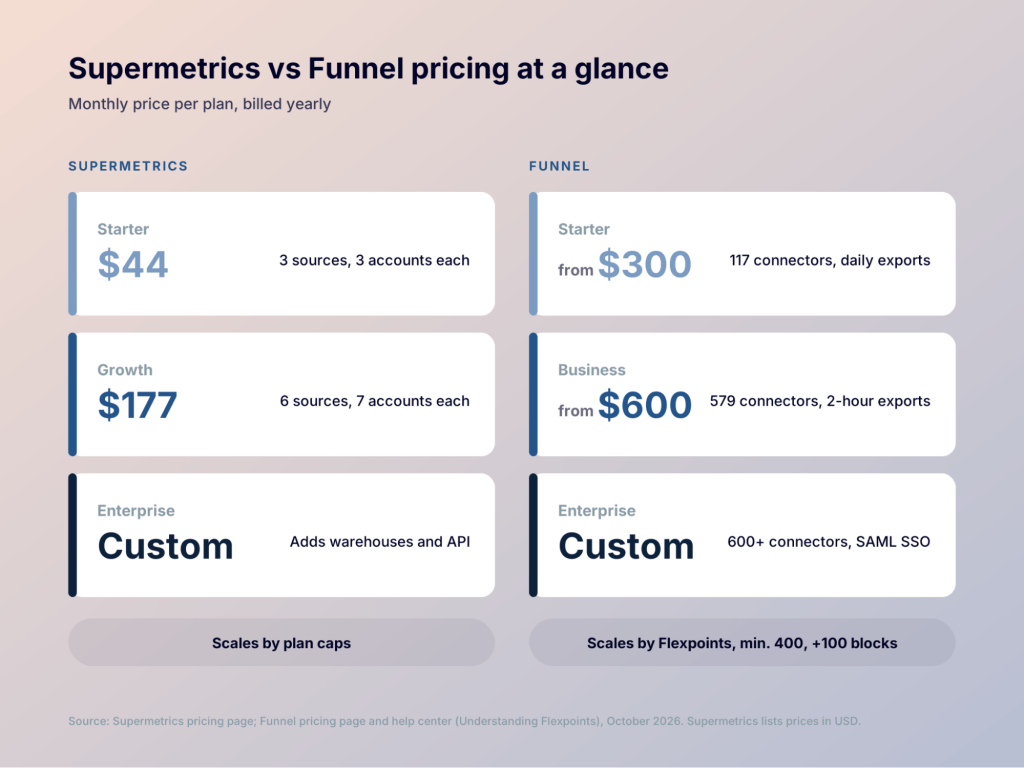
Supermetrics lists two self-serve plans in USD. Starter is $44/month billed yearly and gives you 3 data sources with 3 accounts each. Growth is $177/month billed yearly for 6 sources with 7 accounts each. You can buy add-ons, but each one stops at a fixed ceiling. Enterprise is quoted, and that’s where warehouses and the API live. For the full picture, see a full breakdown of Supermetrics pricing.
Funnel works differently. Each connector costs 50 Flexpoints, and each platform account costs 5. A Data Studio destination costs 150. Every plan needs at least 400 Flexpoints, and you add more in blocks of 100. Starter is from $300/month and Business from $600/month, both billed annually. Funnel doesn’t publish the price per block, and it changes by plan.
Funnel’s help center says this model has applied to new customers since February 4, 2026. Existing customers move to it when they change plans at renewal. One upside: Funnel doesn’t charge for data volume or row counts.
The two pricing models in a worked example
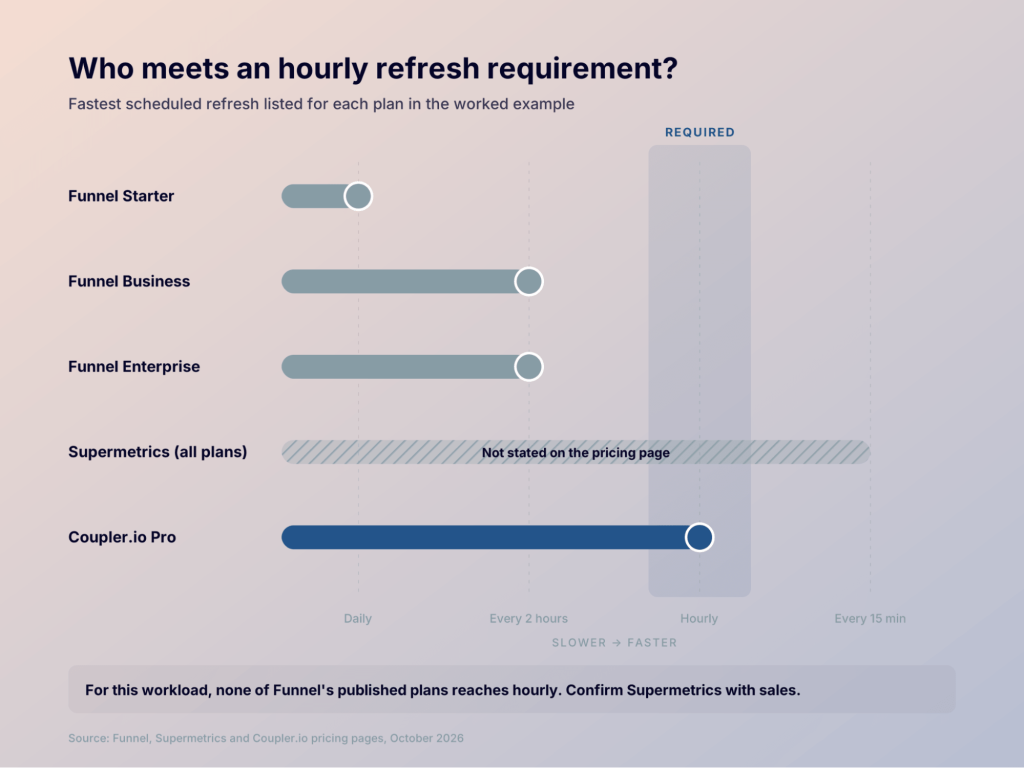
Picture an agency with 10 clients, each running ads on 4 platforms. It wants hourly refreshes and one Data Studio destination.
Supermetrics. Starter is out straight away. It allows 3 data sources and 3 accounts per source. Growth covers the 4 sources but only 7 of the 10 accounts each source needs. The account add-on starts at $11/month on yearly billing and tops out at 15 accounts. The pricing page doesn’t explain how that add-on is counted, so check the final number with sales. The real surprise comes at client 16, when the agency has to move to a custom Enterprise quote. The pricing page doesn’t state refresh frequency either, so confirm hourly support before you sign.
Funnel. Four connectors use 200 Flexpoints. Forty accounts use another 200. Data Studio adds 150, which makes 550. That rounds up to 600 Flexpoints, above the 400-point minimum. Starter refreshes exports daily, while Business and Enterprise refresh every 2 hours. So none of Funnel’s published plans meet the agency’s hourly requirement. Each new client also adds 20 Flexpoints. Funnel says going over capacity may block new accounts until you buy more.

Put side by side, the two bills grow in different ways. Supermetrics goes up in add-on steps until client 16 pushes you to an Enterprise quote, while Funnel adds 20 Flexpoints per client and jumps to a new 100-point block about every 5 clients.
A note on predictable pricing. With Supermetrics, the account ceiling decides when the bill jumps. With Funnel, it’s the next 100-point block. Coupler.io prices mainly by connected accounts, and each plan sets destinations and refresh speed. Its Pro plan covers the agency from our example at $199/month billed annually, with 50 accounts and hourly refresh. See Coupler.io pricing.
Who the Supermetrics vs Funnel audience really is
On G2, small businesses make up the largest reviewer group for both tools. The plans say more. Supermetrics aims Starter at individuals and small teams, and says 200,000+ companies use it.
Funnel says it serves 3,000+ companies. Even its cheapest plan is an annual commitment, and its measurement add-on is priced on ad spend. Funnel makes the most sense for teams that treat marketing data as shared infrastructure.


Track every client’s ad accounts with Coupler.io
Book a demoComparing Supermetrics vs Funnel data sources head-to-head
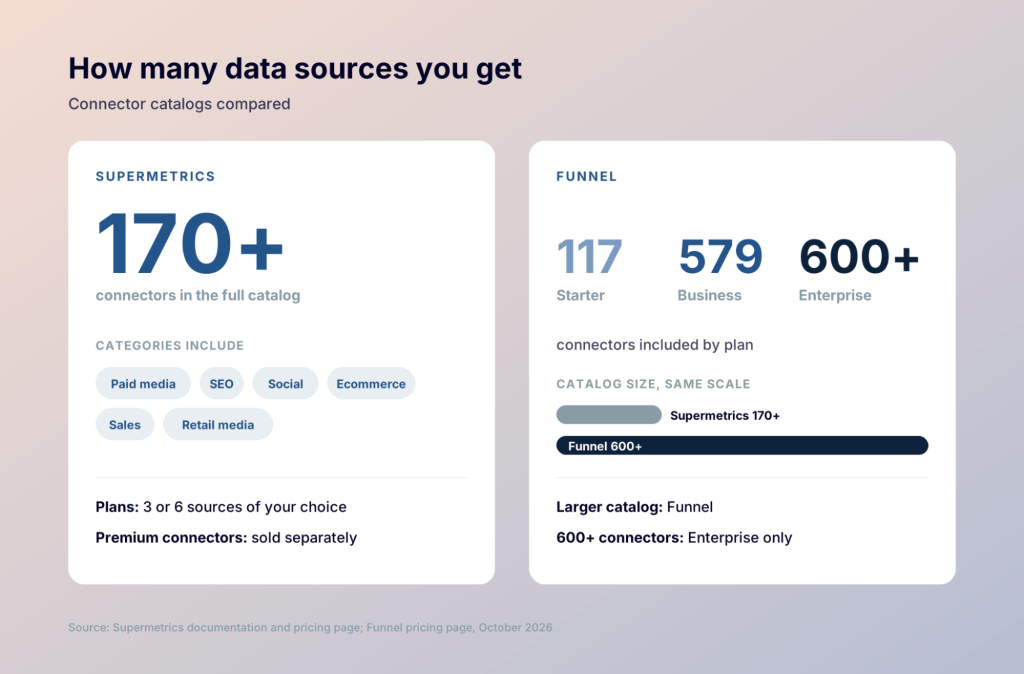
Supermetrics’ documentation lists over 170 data source connectors. They cover paid media, SEO, social, ecommerce, sales, and retail media. Some connectors are Premium, which means you buy them separately through sales.
Funnel lists 600+ connectors on Enterprise. Business includes 579, and Starter includes 117. If catalog size is your deciding factor, Funnel wins.

Where Supermetrics vs Funnel destinations diverge
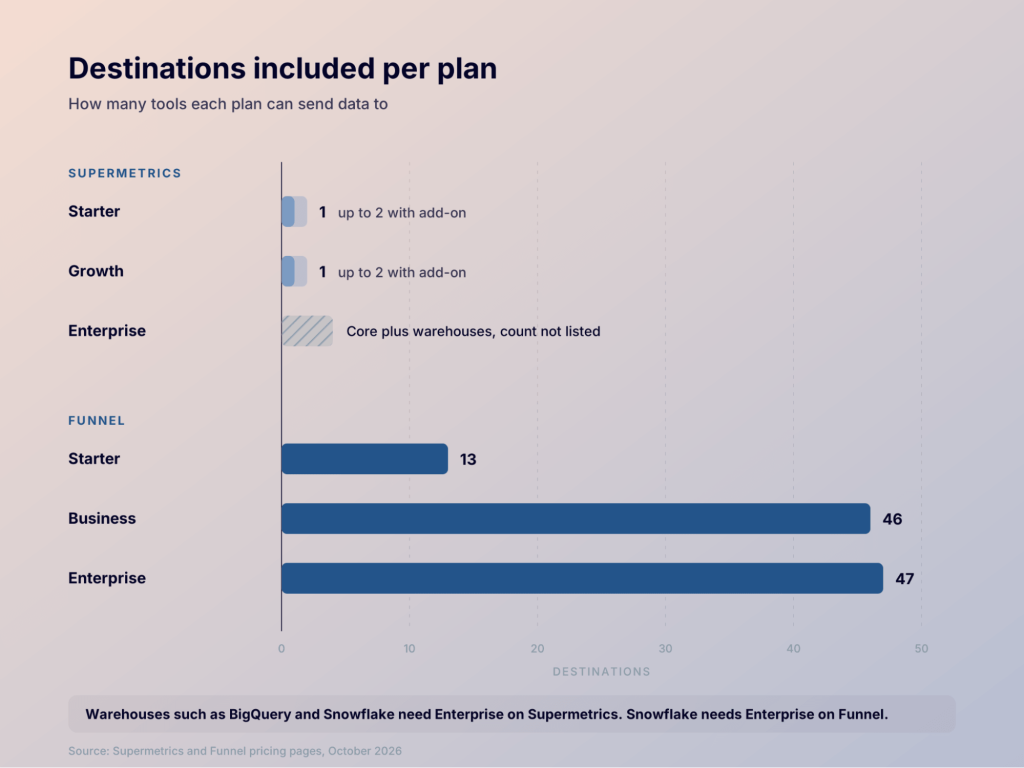
Supermetrics Starter and Growth come with one core destination. You pick from ChatGPT, Claude, Microsoft Copilot, Data Studio, Google Sheets, Excel, and Power BI. An add-on gets you a second one. BigQuery, Snowflake, and other warehouses need Enterprise.
Funnel includes 13 destinations on Starter, 46 on Business, and 47 on Enterprise. Snowflake is Enterprise-only. Funnel can also send conversion data back to ad platforms. In short, Supermetrics suits a single reporting tool, and Funnel suits teams that feed several systems at once.
What each platform adds beyond moving data
Put Supermetrics vs Funnel key features side by side, and the gap comes down to modeling and measurement. Supermetrics keeps data transformations and Supermetrics Storage on Enterprise. Its Campaign Management lets you draft campaign changes from an AI chat and approve them before they go live.
Funnel keeps the original source data, so when you change a transformation, it applies to your whole history. Its marketing data model lets you add business rules and link campaigns to budgets and targets. Funnel Measure adds MMM, multi-touch attribution, incrementality testing, and budget optimization. It’s a paid add-on on Business and Enterprise. Funnel’s calculator shows Digital Measurement at $2,250/month billed annually for $500K to $1M in monthly ad spend.
A closer look at Supermetrics vs Funnel AI
Supermetrics has five AI features. Supermetrics Studio builds dashboards from plain-language prompts, with 4,000 monthly AI credits on Starter and 12,000 on Growth. AI chats connect your data to Claude, ChatGPT, Copilot, and Gemini Enterprise. A separate MCP server needs a subscription that includes the Supermetrics API. The last two are AI custom fields and AI summaries in Sheets and Excel.
Funnel AI, formerly Data Chat, comes with every plan. Funnel MCP is listed in the Claude and ChatGPT app directories, and Funnel says it also works with Cursor and Gemini. Funnel Measure customers can query their MMM and attribution results through it. Both lineups are handy for quick questions about your numbers. For more options, see Funnel.io alternatives for 2026.
Where AI ships today. Both vendors now offer an AI chat and MCP access, so the real difference is how each one handles your data. Coupler.io takes a different route with Coupler AI. Its AI Agent answers questions inside the app. AI Integrations bring the same data into tools like Claude, where you can also set up dataflows by asking. AI Skills add reusable analysis workflows, and 200+ dashboard templates sit behind them.
Let Coupler AI do the data work for you
Tell Coupler AI what you need to know, from which source, and how often. It connects your account, sets up the data flow, keeps it refreshed, and lets you analyze the results inside Coupler.io or another AI tool.
Try for free

Security posture and vendor stability
When it comes to Supermetrics vs Funnel security & stability, the two tools are closely matched. Supermetrics goes through annual SOC 2 Type II audits and holds ISO 27001 certification. It processes data on AWS and GCP servers in the EU. Its products are GDPR and CCPA compliant.
Funnel holds a SOC 2 Type 2 attestation and ISO 27001 certification, and complies with GDPR and CCPA. Select subscriptions can choose EU, US, or global hosting.
Access control is where they split. Supermetrics includes SSO on Starter and Growth, while SAML-based SSO is an Enterprise feature. Funnel Starter and Business use Google sign-in only; SAML, OIDC, SCIM, and the audit log require Enterprise. Neither security page states an uptime figure.
Build multi-client ad reporting with hourly refresh
Try Coupler.io for freeSupermetrics vs Funnel ease of use, support: how they compare in practice
On G2, Funnel scores 4.5 from 270 reviews and Supermetrics 4.4 from 823. Funnel also leads on ease of setup (8.7 vs 8.1) and ease of use (8.6 vs 8.2). Support is the widest gap: 9.2 for Funnel against 7.8 for Supermetrics.
Getting started looks different too. Supermetrics lets you start a trial without a credit card, while Funnel starts with a demo. Leaving differs as well. Funnel Starter customers can cancel in the app, but Business and Enterprise customers have to contact support.
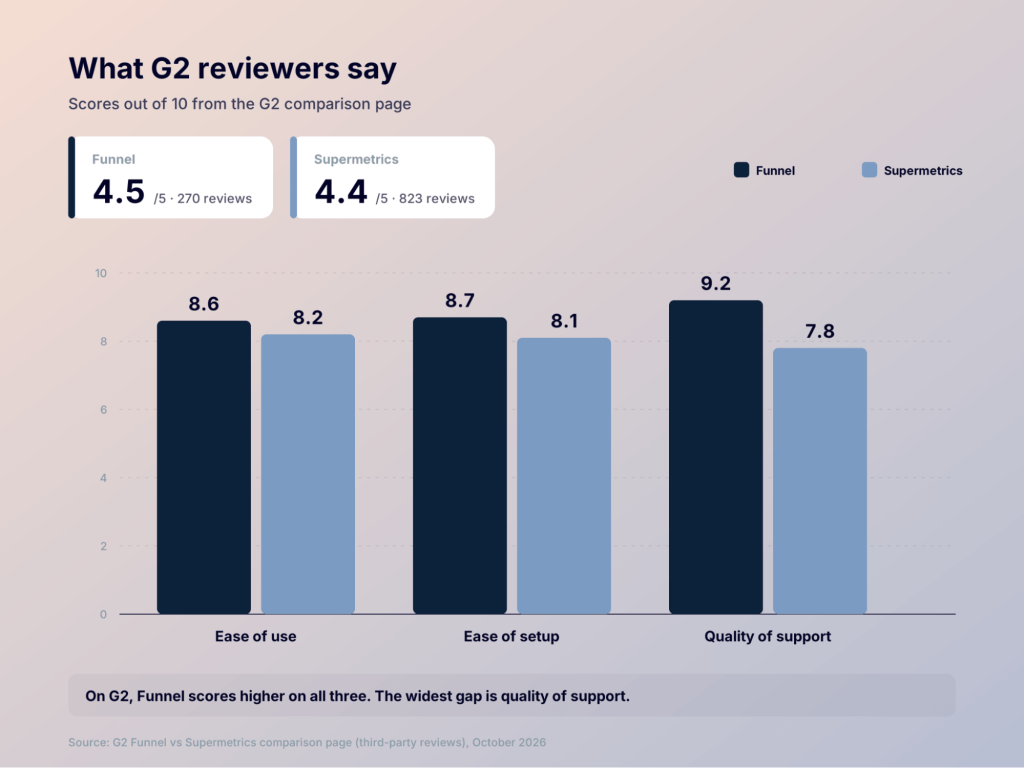
Both tools score above 4 out of 5 on G2, so reviews alone won’t settle the choice. Pricing and plan limits are where they really split.
Get hourly refresh for 50 ad accounts with Coupler.io
Try for freeLooking beyond Supermetrics and Funnel
If neither tool feels right, it’s usually down to cost or fit. The pricing may grow faster than your data, or neither tool matches the destinations you use. In that case, Coupler.io is worth a look.
Coupler.io, a data integration and AI analytics platform, doesn’t lock connectors behind plan tiers. All 400+ data sources are available on every plan, so you never pay extra to unlock one. That means ad spend can sit next to CRM or finance numbers in the same report. Data can go to Google Sheets, Excel, Data Studio, Power BI, BigQuery, Snowflake, and AI tools such as Claude. Billing scales with connected accounts, and your plan sets destinations and refresh speed. Paid plans start at $24/month billed annually. There’s also a free plan and a 7-day trial. On the Custom plan, data refreshes as often as every 15 minutes.
Coupler AI is made up of the AI Agent, AI Integrations, and Skills. Security covers SOC 2 Type II, GDPR, HIPAA, and DORA, with TLS in transit and AES-256 for stored credentials.
| Coupler.io | Supermetrics | Funnel | |
|---|---|---|---|
| Pricing model | Accounts, destinations, refresh frequency | Plans with source and account caps | Flexpoints capacity |
| Entry price | $24/month billed annually | $44/month billed yearly | From $300/month billed annually |
| Free trial | 7 days, plus a free plan | 14 days | Not listed |
| Data sources | 400+, marketing and beyond | 170+, marketing-focused | 600+ on Enterprise |
| Dashboard templates | 200+ | AI-built dashboards in Studio | Built-in dashboards, no template count listed |
| AI capabilities | Coupler AI: AI Agent, AI Integrations, Skills | Studio, AI chats, MCP server | Funnel AI, Funnel MCP |
On Supermetrics vs Coupler.io, the gap starts at entry level. Supermetrics Starter is $44/month for 3 data sources, while Coupler.io starts at $24/month with every source available, both billed annually.
Coupler.io suits marketing teams and agencies that want a predictable monthly bill and ready-made dashboards, without the overhead of a full marketing data hub. It isn’t the answer for everyone, though. If you need MMM or incrementality testing, Funnel is the better fit. And if your whole workflow is one Google Sheet, Supermetrics’ entry plan may still cost less.
If you’re on Funnel and the pricing has you reconsidering, the Coupler.io team will scope a migration. See Coupler.io vs Funnel.io for the full head-to-head.
Verdict: which should you choose?
Pick Supermetrics if
You need ad data in one reporting tool on a small budget. The trial doesn’t ask for a credit card, so you can test it first. Keep an eye on the account ceiling as your client list grows.
Pick Funnel if
You run a marketing data hub that feeds several destinations and needs consistent history. Funnel is also the pick if you want MMM and incrementality testing from the same vendor.
Consider Coupler.io if
Your data goes beyond marketing, and you want to see prices before talking to sales. Every plan below Custom has a published price. Dashboard templates and Coupler AI cover most reporting from day one. For more options, see the best Supermetrics alternatives.
Walk away from all three if
You run a dbt warehouse and need developer-first ELT. Fivetran is the better match there. If you’d rather self-host open source, look at Airbyte.