
QuickBooks Online is one of the most popular accounting tools for small businesses. You create and send invoices there, but sooner or later you need the invoice data elsewhere: in Excel for a monthly report, in a dashboard for accounts receivable, or in a backup. This article explains how to export invoice data from QuickBooks Online.
You have two options. Coupler.io exports invoices automatically on a schedule to Excel, Google Sheets, BigQuery, BI tools or AI tools, which fits recurring reports. QuickBooks’ own report export gives you a one-off Excel, CSV or PDF file, which fits an occasional list.
How to automate exports of invoices from QuickBooks Online with Coupler.io
You can export invoices manually, but what happens when you need weekly or monthly reports of invoices? You’d have to repeat the same export every time. A QuickBooks data connector does it for you. Coupler.io is a reporting automation platform for business teams. It automatically collects and blends data from 400+ apps and keeps it up to date for your reports and AI. With it, QuickBooks export to Excel is easy, and you can also connect QuickBooks to BigQuery, Google Sheets, BI tools or AI tools.
The quickest way to start is to ask the Coupler AI agent. Describe which invoices you need, where to send them and how often, and the agent creates the data flow for you.
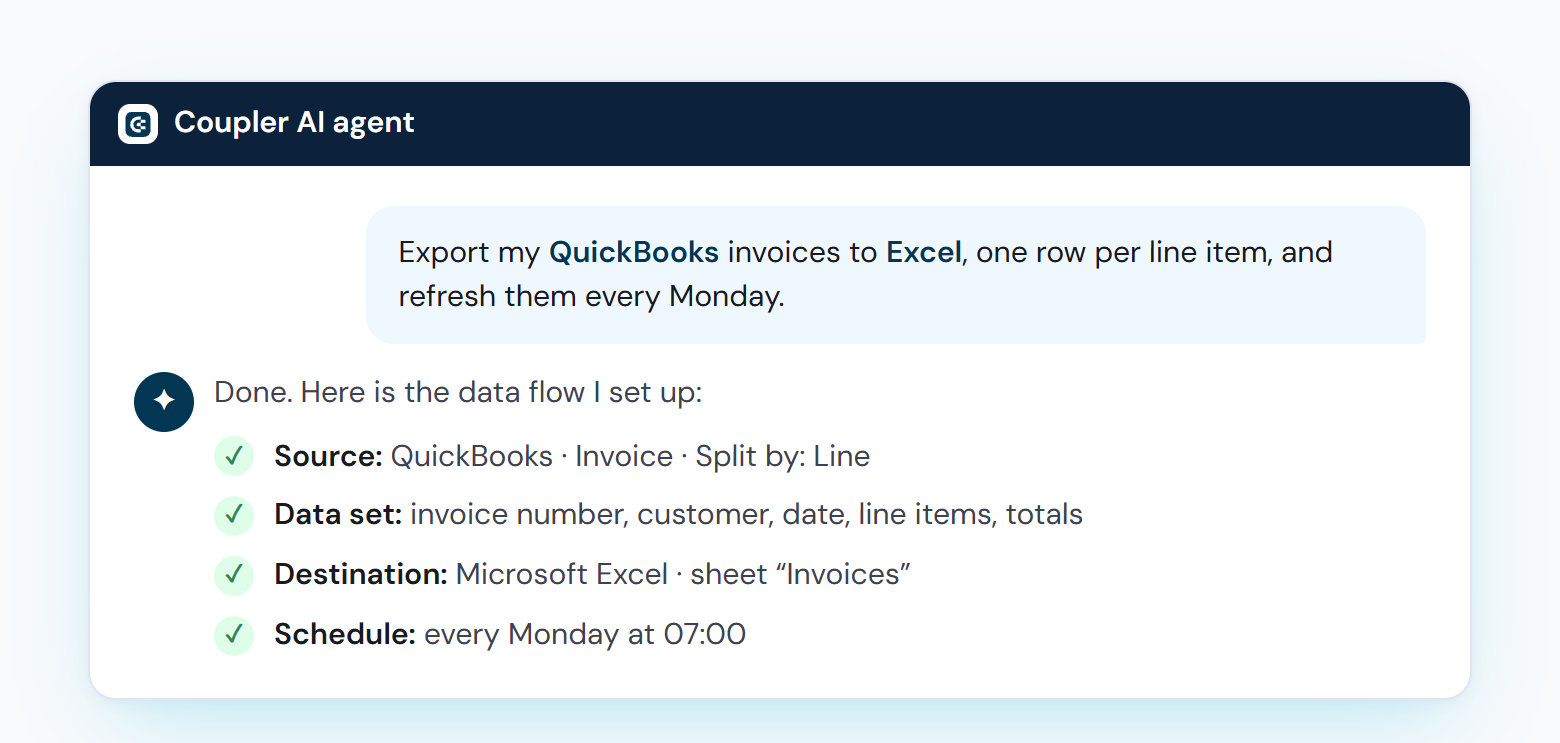
To set up QuickBooks invoice exports yourself, create a data flow in Coupler.io and complete three steps. Try it out right away with the form below. It does not require your credit card to get started with Coupler.io for free.
Step 1: Collect your QuickBooks invoices
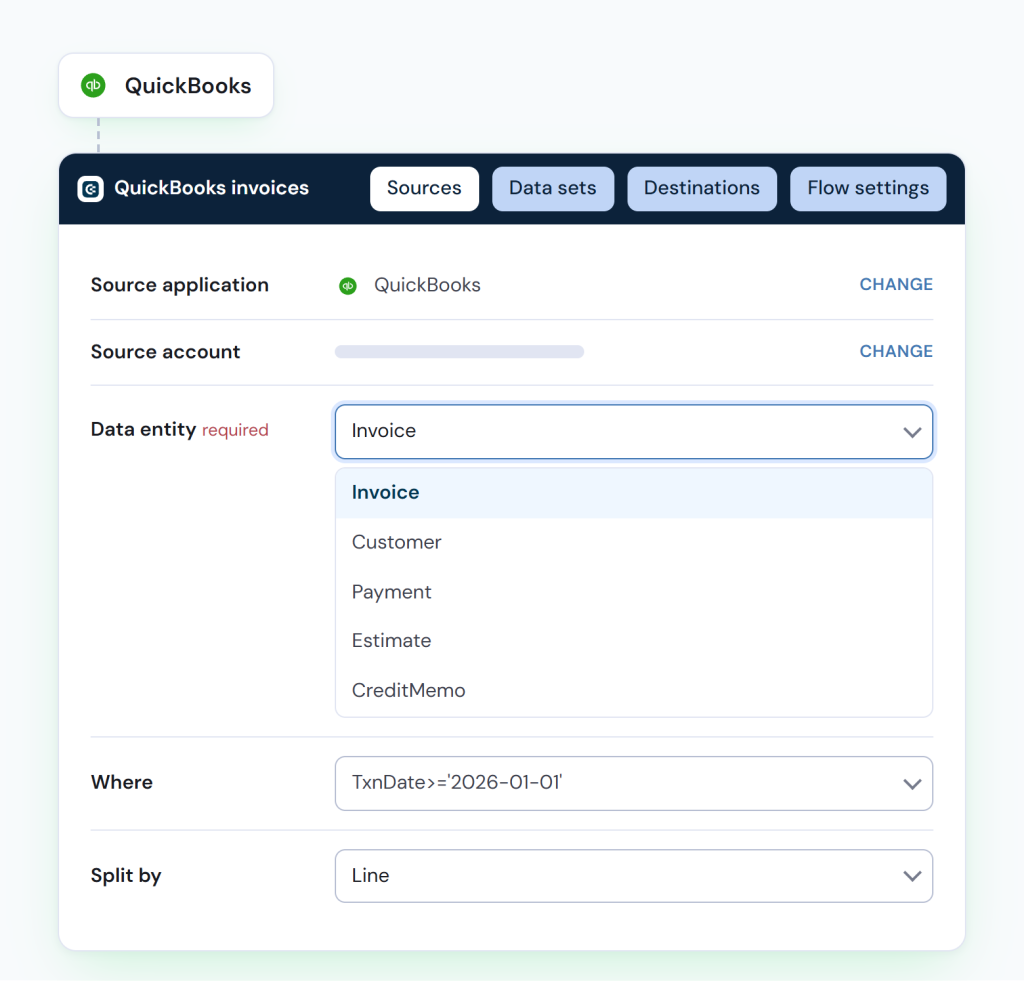
Add QuickBooks as the source, connect your Intuit account, and allow Coupler.io to view your QuickBooks data. Choose Invoice as the data entity. Optionally, limit the export with a Where condition, for example, to invoices dated this year, and split the invoices by Line to get one row per line item.
Step 2: Organize the invoice data
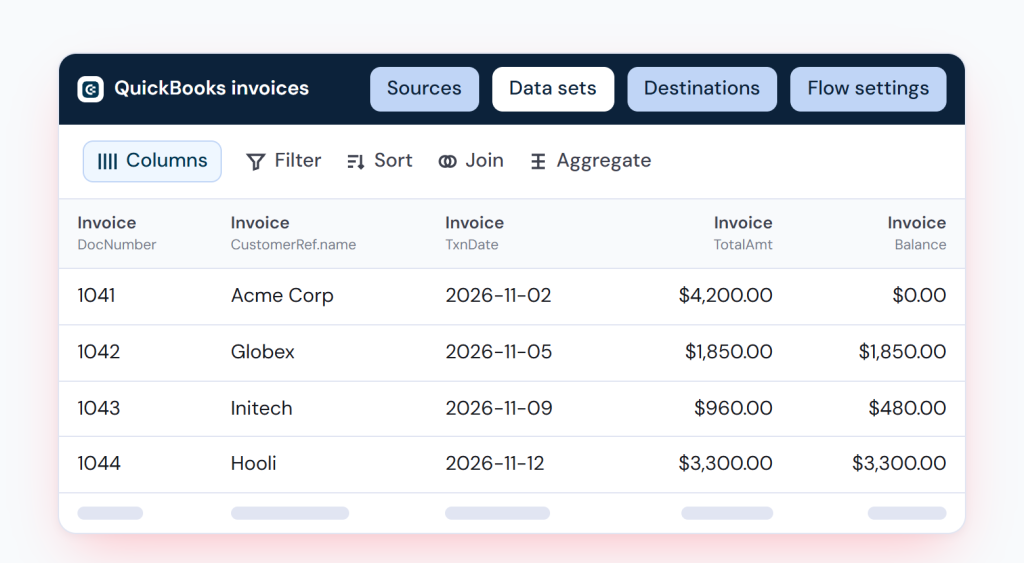
Preview the invoices before they reach the destination. Keep the columns you need, filter rows, sort them or add calculated columns. To add data from another app, such as payments or your CRM, add it as a second source and blend it with the invoices.
Step 3: Load the invoices and schedule the export
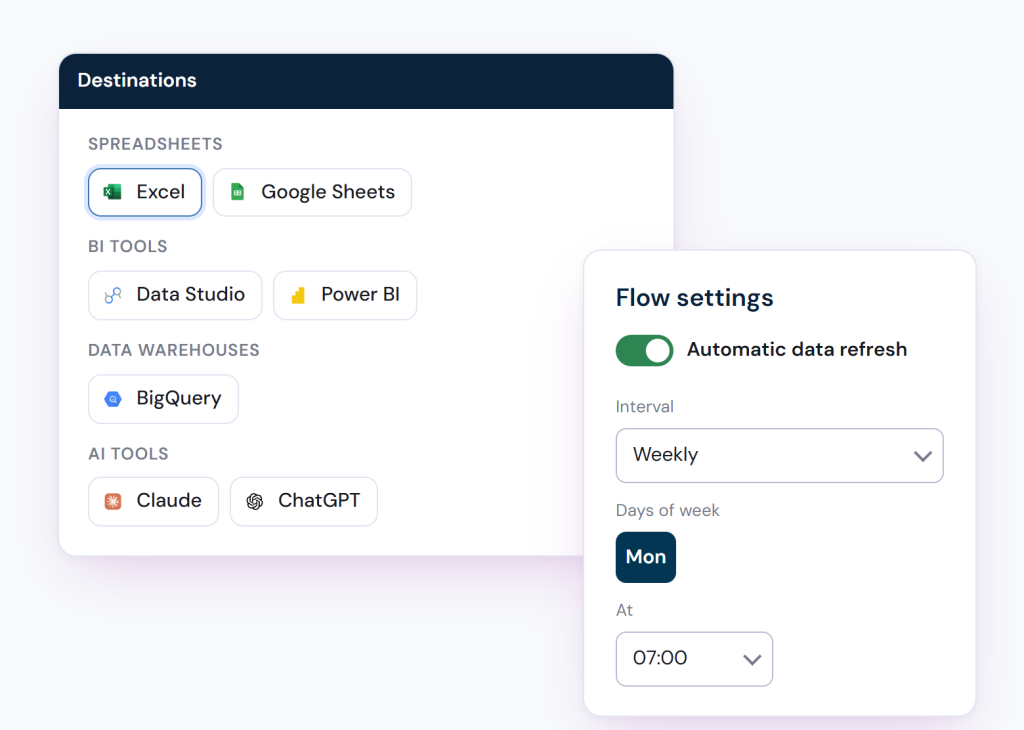
Choose where to send the invoices and connect that account. For a spreadsheet, select the workbook and the sheet, or create a new one. Then turn on Automatic data refresh and set the interval, days and time, for example every Monday morning for a weekly invoice report. Save and run the data flow.
What invoice data you can export from QuickBooks Online
The Invoice entity exports every invoice with its fields as columns, including:
- Invoice details:
DocNumber,TxnDate,DueDateandCustomerRef.name. - Amounts:
TotalAmt,Balanceand tax fields such asTxnTaxDetail.TotalTax. - Line items:
Line.Description,Line.Amountand the product details, one row per line with Split byLine. - Addresses: billing address fields such as
BillAddr.City.
The same connector exports 30+ other QuickBooks entities, such as Customer, Payment and CreditMemo, and the QuickBooks Reports source exports financial reports like Profit and Loss or AR Aging. Coupler.io works with QuickBooks Online; QuickBooks Desktop isn’t supported.
Where you can export QuickBooks invoices
- Spreadsheets: Excel and Google Sheets, for invoice lists, collections tracking and custom reports.
- BI tools: Data Studio and Power BI, for accounts receivable and revenue dashboards.
- Data warehouses: BigQuery, Snowflake, and others, to keep invoice history next to the rest of your data.
- AI tools: Claude, ChatGPT and other AI tools, to ask questions about your invoices.
One data flow can send the same invoices to several destinations, so your spreadsheet, dashboard and AI tool show the same numbers.
What you get with Coupler.io
A one-off export gives you a list of invoices as they were on the day you ran it. A Coupler.io data flow keeps that list current and lets you do more with it: blend invoices with data from your other apps, send them to several tools at once, start from ready-made dashboards, and analyze them with Coupler AI, with your financial data kept secure.
Blend invoices with data from your other apps
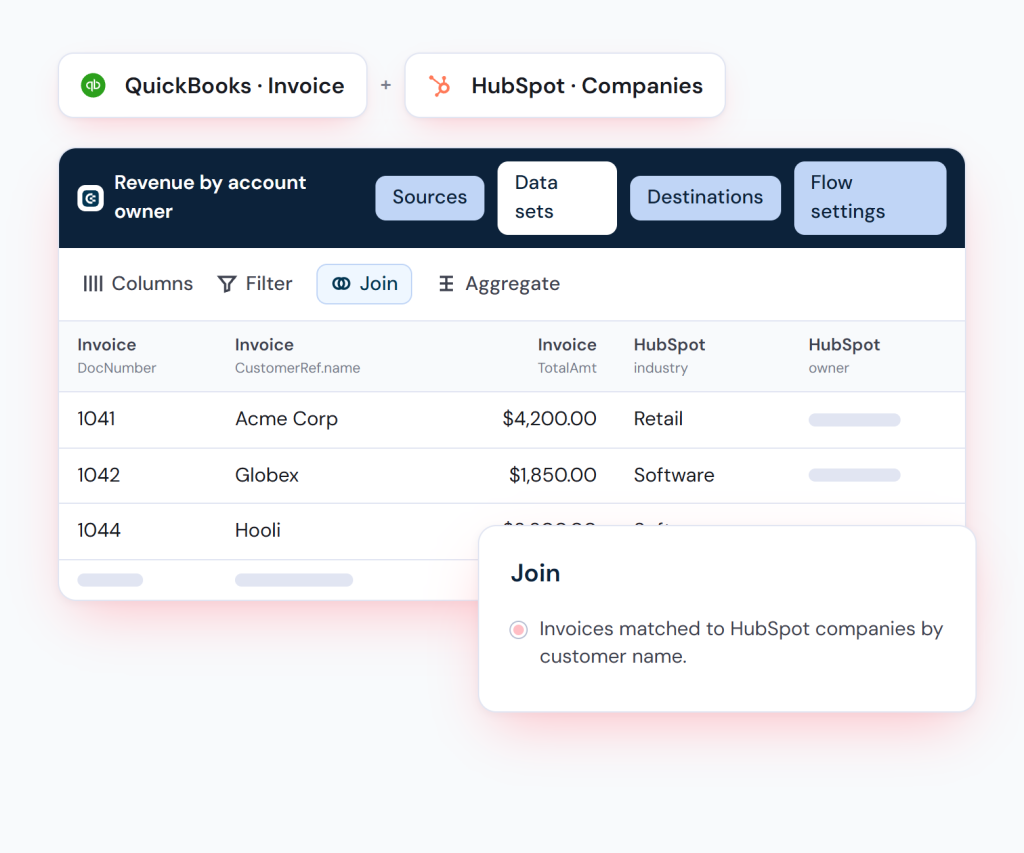
QuickBooks knows what you billed. Your CRM knows who owns each account and which industry it’s in. Blend QuickBooks invoices with HubSpot companies, Stripe payments or any of 400+ apps in one data set, and report revenue by account owner or segment without copying data between files.
Analyze invoices with Coupler AI
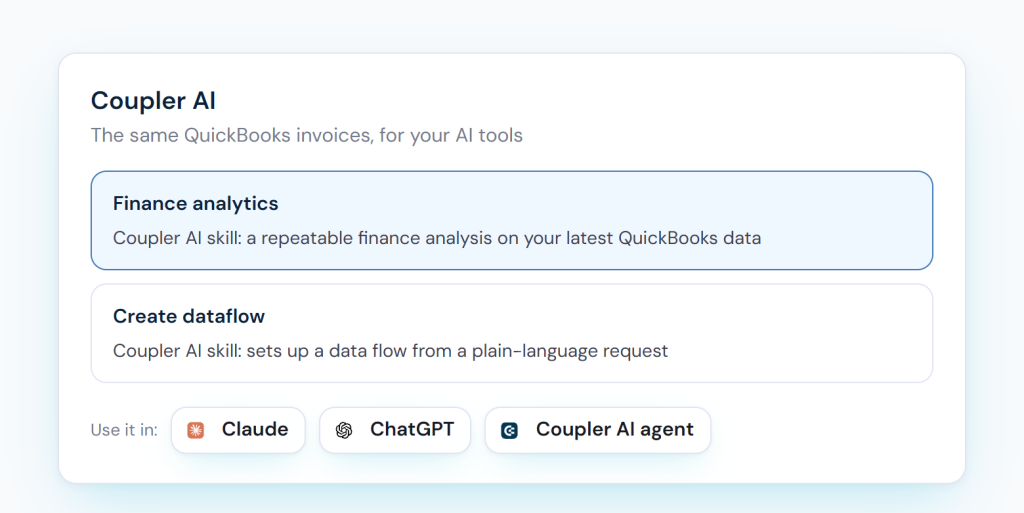
Ask the Coupler AI agent which invoices are overdue or which customers owe the most, or send the data to Claude or ChatGPT through Coupler AI integrations. The AI asks, Coupler.io calculates: every answer comes from a query you can check. The Finance analytics Coupler AI skill runs the same finance analysis on your latest QuickBooks data every time.
Send the same invoices to several destinations
One data flow can feed Excel for the finance team, Data Studio for a receivables dashboard and Claude for questions at the same time. Every tool works from the same invoice numbers, refreshed on the same schedule.
Start from ready-made dashboard templates
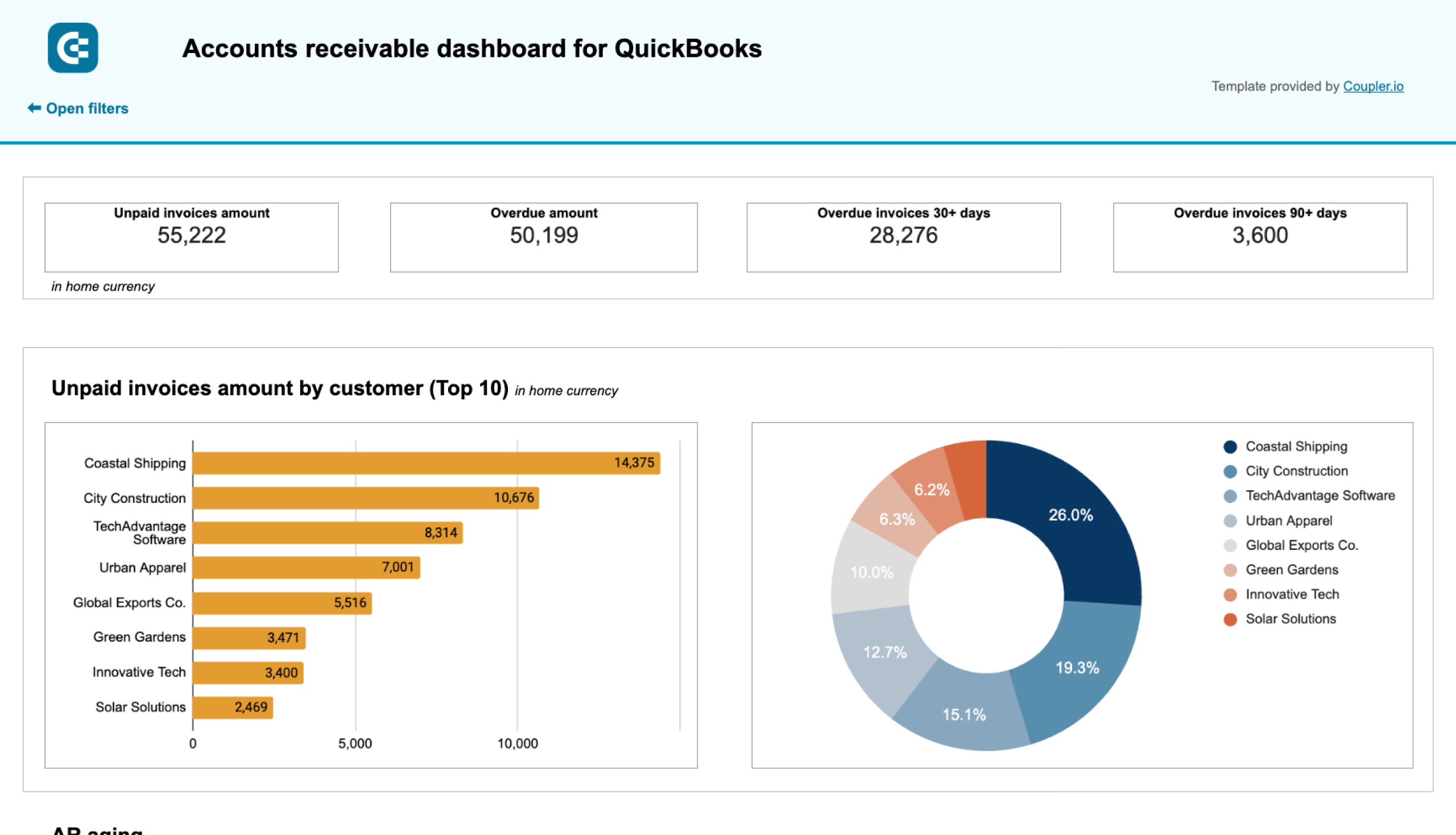
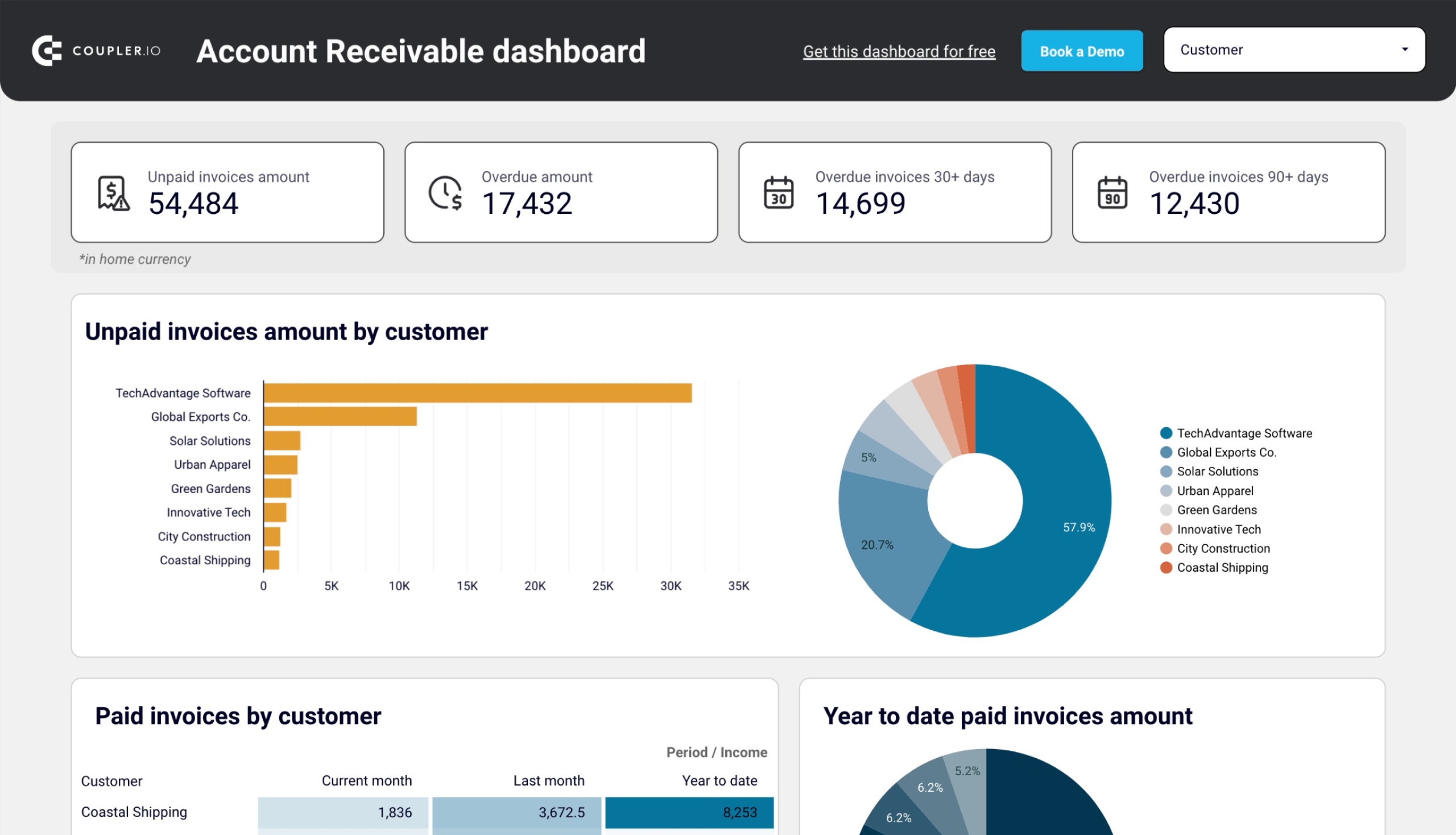
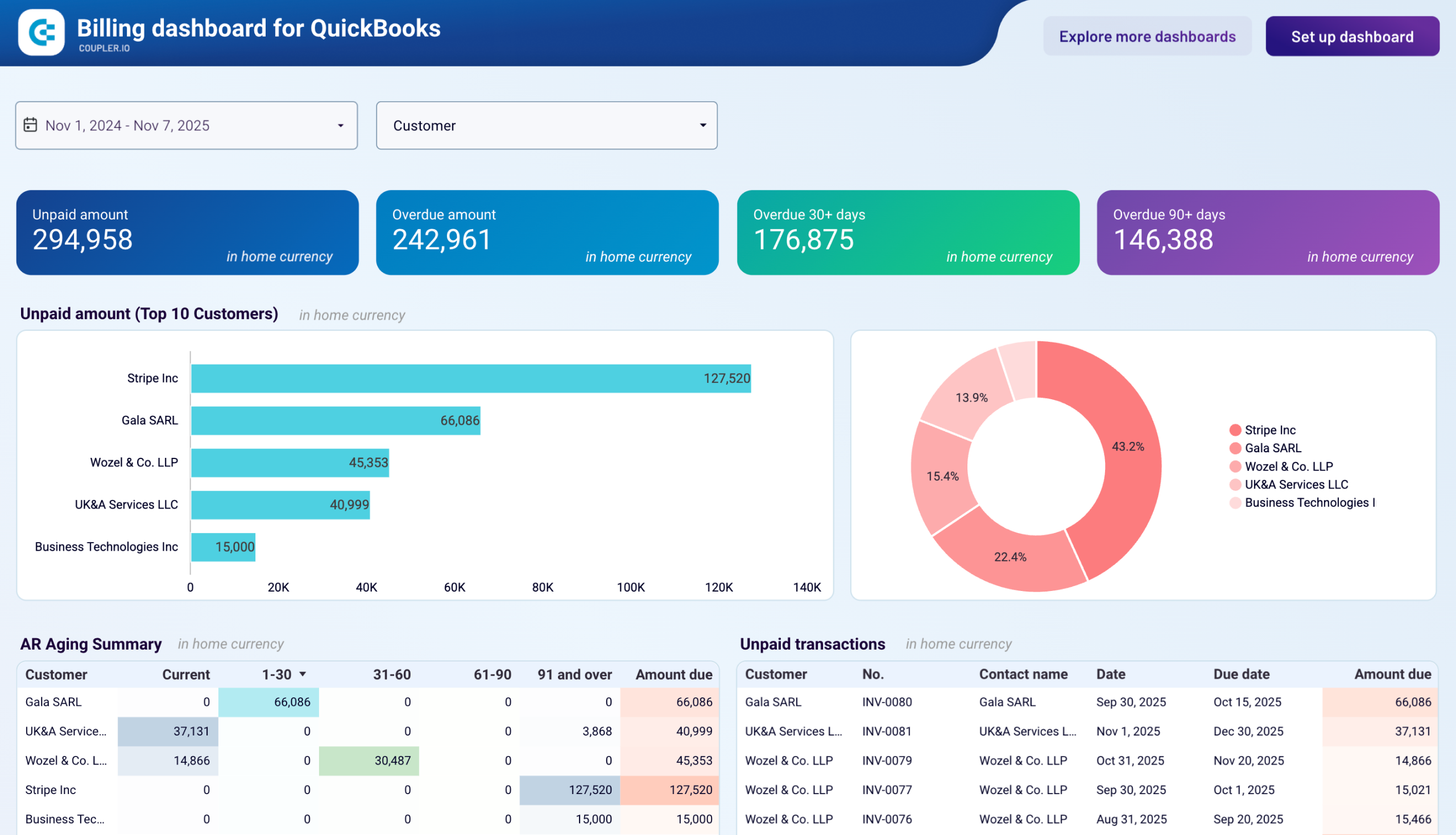
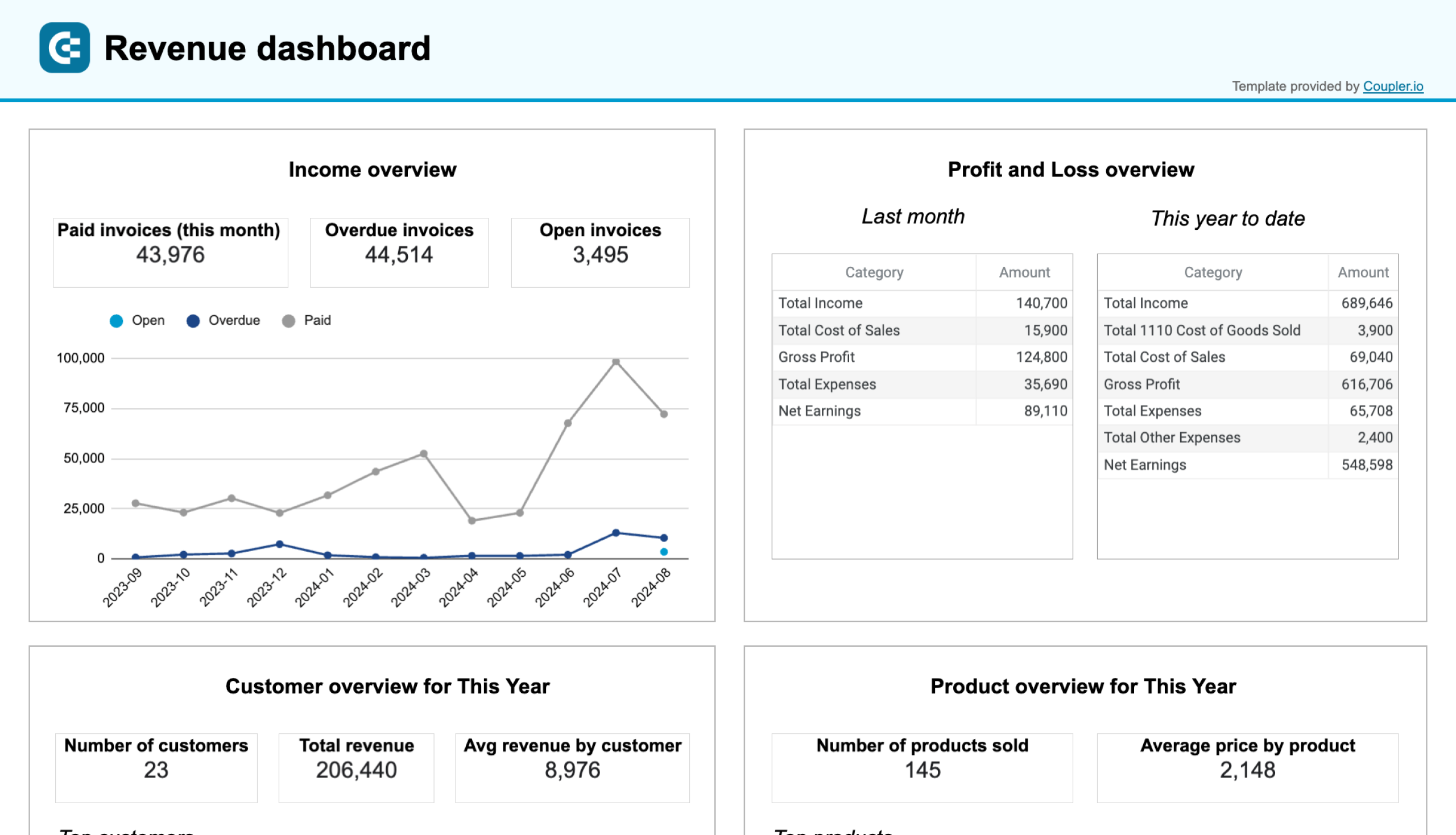
Instead of building a report from scratch, connect your QuickBooks account to a ready-made dashboard template. It loads your invoices and revenue data and refreshes on a schedule. Browse them in the dashboard templates gallery, or see the QuickBooks ones below.



Keep your financial data secure
Coupler.io connects to QuickBooks Online with OAuth, so you sign in with Intuit and never share your password. You decide which data goes to which destination. Coupler.io is SOC 2, ISO 27001 and GDPR compliant; see the security page for details.

Blend invoices with your CRM and payment data
Try Coupler.io for freeHow to export invoice data without tax from QuickBooks Online
Many businesses include sales tax in each invoice, but some reports need only the invoices without tax. You can filter them out before the data reaches your spreadsheet. In the data set step of your QuickBooks data flow, add a filter on TxnTaxDetail.TotalTax (the total tax charged) that keeps rows equal to 0.
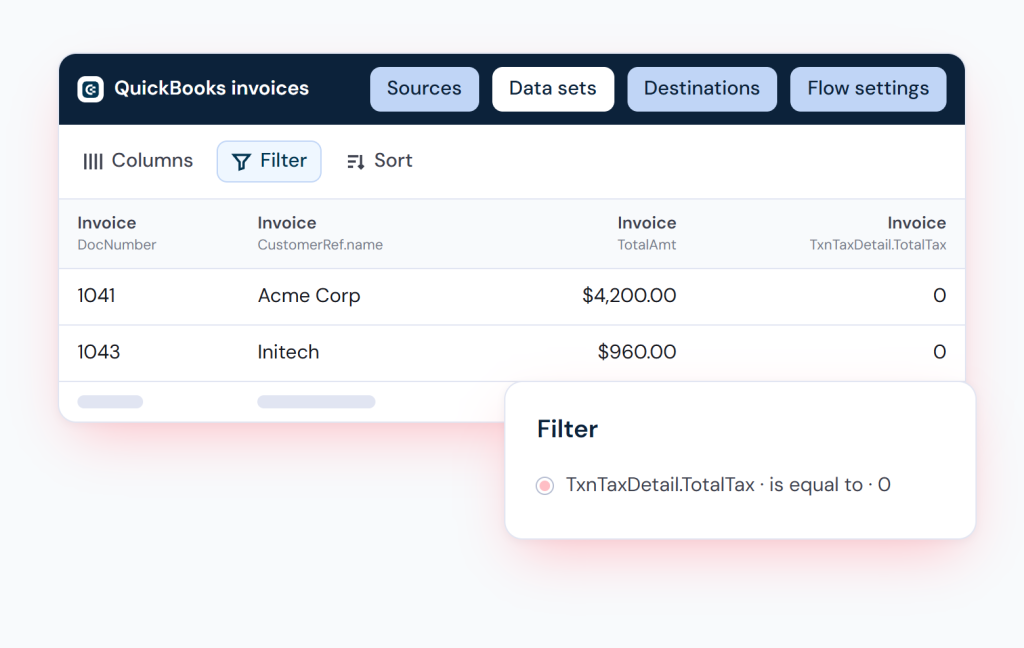
Other tax-related fields help, too. TotalAmt shows the total amount on an invoice, and GlobalTaxCalculation states whether tax is excluded, not applicable or included in the price. The same approach works when you export QuickBooks data to Excel for other entities.
QuickBooks export invoice line items
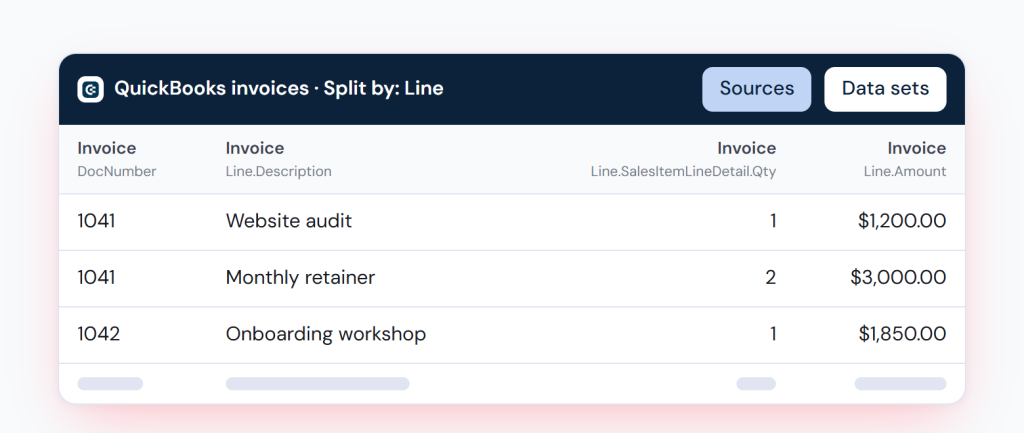
Line items are the products or services on an invoice, with their quantities, rates and amounts. To export QuickBooks invoice line items as separate rows, split the invoices by Line in the QuickBooks source settings. Without it, each invoice is one row with its line items combined in one cell. Useful columns:
Line.Amount: the total amount for each line item.Line.SalesItemLineDetailfields: the item, unit price and quantity.Line.Description: the description added to each line item.
Export invoice addresses in QuickBooks Online
The invoice address, or billing address, is your customer’s address. It may differ from the shipping address. Coupler.io exports invoice addresses with the rest of the invoice data, in these columns:
BillAddr.Line1: the address.BillAddr.City: the customer’s city.BillAddr.Country: the country.BillAddr.PostalCode: the postal code.
How to export invoices from QuickBooks Online manually
QuickBooks Online doesn’t export invoices as documents to Excel. You can export a list of invoices as a report in Excel, CSV or PDF format, and download individual invoices as PDF.
Export a list of invoices to Excel, CSV or PDF
- Open the standard reports in QuickBooks Online.
- Find the Invoice List report and open it.
- Adjust the report period, columns or filters if needed.
- Export the report to Excel or CSV, or save it as a PDF.
See Intuit’s guide to running reports in QuickBooks Online (as of November 2026).
Download a single invoice as PDF
- Open the customer’s profile in the Customer Hub.
- Find the invoice in the customer’s transaction list and open it.
- Download the invoice as a PDF.
To email or print several invoices at once, select them in the sales transactions list and use the batch actions. See Intuit’s guide to downloading sales forms.
Why export invoices from QuickBooks Online with Coupler.io?
A business owner or accountant needs accurate invoice records to manage cash flow and track what customers owe. The manual method works for a one-off list: open the Invoice List report and export it to Excel or PDF.
For anything you repeat, the best way to export invoices from QuickBooks Online is to automate it. Coupler.io refreshes your invoice data on a schedule, splits line items, filters out what you don’t need, and blends invoices with your CRM or payment data. 200K+ users rely on it, and it’s rated 4.9/5 on G2 and Capterra. See all the apps it connects in the integrations directory.
Export QuickBooks invoices on a schedule with Coupler.io
Get started for freeFAQs
Why export invoices from QuickBooks Online?
To report on invoices outside QuickBooks, share them with people who don’t have a QuickBooks login, combine them with data from other apps, or keep a QuickBooks backup copy of your invoices.
Is it safe to export QuickBooks invoices with Coupler.io?
Coupler.io connects to QuickBooks Online with OAuth: you sign in to Intuit and grant access to view your data. You choose which data goes to which destination. Coupler.io is SOC 2, ISO 27001 and GDPR compliant.
Can I export QuickBooks invoices to Excel automatically?
Yes. Set up a Coupler.io data flow with QuickBooks as the source and Excel as the destination, and turn on Automatic data refresh. Your workbook then updates on the schedule you choose.
Does this work with QuickBooks Desktop?
No. Coupler.io connects to QuickBooks Online only. QuickBooks Desktop isn’t supported.