
Best Marketing Data Integration Tools in 2026 for Unified Campaign Reporting

Tired of creating marketing reports from scratch? Manual reporting, scattered data on various platforms, and no overview of the full customer journey are issues many marketers face at some point.
Want to solve these challenges? In this article, we’ve highlighted the best data integration solutions for marketing to unify your campaign reporting and forget about switching from one platform to another.
Marketing data integration platforms comparison table
In the table below, we compare 7 top marketing data integration platforms, each designed with different levels of complexity, flexibility, and user access in mind. These differences directly impact how marketing teams connect tools, build reports, and act on performance data, with or without engineering support.
| Tool | Integrations | Ease of use | Automation | Attribution | Independence for marketers | Pricing |
|---|---|---|---|---|---|---|
| Coupler.io | 420+ | No-code | Hourly/daily syncs | No native attribution; can be built in reports | 100% marketer-operated | From $24/month (per account) |
| Funnel | 500+ | No-code | Auto-refresh by source type | Rule-based attribution + campaign grouping | Fully self-serve | From $399/month |
| Adverity | 600+ | Enterprise setup | Batch + streaming options | Predictive attribution + MMM modeling | Works best with data teams | Enterprise pricing (custom) |
| Hevo Data | 150+ | Low-code | Real-time + batch scheduling | Attribution via dbt or external logic | Marketer-accessible | From $399/month |
| Windsor.ai | 200+ | No-code | Automated syncs + model updates | Built-in multi-touch + MMM attribution | Marketer-accessible | Custom (based on use case) |
| Fivetran | 700+ | Low-code | 15-minute auto syncs | Attribution needs dbt or external tooling | Limited without dev support | Usage-based (scales with rows) |
| Airbyte | 600+ | Technical setup | Batch, streaming, dbt integration | No attribution features | Requires engineering setup | Free (self-hosted) or custom |
- Ease of use – Each tool falls into one of four setup categories:
- No-code: Built for non-technical users. Pipelines can be created using a drag-and-drop interface or simple visual setup, no code required.
- Low-code: Accessible to business users with some technical familiarity. Tools offer visual interfaces but may require SQL or scripting for custom logic.
- Technical setup: Designed for data teams or engineers. Setup typically involves command-line tools, scripting, or manual configuration.
- Enterprise setup: Built for large-scale deployments. Requires engineering support for setup, access control, and integration with enterprise systems.
- Attribution – This measures how well a platform handles campaign attribution, from simple channel grouping to full multi-touch modeling (rule-based, data-driven, or MMM).
- Independence for marketers – This evaluates how easily a marketing team can operate the platform without relying on developers or data engineers.
Top marketing data integration solutions
1. Coupler.io
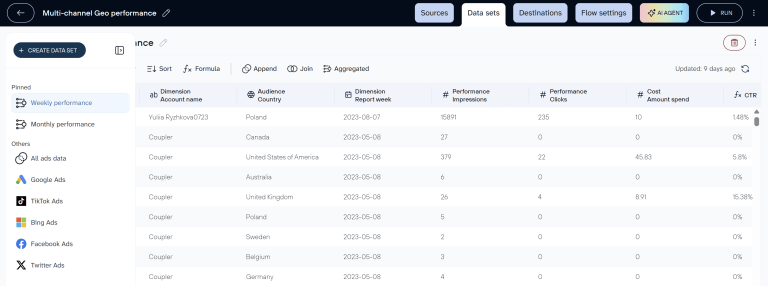
Coupler.io is a no-code data integration platform that helps marketing teams unify data from over 420 apps and tools into spreadsheets, BI platforms, data warehouses, or AI assistants. It’s built for non-technical users who want to automate marketing reporting and performance tracking without relying on engineers or writing code.
Key marketing integrations
Coupler.io provides connectivity to marketing platforms to centralize campaign data, analyze performance across channels, and optimize ROI. The platform supports over 400 business data sources. In terms of marketing, here are the key ones:
- Advertising Platforms
- Paid social: Facebook Ads, Instagram Ads, LinkedIn Ads, TikTok Ads, X (Twitter) Ads, Snapchat Ads, Pinterest Ads
- Search & display: Google Ads, Bing Ads (Microsoft Ads), Amazon Ads
- Emerging channels: Reddit Ads, Quora Ads, Apple Search Ads
- Analytics & Web Tracking
- Google Analytics 4 (GA4)
- Google Search Console
- Google PageSpeed Insights
- Plausible Analytics
- CRM & Marketing Automation
- HubSpot
- Salesforce
- ActiveCampaign
- GoHighLevel
- Email Marketing
- Mailchimp
- Klaviyo
- Campaign Monitor
- MailerLite
- Social Media Analytics
- Instagram Insights
- Facebook Page Insights
- LinkedIn Company Pages
- TikTok Organic
- YouTube Analytics
Each data source connector uses marketing API but no coding or technical skills are needed to use them.
Beyond marketing platforms, Coupler.io connects finance applications (QuickBooks, Xero, Stripe), e-commerce systems (Shopify, WooCommerce, Magento), project management tools, and more for cross-channel marketing analytics.
Data delivery & sync:
- Scheduled data syncs (15 minutes, hourly, or daily depending on account type)
- Connects to destinations like:
- Spreadsheets (Google Sheets, Excel)
- Dashboards (Looker Studio, Power BI, Tableau)
- AI tools (ChatGPT, Claude, Gemini, etc.)
- Data warehouses (BigQuery, PostgreSQL, Redshift)
- And others
- Supports blended flows (combining ad spend with CRM leads or revenue)
- No coding, scripting, or SQL required
Reporting and BI support:
- Over 170 prebuilt marketing dashboards for ROAS, campaign performance, and spend tracking
- Column-level transformation: filtering, renaming, editing
- AI capabilities:
- AI integrations to connect marketing data to AI tools for conversational analytics
- AI agent to analyze your marketing data flows with AI right in Coupler.io
- AI insights in native dashboards
Limitations:
- No built-in attribution or MMM modeling
- No on-premises deployment support
- Not built for complex data engineering workflows
Ideal use case
A marketing team managing 10+ data sources (Meta Ads, TikTok Ads, GA4, HubSpot, Stripe) that needs to sync campaign data daily into Google Sheets and Looker Studio for performance tracking and to unify marketing data for dashboards without engineering help.
Pricing:
As one of the best marketing agency tools, Coupler.io uses account-based pricing. You pay per connected data source, not per user or flow.
- Starter: $24/month ( includes 3 accounts, 1 destination, unlimited sources, daily syncs)
- Active: $99/month ( includes 15 accounts, 3 destinations, unlimited sources, daily data refresh)
- Pro (most popular): $199/month ( includes 50 accounts, unlimited destinations & sources, and hourly data refresh)
For example, a team syncing Facebook Ads, LinkedIn Ads, GA4, HubSpot, and QuickBooks into Google Sheets, Looker Studio, and ChatGPT would pay $99/month with no added user or flow fees.

Automate marketing data integration with Coupler.io
Get started for free2. Funnel
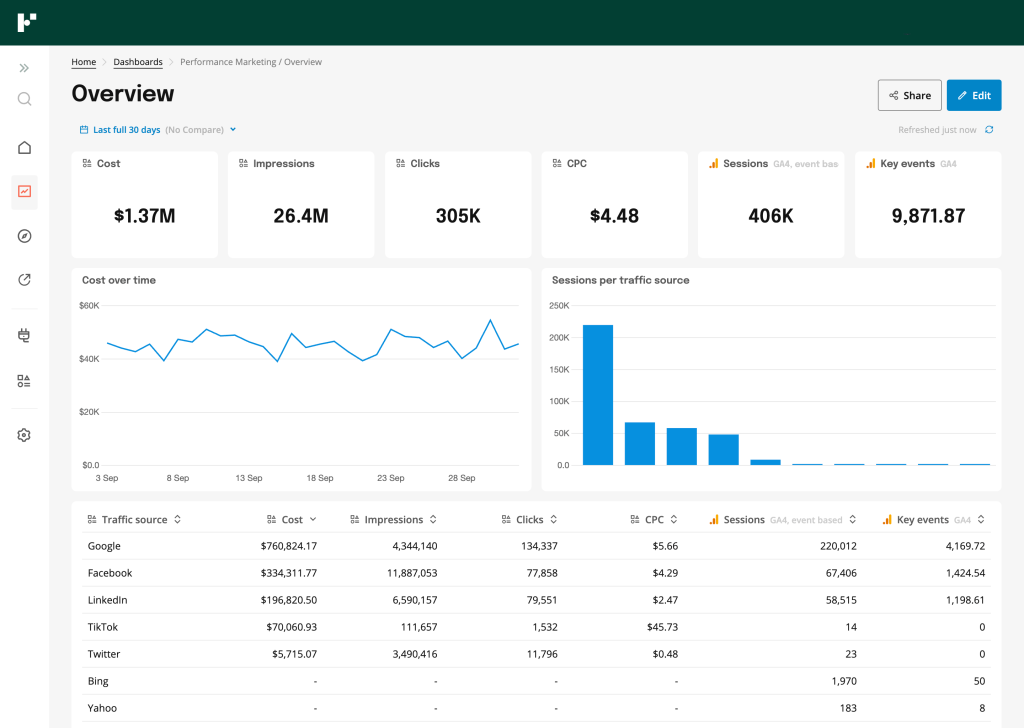
Funnel is a marketing data platform built to centralize, model, and deliver campaign performance data from hundreds of sources into reporting and analytics tools. Designed for marketing teams, agencies, and digital analysts, Funnel eliminates manual exports and messy spreadsheets by providing clean, harmonized marketing data, ready for use in dashboards, warehouses, or BI tools. No coding required.
Key marketing integrations:
Funnel supports various connectors across ad platforms, CRMs, analytics tools, and e-commerce systems.
Sources include:
- Ad platforms: Meta Ads, Google Ads, TikTok, LinkedIn Ads, Amazon Ads, Snapchat, Pinterest
- Analytics: Google Analytics 4, Adobe Analytics
- CRM & email: Salesforce, HubSpot, Mailchimp, ActiveCampaign
Data delivery & sync:
- Scheduled data syncs (daily or every 2 hours depending on plan)
- Connects to destinations like spreadsheets (Excel Online), data visualization tools (Tableau, Power BI), and cloud storage services (Amazon S3, Azure Blob Storage)
- Harmonizes fields across platforms: custom naming, currency conversion, and channel grouping
- Fully no-code interface with rule-based field mapping and logic setup
Reporting and BI support:
- Funnel dashboards: native visualization layer with custom widgets and KPIs
- Field mapping, naming conventions, and transformation logic managed through UI
- Data Chat: conversational AI to query marketing performance in natural language
- Supports real-time campaign tracking without relying on developers
Limitations:
- Measurement modules (MMM, MTA) are paid add-ons
- Not designed for technical data engineering use cases (no SQL/dbt logic)
- Pricing is not public
Ideal use case:
A performance marketing team managing campaigns across Google, Meta, LinkedIn, TikTok, and Amazon Ads, wanting to consolidate performance data into Looker Studio and Google Sheets with harmonized metrics, channel-level attribution, and no developer involvement.
Pricing
Funnel uses a flexpoint-based pricing model, with plans tailored to company size, data volume, and export destinations.
- Starter: Includes ~121 connectors, 3 reporting destinations, 1 workspace, and daily sync
- Business: Offers 579+ connectors, 6 export/reporting solutions, advanced modeling, and 2-hour syncs
- Enterprise: Includes 590 connectors, 27 export destinations, governance controls, and compliance features
Pricing is not public. A pricing estimator is available, but full quotes require booking a demo.
3. Adverity
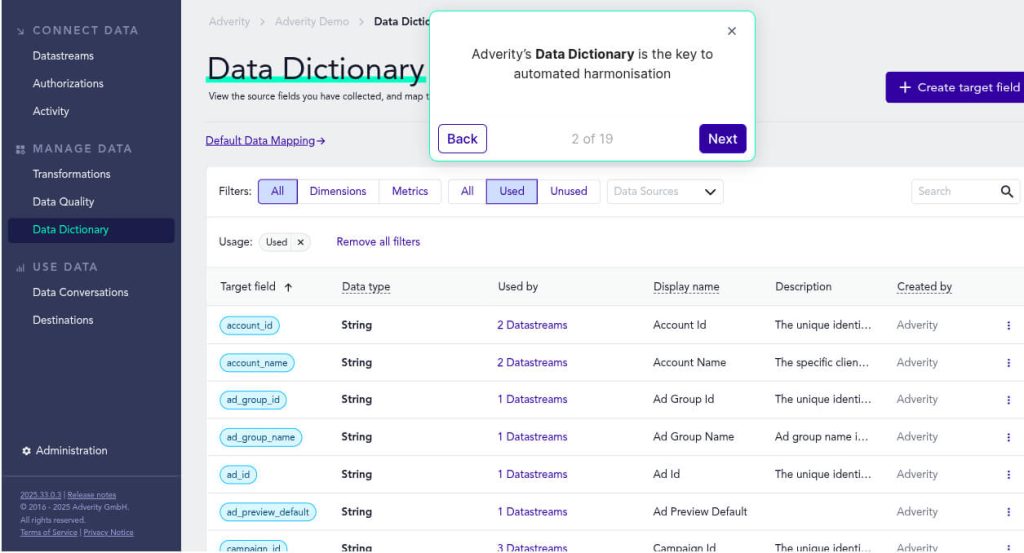
Adverity is a marketing data platform built for teams that need to centralize, govern, and activate large volumes of campaign data across multiple markets, brands, and channels. It connects hundreds of marketing platforms into a single, trusted data layer that feeds BI tools, data warehouses, and AI systems. The platform combines data integration, transformation, governance, and AI‑powered insights into one enterprise‑ready solution.
Key marketing integrations:
Adverity provides a variety of connectors across advertising, analytics, CRM, and commerce platforms, including:
- Ad platforms: Google Ads, Meta Ads, TikTok, LinkedIn Ads, Amazon Ads, Snapchat, Pinterest, YouTube
- Analytics: GA4, Adobe Analytics
- CRM & marketing automation: Salesforce, HubSpot
- Custom sources: Webhooks, APIs, and custom connectors for niche platforms
Data delivery & sync
- Sync options include batch and near real-time updates
- Connects to destinations like spreadsheets (CSV), BI tools (Qlik, SAP Analytics Cloud), and enterprise data warehouses (Snowflake, Azure Synapse)
- Offers schema normalization, currency conversion, and cross-channel metric alignment
- Managed through a visual data flow builder with flexible scheduling and orchestration
Reporting and BI support:
- Native support for real-time dashboards and multi-source visualizations
- Predefined metric libraries for campaign KPIs, spend, and performance
- Conversational AI assistant for querying marketing results and generating cross-channel insights
Limitations:
- Requires onboarding and configuration to unlock full value
- No transparent pricing
- More complex than tools built for small marketing teams
Ideal use case:
An enterprise or agency managing dozens of ad platforms, regions, and brands that needs a governed, scalable marketing data layer feeding Snowflake, BigQuery, Looker, or Power BI with standardized metrics and AI‑driven insights.
Pricing:
Adverity uses fully custom pricing based on the number of connectors, destinations, data volume, and governance requirements.
There are no fixed tiers, every customer receives a tailored quote after a demo and needs assessment.
This pricing model suits large organizations that need enterprise security, governance, advanced transformations, and AI‑driven analytics at scale.
4. Hevo Data
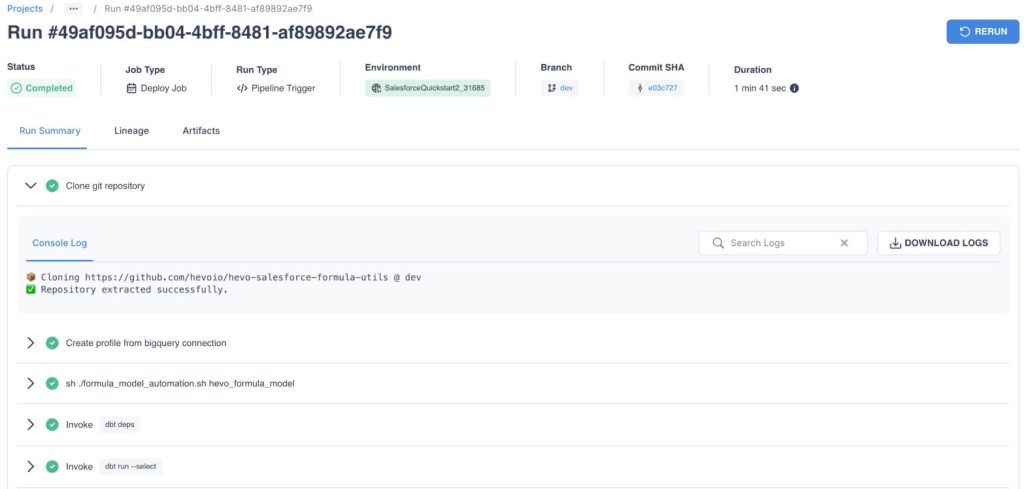
Hevo Data is a no-code platform that helps teams unify and sync real-time data from 150+ SaaS, database, and event sources into cloud data warehouses and BI tools. Built for speed, it supports both ETL and ELT models with low-latency pipelines and minimal setup. Hevo is ideal for teams that need to automate marketing data reporting without managing infrastructure or writing extensive code.
Key marketing integrations:
Hevo supports a variety of native connectors across SaaS, CRM, analytics, and ad platforms.
Common marketing tools include:
- Ad platforms: Google Ads, Facebook Ads, Bing Ads
- E-commerce & CRM: Shopify, Salesforce, HubSpot
Data delivery & sync:
- Offers both real-time and scheduled batch syncs
- Connects to destinations like data warehouses (Redshift, BigQuery, Databricks), spreadsheets (Excel, Google Sheets), and storage layers (S3, GCS)
- Pipelines are managed through a visual UI with support for incremental loads, CDC (change data capture), and retry logic
Reporting and BI support:
- Supports ready-to-query schema structures in target destinations
- Built-in transformations via drag-and-drop or SQL editor
- Integrates with dbt for advanced modeling and campaign metric layering
- Enables marketing teams to power live dashboards and performance trackers without writing complex scripts
- Supports both ETL and ELT workflows within the same interface
Limitations:
- No on-premises deployment
- Advanced transformations rely on dbt
- Event-based pricing can scale up cost
Ideal use case:
Fast-growing marketing or operations teams syncing Shopify, Stripe, GA4, and HubSpot into BigQuery or Redshift for real-time dashboards and campaign reporting, without building custom data infrastructure.
Pricing:
Hevo provides an event-based pricing. It comes with a Free tier (1M events/month, 1 destination) for small workloads or testing.
The Starter plan starts at $399/month, supporting 20M events, 50+ connectors, and 10 users.
For example, a team syncing Shopify orders, Facebook Ads spend, and Stripe revenue into BigQuery for real-time analytics could run on the Starter plan without additional infrastructure. Custom quotes are available for larger needs.
5. Windsor.ai
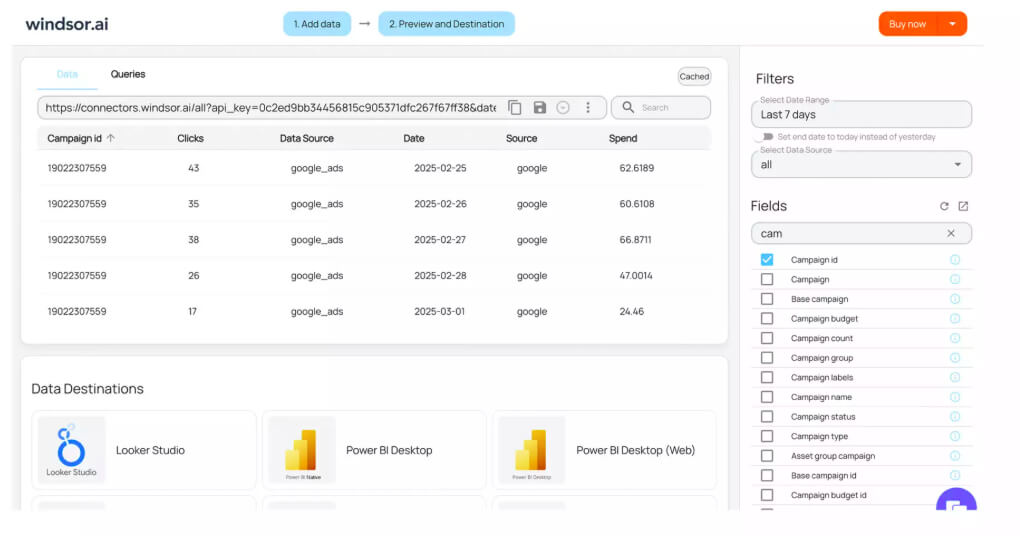
Windsor.ai is a no-code ETL/ELT platform built for marketers and agencies that want to automate cross-channel reporting and unify data from over 325 sources. With native support for BI tools, spreadsheets, and cloud data warehouses, Windsor enables end-to-end data integration and insight generation, all without code. AI features and customizable dashboards make it easy to surface performance insights fast.
Key marketing integrations:
Windsor supports a variety of prebuilt and custom connectors, including major marketing, CRM, and analytics platforms:
- Ad platforms: Facebook Ads, Google Ads, LinkedIn Ads, TikTok Ads, Amazon Ads
- Web & analytics: GA4, YouTube Analytics, Google Search Console
- CRM & e-comm: Salesforce, HubSpot, Shopify, Klaviyo
- Custom connectors: Webhooks and API support
Data delivery & sync:
- Sync frequency ranges from daily to every 15 minutes depending on plan
- Connects to destinations like spreadsheets (Excel, Google Sheets), BI tools (Power BI), data visualization tools (Looker Studio), and cloud platforms (BigQuery, Snowflake)
- Allows field selection and schema mapping directly in the UI, including multi-account and multi-source flows
- Supports campaign-level syncing with cross-platform budget and performance alignment
Reporting and BI support:
- Built-in dashboard builder with pre-configured templates for ROAS, attribution, and funnel metrics
- Integrated multi-touch attribution engine supporting rule-based, data-driven, and MMM models
- AI assistant for querying campaign performance in plain language
- Built-in attribution modeling with support for custom rules and data blending
- Supports 10+ years of historical data, ideal for long-term performance trend analysis
Limitations:
- Row-based pricing model (MAR) can become costly at scale
- Advanced use cases may require MCP configuration
- Free plan is limited in connectors and sync frequency
Ideal use case:
Agencies and marketing teams handling 10-200 client accounts across Meta Ads, Google Ads, Shopify, GA4, and more, who want near real-time syncing into Looker Studio and Power BI, automated client reporting, and clear attribution insights without hiring developers.
Pricing:
Windsor offers flexible, tiered pricing based on monthly active rows (MAR) and number of sources:
- Free: 1 user, 1 data source, 1 account, 5M MAR
- Basic ($19/month): 3 data sources, 75 accounts, daily syncs, 5M MAR
- Standard ($99/month): 7 sources, unlimited syncs/tasks, hourly syncs, 7.5M MAR
- Plus ($249/month): 10 sources, 200 accounts, 10M MAR
- Professional ($499/month): 14 sources, 500 accounts, 15-min syncs, 50M MAR
- Enterprise: Up to 300 sources, 50,000 accounts, custom SLAs, and pricing
For example, a performance team managing data from Google Ads, Meta Ads, GA4, Salesforce, and Shopify across 50 accounts with hourly syncs to Power BI and BigQuery would typically use the Standard or Plus plan.
6. Fivetran
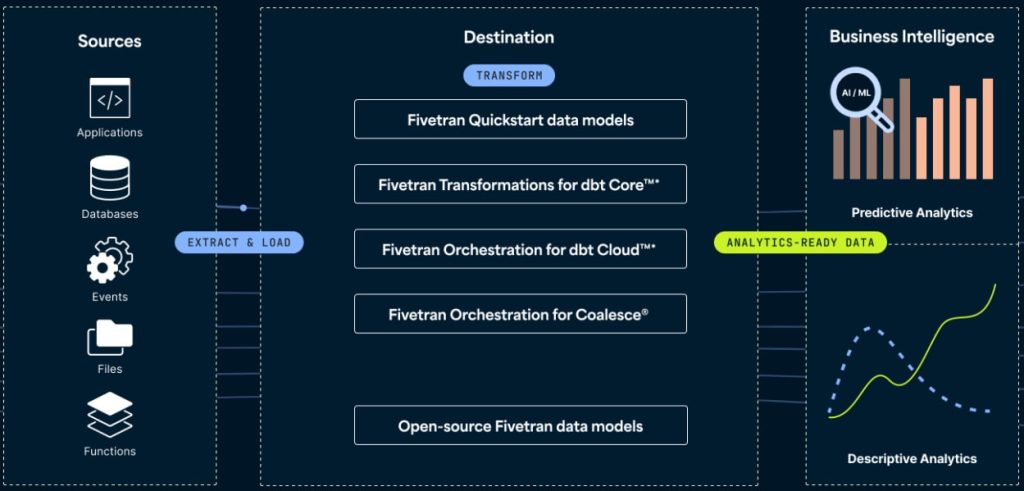
Fivetran is a fully managed, cloud-native ELT platform built to automate the movement of data from over 700 sources into leading cloud data warehouses. It prioritizes pipeline reliability and scalability by managing schema changes, connector updates, and data syncs behind the scenes. With native dbt integration, Fivetran allows teams to run SQL-based transformations post-load, enabling efficient data modeling at scale.
Key marketing integrations:
Fivetran supports a variety of connectors, including a strong selection for marketing, CRM, and finance data:
- Ad platforms: Facebook Ads, Google Ads, LinkedIn Ads, TikTok Ads
- Web & CRM tools: HubSpot, Salesforce, Mailchimp
- Enterprise systems: SAP, Snowflake, Redshift, Azure Synapse
Data delivery & sync:
- Syncs every 15 minutes by default, with real-time options available for select sources
- Connects to destinations like data warehouses (Snowflake, Redshift, BigQuery), spreadsheets (Excel), data visualization tools (Looker, Tableau), and external storage (S3, Azure Blob)
- Extracts raw data, manages schema drift, and supports incremental sync with automatic error recovery
- Optimized for volume-heavy pipelines and change data capture (CDC) across cloud ecosystems
Reporting and BI support:
- Compatible with all major BI tools via warehouse output
- Supports dbt Core for post-load SQL transformations, enabling marketing teams to model ROAS, funnel stages, and cohort metrics inside the warehouse
- Enables scalable campaign reporting by decoupling data movement from visualization
- Ideal for teams building custom dashboards or working with internal data engineers
Limitations:
- No built-in transformation UI (SQL/dbt required)
- Custom connector flexibility is limited
- Usage-based pricing can increase significantly with high-volume data
- On-prem and hybrid environments are not fully supported
Ideal use case:
Mid-sized to large marketing teams with growing data volumes, looking to automate ELT pipelines into Snowflake, BigQuery, or Redshift, and run warehouse-native analytics using dbt and BI tools, without managing infrastructure or manual scripts.
Pricing:
Fivetran uses a usage-based pricing model based on Monthly Active Rows (MAR) and Monthly Model Runs (MMR).
- Free tier: Up to 500,000 rows/month and limited transformations
- Standard plan: Includes 15-minute syncs, dbt Core integration, and full platform access
For example, a team syncing 10M rows/month from Facebook Ads, LinkedIn Ads, TikTok, Instagram, and HubSpot into BigQuery would start around $160/month, with actual pricing adjusted based on usage and transformation frequency.
7. Airbyte
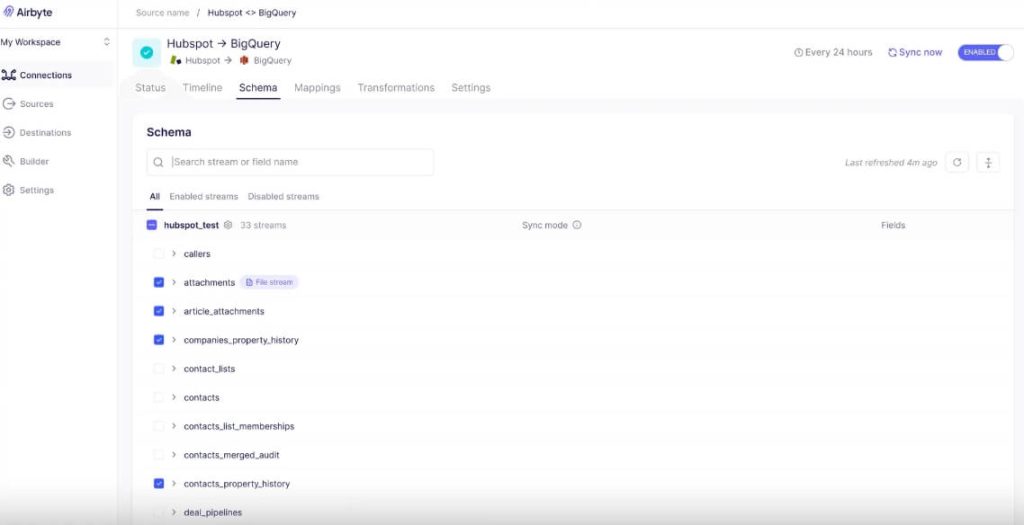
Airbyte is a highly flexible open-source ELT platform designed for data teams that prioritize control, customization, and scalability. With a fast-growing connector catalog and active contributor community, it supports over 600 sources and enables users to build or modify connectors with or without code. It’s available as a free self-hosted solution or a fully managed cloud platform for those who prefer hands-off infrastructure.
Key marketing integrations:
Airbyte offers a variety of connectors across analytics, advertising, CRM, and payment tools.
Notable sources include:
- Ad platforms: Facebook Ads, Google Ads, TikTok Ads
- Analytics tools: GA4,
- CRM systems: Salesforce, HubSpot
Data delivery & sync:
- Supports batch and near real-time syncs depending on connector type
- Connects to destinations like spreadsheets (Google Sheets), BI tools (Metabase, BiQuery), and cloud data platforms (Snowflake, Databricks, DynamoDB)
- Offers built-in support for dbt Core transformations post-load, with orchestration via Airflow, Prefect, or Dagster
- Syncs can be scheduled, incremental, or triggered by external events
Reporting and BI support:
- Output structured, raw data to cloud storage or warehouses for flexible downstream modeling
- Fully compatible with dbt for SQL-based transformations and campaign logic creation
- No built-in reporting layer
- Enables highly customizable campaign reporting pipelines for technical marketing teams
Limitations:
- No built-in UI for transformations
- Airbyte Cloud lacks some enterprise features (SSO, SLAs)
- Some connectors require manual updates or community input
- Self-hosting requires strong DevOps knowledge
Ideal use case:
Best for technical data teams or early-stage companies that want to control every aspect of their pipeline stack. A strong choice for teams that want to build or maintain custom connectors, or that already rely on orchestration tools like Airflow or dbt.
Pricing:
Airbyte uses a flexible pricing model:
- Core (self-hosted): Free forever, ideal for engineering teams managing infrastructure
- Standard (cloud): Starts at $10/month, based on synced data volume
- Enterprise: Custom pricing, includes SLAs, advanced controls, and enterprise support
For example, a startup syncing Stripe, PostgreSQL, and GA4 into Redshift through Airbyte Cloud can manage their pipeline with minimal costs starting at $10/month, without worrying about server maintenance.
Choose the right tool for your team
Most marketing teams don’t need a heavy enterprise setup or engineering workflows. They need fast, flexible, and reliable marketing data integration and reporting, without writing code or depending on developers. For that reason, Coupler.io is the strongest all-around choice.
| Best for | Recommended tool | Why |
| Fast setup and marketer independence | Coupler.io | No-code UI, 400+ connectors, spreadsheet + BI syncs, unlimited flows |
| AI-powered reporting and analysis | Coupler.io | Dashboards with built-in AI recommendations and MCP support for natural language insights |
| Budget-conscious teams and startups | Coupler.io, Airbyte | Transparent and budget-friendly pricing (Coupler), free self-hosting option (Airbyte) |
| Attribution and MMM modeling | Windsor.ai | Built-in multi-touch attribution and funnel reporting |
| Real-time or CDC syncs | Hevo Data, Fivetran | Low-latency syncs, event pipelines, and dbt transformation support |
| Managing multiple client accounts | Coupler.io, Funnel | Client-ready dashboards, templates, and multi-account control |
| Enterprise governance and compliance | Adverity | Access controls, SLAs, advanced transformation layers |
Challenges solved by marketing data integration platforms
This section breaks down the most common data and reporting problems and how integration platforms solve them at the root.
Scattered data across marketing platforms
Marketing teams use multiple tools every day, from Facebook Ads for paid campaigns, Google Analytics for web traffic, HubSpot for CRM, to platforms like Shopify or Stripe for revenue tracking.
A data integration platform helps teams integrate marketing data from multiple sources into a single reporting destination like Looker Studio, BigQuery, or Google Sheets. For example, a retail brand can unify ad spend from Meta Ads with purchase data from Shopify to track ROAS across channels in one place.
Manual reporting and spreadsheet fatigue
Most marketing teams rely on spreadsheets for weekly or monthly performance updates. This means exporting CSVs, copying values into tracking sheets, and rebuilding dashboards regularly. This process is error-prone and slow. Integration tools eliminate this by automating report refreshes.
Inconsistent naming and broken schema mapping
Each platform uses its own naming conventions. Google Ads may call a field “Cost,” while Facebook Ads calls it “Amount Spent.” API changes can also break connections, causing missing or misaligned data. Modern integration tools standardize and rename fields so data is clean and comparable.
Delayed decision-making from outdated data
When marketing data is only updated weekly or monthly, teams react too slowly to optimize campaigns. Budgets may continue flowing into underperforming ads simply because data wasn’t fresh. Platforms with real-time or hourly syncs enable faster decisions.
No single source of truth across teams
Without integration, different teams rely on siloed reports. Marketing might use GA4, while sales pulls from HubSpot. This leads to mismatched metrics and misalignment in performance tracking. Data integration platforms consolidate marketing, sales, and financial data into a unified system.
Heavy reliance on engineers for data tasks
Marketers often need help from developers to set up scripts, fix broken APIs, or connect new tools. This causes delays and prevents marketing teams from being self-sufficient. No-code integration platforms give control to marketers with drag-and-drop interfaces and prebuilt connectors.
Key features to look for in a marketing data integration platform
The right data integration for marketers must do more than move data. It should simplify setup, unify performance metrics, and support agile decision-making. Below are the essential features that separate beginner tools from platforms built for modern marketing teams.
Connectors for marketing, CRM, analytics, and finance tools
The platform should include a broad set of connectors that cover your entire marketing stack. These connectors make it easy to pull data directly from ad platforms like Meta Ads, Google Ads, and TikTok Ads, as well as analytics tools such as GA4 or Looker Studio.
For example, Coupler.io supports over 400 data sources, including both marketing and operational tools, which makes it ideal for teams tracking campaigns, conversions, customer journeys, and revenue in one place.
No-code pipeline builder with visual mapping
Non-technical users should be able to set up data flows using a drag-and-drop interface or a guided workflow. The platform should allow users to choose sources, map fields, configure sync schedules, and define how data should appear on the destination side, all without writing SQL or scripts.
Coupler.io, Funnel, and Windsor.ai are examples of no-code marketing data integration platforms that allow marketers to connect tools and automate workflows without writing code.
Automated syncs with support for scheduled or event-driven updates
Timely data is critical for campaign optimization. Platforms should offer flexible sync options, such as hourly, daily, or near real-time. Coupler.io offers hourly and daily syncs, which is ideal for most campaign tracking use cases.
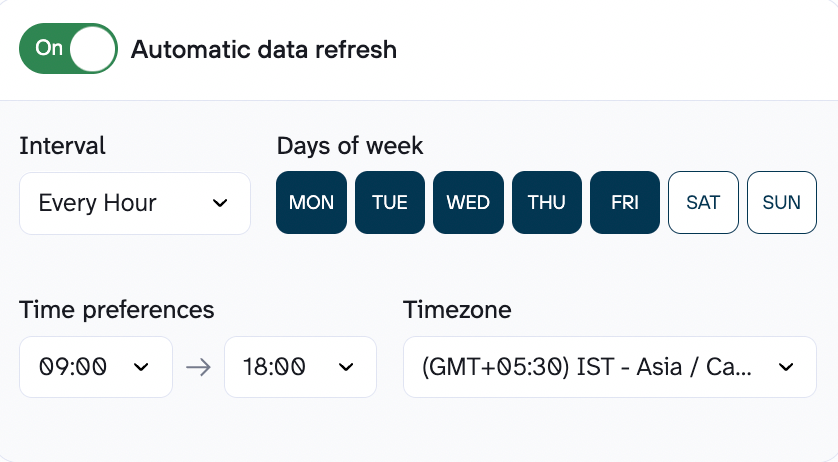
In addition, you can use webhooks to trigger external events or launch your data flows in sequences.
Multiple destinations across tools and formats
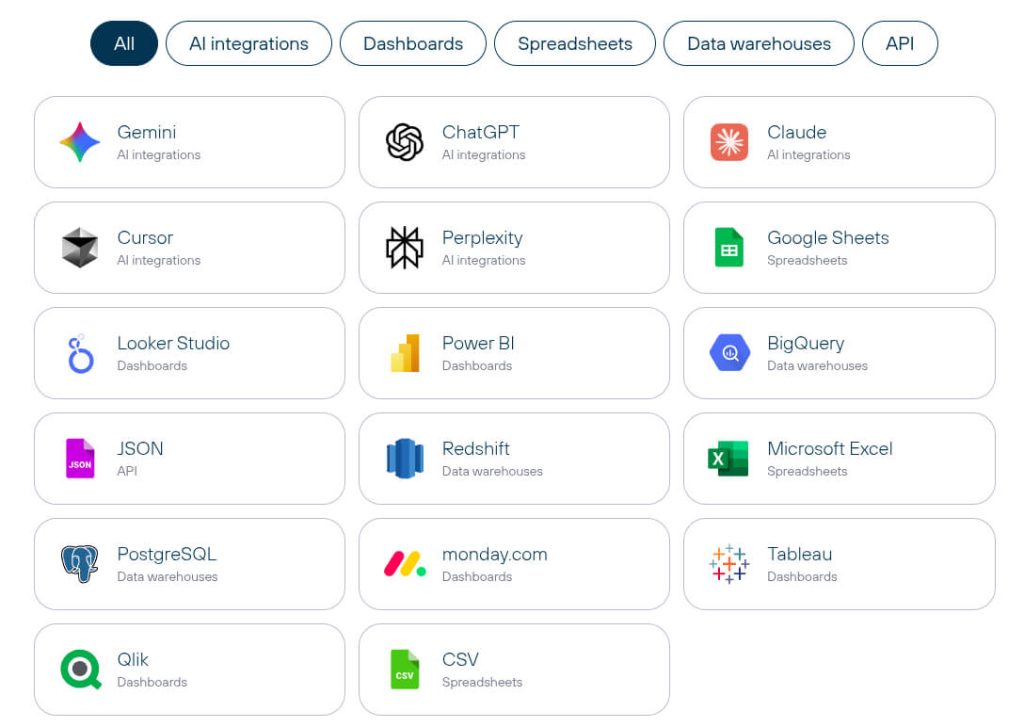
Your data might need to go to multiple places: a spreadsheet for quick edits, a BI tool for visual dashboards, and a warehouse for long-term storage. The best platforms support multi-destination delivery across these categories.
Coupler.io supports exports to spreadsheets like Google Sheets and Excel, BI tools like BigQuery and Power BI, and even integrates with AI tools such as ChatGPT.
Field-level transformations during or after import
To standardize reporting, platforms should allow you to rename, filter, or clean fields during the import process. This prevents inconsistent data like “Amount Spent” vs. “Cost” from breaking dashboards.
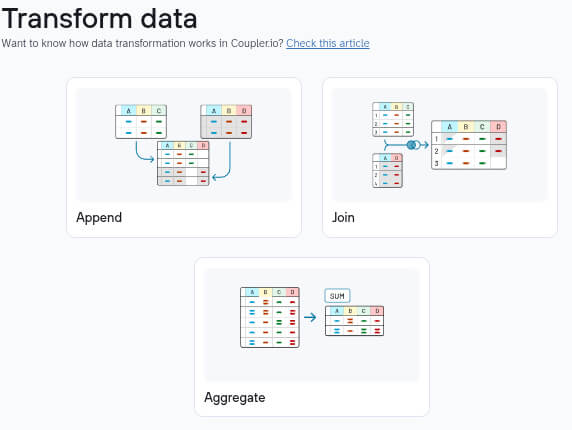
Coupler.io includes built-in transformation tools that let marketers align field names and clean up datasets before they reach the destination.
Attribution modeling and funnel analysis support
Not all platforms offer built-in attribution modeling, but your tool should at least allow you to set up funnel tracking and campaign-level attribution logic. Platforms with native support for multi-touch attribution or MMM (Marketing Mix Modeling) are valuable for large teams.
Dashboard templates and reporting automation
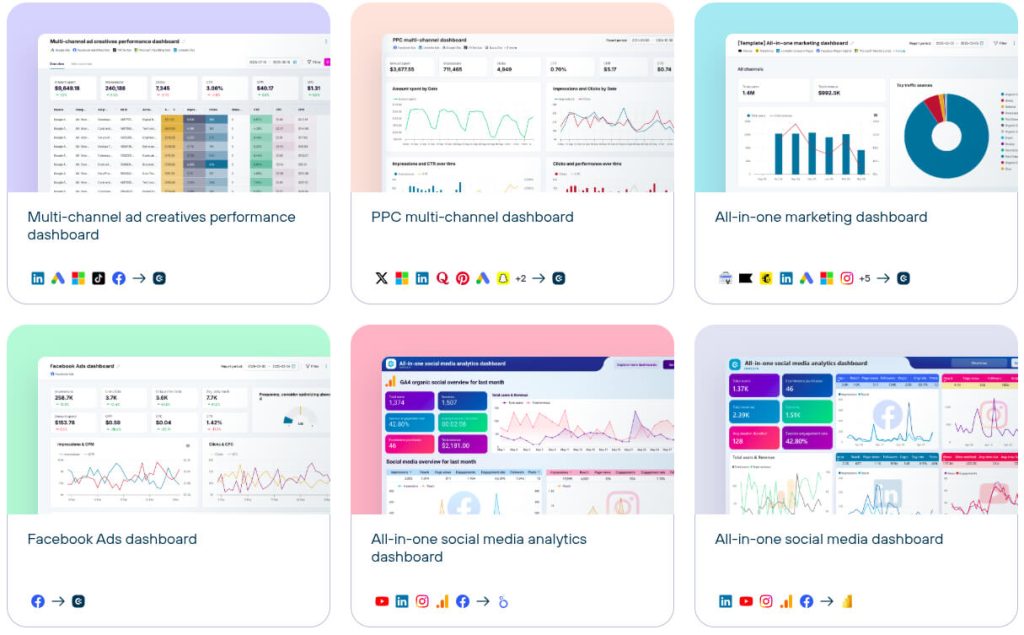
Setting up dashboards from scratch takes time. Platforms that include prebuilt templates for ad spend, ROAS, and conversions help marketing teams get started faster and eliminate recurring manual reporting.
Coupler.io offers free templates for Google Sheets, Looker Studio, and Excel that marketers can adapt to their needs.
AI-powered analytics and natural language insights
Advanced platforms are beginning to support natural language querying, allowing teams to ask questions like “What is our CAC trend for the last 3 months?” and receive structured responses.
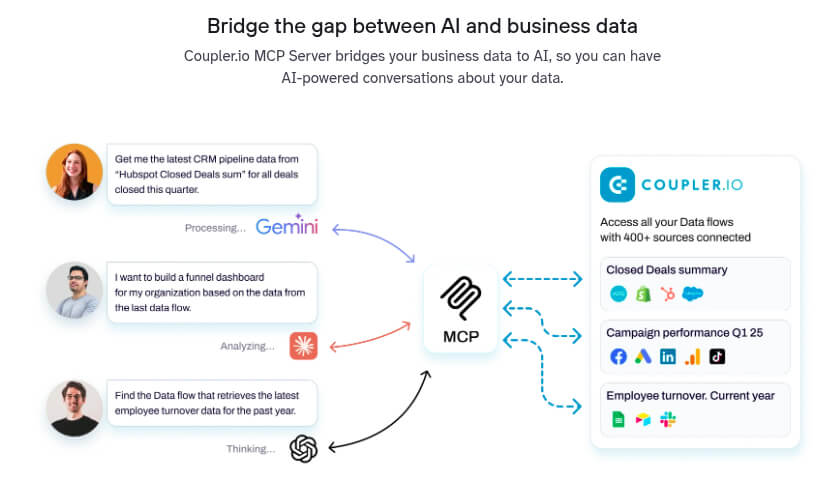
Coupler.io’s MCP bridges synced data with AI tools, enabling conversational analysis without touching a dashboard. This is especially useful for CMOs or team leads preparing reports on the fly.
Built-in data governance and access control
To meet security and compliance standards, platforms should offer role-based access control, secure data transmission, and GDPR-compliant processing. Governance is critical when syncing financial or customer data.
Coupler.io, Fivetran, and Adverity include account-level access control and encrypted data transfers. Teams handling sensitive or PII data should prioritize platforms with built-in governance features.
Transparent and scalable pricing structure
Understanding your pricing model is essential for long-term planning. Some platforms use flat rates based on the number of connected sources or accounts. Others charge based on row count or event volume, which can fluctuate and cause unpredictable costs.
Coupler.io offers account-based pricing with unlimited flows and users, making it easy for smaller teams to scale. Windsor.ai uses row-based pricing, while Hevo and Fivetran use volume-based models based on Monthly Active Rows (MAR).