A marketing team wants all its ad data in one place, refreshed every morning. Two names make the shortlist. One lists $44 a month on its website. The other asks for a demo call first.
That’s Adverity vs Supermetrics in a nutshell: a self-serve connector built for marketers versus an enterprise marketing data platform whose median contract runs past $50,000 a year.
So the real question is which end of the market your team belongs to, and whether Coupler.io, priced between the two, is a better fit.
Key takeaways
- Supermetrics is the self-serve pick. Plans start at $44/month billed yearly, with a 14-day free trial and no sales call.
- Adverity is custom-quote only. Vendr’s purchase data puts the median contract at $53,650 a year.
- The Adverity premium pays for harmonized metrics and governance across brands and markets.
- Supermetrics’ Starter and Growth plans include one core destination. Warehouses and data residency controls are available on Enterprise.
- Both vendors are adding AI features, but these are still new. Test them with your own data to see how useful they are.
Side-by-side at a glance
| Adverity | Supermetrics | |
|---|---|---|
| Best for | Enterprise brands and large agencies running governed marketing data ops | Marketers, SMBs, and agencies that want ad data in Sheets or BI fast |
| Pricing model | Custom annual contract, sales-led | Tiered plans plus paid add-ons |
| Entry price | Not publicly listed (Vendr median: $53,650/year) | Starter: $44/month billed yearly ($55 monthly) |
| Free trial | Not listed; demo first | 14 days, no credit card |
| Data sources | 600+ marketing-focused connectors, plus Universal Connect | 170+ marketing and sales connectors, plus Connector Builder |
| Destinations | Warehouses, Adverity-managed hosting, 40+ other destinations | Sheets, Excel, Data Studio, Power BI, AI chats; warehouses on Enterprise |
| Transformations | No-code tools, 80+ Python functions, dbt, Data Mapping | Full Data Transformations on Enterprise |
| AI capabilities | Adverity Atlas, Transformation Copilot, dashboard AI, MCP server | Supermetrics Studio, AI Chats, MCP and API |
| Security | ISO 27001, SOC 2 Type II, GDPR, UK GDPR, CCPA, HIPAA BAA, DORA | ISO 27001, SOC 2 Type II, GDPR, CCPA |
| G2 rating | 4.4/5 (320+ reviews) | 4.4/5 (800+ reviews) |
Verified as of October 2026.
Adverity vs Supermetrics audience: Who is each tool for?
Supermetrics is built for people who need to get reports out the door. Think of a PPC manager who pulls Google Ads and Meta data into Data Studio every Monday, or a small agency managing 15 client reports in Google Sheets. About 55% of Supermetrics’ G2 reviews come from small businesses.
Adverity is aimed at teams that need more control over their marketing data. Picture a marketing ops lead at a brand running campaigns in 20 markets, where each ad platform defines costs a little differently. Adverity’s customers include American Express and Vodafone, as well as agency groups like Dentsu and IPG Mediabrands. About 43% of its G2 reviews come from mid-market companies.
Supermetrics gets marketing data from one place to another. Adverity also helps teams clean and validate that data, apply consistent rules, and control access.
👉 A quick test: If your main challenge is building reports, start with Supermetrics. If you need consistent, reliable numbers across brands and markets, Adverity may be a better fit.
When Supermetrics stops being enough
Teams often start looking for alternatives when Supermetrics’ limits and add-on costs get in the way.
Common reasons to move on:
- You’ve reached Growth limits. Even with add-ons, Growth tops out at 9 data sources, 2 destinations, and 5 users.
- You need a data warehouse. BigQuery and Snowflake are only available on Enterprise.
- You need more client accounts. Growth allows up to 15 accounts per data source after add-ons; it includes 7 accounts per data source. An agency managing 20 Meta ad accounts has already outgrown that limit.
- Your numbers don’t match. Google Ads and Meta don’t define “conversions” in the same way. Supermetrics can blend data, but Adverity puts data harmonization at the center of its platform.
- You need an audit trail. Legal teams or large clients may ask who accessed the data and where it’s stored.
- You need data quality checks, not just failure alerts. Supermetrics emails you when a refresh fails, but it won’t flag duplicate rows or a sudden drop in volume.
Add-on costs can also make Growth less attractive. Say you’re on Growth at $177/month, billed yearly. You add a second destination (+$149) and 3 more data sources (+$37 each). That’s $437/month, or about $5,244 a year. You still don’t have a data warehouse.
Moving to Adverity takes planning. The company says enterprise onboarding takes 30 to 60 days and includes a dedicated account manager. You’ll need to rebuild your data streams and point your reports to the new warehouse tables. Run both tools side by side for at least one reporting cycle. That gives you time to check the numbers before switching off Supermetrics.
Adverity makes more sense when your team needs consistent numbers across brands and markets, not just another connector. If your main concern is the cost of Supermetrics add-ons, Adverity probably won’t lower your bill. Before committing, compare it with these Adverity alternatives.
Breaking down Adverity vs Supermetrics key features
A big part of Adverity’s cost comes from what happens to your data before it reaches a report. The platform does more than move data between tools.
Adverity Connect is its main product. In 2026, Adverity brought its Data and Intelligence products together under Connect. The platform handles four main tasks:
- Collect. More than 600 connectors pull data on a schedule, as often as every 15 minutes. You can also backfill unlimited historical data.
- Transform and harmonize. Use no-code tools, 80+ Python functions, and dbt support to prepare your data. Data Mapping helps standardize fields like “cost” across different platforms.
- Monitor. Four checks run with every data fetch. They flag duplicates, drops in data volume, late data, and schema changes. You can get alerts through email, Slack, or Teams.
- Deliver. Send data to your warehouse, use Adverity-managed hosting, or connect to more than 40 other destinations.
Supermetrics takes a simpler approach. It pulls data into the tools marketers already use and doesn’t store your data by default. It also offers a free gallery of reporting templates. Custom Data Import and Connector Builder help you work with sources that aren’t supported out of the box. Enterprise adds full Data Transformations and Supermetrics Storage.
One feature worth noting is campaign management. From a Supermetrics Studio dashboard, you can edit campaign budgets and send those changes back to the ad platforms.
The main difference is what each tool does beyond moving data. Adverity helps teams prepare, standardize, and monitor data across the business. Supermetrics focuses on getting marketing data into reporting tools so teams can use it.
Adverity vs Supermetrics security & stability: What’s the difference?
Security is one of the clearest differences between the two tools. Both offer standard enterprise security features, but Adverity provides more controls for larger organizations.
| Area | Adverity | Supermetrics |
|---|---|---|
| Certifications | ISO/IEC 27001 (TÜV Austria), SOC 2 Type II | ISO 27001, SOC 2 Type II |
| Compliance | GDPR, UK GDPR, CCPA, DORA, HIPAA BAA available | GDPR, CCPA |
| Sign-in | SAML SSO, MFA with org-wide enforcement | SSO on all plans; SAML SSO on Enterprise |
| Data residency | EU and US, set per workspace | Region control on Enterprise |
| Where data lives | Your warehouse or Adverity-managed hosting | Not stored by default; Supermetrics Storage on Enterprise |
| Audit trail | Logins, entity changes, dashboard access, downloads | Not documented on public pages |
Verified as of October 2026.
Both hold ISO 27001 and SOC 2 Type II. If your procurement team sends a long security questionnaire, Adverity still ticks more boxes, with HIPAA BAA, DORA, and UK GDPR on top. For most agencies and SMB teams, Supermetrics’ coverage is enough.
Stability works differently, too. Supermetrics Storage (on Enterprise) keeps reports running when a platform’s API goes down. Adverity checks every fetch for problems before data reaches your warehouse.
Comparing costs: Adverity vs Supermetrics pricing
This is one of the biggest differences between the two tools. Supermetrics publishes its prices. Adverity pricing requires you to request a quote.
Supermetrics’ Starter plan starts at $44/month when billed yearly. Each plan comes with set limits for destinations, data sources, users, and accounts. If you need more, you pay for add-ons, each with its own limits. Once you reach those caps, you’ll need a custom Enterprise quote.
This full breakdown of Supermetrics pricing explains how the costs add up.
Adverity doesn’t list its prices online. You need to book a demo to get a quote. Vendr, which tracks real software purchases, puts the median annual Adverity contract at $53,650. Reported deals range from around $13,000 to $168,000 a year.
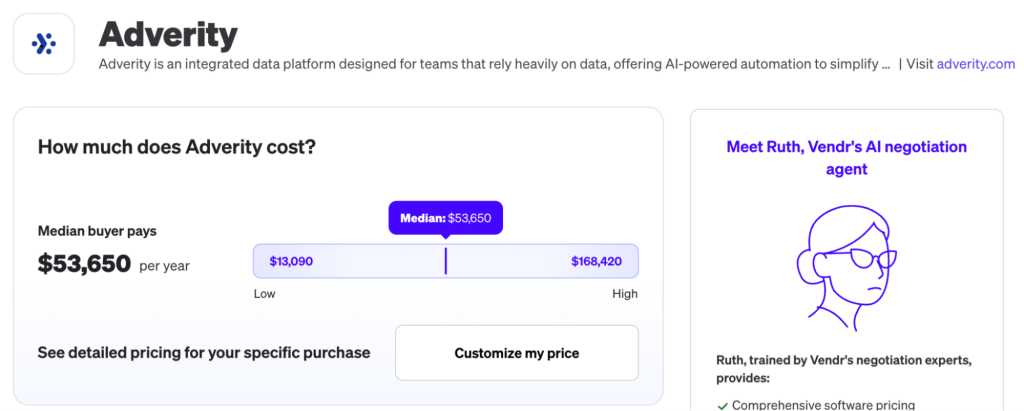
That median is about ten times the $5,244 annual cost of the Growth setup I covered earlier. There’s a big price gap between the two tools.
💡 This leaves mid-market teams with a tough choice. Supermetrics can get expensive when you add more destinations and data sources. Adverity, on the other hand, requires a custom contract that may be more than some teams need.
Coupler.io offers another option with a public pricing page, and plans scaling based on connected accounts and destinations. All 400+ sources are included on every plan. Starter costs $24/month billed yearly, while Pro costs $199/month billed yearly and includes unlimited destinations and hourly refreshes. Only the Custom plan for larger teams requires a sales call.
If Supermetrics no longer meets your needs but Adverity feels like too much, Coupler.io is worth considering.

Get all 400+ sources on every plan, with pricing from $24/month
Book a demoWhat Adverity vs Supermetrics data sources cover
Adverity has the bigger catalog. It lists 600+ connectors across 24+ source categories, all maintained by Adverity. They include Google Ads, Meta, Amazon Advertising, Salesforce, and Adobe Analytics. For anything missing, Universal Connect can pull from other APIs without a pre-built connector.
Supermetrics’ documentation lists 170+ connectors. They cover paid media, social, SEO, ecommerce, email, and sales tools. Some, like The Trade Desk and Salesforce, are premium connectors you buy through the sales team. Connector Builder and Custom Data Import help fill the gaps.
Here’s the catch. With Supermetrics, catalog size matters less than your plan’s source limit. Starter lets you pick 3 sources. Growth includes 6, and you can add up to 9.
Both tools are marketing-first. If finance or product data needs to live in the same pipeline, check each catalog for your exact sources before you sign.
Where Adverity vs Supermetrics destinations fit the workflow
Supermetrics sends data to where marketers already work. On Starter and Growth, you pick one core destination. Options include Google Sheets, Excel, Data Studio, Power BI, or an AI chat like Claude or ChatGPT. A second destination costs extra. Warehouses like BigQuery and Snowflake need Enterprise.
Adverity starts at the warehouse. It delivers to Snowflake, BigQuery, Databricks, Redshift, Microsoft Fabric, and more. No warehouse yet? Adverity can host the data for you. It also connects to 40+ other destinations, including BI tools, spreadsheets, and audience activation platforms. One data stream can feed several destinations at once.
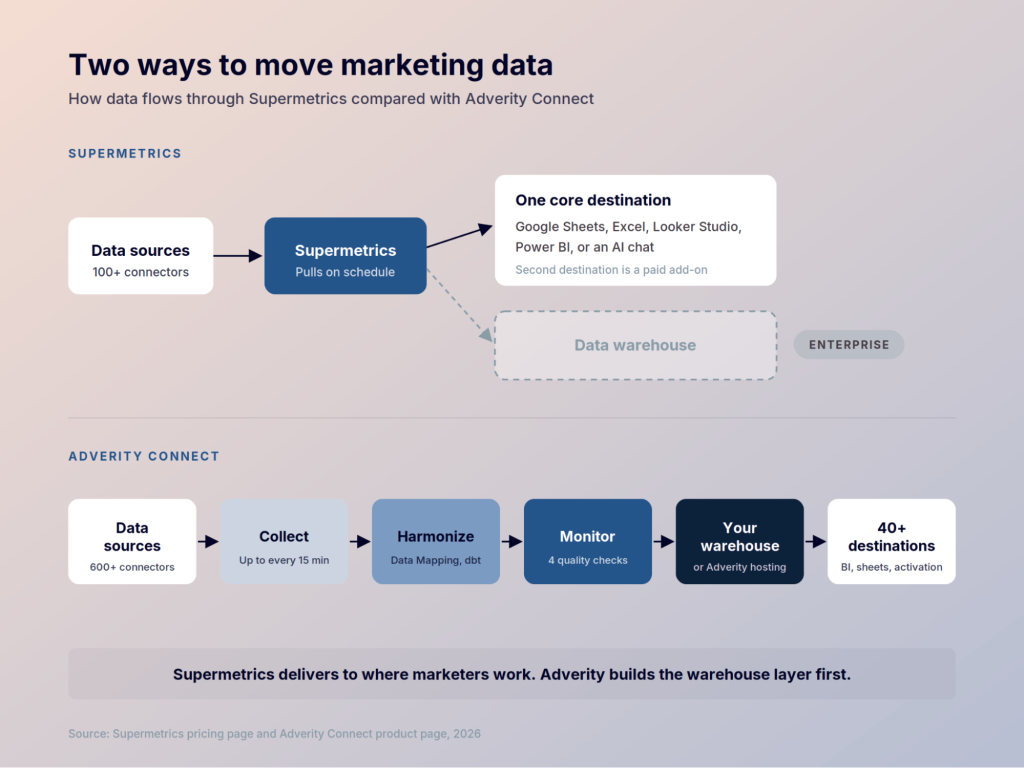
Think of Supermetrics as a courier that drops data on your desk. Adverity checks and sorts everything into a central warehouse first (yours or one it hosts), then ships copies wherever you need them.
What you can do with Adverity vs Supermetrics AI
Adverity vs Supermetrics AI moved fast in 2026. Both vendors shipped real products, and both are new. Take demo claims with a grain of salt.
Adverity’s big bet is Adverity Atlas, a separate product that’s new in 2026. It sits on top of your warehouse (Snowflake, BigQuery, Databricks, or Redshift). It gives AI a shared glossary of what your marketing metrics mean. You can ask “Why did Meta CPA jump in Germany last week?” and get an answer that cites its sources. Atlas also includes anomaly detection and budget pacing, and you can bring your own LLM.
Inside Adverity Connect, Transformation Copilot turns plain-English prompts into transformation scripts. Adverity also has an MCP server that connects your pipelines to AI tools like Claude and ChatGPT.
Supermetrics’ AI is closer to everyday reporting. AI Chats is available across Claude, ChatGPT, Gemini and Copilot via MCP, with Studio AI credits included on every plan. Supermetrics Studio lets you build a dashboard in Claude and push it to Studio, where Supermetrics keeps the data updated. Every plan includes AI credits, from 4,000 a month on Starter to 12,000 on Growth.
My honest take: Atlas is the more ambitious product, but it’s sold separately and needs a warehouse. Supermetrics’ AI is easier to try this week.
Coupler AI takes a different route. Both tools above start from data that’s already flowing. Coupler.io’s AI Agent can set up and manage dataflows for you, then surface insights once the data is loaded.
AI Integrations bring that data into Claude, ChatGPT, Gemini, and other AI tools. Skills turn repeat analysis into reusable workflows. Behind it all sits a library of 230+ dashboard templates. It’s closer to “describe what you want and get a working pipeline” than what either tool offers today.
Let Coupler AI do the data work for you
Tell Coupler AI what you need to know, from which source, and how often. It connects your account, sets up the data flow, keeps it refreshed, and lets you analyze the results inside Coupler.io or another AI tool.
Try for free
Adverity vs Supermetrics ease of use, support in daily work
Supermetrics wins on day one. You start a free trial and pull Google Ads data into Google Sheets the same afternoon. G2 reviewers often mention its simple setup. Support comes through tickets and chat on every plan. A customer success manager is Enterprise-only.
The weak spot is support depth. G2 scores Supermetrics’ quality of support at 7.8 out of 10.
Adverity is slower to start, but stronger once you’re in. Enterprise onboarding takes 30 to 60 days, and every customer gets a dedicated account manager. G2 scores its quality of support at 9.0. Some reviewers say getting started takes longer than with simpler tools.
In daily work, a Supermetrics user fixes their own report. An Adverity user has someone to call when a pipeline acts up.
Coupler.io as an alternative
If you’re stuck between Supermetrics’ plan ceiling and Adverity’s enterprise price floor, there’s a third option worth a look.
Coupler.io does more than Supermetrics for teams that have outgrown per-destination billing. And it’s easier to buy than Adverity for teams that don’t need full enterprise data operations.
Coupler.io is a data integration and AI analytics platform. It connects 400+ data sources across marketing, sales, finance, and ops, and every plan includes all of them. So your ad data and your CRM can sit in the same pipeline. You can send data to spreadsheets, BI tools, warehouses, or AI tools. And you can start from 230+ ready-to-use dashboard templates.
Pricing is public. Plans scale with connected accounts and destinations, and the self-serve plans need no sales call. Security covers SOC 2 Type II, GDPR, HIPAA, and DORA. Credentials are encrypted with AES-256, and data moves over TLS. Coupler AI (the AI Agent, AI Integrations, and Skills) helps you set up dataflows and analyze your data in plain language.
Here’s how the three compare:
| Coupler.io | Adverity | Supermetrics | |
|---|---|---|---|
| Pricing model | Public plans based on accounts and destinations; Custom tier for large teams | Custom annual contract | Tiered plans plus add-ons |
| Entry price and purchase | Free plan; Starter $24/month billed yearly, self-serve | Demo and custom quote | Starter $44/month billed yearly, self-serve |
| Data sources | 400+ across marketing, sales, finance, and ops | 600+, marketing-focused (more marketing depth) | 170+ marketing and sales |
| Dashboard templates | 230+ ready to use | Optional Dashboards add-on | Free template gallery |
| Security | SOC 2 Type II, GDPR, HIPAA, DORA | Broadest set: ISO 27001, SOC 2 Type II, DORA, HIPAA BAA, more | ISO 27001, SOC 2 Type II, GDPR, CCPA |
| Governance | SAML SSO and audit logs (on request) on Custom plan | Deepest: nested workspaces, roles, full audit trail | SAML SSO and region control on Enterprise; audit trail not documented |
| AI capabilities | Coupler AI: AI Agent, AI Integrations, Skills | Adverity Atlas, copilots, MCP server | Studio, AI Chats, MCP |
Comparison verified as of October 2026.
Coupler.io fits a mid-market marketing or ops team that needs reliable multi-source pipelines and predictable monthly costs. It also suits growing agencies that want ready-made dashboards without Adverity’s enterprise overhead.
It isn’t the right call for everyone, though. If you need audit-grade governance and harmonized metrics across many brands and markets, Adverity is built for that job. And if one Data Studio connector with a few ad sources covers all your reporting, Supermetrics may be all you need.
If you’re on Supermetrics now and the add-on bills have you rethinking, the Coupler.io team will help scope the move. See Coupler.io vs Supermetrics for the full head-to-head.
Transparent Coupler.io pricing from $24/month billed annually
Book a demoWhich tool should you choose?
✅ Pick Adverity if you run marketing data across many brands or markets, and trust in the numbers is the real problem. You need harmonization and audit trails, and your procurement team is ready for a sales-led contract.
✅ Pick Supermetrics if you’re a small team or agency that lives in Google Sheets or Data Studio. You want to start today with a credit card and keep the bill to a few hundred dollars a month.
✅ Consider Coupler.io if you’re a mid-market team with sources beyond marketing. You want public, predictable pricing and SOC 2 Type II security without an enterprise contract. For more options, see this list of the best Supermetrics alternatives.