Funnel.io Pricing in 2026: How Flexpoints Shape Your Bill

Funnel’s pricing page shows a starting price for each plan. But that number alone won’t tell you what you’ll pay. Funnel.io pricing has two parts: your plan and flexpoints (the capacity your workspace needs to run your setup). Each ad account and destination you turn on uses some of that capacity.
So the real question is how many flexpoints does your marketing setup need, and what will that capacity cost?
I’ll show you how to count flexpoints and walk through the plans and four example setups. Coupler.io takes a different approach and prices by connected accounts and destinations. I’ll compare the two at the end, so you can judge which is easier to budget for.
All prices and limits below come from Funnel’s and Coupler.io’s official pages, checked on October 12, 2026.
TL;DR: How much does Funnel.io cost?
- Funnel starts at $300 a month on Starter and $600 a month on Business, billed annually. Enterprise is custom.
- That’s only part one of your bill. Part two is flexpoints, the capacity your setup uses.
- Every plan needs at least 400 flexpoints, even for a small team.
- Grow a simple setup to 30 accounts, add BigQuery, and you’re at about 750 flexpoints, so you need to buy 800.
- What do those extra points cost? Funnel doesn’t say publicly.
- Coupler.io shows every price from Free to Pro on its website. Paid plans start at $24 a month, billed annually.
Build your Funnel price from your setup
Funnel doesn’t charge by rows of data. Its pricing page says it doesn’t charge for “data volume, row counts, or how many report types you pull.” What counts is what you have switched on.
Let’s take a small paid media team. They connect:
- Google Ads with 2 ad accounts
- Facebook Ads with 2 ad accounts
- Google Analytics with 1 property
- Data Studio as the place where their reports live
Here is how that setup turns into flexpoints, using Funnel’s current rate card:
| Item | Flexpoints each | Count | Total |
|---|---|---|---|
| Connector (Google Ads, Facebook Ads, Google Analytics) | 50 | 3 | 150 |
| Platform account (ad account or property) | 5 | 5 | 25 |
| Visualization destination (Data Studio) | 150 | 1 | 150 |
| Total | 325 |
This team needs 325 flexpoints. Every Funnel plan has a minimum of 400. So this setup fits inside the minimum and leaves 75 points free.
Now say the team also wants its data in Google Sheets. Funnel’s own pages give different costs for this. One example in its help center counts the Google Sheets destination at 50 flexpoints, plus 10 for each workbook. Extra tabs are free. That’s 60 points for one workbook. Funnel’s pricing page lists Google Sheets as a visualization destination at 150 points. Ask Funnel which rate applies before you plan your capacity.
The key idea is that your bill follows your setup. More accounts and more destinations mean more flexpoints. Row counts don’t change it.
How the Funnel.io pricing model uses flexpoints
The Funnel.io pricing model consists of two layers:
- The plan decides which features, connectors, and destinations you can use.
- The flexpoints decide how much of those features you can switch on at once.
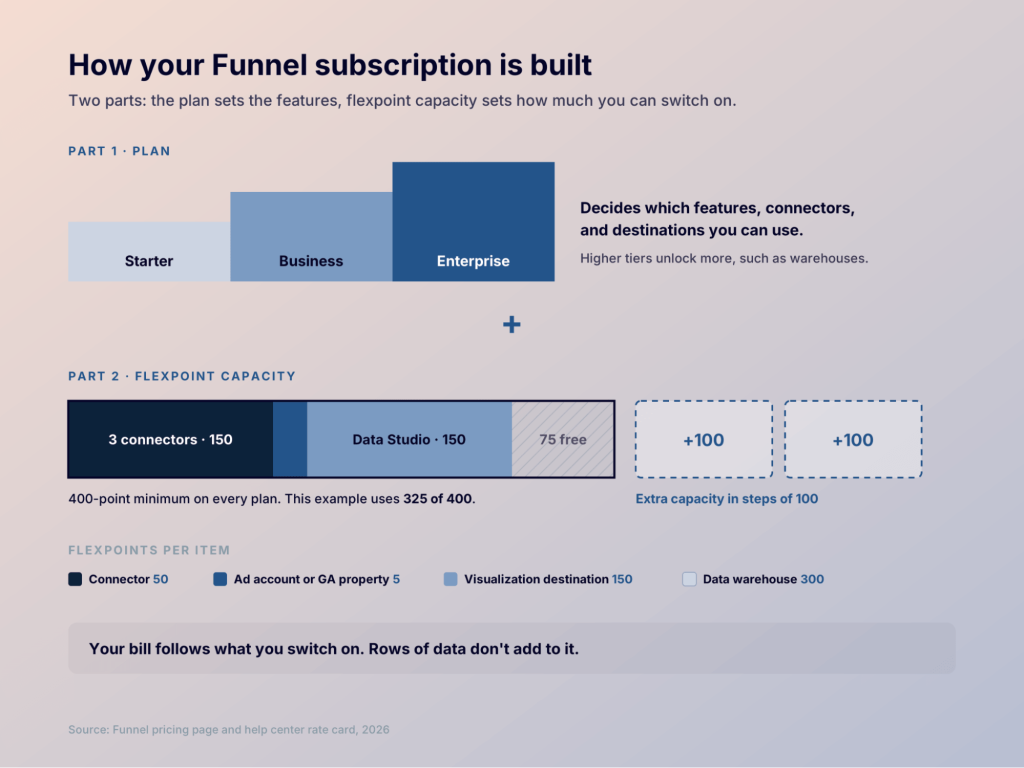
Funnel describes flexpoints as purchased capacity. Its pricing page says flexpoints are “not credits, and not a monthly balance to manage.” You don’t watch a balance drain as data flows in. You buy a set amount of capacity in your contract, and your active setup sits inside it.
The minimum and how you add more
All Funnel plans need at least 400 flexpoints. You add more in steps of 100. The price of each 100-point bundle depends on your plan tier. Funnel doesn’t publish those bundle prices.
✅ What uses flexpoints
Here is the rate card from Funnel’s help center as of October 2026:
| Item | Flexpoints |
|---|---|
| Connector (for example, Google Ads) | 50 |
| Custom connector | 50 |
| Platform account (an ad account or GA property) | 5 |
| Visualization destination (for example, Looker Studio) | 150 |
| Dashboard | 150 |
| Data warehouse destination (for example, BigQuery, Snowflake) | 300 |
| Conversion upload | 50 |
| Each platform account in a conversion upload | 5 |
| Google Sheets workbook | 10 |
A connector starts using flexpoints when at least one data source in its platform account is active. This happens even if you don’t send the data anywhere yet.
❌ What doesn’t use flexpoints
Some things are free:
- Individual data sources inside an account
- Extra tabs in a Google Sheets workbook
- Dashboards you build on Funnel’s Insights page (the help center says these use no flexpoints, even though “Dashboard” appears on the rate card)
- Beta features and beta connectors (they may start using points after release)
Moving capacity around
Pausing frees up flexpoints. If you pause or delete every data source in an account, that account stops using points. The same goes for pausing an export. You can then use the freed points somewhere else, such as a new client account.
What happens when you run out
Funnel’s help center says you may be blocked from adding new accounts or destinations until you free up flexpoints or upgrade. Funnel’s pricing page says flexpoints are “part of your contract, not a usage meter.” Your bill changes only when you buy more.
The February 2026 rate card change
Funnel updated its rate card in early 2026. From February 4, 2026, the new rate card applies to anyone buying Funnel for the first time. It also applies if you change your plan at renewal. Funnel notes that legacy plans may not match the new table.
The main changes:
| Item | Old rate | New rate |
|---|---|---|
| Platform account | 0 | 5 |
| Data source | 5 | 0 |
| Custom connector | 100 | 50 |
| Google Sheets | Charged per tab | 10 per workbook |
This matters if you compare an older Funnel quote with a new one. Under the new card, each ad account costs points. Under the old one, each data source did.

Get one monthly price for all your ad accounts with Coupler.io
Book a demoFunnel.io pricing plans and the cost of capacity
Funnel’s pricing page shows three plans for brands. Its help center also describes a Free plan, and agencies get their own pricing page. All paid prices on the pricing page are shown as “billed annually.”
| Plan | Starting price | Connectors | Destinations | Users | Export frequency |
|---|---|---|---|---|---|
| Free | $0 | Not listed on the pricing page | Not listed | Not listed | Not listed |
| Starter | From $300/month | 117 | 13 | 5 | Daily |
| Business | From $600/month | 579 | 46 | Unlimited | Every 2 hours |
| Enterprise | Custom | 600+ | 47 | Unlimited | Every 2 hours |
The Free plan isn’t on Funnel’s pricing page. Funnel’s help center describes it as having a 400-flexpoint limit.
A few plan details change what you can build:
- Starter includes Data Studio, Google Sheets, and conversion APIs. Power BI and Tableau aren’t included. It also includes Funnel AI and Funnel MCP, which connect your data to AI tools like Claude and ChatGPT.
- Business adds Power BI, Tableau, BigQuery, and other cloud destinations. It also adds unlimited users and workspaces.
- Enterprise adds Snowflake, enterprise single sign-on (SAML, OIDC, SCIM), an audit log, and an EU data center option.
Agencies see two plans. Agency Standard starts at $300/month and Agency Advanced at $600/month, both billed annually. BigQuery is only in Agency Advanced.
What the starting price doesn’t tell you
Funnel doesn’t say how many flexpoints come with each starting price. It also doesn’t list the price of extra 100-point bundles. So you can’t work out your full Funnel.io pricing per month from the website. If you already use Funnel, your subscription owner can buy more capacity in the app, in steps of 100. You can also buy it through your Funnel representative. If you’re still comparing tools, contact Funnel for the price.
Contract terms worth knowing
Funnel’s general terms say subscriptions renew automatically for the same period. To stop renewal, you give notice at least 30 days before the period ends. Funnel can raise its fees at renewal, and it must tell you before the increase starts. Its help center says Starter users can cancel in the app. Business and Enterprise users need to contact support.
Funnel.io features pricing: What makes you need a larger setup
Funnel.io features pricing mostly comes down to what you switch on. A few things push teams into more flexpoints or a higher plan.
More platform accounts. Each ad account or GA property costs 5 points. An agency with 60 client accounts uses 300 points on accounts alone.
Data warehouse destinations. BigQuery or Snowflake costs 300 points each. One warehouse uses three-quarters of the 400-point minimum. BigQuery also needs at least the Business plan. Snowflake needs Enterprise.
Reporting tools. Each visualization destination, such as Data Studio, costs 150 points. If you report in two tools, that’s 300 points.
Google Sheets workbooks. Each workbook adds 10 points. Teams that keep one workbook per client can add up quickly.
Measurement. Funnel Measure covers marketing mix modeling, multi-touch attribution, and incrementality testing. It’s an add-on for Business and Enterprise. Funnel’s calculator shows Digital Measurement at $2,250/month, billed annually, for brands spending $500K to $1M a month on ads. Advanced Measurement has custom pricing.
Funnel.io pricing, features, pros, and cons
Here’s my short take on the trade-offs.
| Pros | Cons |
|---|---|
| No charges for rows or data volume | Bundle prices aren’t public |
| Paused items free up capacity | Small setups still need the 400-point minimum |
| Funnel AI and MCP are on every paid plan | Warehouse destinations use a lot of capacity |
| Advanced measurement is available as an add-on | Paid prices are shown as annual billing |
Most of these cons make your final price hard to know upfront. The setups below show how quickly the points add up.
Pick the pricing you can plan around
Try Coupler.io for freeFour setups, four flexpoint requirements
The examples below use Funnel’s current rate card. Funnel adds capacity in steps of 100, so I round each total up. I can’t show full dollar totals because Funnel doesn’t publish bundle prices.
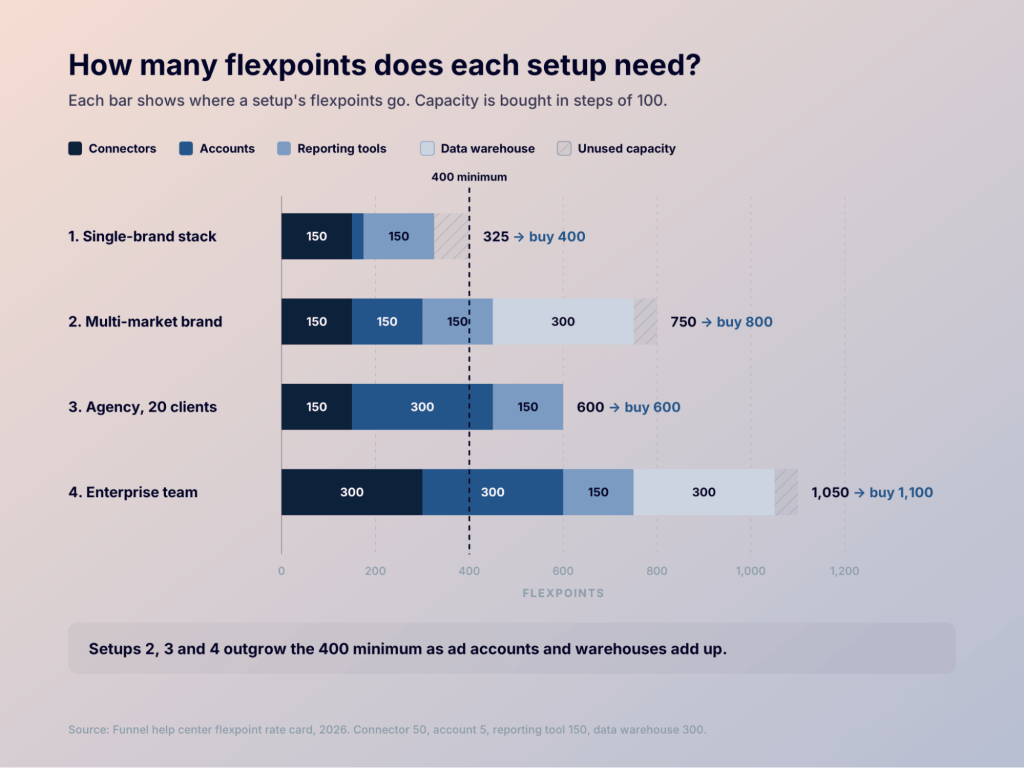
#1. Single-brand paid media stack
A brand runs Google Ads (2 accounts), Facebook Ads (2 accounts), and Google Analytics (1 property). Reports go to Data Studio.
- Connectors: 3 × 50 = 150
- Accounts: 5 × 5 = 25
- Data Studio: 150
- Total: 325 flexpoints
This fits in the 400 minimum. Starter covers it: Google Ads, Facebook Ads, and Google Analytics are all available on Starter, and so is Data Studio. Price: from $300/month, billed annually.
#2. Multi-market brand
A brand runs ads in six countries. It has 12 Google Ads accounts, 12 Facebook Ads accounts, and 6 Google Analytics properties. Data goes to Data Studio and BigQuery.
- Connectors: 3 × 50 = 150
- Accounts: 30 × 5 = 150
- Data Studio: 150
- BigQuery: 300
- Total: 750 flexpoints, so 800 of capacity
BigQuery means Business at least. Price: from $600/month, billed annually, plus four extra 100-point bundles at a rate Funnel doesn’t publish.
#3. Agency workspace
An agency reports for 20 clients. Each client has 1 Google Ads account, 1 Facebook Ads account, and 1 Google Analytics property. All reports go to Data Studio.
- Connectors: 3 × 50 = 150
- Accounts: 60 × 5 = 300
- Data Studio: 150
- Total: 600 flexpoints
The agency needs two 100-point bundles on top of the minimum. Each new client adds 15 more points. Agency Standard includes Data Studio and starts from $300/month, billed annually. Funnel doesn’t publish the price of those extra bundles.
#4. Enterprise team with advanced measurement
A large brand runs 6 connectors and 60 platform accounts. It sends data to Snowflake and Data Studio. It also wants marketing mix modeling.
- Connectors: 6 × 50 = 300
- Accounts: 60 × 5 = 300
- Snowflake: 300
- Data Studio: 150
- Total: 1,050 flexpoints, so 1,100 of capacity
Snowflake needs Enterprise, which has custom pricing. Funnel Measure is a separate add-on. For this team, Funnel’s measurement tools may be worth the cost and the extra planning.
When Coupler.io pricing is easier to forecast
With Coupler.io, a data integration and AI analytics platform, you know what you’ll pay before you start. Each plan shows a published price next to how many accounts and destinations it covers and how often data refreshes. There are no capacity points to count and no bundle prices to ask for. All 400+ sources come with every plan, and you never upgrade just to unlock a connector. Compare the limits on the Coupler.io pricing page.
Coupler.io bills by connected accounts. Each Google Ads ad account or Google Analytics 4 property you connect takes up one place in your plan. You can use it in as many reports and dashboards as you need at no extra cost. Paid plans start at $24/month, billed annually. You can try Coupler.io free for 7 days or stay on the free plan.
Here’s how the first three setups from above look on Coupler.io. The table compares what each tool bills for.
| Setup | What Funnel bills for | What Coupler.io bills for | Coupler.io plan |
|---|---|---|---|
| Single-brand stack (5 accounts, 1 destination) | 325 flexpoints inside the 400 minimum | 5 accounts, 1 destination | Active: $99/month billed annually ($132 monthly), up to 15 accounts, 3 destinations, daily refresh, unlimited users |
| Multi-market brand (30 accounts, 2 destinations) | 750 flexpoints, 800 capacity | 30 accounts, 2 destinations | Pro: $199/month billed annually ($259 monthly), up to 50 accounts, unlimited destinations, hourly refresh |
| Agency with 20 clients (60 accounts, 1 destination) | 600 flexpoints | 60 accounts, 1 destination | Above Pro’s 50 accounts: buy extra accounts through support or move to a custom Agency plan |
Two things make Coupler.io easier to forecast in these cases. First, the pricing page shows the exact price for every plan from Free to Pro. Second, Pro has no limit on destinations, so adding one doesn’t change your plan or your price.
Coupler.io can load data into Google Sheets, Excel, Data Studio, Power BI, Tableau, BigQuery, Snowflake, and other destinations. You can also connect it to AI tools such as Claude, ChatGPT, and Gemini. There are 230+ ready-made dashboard templates to start from.
Setup 4 is where I’d still point to Funnel. Coupler.io’s plans don’t include marketing mix modeling, multi-touch attribution, or incrementality testing. If you need those, Funnel Measure is built for it.
If you’re already on Funnel, the Coupler.io migration page for Funnel users explains how the switch works. Migration support is included with your Coupler.io plan.
Test account-based pricing on your own data
Start free with Coupler.ioChoose Funnel or Coupler.io based on what you are buying
Choose Funnel if you need its marketing data hub and advanced measurement. It also suits teams that like moving capacity between accounts as their channels change. If you plan to use Funnel Measure, the flexpoint model is part of a bigger package.
Consider Coupler.io if your main job is pulling data from many channels into dashboards, spreadsheets, warehouses, or AI tools. Plan prices are on the website, and the account count is easy to predict.
Here’s how I’d decide:
| If you need… | Better fit |
|---|---|
| Marketing mix modeling, attribution, or incrementality testing | ➡ Funnel |
| A full published price before you talk to sales | ➡ Coupler.io |
| Data in AI tools like Claude or ChatGPT | ➡ Both |
| Many destinations without extra capacity costs | ➡ Coupler.io (Pro and above) |
| Hourly refresh (Funnel’s fastest export is every 2 hours) | ➡ Coupler.io (Pro and above) |
For a full feature comparison, see Coupler.io vs Funnel.io or our list of Funnel.io alternatives.
FAQ
Does Funnel have a free trial?
Yes. Funnel’s help center lists a 14-day Starter trial with unlimited flexpoints. There’s also a 7-day data integration trial with premium features. You can use only one of them. When the Starter trial ends, you go back to the Free plan’s 400-flexpoint limit. Anything over that limit pauses.
What happens if I go over my flexpoint capacity?
You may not be able to add new accounts or destinations. You can pause something to free up points, buy more capacity in steps of 100, or upgrade.
Does Funnel offer monthly billing?
Funnel’s pricing page shows paid plans as “billed annually.” It doesn’t list a monthly billing option. Ask Funnel’s sales team if you need one.
How do I cancel Funnel?
On Starter, you can cancel in the app. On Business and Enterprise, you can contact Funnel support from the Help menu. Either way, cancel at least 30 days before your renewal date. If you cancel later, you’ll be billed for the next period.