Your support queue doubles before lunch. Who notices first? With Geckoboard vs Databox, the answer depends on which tool you pick. Geckoboard puts that number on a TV in the office, where the whole team sees it within minutes. Databox tries to tell you why it happened and what to do next.
Both tools connect to your business apps and turn their data into KPI dashboards. Both now offer MCP access, which lets Claude and ChatGPT read their metrics. Past that point, they split. Geckoboard stays a live dashboard for teams that act during the day. Databox now calls itself an “agentic analytics platform”, built around an AI analyst called Genie.
So the real question is whether your team needs to see the number or understand it. The sections below help you answer that, with prices taken from each vendor’s own pages in November 2026.
Key takeaways
- Geckoboard is built to show live KPIs to a whole team, on TV screens and shared links. Databox is built to analyze KPIs, with Genie answering questions and Routines delivering recurring analysis.
- Geckoboard bills by dashboards, editors, and screens, with unlimited viewers on every plan. Databox sells plan tiers sized by data sources and AI credits, each with a set user allowance, and it doesn’t charge per seat.
- Geckoboard starts at $79/month and Databox’s paid plans start at $71/month, both billed annually. Databox also has a free plan.
- Geckoboard’s MCP is read-only and comes with every plan. Databox’s MCP can read and write, and it comes with every paid plan.
- On G2, the two sit close. Geckoboard scores higher on admin and setup, while Databox scores higher on support and ease of use.
- Coupler.io fits teams whose KPIs sit in more apps than either catalog covers. It connects 400+ sources to the reporting tools you already use, from $24/month, billed annually.
Geckoboard and Databox on one page
This overview covers the points most teams check first. Plan-specific features name the plan that includes them.
| Geckoboard | Databox | |
|---|---|---|
| Built for | Live KPI visibility for teams | AI-assisted analysis and reporting |
| Billing unit | Dashboards, editors and screens; unlimited viewers | Plan tier, sized by data sources and AI credits; set user allowance per tier, no per-seat pricing |
| Entry price | Essentials from $79/month, billed annually | Free plan; Analyst $71/month, billed annually |
| Trial | 14 days | 14 days on any plan, no credit card |
| Integrations | 90+, plus SQL databases, spreadsheets and Datasets API | 130+ tools, spreadsheets, databases and APIs |
| Refresh | Real-time per data source; most integrations every few minutes | Daily on Free; hourly on paid plans |
| Sharing | TV screens, live links, snapshots to Slack, Teams or email | Links, TV and embeds on Team and up |
| AI | Metrics MCP (read-only) | Genie, Skills, Routines, MCP (read and write), MCP connectors |
| Security | GDPR, CCPA, PCI DSS, CASA; SSO on Enterprise | SOC 2, GDPR, CCPA; SAML SSO; hosted on AWS in the US |
| G2 rating | 4.3/5 (48 reviews) | 4.4/5 (194 reviews) |
Wall screen or AI analyst
Every difference in this comparison comes back to who looks at the numbers and what they do next.
Geckoboard is a wall screen. Its homepage calls it “KPI dashboard software for teams that need live numbers in plain sight.” Dashboards run on any TV with off-the-shelf hardware and rotate in loops. Celebrations mark new deals and leaderboards rank the team. On Performance and up, alerts ping Slack or Teams when a KPI crosses a line. The goal is a team that reacts within the same shift.
Databox is an analyst. In September 2026, Databox announced it “is now an agentic analytics platform.” Genie answers plain-language questions and explains what changed. It can also build metrics and dashboards from a prompt. Skills store the steps for repeat work. Routines run that work on a schedule and send the findings by email, Slack, or in-app.
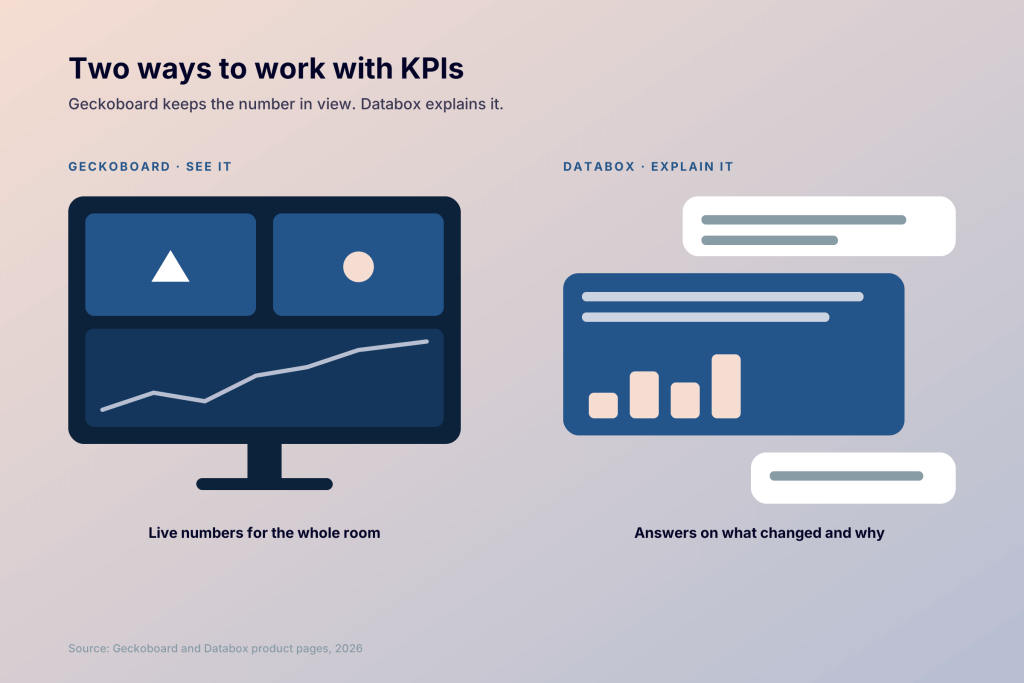
Here’s a quick way to decide. Picture the moment a number goes wrong. If the fix is “the team sees it and acts now”, that’s Geckoboard’s home ground. If the fix is “someone works out why and writes it up”, Databox is aimed at that job.
Matching the Geckoboard vs Databox audience to your team
Geckoboard says it’s “trusted by 2,000+ teams” and names sales, support, operations, marketing, leadership and finance as users. Recent releases added Dialpad and Zendesk QA, plus tracking for Zendesk AI agent tickets. Support desks and sales floors fit the product especially well.
Databox runs two tracks. The business track serves one company’s performance, from a single analyst up to teams of ten users on Team Scale. The agency track serves agencies and multi-brand groups, with cross-account reporting and account packs that grow with the client list.
Some managers want both a shared dashboard and a quick explanation. Databox can also share dashboards on TV from the Team plan up. Geckoboard has no built-in AI analyst, though its MCP lets your own AI tool read its metrics.
Geckoboard vs Databox data sources by the numbers
Geckoboard lists 90+ integrations on every plan. SQL databases such as MySQL and PostgreSQL sit next to Google Sheets and Excel. For anything missing, you can push data through the Datasets API, which gained numeric filters and future timespans in October 2026. Data volume depends on the plan, with Performance adding “high data volume” for some sources, including Zendesk Support and Shopify.
Databox says it connects “130+ tools, spreadsheets, databases, and APIs”, and its integrations filter shows 107 one-click integrations. Custom API connections turn almost any API response into a dataset. Each plan caps the number of data sources, from 3 on Free to 30 on Team Scale.
For mainstream sales and marketing apps, either catalog will do. Geckoboard goes deeper on support and calling tools, while Databox offers more breadth and custom APIs.
Screens and Slack messages in Geckoboard vs Databox destinations
Geckoboard sends numbers to where people already look. Live links need no login. Screens can be managed remotely. Snapshots go out by email, Slack, or Teams on schedules that can match your shifts. Viewers are unlimited on every plan.
Databox sends analysis as well as dashboards. On Team and above, you can share dashboards and reports by link, TV or embed, and Routines deliver finished analysis by email, Slack or in-app. Databox also offers CSV export on Team, and its MCP lets AI tools push data back into Databox.
Neither tool lists loading data into a warehouse or BI tool. Outside AI tools reach the metrics through MCP.
Reading the fine print on Geckoboard vs Databox pricing
The two pricing pages measure different things. Geckoboard counts what you build and display. Databox sells tiers sized by the data sources and AI credits you need, and says it “doesn’t charge per seat.”
Geckoboard Essentials starts at $79 per month, billed annually, with 2 dashboards, 1 editor and 1 screen. Extra dashboards cost $24 each, and extra editors or screens $20 each. Performance starts at $319 per month with 20 dashboards, 3 editors, and 5 screens, plus alerts and support within an hour. Viewers are unlimited on every plan, and Enterprise is custom.
Databox has a free plan with 1 user, 3 data sources, and 50 AI credits. Analyst costs $71 per month, billed annually, with 1 user, 5 data sources, and 150 AI credits. The Team plan card shows $199 per month, billed annually. The FAQ on the same page lists Team Core at $249 per month, with 3 users, 10 data sources, and 500 AI credits. Databox doesn’t explain the gap. Confirm the price with its sales team. White-labeling costs an extra $80 a month.
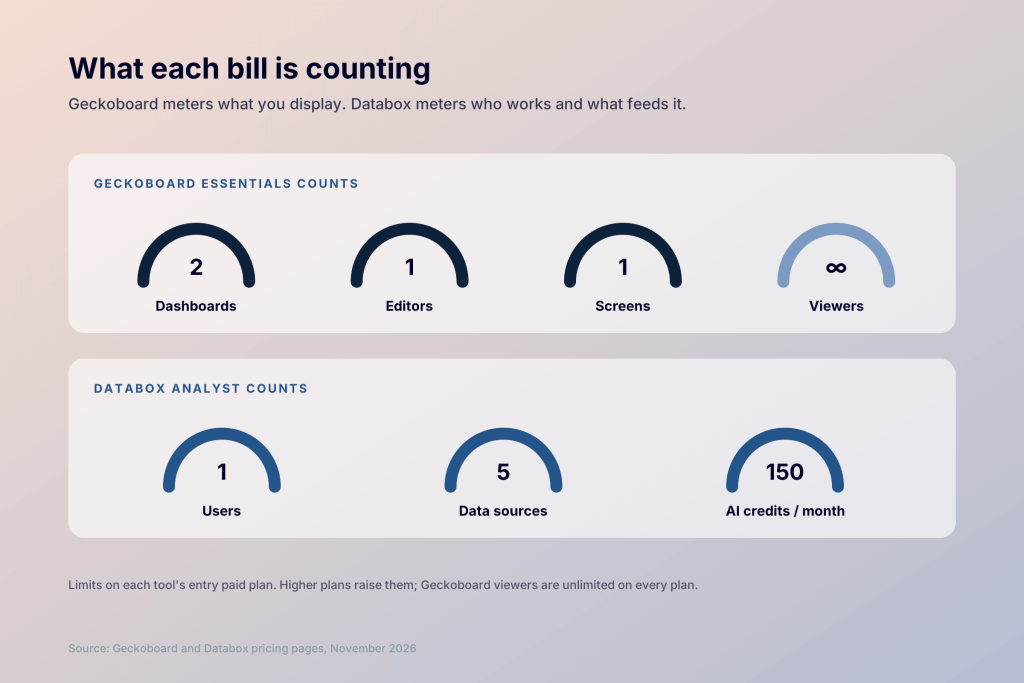
Two quick examples make it concrete. A support lead wants 4 dashboards on 2 office TVs, with one co-editor. On Geckoboard Essentials, that comes to $167 a month: $79 plus $48 for two extra dashboards and $20 each for an editor and a screen. A solo analyst with 5 data sources pays $71 a month on Databox Analyst.
Some teams need neither a wall screen nor an AI analyst. They want KPIs from many apps in Data Studio, Google Sheets, or Power BI, where they already report. Coupler.io, a reporting automation platform for business teams, covers that route with 400+ sources. Its pricing is account-based. Plans start at $24 per month billed annually, and Pro covers 50 connected accounts with hourly refresh for $199.
If your KPIs come from more apps than either catalog covers, the Coupler.io team can map them to one setup with you.

Get every KPI source on one plan
Book a demo with Coupler.ioWhat sets the Geckoboard vs Databox key features apart
Geckoboard’s features keep a team focused during the day. Goals and status indicators show who’s on track. Leaderboards and Celebrations turn wins into moments the room can see. Countdowns track the time left until a big moment. Interactive View lets you drill into a number that looks off and click through to the CRM or support tool behind it.
Databox’s features shape the numbers before anyone reads them. A semantic layer gives each metric one shared definition. Goals and anomaly detection flag movements outside the normal range. Pre-built templates and metrics help you start fast, and custom metrics cover the rest. Team plans add verified assets with badges for trusted dashboards.
The result is two different daily habits. Geckoboard users glance at a screen and act. Databox users open a report or ask Genie, and then decide.
How Geckoboard vs Databox AI handles your questions
Geckoboard keeps AI outside the product. Its Metrics MCP launched in September 2026. It gives assistants such as Claude and ChatGPT “accurate, real-time, pre-calculated metrics.” The MCP is read-only by design and included with every plan, including the trial. You ask questions in your own AI tool, and Geckoboard supplies the numbers.
Databox builds AI into the product. Genie answers questions and explains changes. Databox claims it “does not generate or hallucinate responses.” Skills, added in September 2026, save the steps for repeat analysis. Routines, added in October, run that analysis on a schedule. MCP connectors pull context from 50+ outside tools into Genie’s analysis. Databox’s MCP works with Claude, ChatGPT, n8n, and other clients, and it can push data and create datasets as well as read.
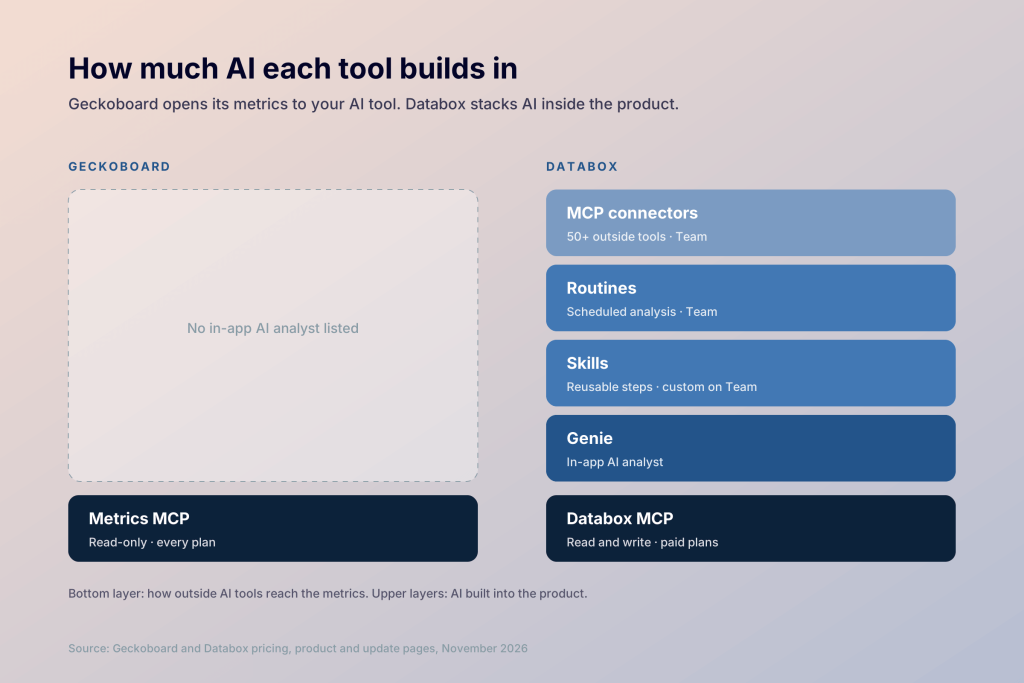
Plan limits shape the Databox side. The Team plan unlocks Routines and custom Skills. It also adds MCP connectors. Each plan includes a monthly AI credit allowance, and extra credits cost $200 a month as an add-on. Databox’s AI page still describes Genie as free during early access, which differs from the credit model on the pricing page.
Both tools stay focused on the apps they connect. When the question spans finance and ad data at once, the answer depends on the sources behind it. Coupler.io brings 400+ sources into Claude, ChatGPT, and other AI tools. Its Analytical Engine runs the calculations, and the AI model explains the results.
A demo can show how that works with your own KPIs.
Put 400+ sources behind every Claude KPI answer
Book a demo with Coupler.ioGeckoboard vs Databox security & stability under review
Databox publishes the clearer certification. Its security policy states that “Databox is SOC 2 certified.” It also says it is “not currently ISO 27001 certified.” Data is hosted on AWS in the US, encrypted with AES-256 at rest and TLS 1.2 or higher in transit. Customers can use SAML SSO, and admins can enforce MFA on certain plans or through an add-on.
Geckoboard lists PCI DSS, CASA, GDPR, and CCPA compliance. Its security article doesn’t mention SOC 2 or ISO 27001. Connections use 256-bit TLS, and it encrypts stored credentials with AES-GCM using a unique key per service. SSO with Okta, Azure AD, or other SAML providers is reserved for Enterprise.
On stability, neither vendor publishes an uptime figure on the pages we checked. Databox lists hourly sync on paid plans, with 15-minute sync for some sources as an add-on. Geckoboard refreshes most integrations every few minutes.
If your security team needs a SOC 2 report, Databox says a recent one is available through its trust portal. Coupler.io publishes its SOC 2 Type II and compliance details as well.
Geckoboard vs Databox ease of use, support for everyday users
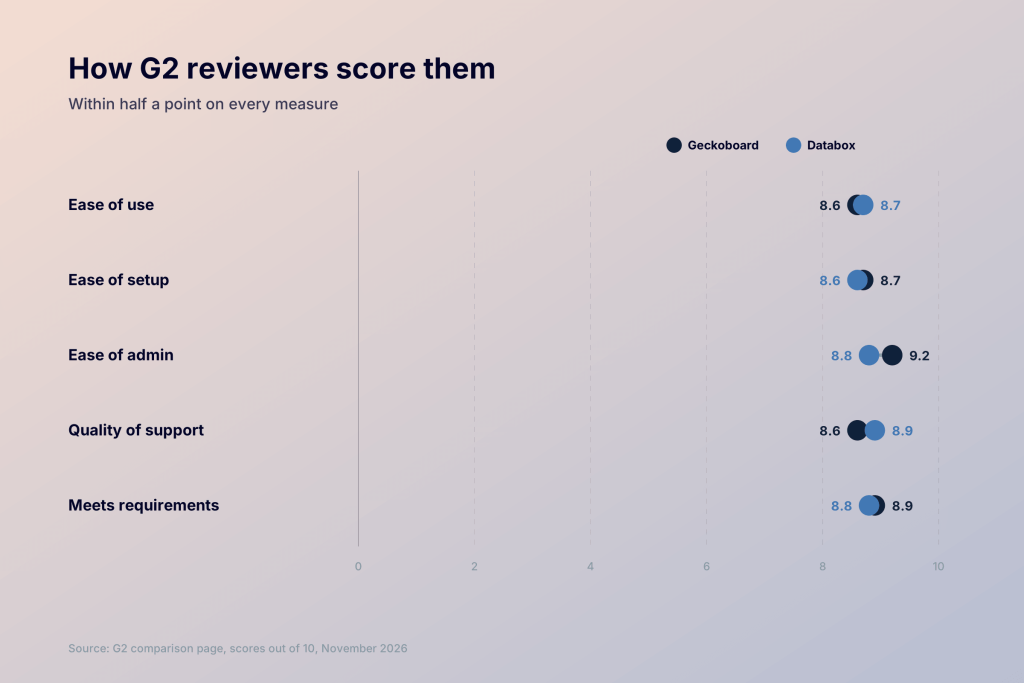
The two tools land close on G2. Databox scores 8.7 for ease of use against Geckoboard’s 8.6, and 8.9 for quality of support against 8.6. Geckoboard scores 9.2 for ease of admin against 8.8, and 8.7 for ease of setup against 8.6. Overall ratings are 4.4/5 from 194 reviews for Databox and 4.3/5 from 48 reviews for Geckoboard.
Both offer a 14-day trial. Databox needs no credit card and also offers a free plan. Geckoboard has no free plan. Its support starts with replies within a day on Essentials. Performance adds replies within an hour and onboarding help, and Enterprise brings a dedicated support manager.
In practice, Geckoboard asks less of the people watching. Viewers on a shared link never log in or learn a tool. Databox asks a bit more of the person running it: setting up metrics and Routines, and getting analysis back in return.
For teams whose data outgrows both catalogs
Many teams track KPIs across more apps than either tool lists. Finance data sits in accounting tools, while pipeline data lives in a CRM. Some of those teams already report in Data Studio, Google Sheets, or Power BI. Others want to ask Claude about the business as a whole.
Coupler.io covers that case. It’s a reporting automation platform with 400+ sources across marketing, sales, finance, and operations. Data lands in spreadsheets, BI tools, warehouses, or AI tools on a schedule.
Here’s how it compares with both tools on the points teams ask about first.
| Coupler.io | Geckoboard | Databox | |
|---|---|---|---|
| Billing unit | Connected accounts | Dashboards, editors, screens | Plan tier (data sources, AI credits) |
| Entry price | Free plan; paid from $24/month (annual) | $79/month (annual) | Free plan; $71/month (annual) |
| Sources | 400+, all on every plan | 90+ | 130+ |
| Where data goes | Google Sheets, Excel, Data Studio, Power BI, BigQuery, AI tools | TV screens, links, Slack, Teams, email | Links, TV, embeds, email, Slack |
| AI | AI Agent, AI Integrations, Skills | Metrics MCP | Genie, Skills, Routines, MCP |
| Trial | 7 days, full access | 14 days | 14 days |
Coupler.io doesn’t replace either tool outright. Geckoboard keeps the lead on live office displays. Databox keeps it on Routines and AI analysis inside its own dashboards.
What Coupler.io adds is coverage. It pulls in sources neither catalog lists and sends the data to your existing reporting tools, with more than 230 dashboard templates to start from. If you’re comparing Databox alternatives for a multi-app stack, that coverage is the main reason to look.
A short call is enough to see your own apps mapped to Coupler.io dashboards.
See every app your team uses in one KPI view
Schedule a call with Coupler.ioChoosing your KPI tool
Pick Geckoboard if…
Your team works in shifts or on a floor, and the numbers need to sit on a screen everyone sees. You want unlimited viewers and dashboards that refresh within minutes, with Slack or Teams alerts on Performance. Support and calling tools like Zendesk and Aircall are central to your work.
Pick Databox if…
You want an AI analyst that explains changes and runs recurring analysis on a schedule. A free plan or a $71 starting point fits your budget, and a SOC 2 report matters to your security team.
Consider Coupler.io if…
Your KPIs live in more apps than either catalog covers, or your team already reports in Data Studio, Google Sheets, Power BI, or Claude. You want 400+ sources on account-based pricing.
Walk away from all three if…
You need a full BI platform for data modeling and ad hoc SQL across a warehouse. Power BI or Data Studio fit that job better. For a wider shortlist, see these Geckoboard alternatives and dashboard reporting tools.