Integrate.io vs Airbyte comes up a lot when data teams shortlist pipeline tools. On paper, they overlap. Both move data from apps and databases into a warehouse, and both handle change data capture and reverse ETL.
Under the hood, they were built for different people. Integrate.io is a low-code ETL platform with one fixed monthly price. You design pipelines in a visual editor and clean the data before it lands. Airbyte is an open-source ELT platform that you can self-host for free or run in Airbyte’s cloud. It loads raw data first and leaves most of the modeling to your warehouse.
Below, we compare them on audience, connectors, pricing, AI, security, and support. All numbers come from each vendor’s own pages as of November 2026.
Key takeaways
- Integrate.io transforms data inside the pipeline with 220+ drag-and-drop steps. Airbyte loads raw data and hands the modeling to dbt or SQL in the warehouse.
- Airbyte’s catalog is much bigger, with 700+ connectors and a Connector Builder for the gaps. Integrate.io lists 200+ connectors and says it builds new ones on demand within 24 to 48 hours.
- Integrate.io Core costs $1,999/month with unlimited data volumes and pipelines. Airbyte is free to self-host, and its cloud starts at $20/month with credits.
- Integrate.io’s AI drafts pipelines and helps with failed runs. Airbyte’s new MCP server lets AI clients manage connections and diagnose syncs, and its Agents platform serves data to AI agents.
- On G2, Integrate.io scores higher for support and Airbyte scores higher for ease of use. Of the two, only Airbyte lists self-hosted and hybrid deployment.
The quick comparison table
If you only have a minute, the table covers the basics. Each section below goes deeper.
| Integrate.io | Airbyte | |
|---|---|---|
| Approach | Low-code ETL; ELT also supported | Open-source ELT |
| Best for | Teams with complex pipeline logic or regulated data | Data engineering teams that want control or self-hosting |
| Deployment | Hosted by Integrate.io; no self-hosted option listed | Self-hosted, fully managed cloud, hybrid, in-boundary |
| Pricing model | Fixed monthly fee | Free self-hosted; credits (Standard, Plus) or Data Workers (Pro, Enterprise Flex) |
| Entry price | $1,999/month (Core) | Free (Core); cloud from $20/month |
| Free trial | 14 days, no credit card | 14 days with 400 credits, no credit card |
| Data sources | 200+ connectors, universal API connector | 700+ connectors, Connector Builder |
| Destinations | Warehouses, databases, file stores, APIs, custom endpoints | Warehouses, data lakes, databases, vector databases, business apps |
| Transformations | 220+ drag-and-drop steps, SQL, Python | Field renaming on Plus; hashing, encryption and row filtering on Pro and Enterprise Flex; dbt Cloud integration |
| Fastest scheduled sync | Every 60 seconds | Every 5 minutes (Pro) |
| AI | Helm copilot, MCP server | Connector Builder AI assistant (beta), AI-configured connections, MCP server, Agents platform |
| Security | Annual SOC 2 audit, HIPAA with BAA, GDPR, CCPA | SOC 2 Type II, ISO 27001, GDPR, HIPAA conduit exception |
| Support | 24/7 on every plan, 30-day onboarding | Community on Core; 7 am–7 pm EST on Standard; 24-hour SLA on Plus; 12-hour critical response on Pro |
Low-code ETL or open-source ELT, and why it decides the rest
Nearly every difference in this comparison comes back to one question. Where does the transformation happen?
Integrate.io is built for ETL. Data gets cleaned or masked inside the pipeline before it reaches the destination. That matters when raw data shouldn’t land anywhere at all, like patient records that need masking first. Transformation depth is also what separates Integrate.io from lighter tools in Skyvia vs Integrate.io comparisons.
Airbyte is built for ELT. It copies source data into the warehouse largely as is, and your team models it there with SQL or dbt. Pipelines stay simple, and business logic lives in version-controlled code. The catch is that someone has to own that code.
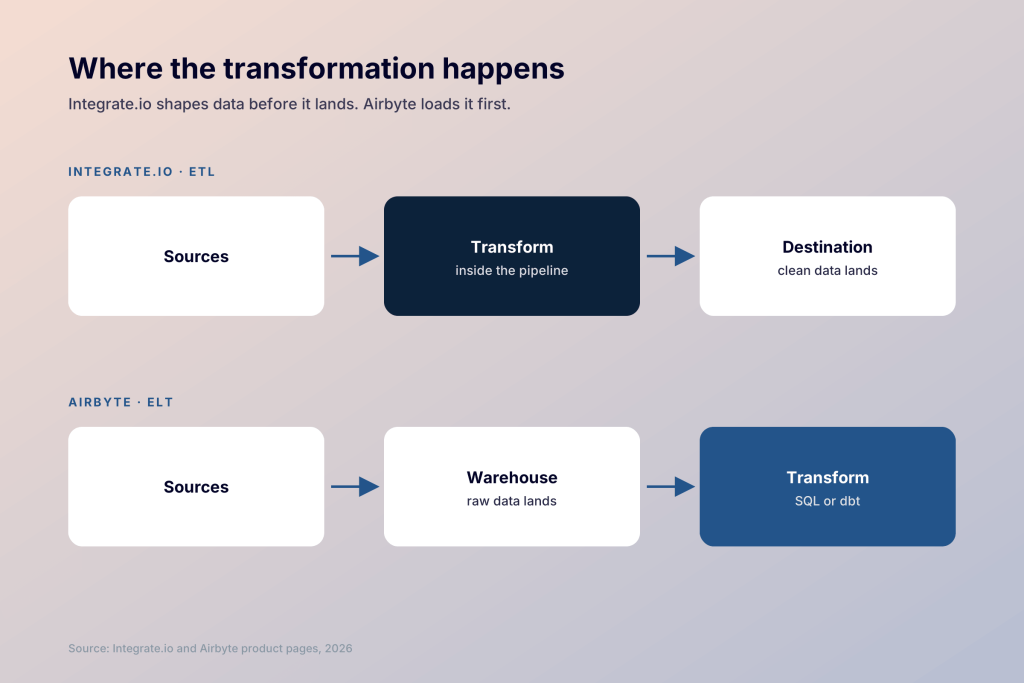
A quick test helps. Look at where your transformation logic lives today. If it’s already in dbt models your engineers maintain, Airbyte slots right in. If it lives in spreadsheets and ad hoc scripts, Integrate.io’s visual builder gives it a proper home.
Which teams fit the Integrate.io vs Airbyte audience
Integrate.io is for companies whose pipelines carry real business logic but who don’t want a big engineering team to maintain them. It has a dedicated healthcare offering, where a signed BAA is non-negotiable. Ops teams that need Salesforce in two-way sync with other systems are another natural fit.
Airbyte is built with data engineers in mind. The company says 18% of the Fortune 500 use it, and the open-source project has 1,000+ contributors. Teams choose it when they want to own the code or keep data on their own servers. Its vector database destinations also appeal to AI engineers building RAG apps.
The two audiences meet in mid-sized data teams with some engineering capacity. For them, the question is simple. Do you want a visual platform that handles transformations for you, or an open one your engineers shape around dbt?
How far Integrate.io vs Airbyte data sources reach
Airbyte wins on catalog size, by a wide margin. It lists 700+ connectors, and the Connector Builder lets you add missing APIs yourself. An AI assistant inside the builder, still in beta, reads API docs and pre-fills much of the setup. It works on paid plans but not on self-hosted Core.
Check a connector’s support level before you rely on it, though. Airbyte-maintained connectors are tested and production-ready. Marketplace connectors come from the community, carry no support SLA, and can change without notice.
Integrate.io’s catalog is smaller. Its ETL page lists 200+ connectors across SaaS apps, databases, files, and APIs, and a universal API connector handles custom systems. Integrate.io also says it builds new connectors on demand within 24 to 48 hours.
Sending data out with Integrate.io vs Airbyte destinations
Integrate.io leans operational. Pipelines can deliver to warehouses, databases, file stores, APIs, and custom endpoints. Two-way Salesforce sync and reverse ETL are core use cases, and CDC keeps target systems fresh as source data changes.
Airbyte leans analytical. It loads into Snowflake, Databricks, BigQuery, and other warehouses, plus data lakes on AWS or Google Cloud and Apache Iceberg tables. It supports vector databases like Pinecone, Weaviate and Milvus for AI workloads. Data activation sends warehouse data back into business apps.
Neither tool builds dashboards. For those, you still need a separate BI tool.
Integrate.io vs Airbyte pricing in real numbers
These two pricing pages could hardly be more different. Integrate.io charges one fixed fee. Airbyte charges by usage or by capacity, depending on the plan, or nothing at all if you host it yourself.
Integrate.io publishes a single plan. Core costs $1,999/month, close to $24,000 a year. It includes unlimited data volumes, pipelines, and connectors, with 60-second pipeline frequency and 30-day onboarding. Add-ons like team role-based access control and HIPAA readiness are priced through sales. The 14-day trial needs no credit card.
Airbyte has more ways in. Core is free to self-host with unlimited volume, but you pay for the servers and the people who run them. Standard costs $20/month with 5 credits included, about 1 GB of syncs, and extra credits cost $5 each. Plus sells credit packages from $189/month for 40 credits up to $4,999/month for 2,000, and unused credits roll over for three months. Pro and Enterprise Flex use custom pricing based on Data Workers, a unit of compute capacity. The 14-day trial includes 400 credits, which Airbyte puts at about 100 GB of syncs.
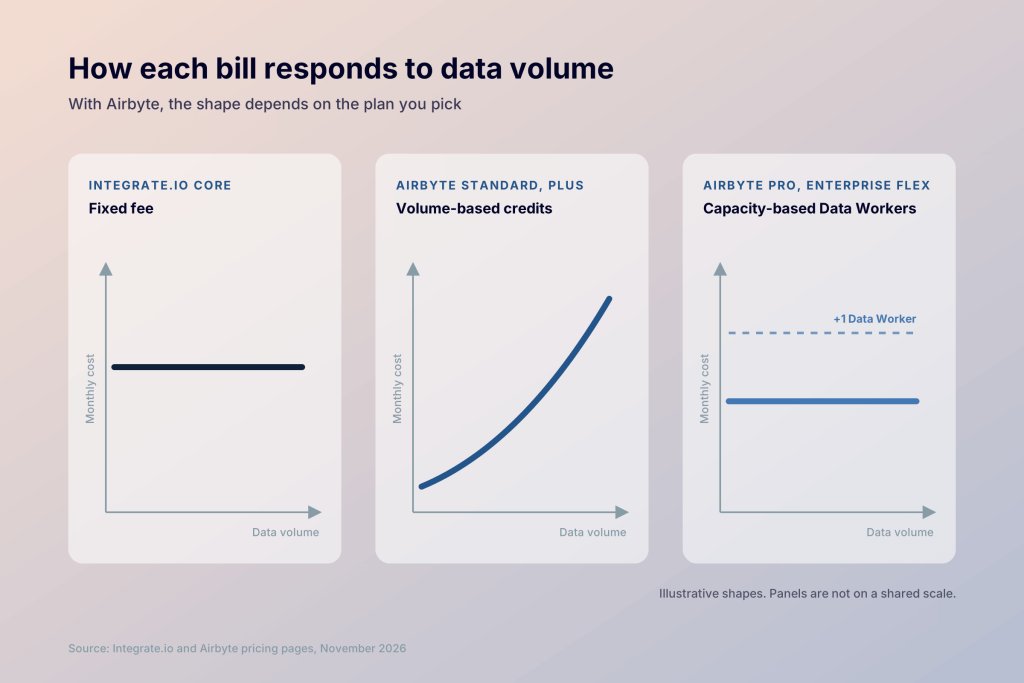
Here’s how the math usually plays out. Fixed fees reward heavy use. At high volume, Integrate.io’s bill stays flat, while costs on Airbyte’s volume-based Standard and Plus plans grow with your data. Pro and Enterprise Flex avoid that by pricing on Data Workers, and Airbyte says volume spikes don’t raise the bill. At low volume, $1,999 is a steep floor, and Airbyte will likely cost far less. On Standard and Plus, credits also make Airbyte pricing harder to forecast when volumes jump from month to month.
Some teams don’t fit either model. Picture a marketing or finance team that needs a dozen apps refreshed into reports. $1,999 a month feels like a lot for that, and watching a credit balance gets old fast. Coupler.io, a reporting automation platform, prices this kind of work another way. Its pricing is account-based. The number of connected accounts sets the tier, while destinations and refresh frequency shape the plan. Paid plans start at $24/month billed annually, and data volume is unlimited from the Active plan up.
If that sounds closer to how your team works, the Coupler.io team can price it against your actual sources.

See what your data stack would cost on Coupler.io
Get a demoThe Integrate.io vs Airbyte key features that shape daily work
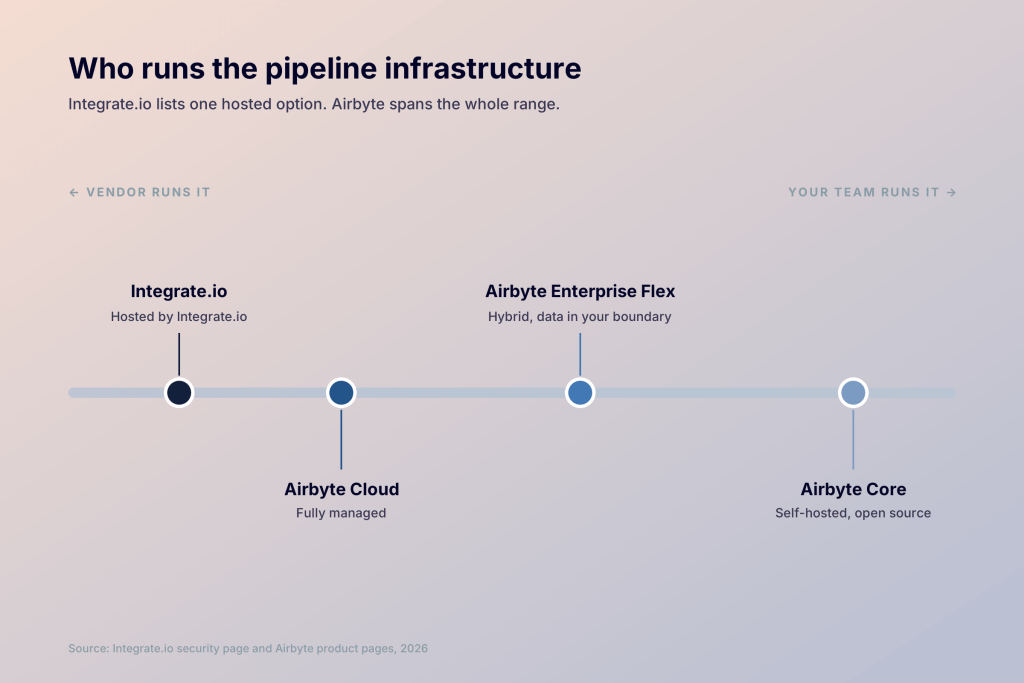
Integrate.io puts its power inside the pipeline. You clean, join, filter, and enrich data with 220+ drag-and-drop steps, then switch to SQL or Python for edge cases. Field-level encryption, hashing, masking, and removal run directly in transformation workflows. ETL, ELT, CDC and reverse ETL all live in one platform. For private databases, it supports SSH tunnels, reverse SSH tunnels, and AWS PrivateLink.
Airbyte puts its power in the platform itself. You can self-host it or use Airbyte’s cloud, and Enterprise Flex adds hybrid and in-boundary options. Changes in flight are light. Plus lets you rename fields, and Pro and Enterprise Flex add hashing, encryption, and row filtering. Anything heavier goes through the dbt Cloud integration. CDC handles high-volume database replication, and the Connector Builder covers custom sources.
Where Integrate.io vs Airbyte AI stands in 2026
Integrate.io aims its AI at building pipelines. With its Helm copilot, you describe what you need, and Helm drafts the pipeline. You review and approve each step before it runs. Helm also helps investigate failed runs. A separate MCP server lets clients like Claude Desktop or Cursor inspect, build, edit, validate, and run Integrate.io pipelines in natural language.
Airbyte’s AI works on several fronts. For setup, the Connector Builder assistant pre-fills connectors from API docs. AI-configured connections, launched in December 2025, walk you through connector setup in a chat.
In October 2026, Airbyte released an open-source MCP server that’s free on every plan, Core included. From Claude, ChatGPT, or Cursor, you can manage connections, diagnose failed syncs, and manage custom connectors. Paid plans also get a context layer. It lets those AI clients read your Snowflake or BigQuery warehouse and query 50+ supported sources directly, even ones you never loaded. It’s off by default, and an org admin has to turn it on. This MCP server is separate from the Agents platform, which launched in May 2026 and which Airbyte still calls early.
Both vendors mostly use AI to build and run pipelines. Airbyte’s context layer moves closer to analysis, though it’s off by default and limited to paid plans.
Coupler.io starts from the analysis side. With Coupler AI, you can connect sources, transform data, run analyses, and create reports through conversation. Its AI Agent answers plain-English questions about your business data. AI Integrations bring the same data into Claude, ChatGPT, Gemini, and other AI tools. Behind each answer, an Analytical Engine runs the calculations, and the AI model explains the results.
Let Coupler AI do the data work for you
Tell Coupler AI what you need to know, from which source, and how often. It connects your account, sets up the data flow, keeps it refreshed, and lets you analyze the results inside Coupler.io or another AI tool.
Try for free
The 7-day trial includes full access, which is enough time to test it on your own sources.
Integrate.io vs Airbyte security & stability for sensitive data
Integrate.io’s security pitch rests on not keeping your data. It says it doesn’t store customer data, and it deletes temporary copies within 24 hours. It goes through an annual SOC 2 audit and a third-party penetration test, though its security page doesn’t name the report type. It signs a BAA for HIPAA data and can process GDPR data in its EU data center in Ireland. Data is encrypted in transit and at rest, and 2FA and SSO are supported.
Airbyte holds SOC 2 Type II and ISO 27001 certifications, is GDPR compliant, and has HIPAA conduit exception status. Self-hosting changes the picture. Once Airbyte runs on your servers, securing it is your team’s job, which suits companies with strict data residency rules. Enterprise Flex sits in between, with a hybrid deployment that keeps data inside your own boundary.
For Airbyte, stability depends mostly on the connector. Airbyte-maintained connectors are tested and production-ready, while Marketplace ones may break without warning.
Whichever tool you pick, ask for the full audit report before you sign. Coupler.io, for example, publishes its SOC 2 Type II and compliance details openly.
Integrate.io vs Airbyte: ease of use, support after go-live
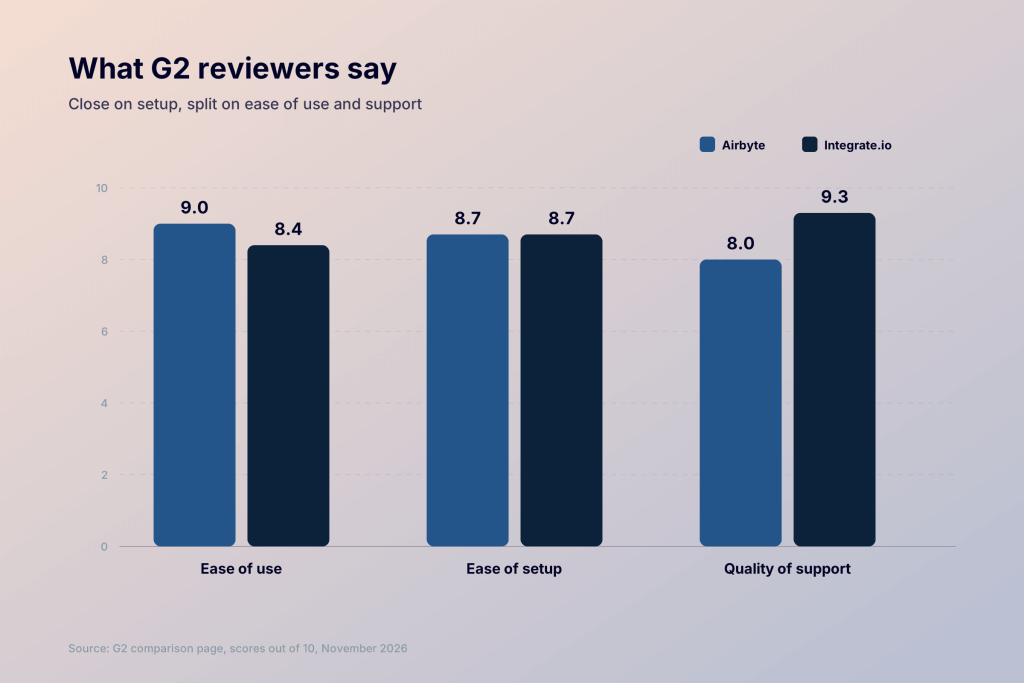
G2 reviewers split these two clearly. Airbyte scores 9.0 for ease of use against Integrate.io’s 8.4. Integrate.io scores 9.3 for quality of support against Airbyte’s 8.0. Both get 8.7 for ease of setup.
The support gap makes sense once you look at the plans. On Airbyte, self-hosted Core users get help from the Slack and GitHub communities. Standard includes support from 7 am to 7 pm EST. Plus adds a 24-hour support SLA, and Pro adds 12-hour critical response with a dedicated Solutions Architect.
Integrate.io includes 24/7 support on every plan and says its average first response time is two minutes. New customers also get 30 days of onboarding.
A third option when reports are the real goal
Maybe you’ve read this far and realized the pipeline was never the point. Plenty of teams compare ETL tools when what they want is a dashboard that updates itself. Others want an AI assistant that can answer questions about last month’s numbers.
That’s where Coupler.io fits. It’s a data integration and AI analytics platform that brings data from 400+ sources into spreadsheets, BI tools, warehouses, and AI tools. It doesn’t try to match Integrate.io’s transformation depth or Airbyte’s self-hosting.
For a team that mainly reports on its data, here’s how the three line up.
| Coupler.io | Integrate.io | Airbyte | |
|---|---|---|---|
| Pricing model | Account-based | Fixed fee | Credits or capacity |
| Entry price | Free plan; from $24/month (annual) | $1,999/month | Free self-hosted; cloud from $20/month |
| Data sources | 400+, all on every plan | 200+ connectors | 700+ connectors |
| Dashboard templates | 230+ | None | None |
| Transformations | Formulas, filters, aggregations, joins, append | 220+ steps, SQL, Python | Mappings by plan, dbt |
| AI | AI Agent, AI Integrations, Skills | Helm copilot, MCP server | Connector Builder assistant, MCP server, Agents platform |
| Self-hosting | No | No option listed | Yes |
Coupler.io doesn’t win every row. Integrate.io keeps the lead on transformation depth and regulated-data workflows. Airbyte keeps it on connector count and self-hosting.
Coupler.io pulls ahead after the data lands. You can send it to Google Sheets, Excel, Data Studio, Power BI or BigQuery, or straight into Claude and ChatGPT. More than 230 dashboard templates turn it into reports without a separate BI project. Coupler.io is SOC 2 Type II certified and compliant with GDPR, HIPAA and DORA.
Teams weighing Coupler.io vs Airbyte usually find the choice depends on who works with the data. When it’s engineers, Airbyte makes sense. When it’s marketers or finance leads, Coupler.io is built for them.
The Coupler.io team can walk through your sources and reports and show you what the setup would look like.
Turn your data sources into ready-made reports
Try for freeSo which one should you pick?
Pick Integrate.io if…
Your pipelines carry heavy logic, or sensitive data has to be masked before it lands. You want a visual builder with SQL and Python as a backup, plus 24/7 support and a bill that ignores volume. Roughly $24,000 a year fits the budget.
Pick Airbyte if…
You have data engineers and a warehouse with dbt already in place. You need long-tail connectors or the freedom to build your own. Self-hosting matters for cost or data residency, or you’re comfortable with usage-based or capacity-based cloud pricing.
Consider Coupler.io if…
Your end goal is a dashboard or AI-ready data, not a pipeline. You want 400+ sources and 230+ dashboard templates on a self-serve plan with account-based pricing.
Walk away from all three if…
You want a fully managed ELT service with 500+ connectors and dbt support, priced by monthly active rows. Fivetran fits that better. Or you need a budget tool with a free plan and a separate backup product, which is Skyvia’s territory. For a broader shortlist, this list of Airbyte alternatives covers more options.