Whatagraph vs AgencyAnalytics for Agencies Picking a Client Reporting Tool

Agencies tired of building client reports by hand often end up comparing Whatagraph vs AgencyAnalytics. Both pull marketing data into branded reports and dashboards. Both now offer AI assistants and MCP access.
The overlap hides two different products. AgencyAnalytics is an all-in-one agency workspace, with a client portal and SEO tools built around the reports. Whatagraph is putting its weight on AI agents that build and fix reporting for you. They also bill on different units: AgencyAnalytics charges per client, while Whatagraph charges per connected data account.
The same client can count as one unit in AgencyAnalytics and four in Whatagraph. That gap decides more than you’d expect, so let’s see where each tool comes out ahead.
Key takeaways
- AgencyAnalytics is built as an agency workspace. Whatagraph is built around AI agents that run reporting work in the background.
- AgencyAnalytics costs $20 per client per month on annual billing, with unlimited data sources per client. Whatagraph Max starts at €699 per month with 50 credits included, where each credit is one connected data account.
- AgencyAnalytics lists 90+ marketing integrations. Whatagraph lists 60+ native integrations and supports custom API sources.
- Both offer a 14-day trial. AgencyAnalytics needs no credit card, while Whatagraph’s trial runs on Max and ends with a call to choose a plan.
- AgencyAnalytics leads every G2 comparison score, including ease of use and quality of support.
Both tools in one table
Here is a quick overview before the details. Plan-specific features are labeled with the plan that includes them.
| Whatagraph | AgencyAnalytics | |
|---|---|---|
| Built around | AI agents and cross-channel reporting | Agency workspace with client portal |
| Best for | Agencies and brands scaling reporting without adding staff | Marketing agencies that want reporting and client management in one place |
| Pricing unit | Per connected data account (1 credit = 1 account) | Per client |
| Entry price | Max from €699/month, billed annually, from 50 credits | $20 per client per month (billed annually) or $25 billed monthly |
| Trial | 14-day Max trial, then a call to choose a plan | 14 days, no credit card |
| Integrations | 60+ native, plus Google Sheets, BigQuery and custom API | 90+ marketing integrations; database integrations as an add-on |
| Outputs | Reports, dashboards; Prime transfers to Data Studio and BigQuery (BigQuery marked as an add-on in the pricing table) | Reports, dashboards, white-labeled client portal, shareable AgencyAI pages |
| AI | Whatagraph IQ, IQ Chat, IQ Agents, MCP | AgencyAI, AI summaries, AI Tracker (add-on), MCP |
| MCP | Read on every plan; write and delete on plans that include them | Included; read and write since October 2026 |
| Security | GDPR compliant, data processed in the EU, AES-256 encryption | Trust center says it is “working towards compliance certifications” |
| Support | Live chat and a dedicated Customer Success Manager; Enterprise SLA on Prime | Email and chat, free onboarding call |
| G2 rating | 4.5/5 (283 reviews) | 4.7/5 (462 reviews) |
Agency workspace or AI reporting crew
Most differences in this comparison trace back to one question. Do you want a place where your team works, or a crew that does part of the work for you?
AgencyAnalytics is the workspace. Reports and dashboards sit next to a client portal, task management, rank tracking, and backlink monitoring. Clients log in to their own branded portal. Staff get access to the clients they handle. It covers jobs that agencies often spread across several tools.
Whatagraph is the crew. Its IQ Agents, launched in September 2026, are described as “AI teammates that build, watch, and fix your reporting.” They can build monthly client reports on a schedule, flag ads running past their end date, post summaries to Slack, and create tasks in ClickUp or Asana. They run on Whatagraph’s servers, and scheduled work keeps going while your laptop is closed.
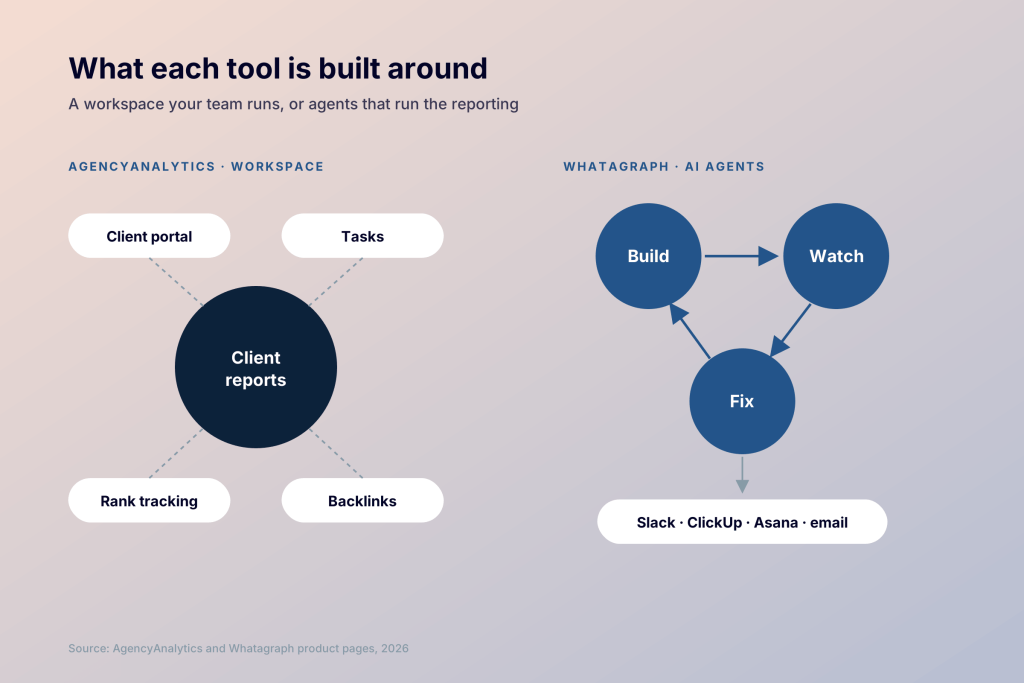
A simple test helps here. If your pain is juggling tools and client logins, AgencyAnalytics speaks to it directly. If your pain is the hours analysts spend assembling and checking reports, Whatagraph’s agents target that work.
Where the Whatagraph vs AgencyAnalytics audience splits
AgencyAnalytics describes itself as client reporting and performance insights for marketing agencies. Pricing per client makes it easy to start with a few clients and grow. Agencies managing 25+ clients can ask for volume pricing, with discounted per-client rates and priority support.
Whatagraph speaks to agencies and in-house brand teams. Its Max plan is pitched at “teams scaling reporting without scaling the team.” Prime targets “teams with complex, high-volume reporting needs.” The €699 starting point and sales-assisted plan choice suggest mid-sized and larger teams.
The two audiences meet in mid-sized agencies. There, the number of data accounts per client can decide it, as the pricing section shows.
Counting the Whatagraph vs AgencyAnalytics data sources
AgencyAnalytics lists 90+ marketing integrations, and its integrations page counts 96 across all categories. Every client gets unlimited data sources. Database connections, such as Amazon Redshift, come as an optional add-on. New integrations keep arriving, with Shopify store analytics and Quantcast added in October 2026.
Whatagraph’s features page lists 60+ integrations, and its integrations page shows 68. It fills gaps with Google Sheets and BigQuery as sources. Custom API connections cover the rest. Inside the platform, you can standardize naming across channels, create calculated metrics and blend sources into one cross-channel view. The two counts differ across Whatagraph’s own pages. Check your exact platforms before you shortlist.
Both catalogs include the major ad and analytics platforms, such as Google Ads, Facebook Ads, and Google Analytics. AgencyAnalytics has the longer native list.
Whatagraph vs AgencyAnalytics destinations beyond the client report
AgencyAnalytics centers delivery on its own platform. Clients see reports and dashboards in a white-labeled portal, and reports can be scheduled for delivery. Since September 2026, AgencyAI answers can also become branded HTML pages with public links. Through MCP, the same client data is available in ChatGPT and Claude.
Whatagraph sends data further on its higher plan. Prime’s plan card lists transfer to BigQuery and Data Studio, though the comparison table on the same page marks BigQuery as an add-on. Max has neither. On both plans, IQ Agents can email reports after manual approval or post summaries to Slack.
If your team or clients already work in Data Studio or a warehouse, that Prime transfer matters. If everything lives in one client portal, AgencyAnalytics covers it.
What a client roster costs in Whatagraph vs AgencyAnalytics pricing
The two tools count your agency in different ways. AgencyAnalytics counts clients. Whatagraph counts connected data accounts, and one client can use several.
AgencyAnalytics pricing starts at $20 per client per month on annual billing, or $25 on monthly billing. Each client gets unlimited data sources, reports, dashboards, and staff accounts. AI Tracker costs extra at $20.83 per month for 250 credits, and Rank Tracker at $41.67 per month for 500 keywords, both billed annually.
Whatagraph Max starts at €699 per month, billed annually, with 50 credits included. One credit equals one connected data account, such as one Facebook Ads account. Users and reports are unlimited. You can buy extra credits until you reach the next plan threshold, but Whatagraph doesn’t publish the price per extra credit. Prime pricing is custom.
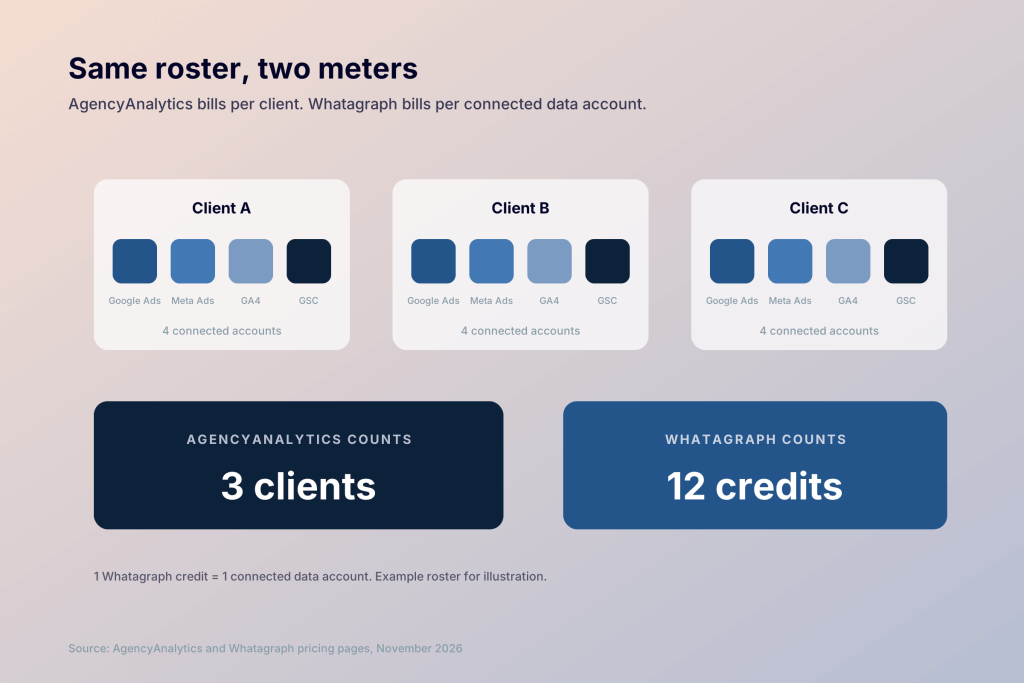
Here’s how that plays out. A client with Google Ads, Meta Ads, GA4, and Search Console counts as one client in AgencyAnalytics and four credits in Whatagraph. A 10-client agency pays $200 a month for AgencyAnalytics on annual billing. Whatagraph’s floor is €699 a month with 50 credits. Small rosters favor AgencyAnalytics on list price. Past that point, compare quotes, because Whatagraph’s extra credits and Prime aren’t priced publicly.
Some agencies need neither a portal nor agents. They want client data in Data Studio, Google Sheets, or Claude, with ready-made templates. Coupler.io, a reporting automation platform for business teams, covers that route with account-based pricing. Its Pro plan includes 50 connected accounts with hourly refresh for $199 per month, billed annually. It also adds team and client workspaces.
If your roster spans dozens of ad accounts, the Coupler.io team can map them to a plan with you.

Plan reporting for dozens of client ad accounts
Book a demo with Coupler.ioWhatagraph vs AgencyAnalytics key features agencies use every week
AgencyAnalytics covers the day-to-day agency routine. Goals, alerts, and anomaly detection flag issues per client. Benchmarks and forecasting add context to monthly numbers. Task management lets you filter work by client, team member, or due date. Views, added in July 2026, turn a plain-language request into one table that combines several platforms.
Whatagraph focuses on report building and data shaping. You create reports with AI or drag-and-drop widgets, with 20+ widget types to choose from. Source blends combine platforms into cross-channel dashboards. The 3.0 release in February 2026 added Insights, which audits your data sources and flags anomalies with recommendations.
Both tools white-label their outputs. AgencyAnalytics adds custom domains and a branded login URL. Whatagraph includes white-labeling on both plans, with a custom report domain on Prime.
Agents and MCP in Whatagraph vs AgencyAnalytics AI
Whatagraph’s AI does more of the work itself. IQ Chat answers plain-language questions and can be client-facing. IQ Agents build reports and monitor accounts, then push results to Slack, ClickUp, Asana, or monday.com. Whatagraph lists some limits: editors and client-facing access aren’t available for agents yet, and agents can’t set up new data transfers. Agent usage comes in tiers, with Base included on every plan and Mid and Heavy as add-ons. The higher tiers add AI visibility tracking and computer and browser use.
AgencyAnalytics’ AI sits closer to the analyst. AgencyAI is a sidebar assistant that answers questions about any client, and AI summaries now refresh automatically. AI Tracker, a paid add-on, monitors how clients appear in AI engines such as ChatGPT and Gemini. That gives agencies a way to report on AI search next to other channels.
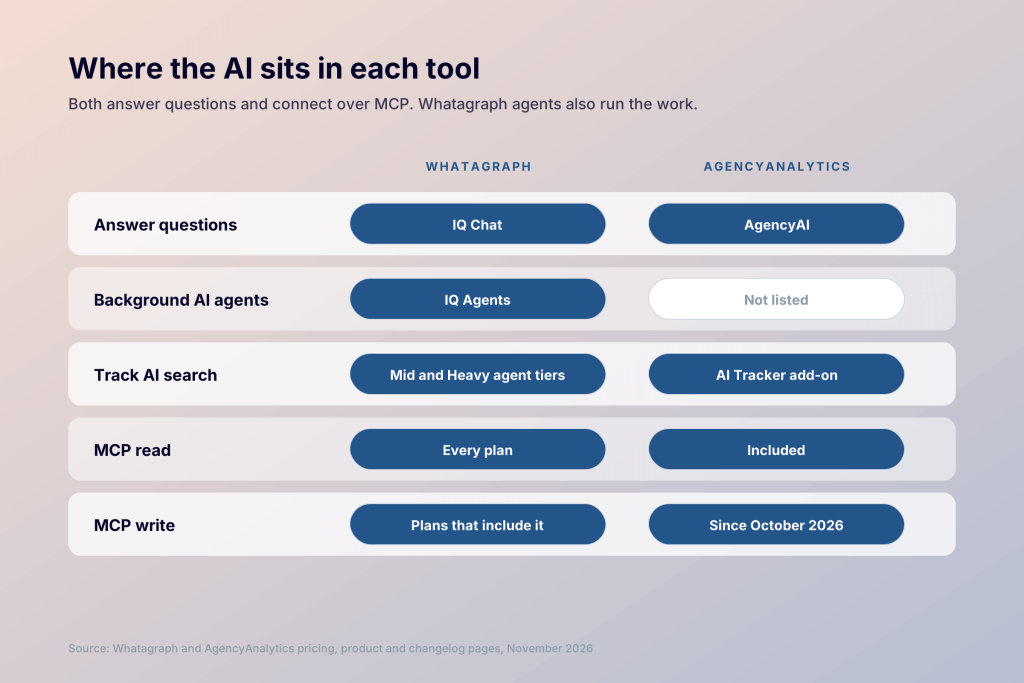
Both tools now connect to external AI through MCP. AgencyAnalytics includes MCP access for ChatGPT and Claude, and since October 2026 it can write as well as read. It can create clients, users, metrics, and custom views, and it shows costs before running. Whatagraph’s MCP works with Claude, Cursor, and other MCP clients. Reading data works on every plan. Whatagraph says write and delete tools come with plans that include that access, without naming those plans.
Both answer questions inside a marketing reporting tool. Agencies that also want CRM or finance data in the same AI conversation need a broader source list. Coupler.io connects 400+ sources to Claude, ChatGPT, and other AI tools. Its Analytical Engine runs the calculations, and the AI model explains the results.
You can test that on your own client data during a 7-day trial with full access.
Let Coupler AI do the data work for you
Tell Coupler AI what you need to know, from which source, and how often. It connects your account, sets up the data flow, keeps it refreshed, and lets you analyze the results inside Coupler.io or another AI tool.
Try for free
Whatagraph vs AgencyAnalytics security & stability on paper
Whatagraph publishes more detail. Its security policy says it is GDPR compliant and that “your data is processed in the European Union.” Stored data uses AES-256 encryption, and traffic uses TLS 1.2 or higher. The footer shows ISO 27001 and SSO/SAML badges, but the policy itself doesn’t describe either. On the plan level, SAML SSO is a Prime add-on, and Prime includes an Enterprise SLA.
AgencyAnalytics says less. Its trust center states that it follows industry best practices and is “working towards compliance certifications.” It mentions access control and single sign-on as enterprise features but names no certification.
If your clients send security questionnaires, ask both vendors for documentation before you sign. Coupler.io, for example, publishes its SOC 2 Type II and compliance details openly.
Whatagraph vs AgencyAnalytics: ease of use, support from trial to rollout
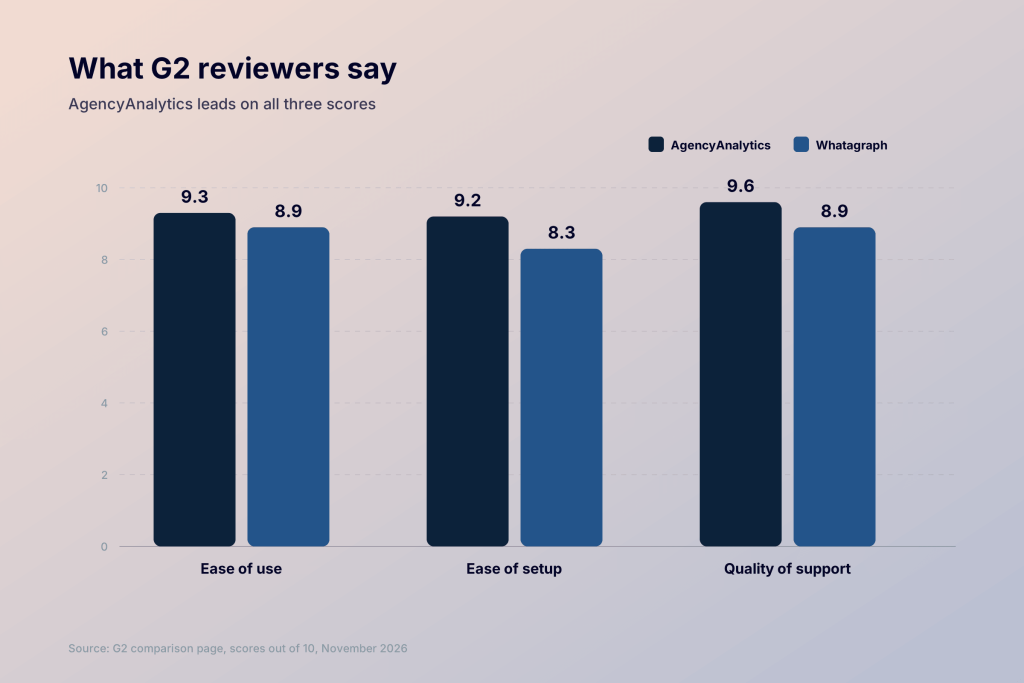
On G2, AgencyAnalytics leads every comparison score. It gets 9.3 for ease of use against Whatagraph’s 8.9, and 9.2 for ease of setup against 8.3. Quality of support is 9.6 against 8.9. Overall ratings are 4.7/5 from 462 reviews for AgencyAnalytics and 4.5/5 from 283 for Whatagraph.
Getting started also differs. AgencyAnalytics offers a 14-day trial with no credit card, plus a free onboarding call. Support runs by email and chat. Whatagraph’s help center says all new accounts start with a 14-day Max trial. At the end, you book a call to choose a plan, and everything built during the trial stays in the account. Both plans include live chat and a dedicated Customer Success Manager. Prime adds tailored onboarding, priority support, and an Enterprise SLA.
Both let you test before you buy. AgencyAnalytics keeps the path self-serve with published prices, while Whatagraph brings in its team to agree on a plan. For a larger team that wants a named contact from day one, Whatagraph’s model fits.
A lighter route for agencies that report in Data Studio or Claude
Not every agency needs a client portal or a team of AI agents. Some already build reports in Data Studio, Google Sheets, or Power BI. Others want account managers asking Claude about client performance. For them, the missing piece is getting clean client data into those tools on a schedule.
Coupler.io handles that part. It’s a data integration and AI analytics platform with 400+ sources, including CRM and finance apps beyond marketing. Data lands in spreadsheets, BI tools, warehouses, or AI tools.
Here is how it compares with both tools on the points agencies ask about most.
| Coupler.io | Whatagraph | AgencyAnalytics | |
|---|---|---|---|
| Pricing unit | Connected accounts | Connected data accounts (credits) | Clients |
| Entry price | Free plan; paid from $24/month (annual) | Max from €699/month (annual) | $20 per client per month (annual) |
| Sources | 400+, all on every plan | 60+ native, plus Sheets, BigQuery, custom API | 90+ marketing integrations |
| Outputs | Google Sheets, Excel, Data Studio, Power BI, BigQuery, AI tools | Reports and dashboards; Data Studio on Prime; BigQuery on Prime or as an add-on (pricing page differs) | Reports, dashboards, white-labeled client portal |
| AI | AI Agent, AI Integrations, Skills | IQ Chat, IQ Agents, MCP | AgencyAI, AI Tracker, MCP |
| Trial | 7 days, full access | 14 days on Max | 14 days |
Coupler.io doesn’t replace everything here. AgencyAnalytics keeps its lead on the client portal and agency toolkit. Whatagraph keeps it on agents that run reporting work for you.
Where Coupler.io pulls ahead is reach. It covers sources outside marketing and sends data to the tools your team already uses, with more than 230 dashboard templates to start from. That makes it a practical Whatagraph alternative for agencies that report in their own BI stack.
You can start on the free plan and connect your first client accounts right away.
Report on 400+ sources for every client
Start free with Coupler.ioPicking between them
Pick AgencyAnalytics if…
You want reporting, a client portal, tasks, and SEO tools in one place. You prefer published per-client pricing and a trial with no sales call. Security certifications aren’t a hard requirement from your clients yet.
Pick Whatagraph if…
Your analysts spend hours assembling and checking reports, and you want agents to take that over. You need GDPR coverage with EU data processing, or Data Studio transfer on Prime. A starting budget of €699 a month fits your agency.
Consider Coupler.io if…
Your team already reports in Data Studio, Google Sheets, Power BI, or Claude. You want 400+ sources, including non-marketing apps, on account-based pricing.
Walk away from all three if…
You need a full enterprise marketing data platform with heavy transformation and governance. Adverity or Improvado fit that better. For a wider shortlist, see these AgencyAnalytics alternatives and Whatagraph alternatives.