Every social commerce roundup says the market is booming, then quotes a size anywhere from $586 billion to over $2 trillion.
This article rounds up the social commerce statistics for 2026: market size by region, growth, buyer behavior, the main platforms, sellers and AI. You can find all the sources at the end.
Let’s start with the main social commerce stats for 2026:
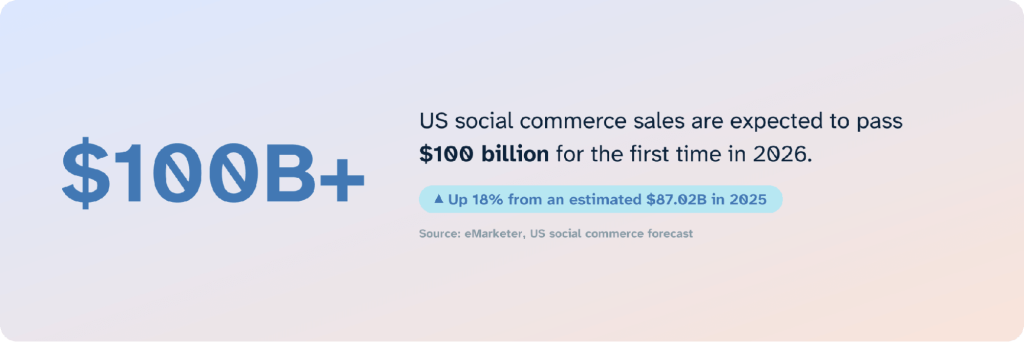
- US social commerce sales are expected to pass $100 billion for the first time in 2026, up 18%, according to eMarketer.
- Social commerce is expected to make up 15.2% of online sales worldwide in 2026, nearly $586 billion, per Statista.
- Douyin and TikTok together are the world’s third-largest online retailer by GMV, behind Amazon and Pinduoduo, with $656 billion in 2025, according to ECDB.
- TikTok Shop is on track to pass $100 billion in global GMV in 2026, after $50.3 billion in the first half, per Momentum Works.
- TikTok Shop’s US sales are forecast to reach $23.41 billion in 2026, up 48%, which would make it a bigger US ecommerce business than Target or Costco, according to eMarketer.
- 52% of shoppers discover products on social media. For Gen Z, it’s the top discovery channel at 73%, per Salsify’s 2026 report (surveyed in October 2025).
- Only 22% of shoppers buy mainly through social media shops
- 63% of retailers sell on social platforms, but only 45% of shoppers buy through them, according to DHL.
- 67% of businesses post paid content on social media to drive sales, while only 37% of shoppers say paid posts influence what they buy, according to DHL.
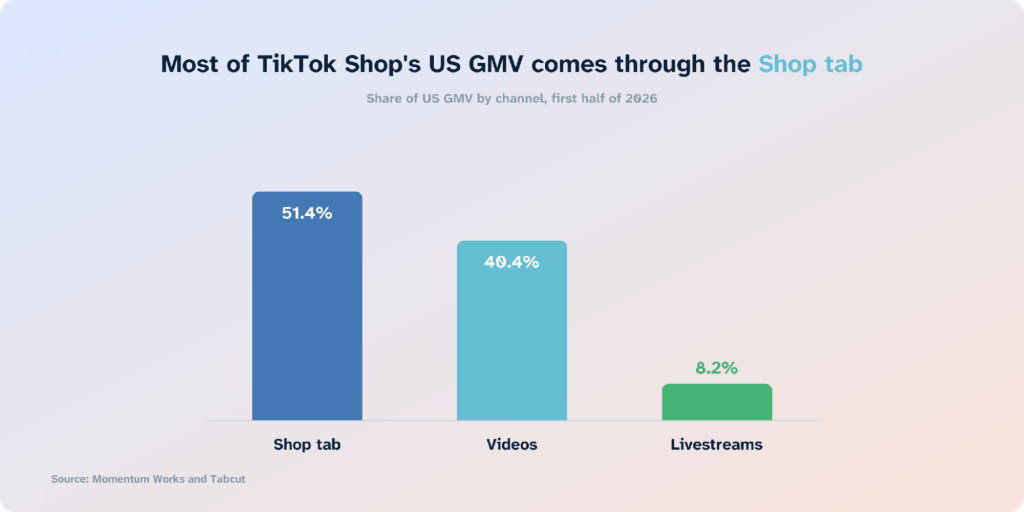
- In the first half of 2026, 51.4% of TikTok Shop’s US GMV came through the Shop tab, 40.4% from videos and 8.2% from livestreams, according to Momentum Works.
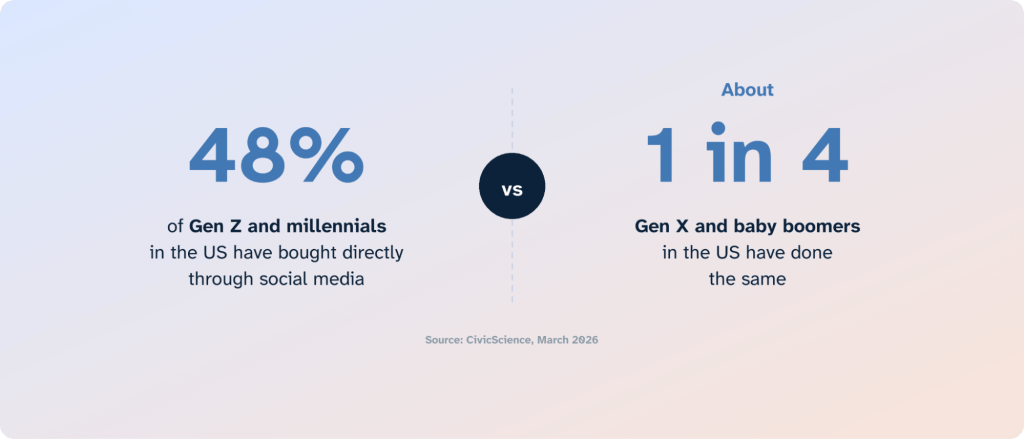
- 48% of Gen Z and millennials in the US have bought directly through social media, against about 1 in 4 Gen X and baby boomers, per CivicScience.
- 38% of online shoppers have used AI chat or virtual assistants to browse or buy, per DHL.
- Sellers list 430 million items on Facebook Marketplace every month, according to Meta.
PRO TIP
If you sell on social media, the numbers that matter most are your own. Coupler.io pulls your ad, social, and store data into one dashboard, so you see which platforms bring buyers, not just clicks.
Social commerce market size statistics
Research firms count social commerce in different ways, so their market sizes for the same year differ a lot.
- US social commerce sales reached an estimated $87.02 billion in 2025, up 21.5%, and are forecasted to pass $100 billion in 2026, according to eMarketer.
- Social commerce made up 6.9% of US retail ecommerce in 2025, and its share keeps growing: eMarketer expects it to reach 9.3% by 2029.
- Worldwide social commerce revenue is projected to reach nearly $586 billion in 2026 (with an upward trend expected to reach $929 billion by 2030), 15.2% of all online sales, per Statista.
- Mordor Intelligence, which counts purchases made through shopping journeys led by social media, expects the market to reach $2.11 trillion in 2026.
- Douyin/TikTok had $656 billion in GMV in 2025, up 21%, and Kuaishou $220 billion, up 15%, according to ECDB.
Social shopping regional breakdown
Asia is the largest region for social commerce, and North America is forecast to grow the fastest.
- China’s social commerce revenue is expected to reach about $366 billion in 2026, per Statista.
- Asia Pacific is expected to hold 34.15% of the global social commerce market in 2026, the largest share of any region, per Mordor Intelligence.
- North America is expected to grow fastest, at 30.5% a year from 2027 to 2032, per Mordor Intelligence. In the US, social commerce sales grew an estimated 21.5% in 2025 and are forecast to grow 18% in 2026, according to eMarketer.
- TikTok Shop’s GMV in Southeast Asia reached $45.6 billion in 2025, about double the year before, according to Momentum Works.
- TikTok Shop’s GMV in Europe was €4.07 billion in 2025, and the UK made up 65% of it, per ECDB. ECDB expects European GMV to nearly double in 2026.
- In Brazil, 69% of social shoppers have bought through TikTok and 67% through Instagram, according to DHL. TikTok reaches 77% of social shoppers in Saudi Arabia, and Facebook 86% in Nigeria and Morocco.
- TikTok Shop’s US GMV was $15.1 billion in 2025 and reached $11.8 billion in the first half of 2026, up 103%, according to Momentum Works.
- By country, ECDB puts TikTok Shop’s 2025 GMV at $13.1 billion in Indonesia, $11.0 billion in Thailand and $7.9 billion in Vietnam.
Social commerce growth statistics
Social commerce grows by double digits on every forecast, and TikTok Shop grows several times faster.
| What grows | 2025 | 2026 |
|---|---|---|
| US social commerce sales | +21.5% | +18% (forecast) |
| Social commerce revenue worldwide | – | About +16.5% (forecast) |
| TikTok Shop GMV worldwide | +94% | +92% (first half) |
| TikTok Shop sales in the US | +108% | +48% (forecast) |
| TikTok Shop GMV in the US | +68% | +103% (first half) |
- Mordor Intelligence expects social commerce worldwide to grow 28.45% a year from 2027 to 2032.
- eMarketer expects US social commerce to grow by double digits “through at least 2029”.
- TikTok Shop’s global GMV reached $64.3 billion in 2025, per Momentum Works.
- TikTok Shop’s share of US social commerce is expected to grow from 18.2% in 2025 to 24.1% by 2027, according to eMarketer. Facebook Marketplace and Instagram make up most of the rest.
Social commerce buyer behavior stats
People use social media to find products much more often than to buy them.
- 36% of American adults have bought something directly through social media, and another 13% plan to, according to CivicScience.
- 48% of Gen Z and millennials have bought through social platforms, against about 1 in 4 Gen X and baby boomers.
- Income makes little difference: people earning above and below $75,000 are nearly equally likely to buy on social media.
- 43% of parents have bought through social media, at least 10 points more than non-parents and grandparents.
- Among social shoppers worldwide, 58% of Gen Z have bought through TikTok and 56% through Instagram. 77% of baby boomers and 68% of Gen X have bought through Facebook, per DHL.
- In a fall 2025 Pew Research Center survey, 24% of US teens on TikTok said looking at product reviews or recommendations is a major reason they use it, and 34% said it’s a minor reason.
- 52% of shoppers discover products on social media, behind physical stores (60%) and online marketplaces (57%), according to Salsify’s 2026 report (surveyed in October 2025).
- Social media is the top discovery channel for Gen Z (73%) and millennials (67%).
- Gen Z and millennials do more product research on social media than on any other channel, per Salsify.
- Social media is Gen Z’s top place to discover products, used by 54% of them, per Sprout Social.
- More than 30% of adult internet users find new brands through social media ads, based on 2025 GWI data in DataReportal’s Digital 2026 report. For 16 to 34-year-olds, social ads are the top brand discovery channel.
- In March 2026, 10% of US online shoppers started their product searches on TikTok, up from 5% in 2022, per CivicScience.
- Discounts and offers influence 63% of shoppers, user-generated content 42%, and shoppable posts 40%, according to DHL.
- Only 22% of shoppers buy mainly through social media shops like TikTok Shop or Instagram Shopping, down 12 points since its 2025 report, per Salsify.
- 57% of social media users are open to buying directly inside social apps, according to Sprout Social.
Purchases driven by social media trends fell between Salsify’s 2025 and 2026 reports:
| Why shoppers bought | 2026 report (surveyed October 2025) | Change since the 2025 report |
|---|---|---|
| An influencer recommended it | 23% | −16 points |
| At a livestream shopping event | 23% | −12 points |
| It went viral on social media | 17% | −17 points |
Pro tip
If customers find you on social media and buy on your site, the platform’s own reports miss that sale. The Shopify marketing funnel dashboard from Coupler.io connects ad impressions and clicks with visitors and orders on your store, so you see which channel brings buyers.
Fashion and beauty lead social commerce.
- Apparel is the largest product type in social commerce worldwide, at 27.2% of the market, per Mordor Intelligence.
- Personal and beauty care is expected to grow fastest, at 32.5% a year from 2027 to 2032.
- eMarketer names beauty, cosmetics and apparel as the categories that “perform particularly well” on social platforms.
Social media ecommerce statistics
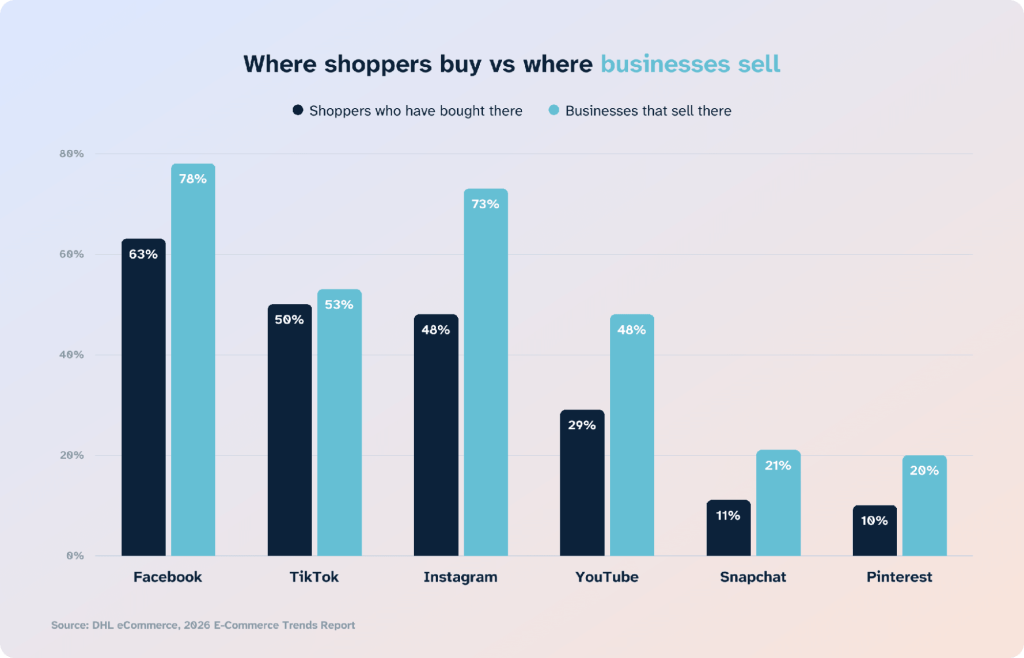
TikTok Shop runs the whole purchase inside the app, while Instagram often sends shoppers to the brand’s own site, according to ECDB. Here’s how many shoppers and sellers use each platform.
| Platform | Social shoppers who have bought there | Businesses that sell there |
|---|---|---|
| 63% | 78% | |
| TikTok | 50% | 53% |
| 48% | 73% | |
| YouTube | 29% | 48% |
| Snapchat | 11% | 21% |
| 10% | 20% |
TikTok Shop statistics
- TikTok Shop’s global GMV reached $50.3 billion in the first half of 2026, up 92%, and is on track to pass $100 billion for the year, according to Momentum Works.
- The US is its largest market, with $11.8 billion in GMV in the first half of 2026.
- More than 5,700 US stores passed $1 million in GMV, eight times as many as a year earlier, and 506 passed $10 million.
- In the first half of 2026, the Shop tab brought in 51.4% of TikTok Shop’s US GMV, videos 40.4% and livestreams 8.2%.
- Average prices fell in 21 of 27 categories.
- TikTok Shop’s US sales are forecast to reach $23.41 billion in 2026, up 48%, per eMarketer.
- 57.7 million people, more than half of US social buyers, are expected to shop on TikTok in 2026, per eMarketer.
- TikTok Shop usage reached 35% in a March 2026 CivicScience survey, up from 23% in 2025.
- TikTok reaches 67% of social shoppers in the US and 93% in Thailand, per DHL.
PRO TIP
The TikTok Ads dashboard from Coupler.io tracks spend, clicks, CTR, and conversions by campaign, and breaks conversions down by age, gender, device, etc. It refreshes on a schedule, so you don’t export reports by hand.
Instagram Shopping statistics
- 48% of social shoppers have bought on Instagram, while 73% of businesses that sell on social sell there, according to DHL.
- 85% of social shoppers in Türkiye, 83% in India and 67% in Brazil have bought on Instagram.
- 56% of Gen Z social shoppers worldwide have bought on Instagram.
- In the same fall 2025 Pew survey, 16% of US teens on Instagram said looking at product reviews or recommendations is a major reason they use it, and 33% said it’s a minor reason.
- Instagram often hands the checkout to the brand’s own site, so ECDB suggests judging it on the demand it creates rather than last-click sales.
Facebook Marketplace statistics
- Sellers list 430 million items on Facebook Marketplace every month, according to Meta.
- Meta launched a standalone Seller app for Marketplace in the US in July 2026, the year Marketplace turns ten.
- 63% of social shoppers have bought through Facebook, and 78% of businesses that sell on social sell there, per DHL. These figures cover all of Facebook, not only Marketplace.
- 77% of baby boomer and 68% of Gen X social shoppers have bought through Facebook.
- Facebook has the most social buyers in the US, according to eMarketer.
YouTube Shopping statistics
- More than 1.3 million creators are in the YouTube Shopping affiliate program, according to YouTube.
- The program’s GMV grew 13 times in two years, and it is set to reach 35 countries by the end of 2026.
- Shopping tags get more than twice the clicks of links in a video description.
- 29% of social shoppers have bought through YouTube, while 48% of businesses that sell on social use it, per DHL.
- In India, 71% of social shoppers have bought on YouTube, against 41% in the US.
Social commerce seller statistics
DHL surveyed 5,800 businesses alongside 29,000 shoppers, so its data shows both sides of social commerce.
- 63% of retailers sell on social platforms, but only 45% of shoppers buy through them, according to DHL.
- 76% of marketplace sellers say a social media profile is the best way to get new customers.
- 64% of businesses expect their customers to buy more on social media over the next five years. Only 24% of shoppers expect to.
Businesses also post a different mix of content than the one that influences shoppers:
| Content type | Businesses that produce it | Shoppers it influences |
|---|---|---|
| Discounts and offers | 68% | 63% |
| Sponsored or paid posts | 67% | 37% |
| Influencer partnerships | 57% | 34% |
| Shoppable posts | 50% | 40% |
| User-generated content | 47% | 42% |
| Live shopping events | 33% | 30% |
| How-to and product demos | 31% | 36% |
Pro tip
A survey says paid posts influence 37% of shoppers. Your own ad data shows which posts work for you. The multi-channel creatives performance dashboard from Coupler.io puts your creatives from Meta Ads, TikTok Ads, Google Ads, LinkedIn Ads and Microsoft Ads side by side, so you compare them on your own results.
AI assistants are a new place where people find products.
- 38% of online shoppers have used AI chat or virtual assistants to browse or buy, according to DHL.
- 19% of shoppers discover new products through AI search tools like ChatGPT and Gemini, per Salsify’s 2026 report (surveyed in October 2025). Among US shoppers, it’s 1 in 4.
- 22% use AI search tools to research products, more than use product review sites (19%) or online forums like Reddit (14%).
- 22% of shoppers bought something because an AI search tool or shopping assistant recommended it, up 5 points since Salsify’s 2025 report.
- Millennials (32%) and Gen Z (31%) make the most AI-recommended purchases, ahead of Gen X (20%) and baby boomers (3%). Men do it more than women, at 26% against 17%.
- 14% of shoppers trust AI shopping tools and use them regularly, 27% trust them for some purchases but check other sources, and 33% don’t use them at all, per Salsify.
- 23% of shoppers expect to buy more through AI chat over the next five years, while 59% of businesses expect their customers to, according to DHL.
PRO TIP
Coupler.io sends your store, ad, and social data to Claude or ChatGPT to ask which channel brings buyers, and it answers based on your numbers. Coupler.io’s Analytical Engine runs the calculations, and the AI model explains the result. Learn more about Coupler AI.
Social commerce trends 2027
Here are the trends the 2027 forecasts point to:
- TikTok Shop takes more of the market. eMarketer expects TikTok Shop to hold 24.1% of US social commerce by 2027, up from 18.2% in 2025. In Europe, ECDB expects its GMV to nearly double in 2026.
- Social commerce keeps growing. Mordor Intelligence expects the market to reach $2.72 trillion in 2027, and Statista expects social commerce to make up 19.1% of online sales worldwide by 2030. eMarketer expects more than half of US digital buyers to buy on social media by 2028.
- More sales come through the shop. In the first half of 2026, half of TikTok Shop’s US GMV came from the Shop tab rather than from videos, up from 36% in 2025.
- Fewer impulse purchases. Purchases driven by influencers, livestreams and viral posts fell 12 to 17 points between Salsify’s 2025 and 2026 reports. Live commerce is still large: Statista expects it to pass $200 billion in 2026.
- Creators sell more. Social media creator revenue is expected to reach $20.6 billion in 2026, up 16.2%, per eMarketer, and more than 1.3 million creators sell through YouTube’s affiliate program.
Sources
- eMarketer, US social commerce forecast (December 2025)
- eMarketer, TikTok Shop is becoming a major US ecommerce player (December 2025)
- eMarketer, FAQ on social commerce (January 2026)
- Statista, social commerce share of online sales worldwide (March 2026)
- Statista, social commerce topic page
- Momentum Works and Tabcut, TikTok Shop GMV in 2025 (February 2026)
- Momentum Works, TikTok Shop in the first half of 2026 (August 2026)
- ECDB, The UK is TikTok Shop’s most important market (September 2026)
- ECDB, The Social Commerce Report 2026
- YouTube Official Blog, Made on YouTube 2026 (September 2026)
- Meta, Introducing the Seller app for Facebook Marketplace (July 2026)
- Salsify, 2026 Consumer Research Report (January 2026)
- DHL eCommerce, 2026 E-Commerce Trends Report
- Sprout Social, Q3 2026 Pulse Survey (September 2026)
- CivicScience, social media in-app buying (March 2026)
- Pew Research Center, teens and social media topline (April 2026)
- DataReportal, Digital 2026 Global Overview Report (October 2025)
- Mordor Intelligence, Social Commerce Market (October 2026)