A friend of mine runs paid acquisition for a mid-size SaaS company. Last quarter, her team asked AI which channels drove the most revenue. AI said direct, by a huge margin. But UTM tagging had broken for a week in June, and every paid click got bucketed under direct. The AI had no way of knowing that. It gave a recommendation that would have burned real money.
Her team had a context problem. The AI was missing background knowledge that everyone on the team knew, but nobody had written down anywhere the AI could see. Most AI mistakes in business analytics come from gaps like this, not from the model being bad at its job.
This is what context engineering solves. It’s designing what an AI model sees and knows before it starts working.
At Coupler.io, we’ve built this into the product through context layers. These are persistent definitions, business rules, and analytical skills that travel with your data. Below, I’ll walk you through what context engineering in AI is, how we practice it, and where the field is headed.
What is context engineering in AI?
When you ask AI a question, the model doesn’t just see your question. It sees everything loaded into its working memory. Things like system instructions, data schemas, business rules, conversation history, tool definitions. The simplest definition of context engineering in AI: it’s the practice of designing that full environment so the model has what it needs to give you a good answer.
The analogy I keep coming back to is onboarding. Hand a new analyst a spreadsheet and say “figure it out,” and they’ll make reasonable assumptions that might still be wrong. Give them the spreadsheet plus a glossary, a note about a recent pricing change, and a formula for how you calculate ROAS. You’ll get wildly different output. Context engineering is building that second version, but for AI.
The primary goal of context engineering in AI systems is closing the gap between what the data shows and what the data means. An LLM produces output based on what’s in its context window. If that window is missing a metric definition or a known data issue, the model won’t pause and ask. It fills the gap with its best guess and keeps going.
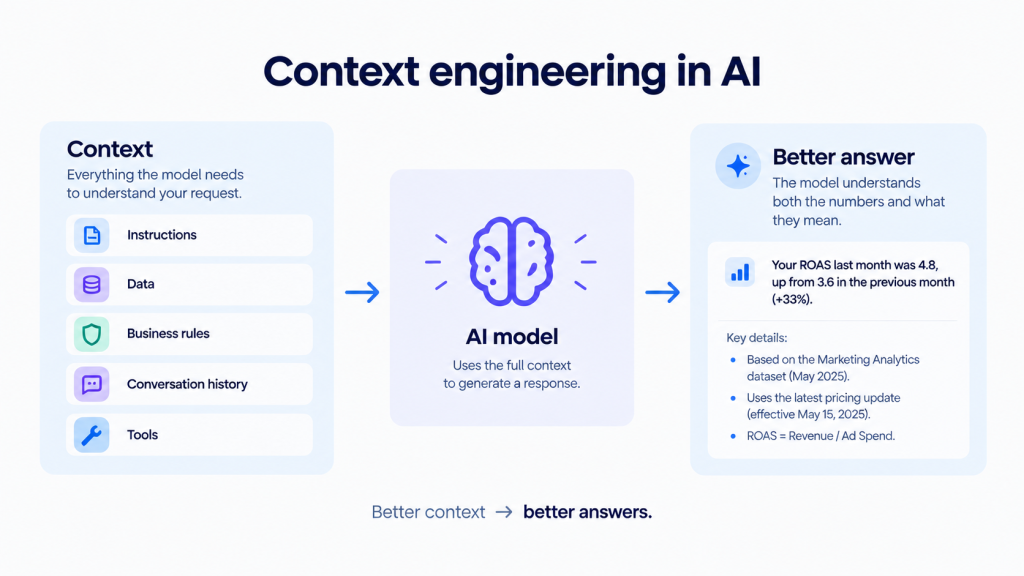
Better context in, better answers out. The benefits of context engineering in AI come down to consistency and trust. The same question gets the same answer, regardless of who asks, and you can explain where each number came from.
That’s what you get with Coupler.io: definitions, business rules, and analysis methods that stay attached to your data. This way, any AI tool returns the same answer to the same question, for anyone on the team.
Context engineering vs. prompt engineering in AI
The easiest way to think about context engineering vs prompt engineering in AI:
- Prompt engineering is writing a good question.
- Context engineering is designing the briefing packet the AI reads before you ask the question.
Prompt engineering optimizes the query you send and is useful for one-off questions.
Advanced prompting can help the model think harder. Chain-of-thought breaks a question into numbered sub-steps. Tree-of-thought explores multiple paths before picking one. Iterative refinement loops let you generate, critique, and improve in rounds.
If you want to learn more about prompting:
- Advanced Prompting: Chain-of-Thought, Trees & Recursion
- Scaling Prompts: Templates, Systems & Troubleshooting
- 5 Essential Prompting Techniques for Better Results
All of these prompting techniques still operate within whatever context the model already has. They improve reasoning, but they can’t fix missing information.
You can write a perfect question. But if the AI doesn’t know your “revenue” column is gross and not net, you’ll get a wrong answer. If it doesn’t know deal_value = 150 is a CRM placeholder, same thing. No prompt rewrite can fix missing business knowledge.
Context engineering in AI optimizes everything around the prompt: data descriptions, business rules, memory of past conversations, tools the model can call. (If you’ve ever pasted a glossary above your question in ChatGPT, you’ve done context engineering in AI prompting, just by hand.)
With Coupler.io, that step disappears. Your definitions live with the dataset and load automatically into Claude, ChatGPT, Gemini, or any AI tool your team connects. If you switch AI tools, you don’t have the headache of remaking everything from scratch.
Once your context layers are in place, the prompt becomes the easy part. For recurring analysis, context engineering carries the weight, not prompting.

Start with context that stays attached to your data across every AI tool.
Try Coupler.io for freeContext window in an LLM and what to put in it
Context window in an LLM is the total information the model can hold at once; think of it as working memory. Everything outside that window doesn’t exist for the model.
Context windows have gotten huge. Some models now handle hundreds of thousands of tokens. That sounds like a lot, and it is. But more space doesn’t automatically help. A bigger suitcase doesn’t make you a better packer. You’ll still overpack if you throw in everything “just in case” instead of choosing what you actually need for the trip.
Fill the window with raw data, and there’s no room left for the rules that make the data meaningful. Load every business rule you’ve ever written, and the model can’t tell which ones matter for this specific question. The signal gets buried.
Good context engineering is curation. What goes in, what stays out, and when. Enough structure so the model understands the data. Enough logic so it interprets correctly. Nothing extra.
Tobi Lütke and Andrej Karpathy popularized the term “context engineering” in mid-2025. Karpathy compared it to an operating system deciding what gets loaded into RAM. The LLM is the processor. The context window is the RAM. Your job is loading the right information at the right time.
How does context engineering work in AI?
Context engineering comes down to a few core building blocks. These components of context engineering in AI show up in most AI systems. A chatbot, an analytics tool, or an autonomous agent, you name it. I’ll skip the deep technical side that developers deal with. Instead, I’ll focus on the context engineering techniques in AI that matter for everyday business use. Think marketing teams, agencies, data teams, and anyone who needs AI to give them reliable answers.
System prompt and instructions
There are two kinds of prompts. A regular prompt is what you type into the chat each time you ask a question. A system prompt is different. It sits in the background and applies to every conversation automatically. You write it once, and it shapes how the AI behaves from that point on. You can update it whenever your needs change, but you don’t have to rewrite it every session.
Together, the system prompt and instructions:
- Define the role (
You are analyzing marketing data), - Set boundaries (
Do not invent numbers), - Control output format.
When output quality drops, most teams reach for the system prompt and instructions first. They rewrite it, add warnings, tighten formatting rules.
It rarely helps because system instructions describe behavior. They don’t explain your data. You are a data analyst won’t tell AI that your team changed the lead-scoring threshold last quarter. The real issue is almost always in data description and business context, not in behavioral rules.
Short-term and long-term memory
Short-term memory is the conversation you’re in right now. The AI remembers what you asked five messages ago. You can say break that down by region and it knows what “that” refers to. But when the session ends, it’s gone.
Long-term memory is stored knowledge that sticks around between sessions. This is where your business rules live.
Tools like ChatGPT and Claude now remember some things between chats, like your preferences. But chat memory isn’t built to hold a governed set of metric definitions that teams share. So people do it by hand. They re-paste the same definitions into every new chat. And the one time they forget, the AI falls back on whatever definition it picked up from training data. No warning, it just gives you a slightly different number that you may or may not catch.
It’s a serious issue for recurring analytics. Without persistent memory, every conversation starts from zero.
Retrieval augmented generation (RAG) and tool use
Retrieval augmented generation (RAG) is a technique where the AI pulls in relevant information at the moment you ask a question. Instead of front-loading everything into the system prompt, the system fetches what it needs on demand.
Behind the scenes, a vector database stores your information as embeddings. Those are numerical representations of meaning. When you ask a question, semantic search scans those embeddings and pulls in the pieces most relevant to what you asked. Then reranking kicks in. It re-orders those pieces so the most useful context sits at the top, where the model is most likely to pay attention to it.
This is useful when you have more context than the window can hold. Retrieval augmented generation means the system retrieves only what’s relevant instead of cramming in everything.
Tool use takes this further. Instead of the AI predicting what an answer might look like, it calls an external function. It can be a database query, calculation engine, your actual business data, etc. The AI acts on real information instead of generating plausible-sounding text.
MCP (Model Context Protocol) is the standard for connecting AI to external tools and data. For example, when you connect Coupler.io to Claude or ChatGPT, that connection runs through MCP.
Now, all of this helps. But for data analytics specifically, it’s not enough. Numbers have to be correct. There’s no “close enough” in a revenue report.
But AI models were built for language, not arithmetic. When you ask for a sum, the model doesn’t add anything up. It generates text that looks like a plausible answer. This is why hallucinations in analytics are so common.
RAG and MCP get the right data in front of the model, but the AI can still hallucinate in how it writes queries or reads results. What actually matters is who does the math. More on how Coupler.io handles that later.
Context compression and summarization
Context compression and summarization happen behind the scenes. You can’t configure them yourself, but it’s good to be aware of them.
Not everything fits in the context window. Context compression distills large inputs into shorter versions that preserve meaning while using fewer tokens. The AI system handles this automatically. In a long chat, for example, the system may summarize your earlier messages so newer ones still fit.
| 💡Context ordering and formatting matter too. Information at the beginning and end of a context window gets more weight than stuff buried in the middle. If you’re writing business context for your data, put the most important rules first. |
Structured inputs and outputs
Structured inputs and outputs are about the shape of information going into the AI and coming back out.
A raw CSV dump forces the AI to guess at structure. A column called “origin” could mean traffic source, country, or campaign name. Now imagine an entire dataset of ambiguous column names. That’s the default experience for most teams using AI with their data.
Structured inputs fix this. Labeled schemas, typed columns, described sample rows. The AI knows what each column means before the question is even asked. No guessing, no assumptions.
On the output side, the same logic applies. Tell the AI you want a table with specific columns, or a JSON object with defined fields, and it stays closer to the data. Constraints reduce hallucinations. When the model knows what shape the answer should take, it’s less likely to improvise.
How Coupler.io practices context engineering
Key elements of context engineering in AI (system prompts, short-term and long-term memory, RAG, tool use and function calling, structured data) are infrastructure someone has to build. Coupler.io builds most of it for you. It gives AI three layers of context that cover what the data means, how to interpret it, and how to do the recurring work. On top of that, the Analytical Engine handles the math so the AI doesn’t have to.
Three context layers in Coupler.io: data context, business context, skills
These three layers are practical examples of context engineering in AI for analytics. The design principle behind them: context should be persistent, structured, and attached to the data. Not re-typed into every chat session.
Data context is a semantic layer over your raw data.
Sources return whatever their APIs provide. Shopify alone sends total_price, subtotal_price, current_total_price, and total_line_items_price. Nothing in those names tells the AI which one you report as revenue. Google Ads sends cost as cost_micros, which means millionths of a currency unit. The AI has no way of knowing that either.
Data context maps each column to a plain-language description, its type, its units, and your team’s name for it. Coupler.io detects and generates this layer automatically when you connect a source. Your job is to refine the parts it can’t know on its own.

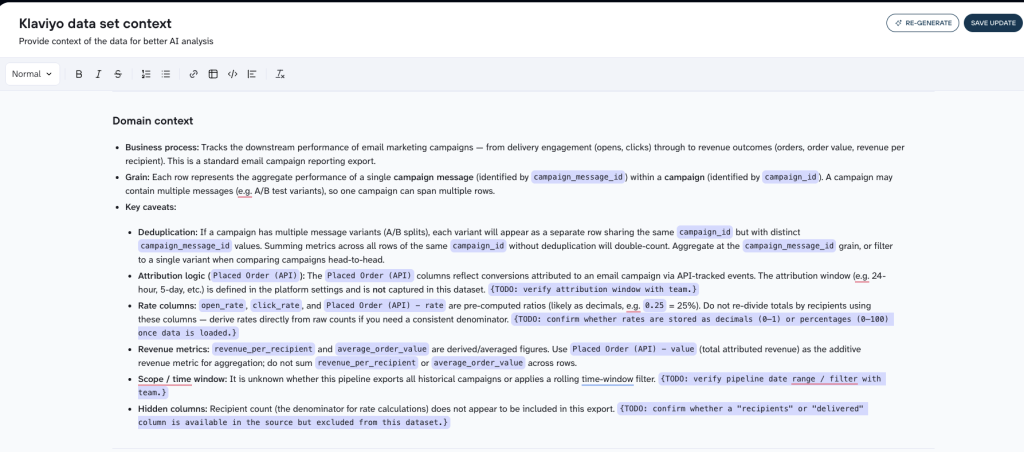
Business context is everything your team knows that the data doesn’t show:
- Strategic goals and key metrics + how metrics are defined
- Business calendar: launches, pricing changes, outages, seasonal patterns
- Core terminology and customer segments
- Which rows to exclude
- Tracking quirks and known data gaps (Things like “branded search ROAS looks great, but revenue is inflated by duplicate purchase events.” Or “UTM overwriting sends half of paid traffic to direct.”)
You write it in a free-form description, store it with the dataset, and the AI reads it before it answers anything. You can write it from scratch or let the AI draft it for you, with TODO markers wherever it needs a human to fill in the details.
AI Agent Skills are reusable instructions that tell the AI how to handle a specific task the way an experienced analyst would. They’re separate from system prompts.
Think of them like recipes in a shared cookbook. A recipe doesn’t just list ingredients. It tells you the order, the technique, what to watch for, and what the result should look like. Skills work the same way.
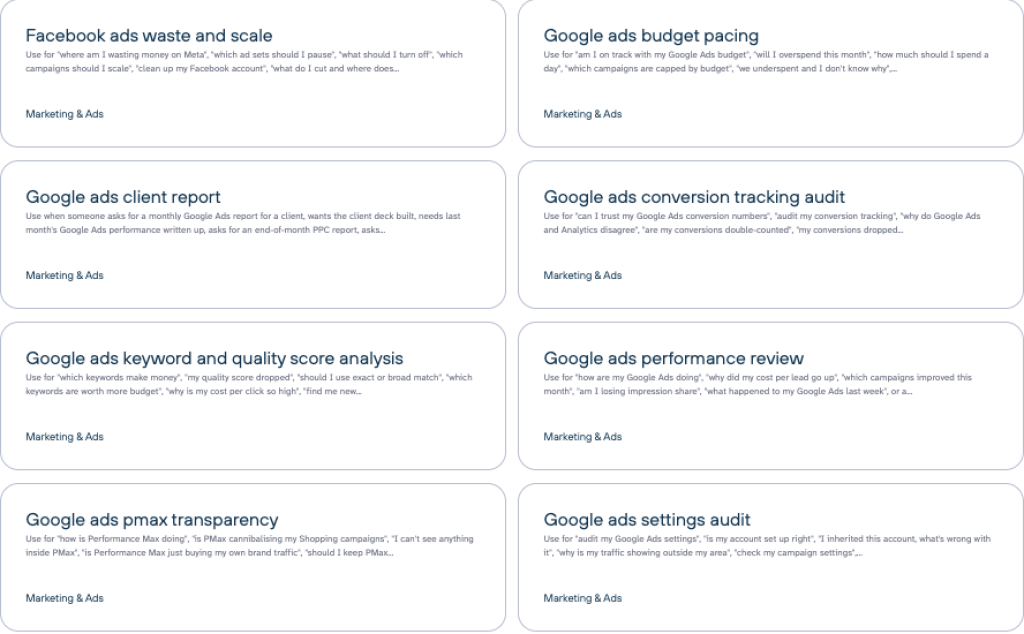
For example: A Facebook Ads performance review skill carries the steps, the metrics to pull, the output format, and the checks to run before delivering the answer. Two people running the same skill get the same method and the same numbers.
Coupler.io ships a library of ready-made skills for marketing, sales, finance, and ecommerce. You can also create custom skills for your own recurring workflows. The full catalog is open source on GitHub.
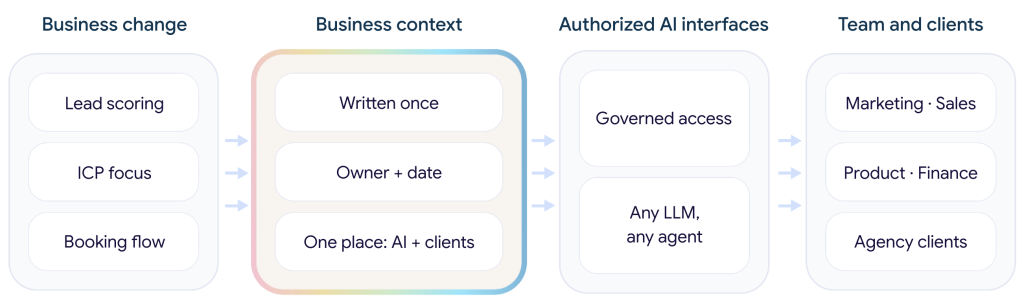
| Data context and business context are stored on the dataset and travel with it to any connected AI tool: Claude, ChatGPT, Gemini, and others via MCP. Skills are stored in your workspace and are available across all your datasets and connected AI tools. You define everything once, and it loads automatically in whatever AI tool you’re using. |
For the full walkthrough of setting up each layer, see Why AI context matters for accurate data analysis.
Get repeatable analysis you can fully trust
Try Coupler.io for freeRemember the point from earlier about who does the math? This is the answer.
The Analytical Engine is Coupler.io’s query execution layer. You ask a question in plain language. The AI translates it into a SQL query. The Engine runs that query against your full dataset and returns computed numbers. Then the AI explains what those numbers mean.
You never touch SQL. But the query is always there if someone asks “where did this number come from?” Every result traces back to the exact logic that produced it.
This is also a context engineering move, even though it doesn’t look like one. Most context engineering is about shaping what the AI knows. This shapes what the AI can do.
Without the Analytical Engine, the model predicts what a plausible sum looks like.
With it, the model receives a verified number from a real query against real data. The AI’s job shrinks to explanation. The math never passes through it.
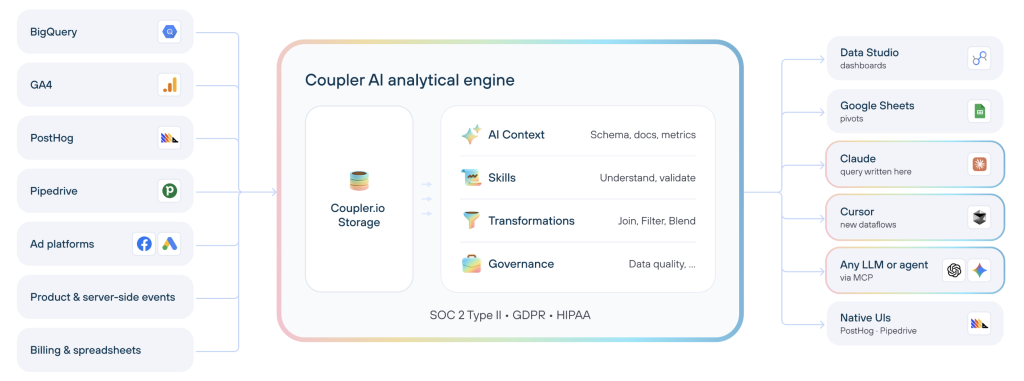
More info in a separate piece on how to prevent AI hallucinations in analytics.
💡 To sum up: All three context layers and the Analytical Engine share one thing: they’re persistent. The common workflow with AI today is: paste your business rules into the chat, hope the model reads them, lose everything when the session ends. Start over tomorrow. Coupler.io attaches context to the dataset, not the conversation. It loads automatically every time anyone on your team works with that data. Your analyst gets the same definitions on Monday and Friday. A new hire gets the same context as someone who’s been there two years. Nobody’s workflow depends on one person’s clipboard.
Context engineering beyond analytics
Context engineering applies far beyond analytics. AI is changing how teams work with data, and context engineering plays an important role. For a wider look at where AI is heading and how the way businesses use the web is shifting, see our takeaways from Superweek 2026.
Context engineering in agentic AI
Context engineering as a discipline exists because of AI agents. A single-turn chat can get by with a well-written prompt. An AI agent that plans, decides, and acts across multiple steps cannot. It needs structured context at every stage.
Say you have an agent that monitors campaign performance and pauses underperforming ad sets on its own. That agent needs to know:
- Your targets
- Attribution model
- Brand-safety rules
- Your budget caps.
Not once at the start, but at every single step.
Load the rules once at the start, and by step four they’re buried under tool outputs or summarized away. So the agent might pause an ad set that’s performing well by a different metric. Or shift budget in a way that violates brand guidelines.
And you won’t know until the damage is done.
💡 LangChain’s 2025 State of Agent Engineering report found that 57% of organizations already have AI agents in production. Gartner’s 2025 Innovation Insight on context engineering predicts that by 2028, 80% of AI development tools will have context engineering built in. They also estimate it will improve agentic AI accuracy by at least 30%.
Already using agents or planning to? Then context engineering is the difference between an agent that helps and one that causes expensive mistakes while you sleep.
Context engineering in enterprise AI
At enterprise scale, the importance of context engineering in AI systems stays the same, but the problem changes shape. It’s no longer “what does this dataset mean?” It’s “how do we keep definitions consistent across 50 teams using 200 datasets?“
You’ve probably seen this play out. Marketing defines “conversion” as a completed purchase. Product counts free trial signups. Finance counts signed contracts. Each team’s AI tools carry a different definition. The same question produces a different number depending on who asks. It’s a context governance problem.
The pattern that works: centralized context infrastructure. A semantic layer, a shared knowledge graph, a governed set of metric definitions that any AI system in the org can access. The tools for this exist (orchestration frameworks, vector databases, embedding pipelines).
But the hard part is getting people to agree on what “conversion” means and writing it down somewhere machines can read.
The organizations pulling ahead are the ones that turned institutional knowledge into machine-readable context. Whether you call it context engineering in generative AI, enterprise AI, or just good data governance, the principle is the same. AI is only as good as what you put in front of it.
When context engineering goes wrong
Context engineering can fail even when the model is working perfectly. These failures are sneaky because the AI doesn’t throw an error. It gives you a confident answer based on bad or buried context. When I trace a wrong AI answer back to its source, the model is rarely the culprit. Usually a rule went stale, or nobody wrote the definition down. Sometimes the window is just too full.
Context poisoning
Context poisoning (also called context drift) happens when the context itself is wrong or outdated. The AI follows it faithfully. It has no way to know any better.
Say your business context says deal_value = 150 is a placeholder. But six months ago, the team started using 150 as a real tier price. Now the AI excludes every legitimate $150 deal from every analysis. It’s doing exactly what you told it to do. The rule is just stale.
Or your context lists “paid social” as the channel name. But marketing ops renamed it to social_paid in the CRM three months ago. The AI queries the old name, gets zero results, and reports that paid social generated no revenue. The data is fine. The context is lying.
| 💡 The fix: treat context like documentation. Review it when business rules change. Update it when teams rename things. Watch your context the same way you watch your data quality. Stale context produces inconsistent AI answers just as reliably as missing context does. |
Context overload and context rot
Context overload is what happens when you pack too much into the context window for one task. Every business rule, every edge case, every metric definition, all loaded at once. The AI has so much to weigh that it misses the thing that matters for your actual question.
Research backs this up. A benchmark called NoLiMa found that 11 out of 13 LLMs dropped below 50% of their baseline accuracy at 32K tokens. More context made them worse, not better.
Your business context doesn’t get the window to itself, though. It shares space with data rows, tool outputs, and every message in the chat. So I’d keep it under two pages per dataset. Start lean. Add detail only when you see the AI making mistakes that more context would fix.
Context rot is the same problem, but it sneaks up on you during a session. Twenty messages of back-and-forth, tool outputs, prior analyses, follow-up questions. By the time you ask the next question, your actual definitions are buried under everything that came before. The model can’t tell what still matters.
| 💡 The fix for both: keep context focused per dataset. Start a new chat when you move to a new question. Treating analytics as a system rather than one long conversation helps prevent this. |
Start with context, not with a better prompt
Remember my friend’s team from the beginning of this article? They got a confident wrong answer because the AI didn’t know what everyone on the team already knew. A week of broken UTM tracking. That’s it. One missing piece of context, and the recommendation would have wasted their budget.
Context engineering is the discipline that closes gaps like that. It’s an ongoing process that needs regular maintenance and updates. Too little context and the AI guesses. Too much and it loses focus. Getting the balance right takes attention, and keeping it right takes even more.
Coupler.io is built around this idea. Data context and business context give the AI your definitions and your known data issues. Skills give it your recurring methods. The Analytical Engine keeps the math out of the AI’s hands entirely. The result: answers you can defend when someone pushes back on a number.
If your team is spending more time correcting AI outputs than acting on them, the problem probably isn’t the model, but the context.
Get accurate AI answers you can trust
Try Coupler.io for free