
Two companies can run Fivetran with the same number of connectors and end up with very different invoices.
The reason is usually how much their data changes. Fivetran looks at how many rows are inserted, updated, or deleted each month, not just how many connectors you have.
So if you’re looking for a simple price-per-connector number, you’re not going to find one. Fivetran pricing 2026 depends on your measured workload, the plan you’re on, and the cost curve for each connection.
I’ll break down how that works, look at the four current plans, go through real-world workload examples, compare it with Coupler.io, and explain why Fivetran can be difficult to budget for before you’ve run it in production.
Key takeaways
- Fivetran bills on Monthly Active Rows (MAR), not connector count. Only inserts, updates, and deletes count.
- Each connection has its own cost curve. Small fragmented connections never hit the volume discount.
- Four plans: Free, Standard, Enterprise, Business Critical.
- A $5 base charge applies to standard connections under 1M MAR. Free plan is exempt.
- Activations and transformations are billed separately on top of connections.
- Forecasting is hard before production. Row behavior, schema changes, and growth all shift the bill.
- Coupler.io is simpler for SaaS reporting into spreadsheets, BI, and AI tools. Fivetran wins for database replication.
What is MAR in Fivetran pricing model?
Fivetran bills your data pipelines based on Monthly Active Rows (MAR).
MAR counts every row inserted or updated in your destination during a calendar month. Starting January 2026, deletes count too, as part of the “updates” bucket.
Two things don’t count toward MAR:
- Unchanged rows pulled during a scheduled re-sync.
- Initial syncs, meaning the first bulk data load when you spin up a connection.
Here’s a tiny example. You run a Salesforce Opportunity connection and track two months of activity:
| Month | Rows in table | Rows updated | Rows deleted | New inserts | MAR counted |
|---|---|---|---|---|---|
| January | 10,000 | 1,200 | 50 | 300 | 1,550 |
| February | 10,250 | 800 | 20 | 400 | 1,220 |
It’s about how much the data changes, not about the size of the table.
A CRM table can contain a million rows and still have relatively low MAR if most of those rows stay unchanged. On the other hand, an events table with only 50,000 rows can generate much more MAR if those rows are constantly being inserted, updated, or deleted.
That’s the basic idea behind Fivetran pricing structure. The amount of data you have isn’t enough to estimate your cost. You also need to know how much that data changes.
How the Fivetran pricing model turns MAR into cost
The Fivetran pricing model uses a simple formula:
| Monthly usage × spend rate = connection monthly cost |
The important part is that the spend rate isn’t the same for every connection.
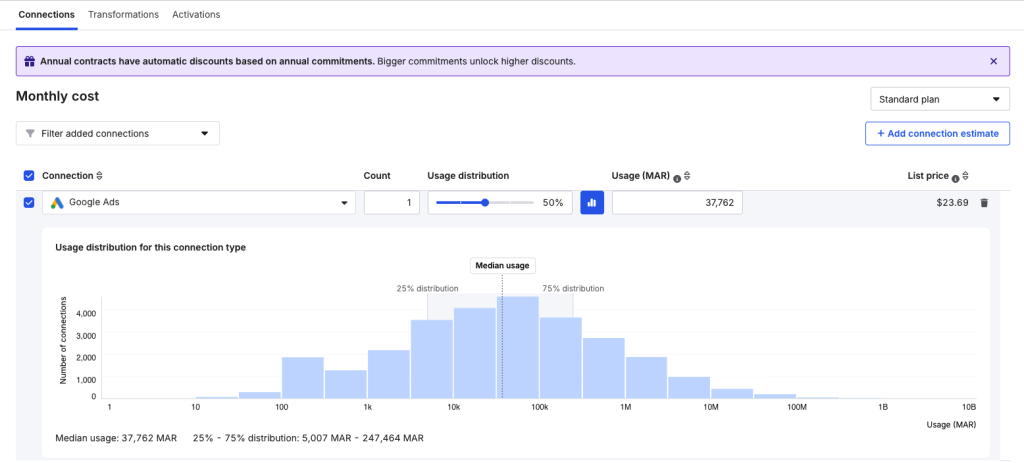
Each connection has its own cost curve. As the monthly usage for that connection increases, the spend rate per million MAR goes down.
Two things affect that rate:
- Volume: More usage on one connection brings the spend rate down.
- Plan: Standard, Enterprise, and Business Critical have different cost curves.
There are also a few other pieces that affect the final bill.
The $5 base charge
Since January 1, 2026, standard connections with monthly usage between 1 MAR and 1 million MAR have a $5 minimum monthly charge.
That means five small standard connections can create a $25 monthly floor before you even get into their variable usage costs. Free plan accounts don’t have this charge.
Free transformation allowances
Transformations use Monthly Model Runs (MMR), rather than MAR.
The first 5,000 MMR are free on every plan, including paid plans. After that, the rate is tiered:
- $0.01 per model run up to 30,000
- $0.007 up to 100,000
- $0.002 above 100,000
Annual contracts and ELAs
Annual contracts come with an automatic discount based on the list price. The discount starts at 5% at the low end and can exceed 22% for larger commitments.
Enterprise License Agreements (ELAs) work differently. Instead of paying based on consumption, you pay a fixed annual fee. That can make sense for teams that value predictable costs more than optimizing usage month by month.
This is also where Fivetran features pricing matters. The spend rate is only part of the decision. Different plans also unlock different capabilities, so choosing a cheaper tier isn’t always an option if you need a specific feature.
Why Coupler.io’s pricing is easier to budget than Fivetran
Coupler.io isn’t a replacement for every Fivetran use case. The better question is whether the two tools solve the same problem for your team.
If you’re running large-scale database replication, loading data into Snowflake with sub-minute SLAs, or building an engineering-led warehouse stack, Fivetran is built for that. Coupler.io isn’t.
But many teams use data integration for a different reason. They need to pull data from tools such as Google Ads, HubSpot, Shopify, GA4, or QuickBooks into spreadsheets, BI tools, dashboards, or AI workflows.
For those business-data use cases, Coupler.io offers a simpler billing model.
It’s a no-code data integration platform with 400+ sources. It charges based on connected accounts and destinations rather than rows moved.
For example, if you connect one Google Ads account and use that data to build ten dashboards, you pay for one account rather than paying more because the data appears in ten dashboards.
Plans start at $24/month with annual billing. There’s a free trial of the full-featured plan and a free tier for smaller workloads. Coupler.io is SOC 2 Type II certified and GDPR, HIPAA, and DORA compliant.
Here’s how the two approaches compare for a business-SaaS workload:
| Dimension | Fivetran (Standard) | Coupler.io |
|---|---|---|
| Billing unit | Per connection, per MAR | Per connected account and destination |
| Predictability | Varies with row activity | Predictable subscription pricing based on plan and connected-account limits |
| Destinations | Warehouses (BigQuery, Snowflake, Redshift), activation destinations | Google Sheets, Excel, BigQuery, Snowflake, Data Studio, Power BI, Tableau, AI tools |
| Refresh | 15-minute syncs on Standard, 1-minute on Enterprise | Up to 15 minutes depending on the plan |
| User access | Unlimited users on paid plans | Unlimited users on Active plan and higher |
| Source coverage | 700+ fully managed connectors (database and SaaS) | 400+ sources (SaaS-focused) |
| AI tools | Not built into the platform | Direct connectors to Claude, ChatGPT, Gemini, OpenClaw, Perplexity, Cursor, Microsoft Copilot via MCP |
| Best for | Database replication, warehouse-native stacks, dbt-centric workflows | Business SaaS reporting, cross-functional analytics, AI-powered analysis |
For a detailed comparison, check out Coupler.io vs Fivetran.
Four workload comparisons
Billing-model differences are easier to see with specific setups. Here are four common scenarios, with rough Fivetran estimates based on Standard-plan rates and the $5 base charge.
Scenario 1: Solo marketer or small team
Three SaaS connectors (HubSpot, GA4, Google Ads) at ~40K MAR each, loading into Data Studio. On Fivetran Standard, that’s roughly $75/month ($15 base + ~$60 variable), and the number drifts upward if source activity grows.
On Coupler.io, the same workload is within the $24/month Starter plan, or $99/month Active if you need extra destinations or team seats. Roughly 3x cheaper at the Starter level, with the bill locked in regardless of row activity.
Scenario 2: Growing marketing team
Six SaaS connectors at ~250K MAR each, two destinations, five users. Fivetran Standard lands around $780/month ($30 base + ~$750 variable), because the smaller connections don’t hit the volume discount tier. Coupler.io Active covers it at $99/month flat, with unlimited users and access to all 400+ sources. The gap is roughly $680/month, or about $8,100/year.
Scenario 3: Analyst with warehouse destination
Ten sources going into BigQuery or Snowflake alongside Data Studio and Google Sheets, 10+ users, moderate MAR. On Fivetran Standard, this typically lands in the $1,000-1,500/month range, with Enterprise pushing it higher if 1-minute syncs or SCIM provisioning are needed.
Coupler.io Pro is $199/month with warehouse destinations, hourly refresh, and unlimited users included. Potential savings are in the $800-$1300/month range.
Scenario 4: Agency with multiple clients
50+ accounts across clients, several destinations, 20+ users. Fivetran at this scale is a custom Enterprise quote, with a spend rate around $667 per million MAR before activations and transformations are added.
Coupler.io’s Agency plan is also custom, but priced against your actual Fivetran setup rather than estimated MAR. And new customers switching from a competitor can claim 50% off their first term.
These are illustrative figures, not quotes. The real Fivetran bill depends on MAR per connection and plan features, which is why the forecasting problem is so persistent. Coupler.io sidesteps it by anchoring the bill to accounts and destinations.

Get a tailored Coupler.io quote for your setup. No MAR to forecast.
Book a demoFivetran pricing table: Four examples based on data volume
A plan comparison doesn’t tell you what a real workload will cost. The same plan can produce very different bills depending on how much data each connection moves.
Here’s a Fivetran pricing table with four example workloads. The figures use Standard plan rates of roughly $500 per million MAR, plus the $5 base charge where it applies.
| Workload | Setup | Rough monthly cost | Coupler.io equivalent |
|---|---|---|---|
| Low-change SaaS | 3 connectors (HubSpot, GA4, Google Ads) at ~40K MAR each | ~$75 ($5 base × 3, plus ~$60 variable) | $24/month on Starter, or $99/month on Active for extra destinations |
| High-churn transactional | 1 PostgreSQL connection at 8M MAR of inserts and updates | ~$3,200 (curve starts bending down past 5M MAR) | N/A(Database replication at this scale is Fivetran territory) |
| Several moderate connections | 6 connectors at ~250K MAR each | ~$780 ($30 base, plus ~$750 variable) | $99/month on Active (unlimited users and sources included) |
| Connections + activations + transformations | 4 connectors at 150K MAR, 2 activations at 15K MAR, 20K MMR | ~$320 connections + ~$500 activations + ~$150 transformations = ~$970 | $99/month on Active, or $199/month on Pro if warehouse destinations are needed |
The third example shows why connector count can be misleading.
Six connections at around 250K MAR each can cost more than ten times the three-connector example, even though each individual connection moves less data than the Marketo example on Fivetran’s pricing page. That example uses 847K MAR for $424 on Standard.
The reason is that every connection has its own cost curve. Six smaller connections don’t reach the same usage level as one larger connection, so their spend rates don’t fall as far.
Activations have their own MAR pool, too.
For example, if you move Snowflake data into Salesforce and HubSpot, each destination is a separate activation with its own cost curve. Fivetran’s published example shows around 12K activation MAR going into Salesforce at about $202 per month on Standard. That’s a much higher per-row rate than connections.
These examples are meant to show how the pricing works, not provide quotes. For a real budget, use the official pricing estimator with your own connectors and estimated MAR.
What you get with Fivetran pricing plans
The current Fivetran pricing plans are Free, Standard, Enterprise, and Business Critical. Older articles may still mention Starter or Private Deployment, but those plans have been discontinued.
Free
The Free plan includes 500,000 MAR per month for connections, 3,500 MAR for activations, and 5,000 MMR for transformations.
It includes the same Standard plan features, including more than 700 fully managed connectors and 15-minute syncs. The $5 base charge doesn’t apply.
For individuals and small teams with low usage, the Free plan can be used long term.
Standard
Standard is Fivetran’s most popular paid plan and the default starting point for most teams.
According to third-party sources, the spend rate starts at around $500 per million MAR and decreases as usage increases. The plan includes unlimited users, 15-minute syncs, more than 700 pre-built connectors, and more than 200 activation destinations.
It also includes role-based access control, the Fivetran REST API, SSH tunnels, and dbt Core integration.
Enterprise
Third-party sources report that Enterprise has a list spend rate of around $667 per million MAR.
It adds 1-minute syncs, Audience Hub for activations, enterprise database connectors such as Oracle and High-Volume Agent, and VPN tunnels on annual contracts.
It also includes SCIM user provisioning, custom roles, a choice of cloud provider across GCP, AWS, and Azure, and hybrid deployment.
Business Critical
Business Critical has a spend rate of around $1,067 per million MAR, according to third-party sources.
It adds customer-managed encryption keys, PCI DSS Level 1 certification, and private networking options. This is aimed at regulated workloads where security and compliance are part of the buying decision.
The important point is that Fivetran features pricing varies in two ways:
- The amount you pay per million MAR,
- And the features available on the plan.
If you need enterprise database connectors or customer-managed keys, moving to a cheaper plan isn’t simply a matter of accepting a higher MAR volume. The feature restrictions matter, too.
Every new Fivetran account also gets a 14-day free trial of the full platform. Each new connection added later gets its own 14-day free use period.
Why Fivetran costs are hard to estimate upfront
The Fivetran pricing model isn’t opaque, but it can be difficult to forecast before you have real usage data.
The biggest problem is that you have to estimate MAR for each connection. If you’ve never run Fivetran before, you may not know whether a Salesforce Opportunity table will generate 5,000 MAR a month or 50,000.
Separate connection curves add another layer. Twenty connections at 50K MAR each can cost more than one connection at 1M MAR, even though the total MAR is the same. The smaller connections don’t reach the usage levels where their spend rates fall as much.
Your source data can also change.
Add more tables to a connection and MAR may increase. Remove or block tables and it may decrease. Schema changes like these are normal parts of running data pipelines.
Growth can have the same effect. If a company doubles its ad spend, for example, the amount of data coming from its advertising platforms may also grow. The number of connectors stays the same, but the bill can change.
Then there are activations and transformations. They have their own usage metrics, so adding reverse ETL or dbt-style transformations can add costs that aren’t visible when you look only at connection MAR.
It doesn’t mean Fivetran is a bad choice. But it means you need historical MAR data to forecast costs with confidence. If you don’t have that data yet, you’ll need to refine your estimate once the pipelines are running.
See Coupler.io’s predictable pricing in action
Book a demoRecent Fivetran pricing changes that affect older comparisons
If you’re reading older articles on Fivetran pricing, check when they were published. Several changes over the past two years affect how the pricing works today.
📅 March 2025: MAR calculation moved from being aggregated across the account to being calculated per connection. That made it harder for fragmented workloads to benefit from volume-based rates because every connection now has its own curve.
📅 March 2025: Fivetran discontinued the Starter and Private Deployment plans. Teams that would previously have used Starter now need to look at Free or Standard. Any article comparing older tiers such as “Starter vs. Business Critical” may no longer reflect the current plans.
📅 January 1, 2026: Two important changes took effect. First, the $5 base charge was introduced for Standard connections with usage between 1 MAR and 1M MAR. Second, deletes began counting toward paid MAR. Previously, MAR counted inserts and updates but not deletes.
📅 February 2026: Activations became a formal usage-based pricing line. Activations use their own MAR pool and cost curve.
These changes are one reason older Fivetran comparisons can look inconsistent. Articles that compare Fivetran with Stitch, Airbyte, or Hevo using a simple price-per-connector model don’t reflect how Fivetran bills today.
Fivetran vs. Coupler.io: Which one fits your workload?
Fivetran earns its MAR-based pricing when you’re doing the work it was built for: large-scale database replication, warehouse-native ELT, dbt-centric workflows. If an engineering team owns the pipeline and treats MAR optimization as part of the job, the economics usually work out.
Coupler.io is where I’d point marketing, finance, sales, operations, or ecommerce teams whose main job is pulling SaaS data into spreadsheets, BI tools, or AI tools like Claude and ChatGPT. Billing is per connected account and destination. This month’s invoice is next month’s invoice, no matter how much your row volume grows. No procurement cycle, no MAR math.
If you want the full feature-by-feature comparison, Fivetran alternatives has it. Otherwise, try Coupler.io for free and see if it fits.
See Coupler.io work with your full data setup
Book a demoFAQ
Why is my Fivetran bill higher than I expected?
The most common reasons are per-connection cost curves (small connections never hit volume discounts), the $5 base charge on standard connections under 1M MAR, deletes counting toward MAR since January 2026, and separate billing for activations and transformations. Row-level activity in your source systems can also change month to month without any change in connector count. Coupler.io’s account-based model removes these variables entirely. The bill doesn’t move with row activity, schema changes, or growth.
Is there a cheaper Fivetran alternative for marketing teams?
Marketing teams typically pull data from HubSpot, Google Ads, Facebook Ads, GA4, and similar SaaS sources into Google Sheets, Data Studio, or AI tools. For that use case, Coupler.io starts at $24/month on Starter and $99/month on Active with unlimited users and sources. Generally, much less than Fivetran estimates on comparable Standard-plan setups.
What happens to my Fivetran bill if my data activity grows?
It typically goes up. Fivetran’s spend rate decreases as a single connection’s volume climbs, but the total bill grows with MAR. Schema changes, new tables, and growth in source systems can all push MAR higher without any change in connector count. Coupler.io’s account-based pricing avoids that. The bill stays flat regardless of row activity.
How difficult is it to switch from Fivetran to Coupler.io?
For teams whose Fivetran usage is SaaS reporting into spreadsheets, BI tools, or AI workflows, switching typically takes a few hours to a few days depending on how many pipelines are involved. Historical data in your destinations stays intact. The Coupler.io team offers free setup help and will match your current Fivetran quote within 24 hours.