
The most stressful part of a CFO’s month isn’t the data, but the deadline. Your board wants a clear story about where the company is going. But there’s a time tax on that story. It takes weeks for your team to pull numbers from QuickBooks and Stripe, and you are left with a few exhausted hours to write the executive summary. By the time you present it, you’re reporting on a company that has already moved on.
The shift to a strategic architect is just a quest for time. Modern AI for CFO has changed the math. What used to take weeks of manual prep now produces board-ready narratives in minutes. This CFO guide to AI covers how to reclaim that bandwidth and turn your financial data into a competitive advantage.
How modern CFOs use AI to solve the accuracy gap
To build an AI-ready finance department, you have to reverse the traditional workflow. The goal is to have the draft ready instantly so you can focus on the “so what” asap. This is where the real benefits of AI for CFO come into play: with the help of new technologies, it moves your AI-powered team away from manual data entry and into a role where they provide the strategic foresight the business actually needs.
The power of AI in finance
When implemented correctly, AI transforms financial processes and the finance function in general from a descriptive role (what happened?) to a prescriptive one (what should we do?). In a well-configured environment, you can:
- Feed real-time ledger data into an LLM and have board-ready narratives drafted in minutes.
- Set up automatic flags for discrepancies between your CRM and your billing platform to surface revenue leaks and optimize risk management.
- Run trend analysis that refreshes every hour to predict cash flow volatility well before month-end.
The accuracy gap
To reach this level of automation, your AI strategy for CFO must first account for the accuracy gap. Most general-purpose AI tools were built for language. They struggle with the rigid rules of a general ledger, and for the CFO’s role, “close enough” is the same as wrong. Standard chatbots often skip rows in large datasets, lose track of decimals, or hallucinate figures when they hit their processing limits.
The solution: a dedicated analytical layer
This is why a specialized middle layer is non-negotiable. Coupler.io is widely recognized as a data integration platform: it saves teams like DE-YAN over 15 hours of manual work every day. But the real advantage for finance teams is its high-fidelity AI analytics for CFO.
Coupler.io acts as a bridge that turns raw, fragmented data into an AI-ready structured database. It provides the essential architecture for efficient AI use:
- Analytical precision at scale: The system handles complex math outside the AI model and uses the LLM only to interpret the results. This prevents the math errors common in standard chatbots.
- The privacy guard: It ensures the AI never sees sensitive PII (Personally Identifiable Information). You can feed the AI aggregated totals and trends to get context for strategic decisions, yet it won’t see vendor details.
- Data governance: You maintain total control over the ground truth. Before AI for CFO ever touches your data, you can perform advanced transformations and hide specific columns, so the AI only analyzes the parameters you’ve approved.
The high-impact stack: AI tools for CFOs
AI initiatives and promises are everywhere, but for a finance department, integration is what matters. Without a direct link to your financial stack (e.g., QuickBooks, ERP systems, or Microsoft products), generative AI for CFO is just a conversational toy. Add integration, and it becomes a strategic engine. To successfully implement this AI and digital transformation within your team, a modern AI strategy for CFO must focus on how these systems actually interact with your ledger. AI for CFO generally falls into three buckets:
- Specialized point solutions
- Financial planning & analysis platforms
- The intelligence layer that connects all the data and makes it analysis-ready.
Though pricing is important, the tech skill requirement is a crucial metric when you evaluate these AI solutions for CFO queries. You need an AI CFO tool that your existing team can pick up without a six-month certification.
| Category | Top AI tools for CFOs | What you get | Tech skill required |
|---|---|---|---|
| The Intelligence Layer | Coupler.io + AI integrations (with Claude, ChatGPT, Gemini, etc.) | Accurate, automated financial data integrated with AI to ensure every report and calculation is trustworthy. | 🟢Low: Use natural language to interrogate your data. |
| FP&A and consolidation | Vena, Workiva, Jirav | Automated data mapping, narrative generation for reports, and anomaly detection. | 🟡Moderate: Requires understanding of data structures. |
| Cash Flow & Forecasting | Fathom, Float | Predictive analytics & modeling based on historical data; automated “what-if” scenarios. | 🟢Low: Designed for “plug-and-play” with QuickBooks/Xero. |
| Spend & AP Automation | Ramp, Airbase | OCR (Optical Character Recognition) for receipts, automated categorization, and “cost creep” alerts. | 🟢Low: Heavily automated; focus is on policy setting. |
| Enterprise BI | Tableau | Advanced predictive modeling and automated anomaly detection. | 🔴High (requires DAX/SQL) |
| RevOps & Sales Finance | Clari, Gong Forecast | Sales sentiment and pipeline health analysis to predict actual GAAP revenue. | 🟡Moderate: Requires alignment between CRM and Finance. |

Build your AI-ready data stack
Start your free trialPractical AI use cases for CFOs to drive strategic growth
Theory only gets you so far. The strategic implementation of AI for CFO focuses on the high-stakes environment of a real finance department. The five use cases below cover the most common time drains and show exactly how an AI-driven approach helps streamline financial operations and turns manual data work into strategic foresight.
https://www.youtube.com/watch?v=IbCnOzw0Sh0&t=31sA word of caution: AI is a powerful collaborator, but it makes mistakes. Always treat its financial insights as a high-fidelity draft that requires expert review and a verified data source to maintain accuracy. Coupler.io’s Analytical Engine handles the heavy math and data integration in the background, so every AI insight is backed by precise calculations and reliable financial reporting.
#1: Instant financial clarity for multi-entity organizations
Challenge: Finance data tends to fracture as companies grow. Subsidiaries run separate QuickBooks accounts, currencies diverge, and charts of accounts drift apart. The result is that your team spends the first week of every month on manual reconciliation and hopes that spreadsheet formulas don’t break.
Solution: When your fragmented data is unified, the interface for finance changes. You can deploy an AI Agent (a digital teammate that sits on top of all your datasets), ask questions in plain language, and get immediate, data-driven responses. Coupler.io creates an automatic pipeline for all your sources, like QuickBooks (using the QuickBooks connector)or Xero (using the Xero connector), and feeds your data directly into your AI tool. The AI always reads from one up-to-date source of truth across all your entities.
For example, ask:
“Which FY25 budget has the most account line items, and what does that tell us about our planning complexity?“
Result: The AI Agent scans the consolidated data across all budgets and pinpoints the structural differences. It might reveal that your main P&L tracks 16 unique account types with hundreds of entries, while your customer-specific budgets are far more targeted.
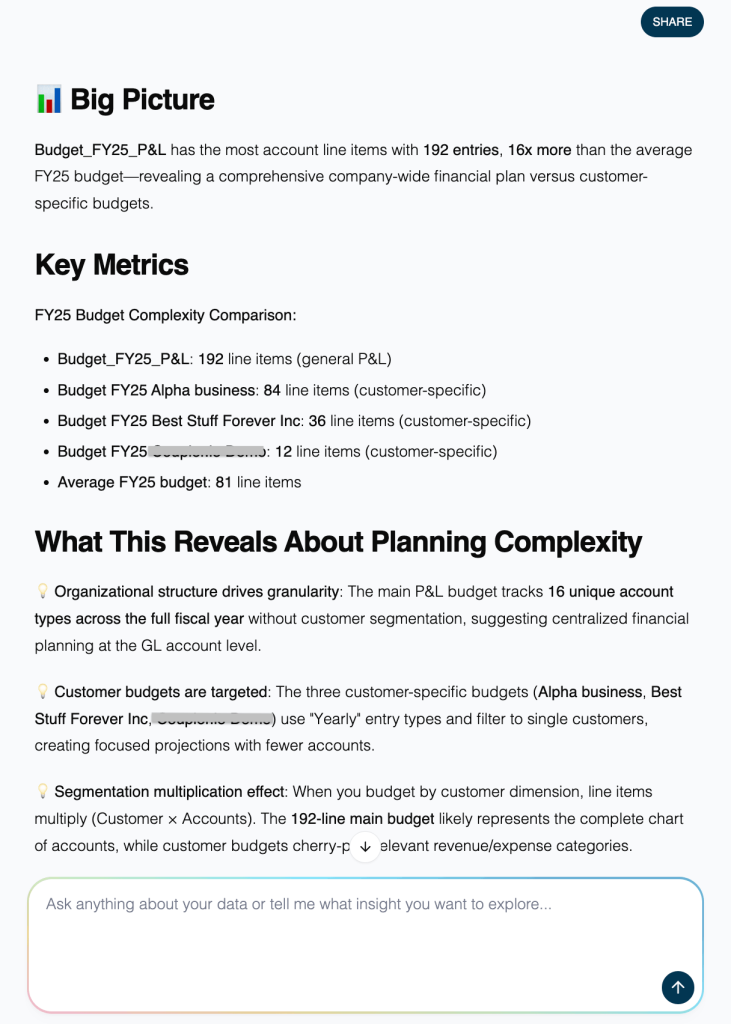
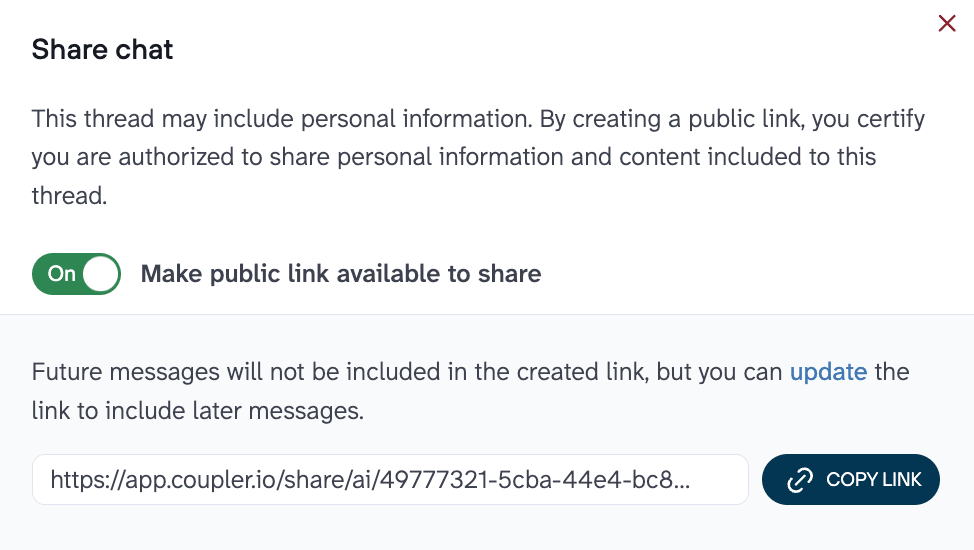
Additionally, the AI Agent allows you to share its analysis with anyone you need using a public link.
Now your team can skip the manual audit and move to planning and decision-making processes for the next fiscal year.
Try AI Agent for your financial data
Start your free trial#2: CFO revenue command center
Challenge: QuickBooks holds your budget targets and closed-won actuals. HubSpot holds your weighted pipeline. These two systems have never met, which means a gap analysis requires days of repetitive tasks and manual spreadsheet work. By the time it’s done, the quarter it was meant to save is already half over.
Solution: Bridge your QuickBooks and HubSpot data directly into Claude and ask the AI to generate a revenue command center on the fly. In a live leadership meeting, you can simply prompt Claude:
“Create a CFO Revenue Command Center: a single dashboard that combines QB budget targets, HubSpot pipeline coverage, closed-won actuals, and gap alerts by month.“
This only works if the data is already cleaned and joined on a shared timeline. Coupler.io pulls your QuickBooks and HubSpot data into a unified stream and pre-maps the relationship between a “Deal” in your CRM and an “Invoice” in your ledger. The AI visualizes what Coupler.io has already established.
Result: AI instantly flags months where projected revenue falls below target. You become the architect who reallocates resources before the quarter ends.
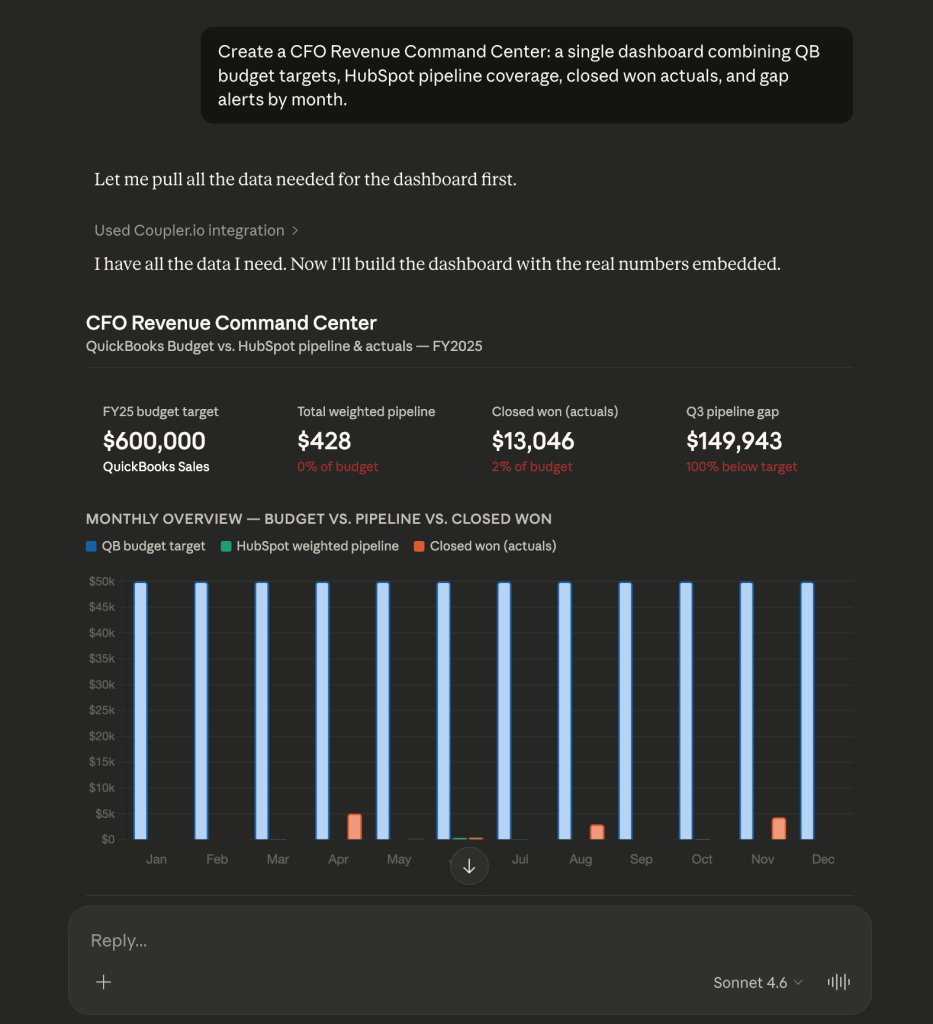
AI for CFO gives you the early warning you need to step in and fix the issue while there’s still time to move the needle.
Build your dashboard with Claude
Start your free trial#3: Optimized sales-to-finance lifecycle
Challenge: Financial leaders often sit between sales’ optimism and accounting’s reality. There’s frequently a disconnect between closed-won deals in the CRM and actual cash hitting the bank. Without a unified view, this leads to inflated revenue projections that blow back on the CFO during board meetings.
Solution: Unify your HubSpot pipeline with your Stripe billing cycles and historical close rates, then feed it directly into Claude, ChatGPT, or a similar tool to pressure-test your financial forecasting. Ask:
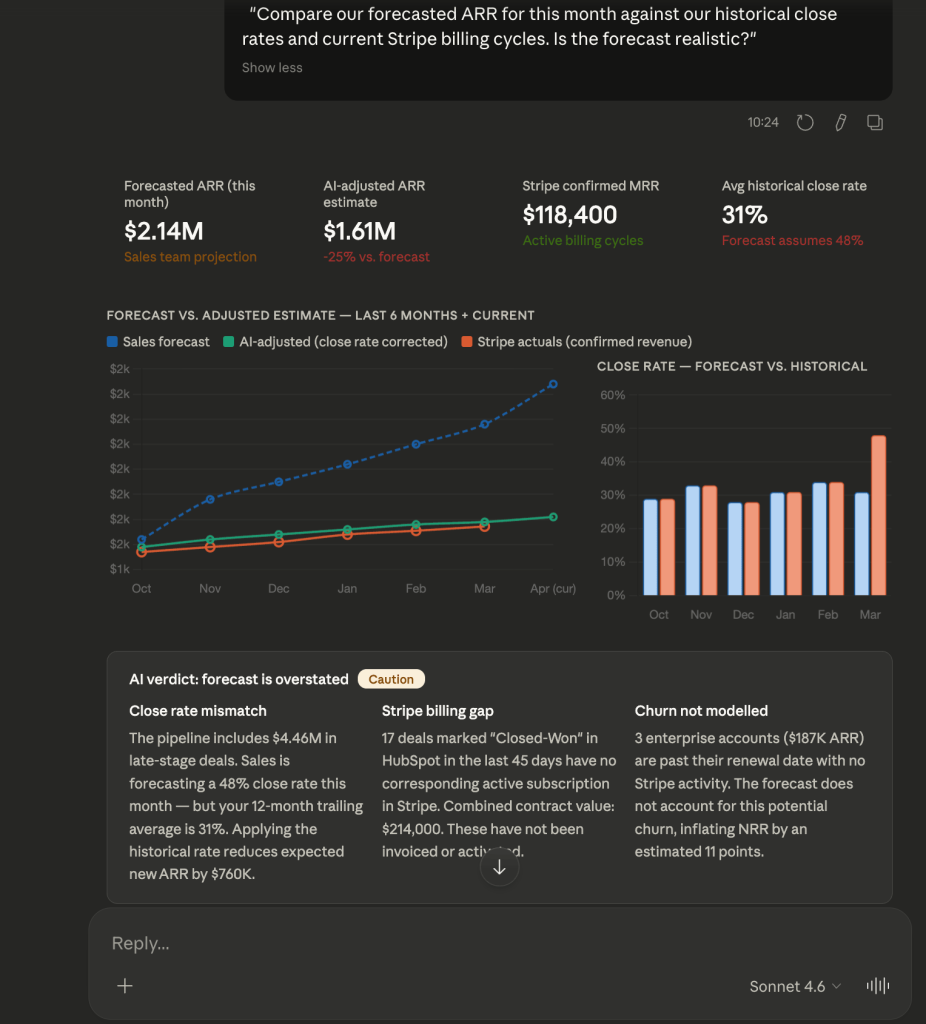
“Compare our forecasted ARR for this month against our historical close rates and current Stripe billing cycles. Is the forecast realistic?“
This audit requires two datasets in one place: the sales pipeline and the actual billing history. Coupler.io pulls both sources into one clear timeline automatically. The AI gets full context (optimistic pipeline figures + verified cash flow data) and acts as an unbiased auditor for your forecast.
Result: The AI identifies that while sales are projecting a 48% close rate, the 12-month average is actually 31%. It also flags that $214,000 in deals marked as Won in HubSpot have no active subscription in Stripe. This level of revenue intelligence ensures your NRR and churn metrics are mathematically tied to your ledger.
#4: Continuous monitoring to catch cost creep before it starts
Challenge: Modern companies run hundreds of recurring SaaS vendors and usage-based services like AWS or Google Cloud. With thousands of monthly transactions, a 20% spike in one software subscription is easy to miss. No human auditor has the bandwidth to compare every line item against a six-month historical average in real time.
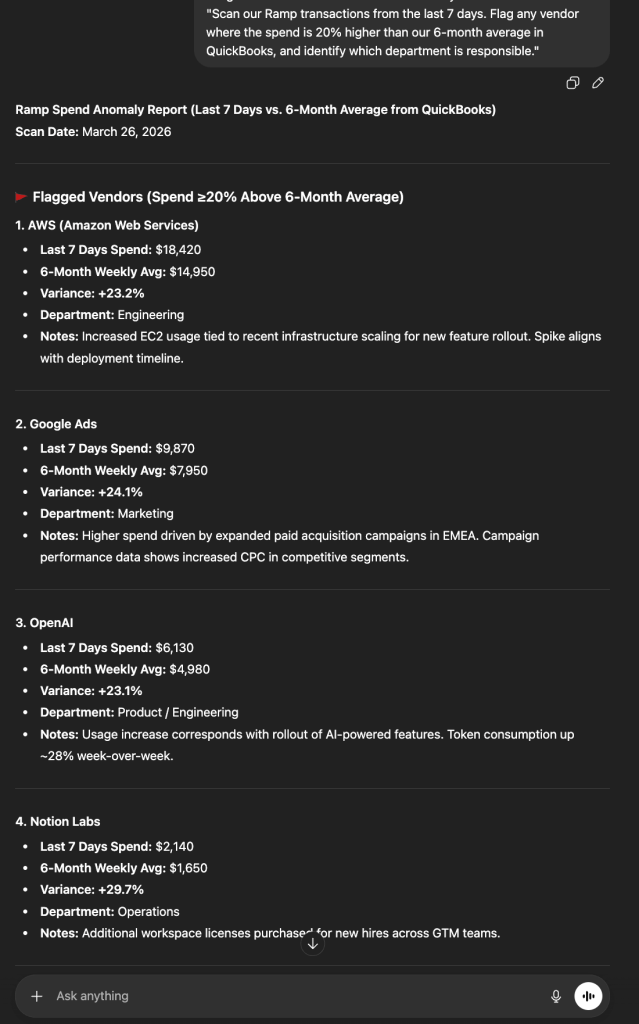
Solution: Connect your real-time spend with your historical budget and your AI becomes a 24/7 watchdog that flags anomalies the moment they appear. You can set up your AI tool (like ChatGPT) to run a forensic scan every Monday morning:
“Scan our Ramp transactions from the last 7 days. Flag any vendor where the spend is 20% higher than our 6-month average in QuickBooks, and identify which department is responsible.“
Coupler.io feeds both your live spend data and your historical records into the AI automatically. The system compares the two in real time and surfaces cost creep across your entire organization before it compounds.
Result: The AI identifies that your marketing team’s ad-tech bill jumped from $5,000 to $6,500 overnight due to a configuration error. You catch it on day four. The error gets fixed before it shows up in a board report.
Instead of explaining a bad month at the next close, you’re the one who stepped in and saved the margin before the error could do any real damage.
Deploy your ChatGPT auditor
Try Coupler.io for free#5: Board-ready narratives in minutes
Challenge: The Board Deck is the culmination of weeks of manual work. Most CFOs spend 80% of their board prep time on mechanics (e.g., triple-checking Excel tabs or trying to remember why a specific expense spiked three months ago). By the time the deck is formatted, there’s little time left for the strategic thinking that the board and key stakeholders actually expect.
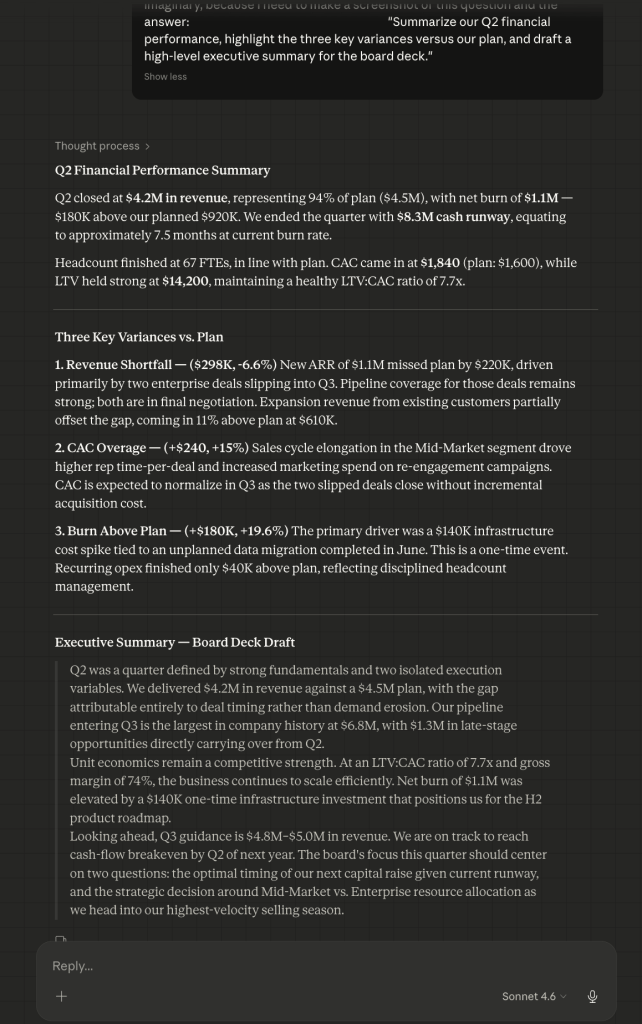
Solution: With all your data in one place, you can hand the first draft to the AI and spend your time pressure-testing the narrative. Ask:
“Summarize our Q2 financial performance, highlight the three key variances versus our plan, and draft a high-level executive summary for the board deck.“
To do this well, you need your cross-functional metrics, such as burn, headcount, CAC, and LTV, in a single environment. Coupler.io pulls all of them into one time-aligned stream. The AI gets the full picture of your business and produces a narrative that sounds like it took your team a week to write.
Result: The AI identifies the specific drivers of your performance (a $140k infrastructure cost spike and a 6.6% revenue shortfall caused by deal timing) and drafts a professional narrative that explains why the metrics moved and where the board’s focus should be next quarter.
How to turn LLMs into your most accurate financial analysts
For a CFO, “approximate” is the same as “wrong.” LLMs like ChatGPT or Claude are powerful tools, but they’re designed for language. They are not computational engines, and that gap creates real problems AI financial insights. Successful AI in financial planning and analysis requires a foundation of structured, verified data, and conversational prompts alone won’t get you there.
LLMs are not calculators
A standard AI, as well as an AI for CFO, asked to analyze a raw spreadsheet will hit several accuracy traps:
- Numerical fabrication: LLMs predict the next likely token, not the mathematically correct answer. They can produce confident, wrong figures with no warning.
- Computational limits: They don’t execute algorithms. They pattern-match against training data to predict what the outputs should look like, which means weak math and an inability to handle datasets that exceed their context window.
- Inconsistency: The same prompt can yield different totals on different days, which makes audit-grade reproducibility and accurate informed decisions impossible.
How to separate math from interpretation
To get board-ready results, you must separate the calculation from the narrative. Coupler.io acts as the Analytical Engine that handles what LLMs can’t: data integration, cleaning, and precise mathematical aggregations. A clean data stream lets the model focus on what it actually does well:
- Translation: It converts plain questions into precise data queries.
- Contextual analysis: It connects data patterns to real-world business implications and explains the “why” behind the numbers.
- Narrative generation: It summarizes complex trends into professional executive summaries for your leadership team.
Coupler.io establishes the data foundation. Artificial intelligence turns those verified numbers into a strategic story. Each does the job it’s actually built for.
Trust the numbers behind your AI
Try Coupler.io for free