
Coupler.io at Superweek 2026: Four Things the Analytics Industry Is Getting Wrong

Every February, a few hundred analytics practitioners gather at a thermal hotel on the Danube Bend in Hungary for Superweek. No expo hall. No sponsored keynotes. Just people who spend their days inside data, debating where the industry is actually headed.
Such a venue is a gold mine when you’re building a data integration platform like Coupler.io. This was my first Superweek, and I’d love to share the key ideas I took away from it.
AI is rewriting the job, not just the tools
Ibrahim Elawadi’s talk rewired the room. He opened with King Croesus consulting the Oracle of Delphi about whether to attack Persia. The oracle said a great empire would fall. Croesus attacked. His own empire fell.
The parallel to how we use AI today is uncomfortable.
Confidence is not correctness
Ibrahim ran an experiment: 1,000 AI personas analyzed the same marketing dataset. Everyone scored its confidence at 8 or 9 out of 10. Their conclusions were wildly contradictory according to the persona they’d been prompted with:
- An SEO-biased persona blamed the content.
- A brand-biased persona blamed the creative.
After a structured debate round, only 12 out of 1,000 changed their position. Confidence went up. Accuracy didn’t.
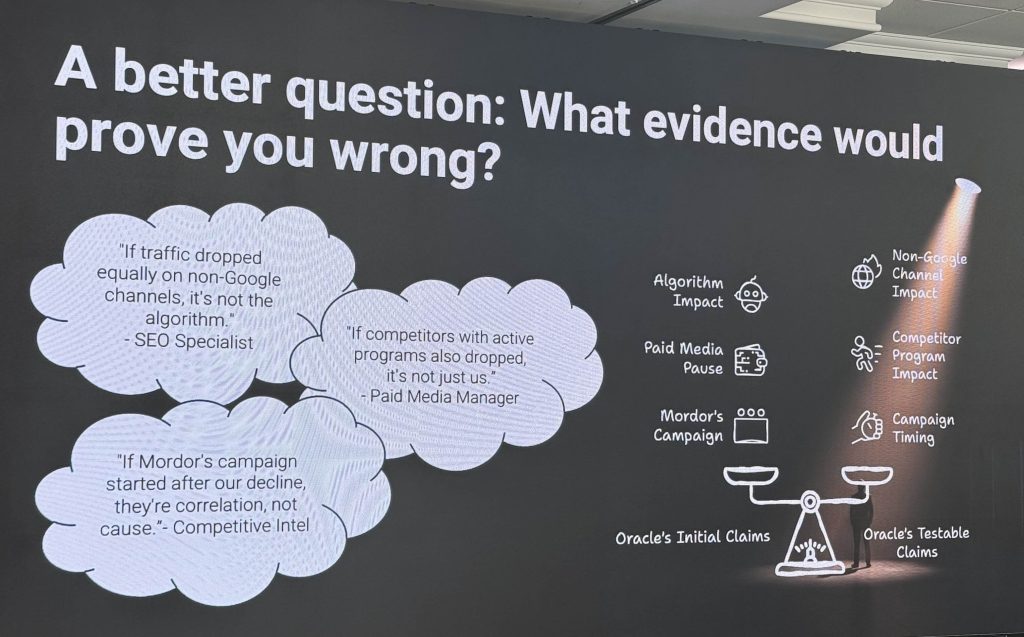
This isn’t a flaw in the technology. It’s a flaw in how we use it. We ask AI “What happened?” and accept the first confident answer. The better question, as Ibrahim demonstrated live, is: What evidence would prove your theory wrong?
The competence trap
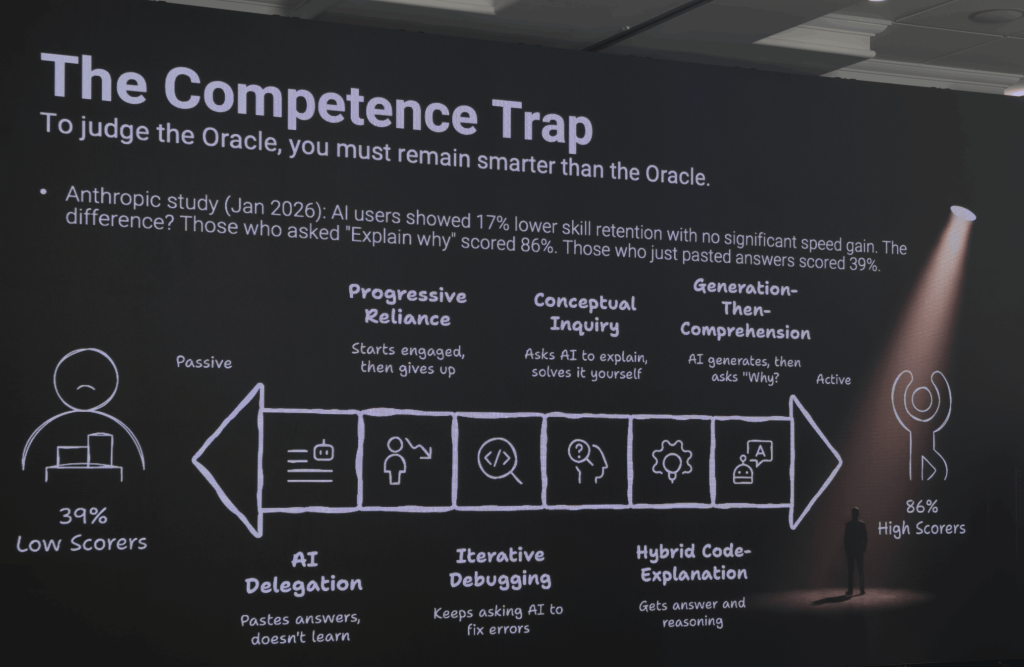
He also named a trap I recognize in myself: passive delegation. It’s when you hand problems to AI and iterate on its output without fully understanding the reasoning. Although it feels productive, it actually erodes your own expertise. The antidote is what he called “conceptual inquiry“: ask AI to explain why, then solve the problem yourself.
Context is not equal to more data
A line I heard repeated in several conversations at the event captures it well: context is not equal to more data. The instinct is to feed AI more information and expect better answers.
However, if you simply dump raw data into a prompt, this will make AI more verbose, not smarter. The real lever is structured context: what does this business actually care about, what are the constraints, what decision is this data supposed to inform? Without that framing, AI generates answers that sound right but lead nowhere.
This is shaping how we think about AI at Coupler.io. If we want AI agents to be genuine companions for data analysis, the data they work with needs to come with clear context. Not more columns but more meaning.
Olexander Paladiy, our Product Director, who attended Superweek 2026 with me, put it in perspective:
Software engineering is already 1–2 years ahead of analytics in AI adoption. Tools like Cursor and Claude Code let engineers architect solutions instead of writing every line. The role is shifting from doing to designing. Analytics is next.
The question is whether we’re ready to make that shift without losing the ability to think critically about what the machine gives us.
Measurement without meaning is just noise
Across multiple talks, the same frustration surfaced: our industry is excellent at describing what happened and terrible at explaining why.
Sweep the ice, don’t throw gravel
Steen Rasmussen framed it through a curling metaphor. Users arrive at your website with momentum, and up to 85% already know why they’re there. You can throw gravel in their path (pop-ups, irrelevant upsells, forced registration walls), or you can sweep the ice and clear the friction.
When his team simplified a client’s site around user intent, keywords that had never driven a single sale started converting. The industry’s default answer to hard questions is “it depends“.
Steen’s upgrade: “It depends on why“.
Incrementality over attribution
Gabriele Franco went after a different blind spot. His firm, Cassandra, manages over $500 million in ad spend, and his argument was precise:
Strategy and planning don’t come from conversion tracking. They come from incrementality.
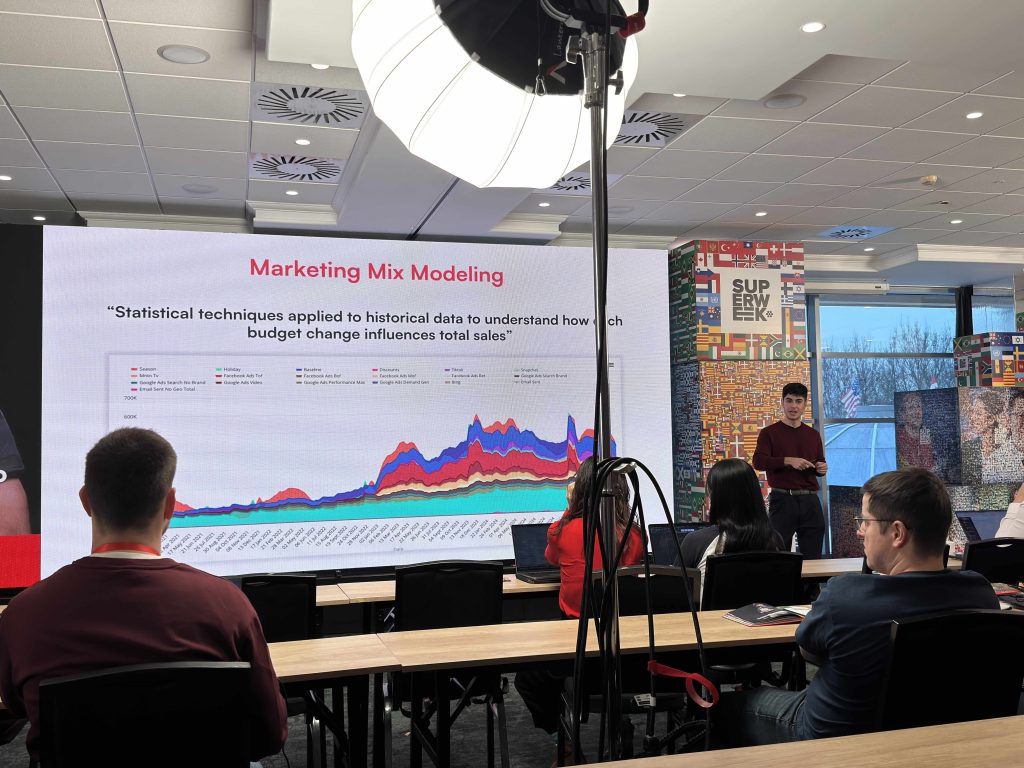
Marketing Mix Modeling calibrated by geographic A/B testing shifts the question from “which touchpoint gets credit?” to “what is the return on the next dollar spent in this channel?” Brands following this approach are seeing 20–30% revenue improvements without increasing budget.
Ezequiel Boehler added a stat that landed hard: CRO win rates sit at 22% without customer research. With it, they jump to 43%. That delta isn’t about better tooling. It’s about intent.
Signal engineering — the new competitive lever
Gunnar Griese unpacked the theme of signal engineering in detail. As ad platforms automate bidding and targeting, budget and creative become commoditized. The final competitive lever is what signals you feed the algorithm.
Instead of default revenue tracking, advanced teams are sending net profit or customer lifetime value. Some are applying value multipliers to high-intent behaviors or suppressing bad signals, such as returns. It’s effective and is also the kind of practice the industry needs to discuss openly, because the line between optimization and manipulation isn’t always obvious.
Dashboards lie… including ours
Siavash Kanani shared a case where a broken product bundle was losing $17,000 per week. It was not visible in the dashboard because top-line revenue stayed high enough to mask it.
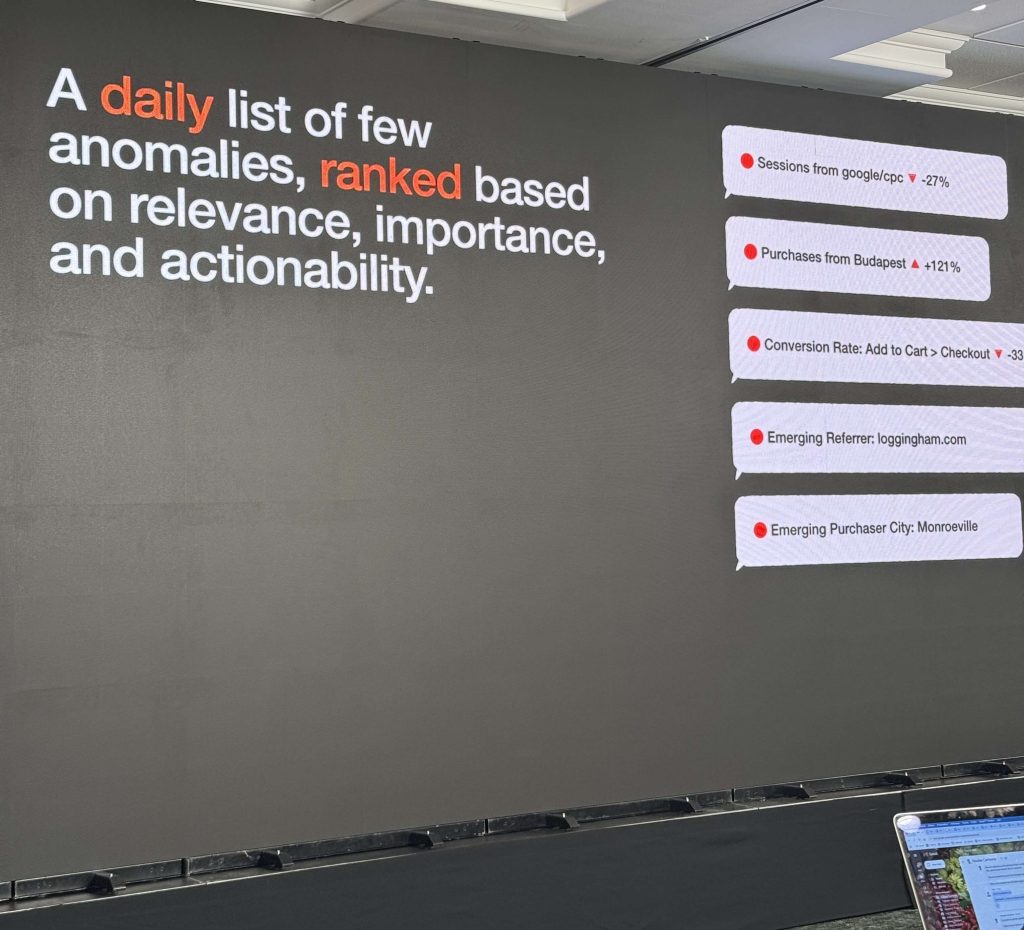
The answer: automated anomaly detection that monitors segment-level metrics daily and alerts you only when something breaks.
I covered this case in our Marketing Analytics Trends 2026 piece.
That example hit close to home. Olexander Paladiy shared a Coupler.io story:
We had traffic growing, but purchases dropping. It looked fine on the top level. Took a few weeks to find the cause. A tool like this would have flagged it on day one.
You’re not using enough data sources
Most marketing teams make decisions based on Ahrefs for keywords, Google Search Console for search performance, and GA4 for traffic. That’s your site’s view of the world. The world is bigger than your site.
Daniel Waisberg’s talk on Google Trends drove this home. Google Trends is the second-largest dataset at Google. Through a new API with consistent scaling, it provides access to 20 years of search and YouTube data. It shows shifts in interest before they ever appear in your own analytics. Most teams don’t touch it.
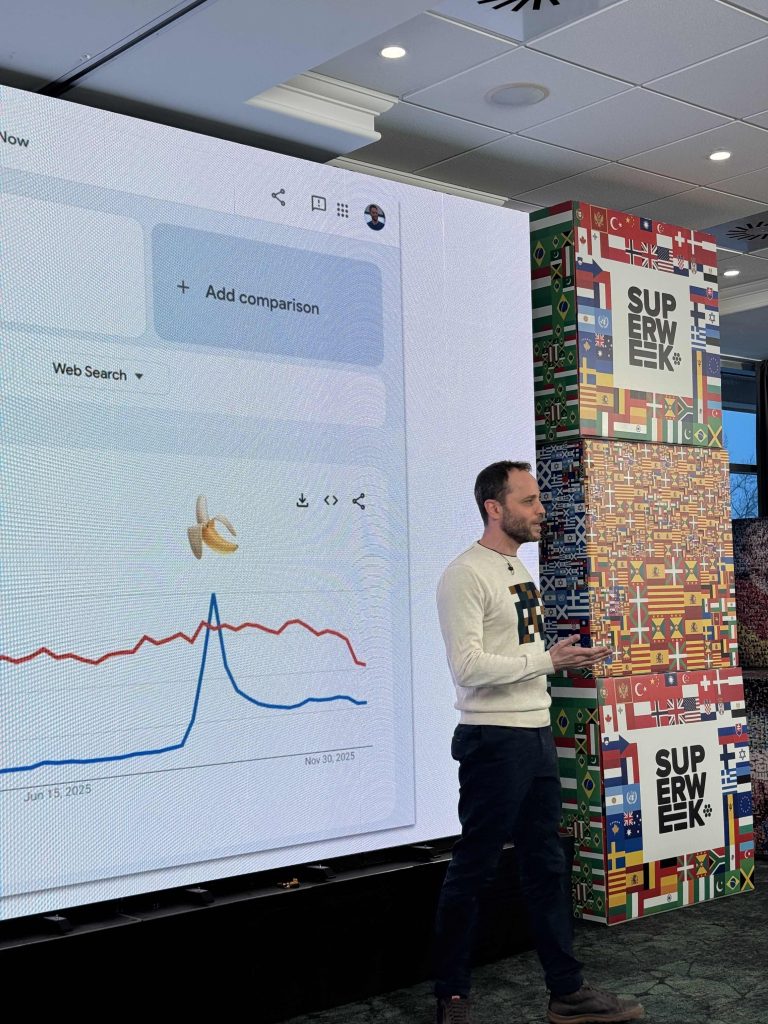
The real problem is the habit: sticking to the sources you know and ignoring the rest. Better marketing decisions come from looking across all available datasets, not just the comfortable ones. And once you bring them together, as Russell McAthy put it:
You still need to connect them in the right way and place.
This is exactly the problem Coupler.io solves — pulling data from hundreds of sources into the destinations where teams actually work.
The web is no longer just for humans
Half your traffic is invisible
Matteo Zambon dropped a number that shifted the room’s energy: by 2024, bot traffic officially crossed 51%. More than half of web visitors aren’t people.
These aren’t the old scrapers. AI agents browse in headless mode, skip JavaScript entirely, and mimic human behavior. If your analytics depends on client-side execution (and we know that GA4 does 🙂), those visitors never existed in your data. AI-powered browsers like Atlas (ChatGPT’s browser), Comet, and DIA are privacy-first by default. Atlas automatically finds and clicks “Reject” on every consent banner it encounters.
It goes further. The Universal Commerce Protocol now allows purchases directly inside chat interfaces. No browser. No cookies. No traditional tracking environment at all.
Microsoft Clarity is already moving in this direction. It now captures bot activity at the CDN level for free, identifies verified bot signatures from OpenAI, Meta, and Google, and is starting to show how AI agents cite your brand. If you only measure what browsers render, you’re working with half the picture.
Server-side isn’t what you think it is
The industry response so far has been to move observation server-side. That helps, but Simo Ahava challenged the room to think harder about what server-side tagging actually is. It’s often sold as a way to “get data back.” Simo’s position: that framing is vendor-centric and unsustainable.
The real value of server-side infrastructure is performance, security, data enrichment, and minimization, not circumventing user privacy. Because server-side operations are behind a veil, users and regulators can no longer audit data streams in the browser. That creates a transparency deficit the industry hasn’t reckoned with.
Teach your agents to report back
The deeper shift is toward what several speakers called Agentic Analytics. If your brand deploys its own AI agents, such as support bots, shopping assistants, and internal tools, they need to emit their own structured logs. Do not rely on UI clicks that may or may not fire. The observation layer moves upstream to the CDN and server, and agents self-report the decisions they make and the tools they use.
Small agency advantage is getting bigger
Doug Hall opened the conference with an argument that’s uncomfortable if you work inside a large organization: every agency acquisition promises leverage and ends in gravity.
Innovation doesn’t fail because people stop caring. It fails because incentives change. Spreadsheets win. Politics creep in. Decision latency explodes.
His point wasn’t that big is bad. It’s that the structure determines behavior. Small agencies (he pinpointed a sweet spot around 25 people) survive by staying sharp. They don’t have the luxury of “performative alignment” and remain close enough to delivery that mistakes are visible, and learning is fast.
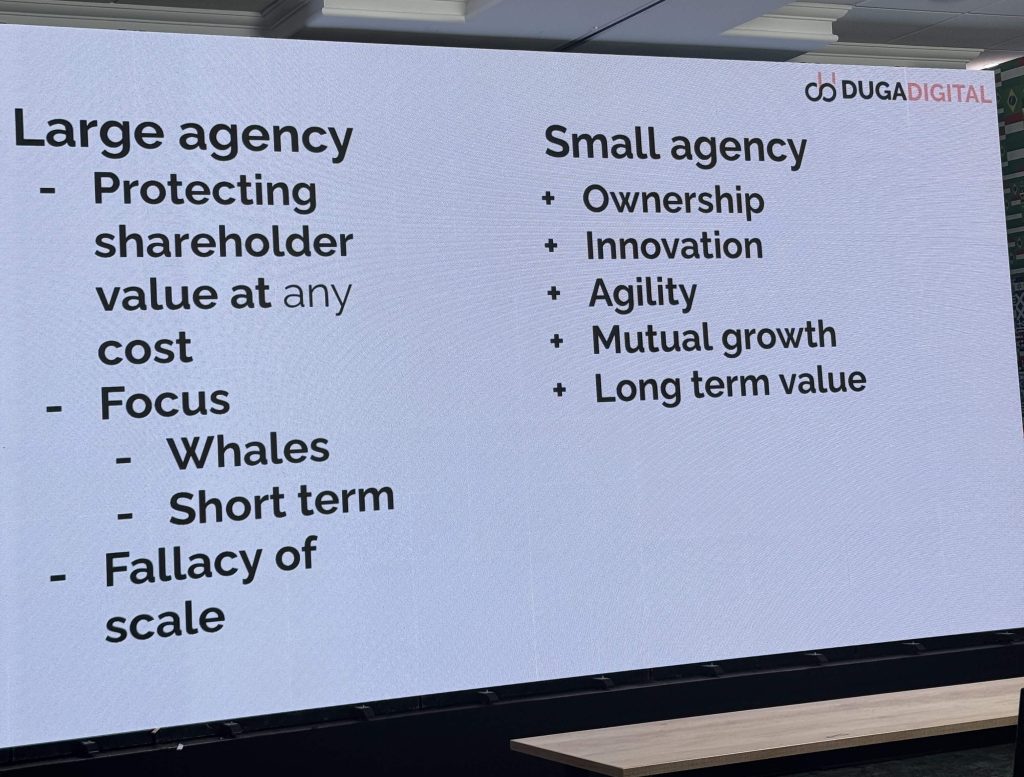
Marie Fenner grounded this in data. Purpose-driven companies see a 1.7× multiplier in employee satisfaction. Moreover, they scale more effectively, adapt faster to disruption, and outperform over time. Purpose isn’t a brand statement on the wall. It’s an operating system.
Anna Lewis, celebrating ten years of running Polka Dot Data, reinforced both points from the ground up. Most work still comes from word of mouth. Community matters more than marketing funnels. Among the business owners she surveyed, connections and determination ranked highest as success factors. Perfectionism ranked last.
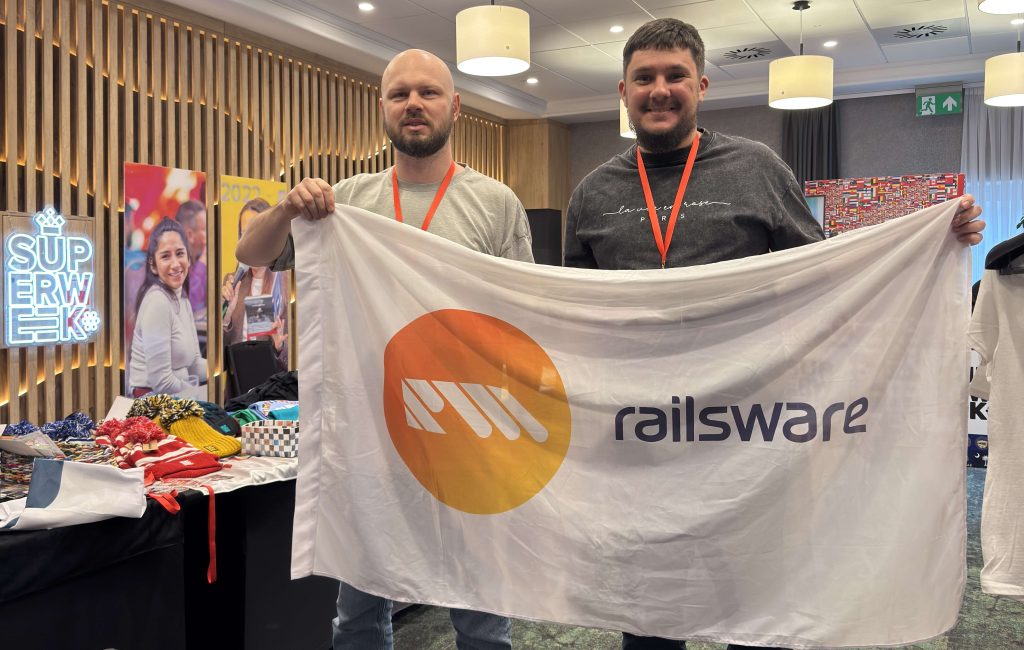
At Railsware and Coupler.io, we operate as a relatively small team. These talks weren’t abstract to me; they described the dynamics I see every day.
What I’m bringing back to Coupler.io
Superweek isn’t the kind of event where you collect business cards and forget. It’s where you land back home and start questioning your own dashboards.
Here’s what’s changing for me:
I’m rethinking how we approach anomaly detection at Coupler.io. Top-line metrics that look green aren’t enough. We need to surface segment-level breaks before they cost weeks of revenue.
Our AI development is moving in the same direction. Feeding an AI agent more spreadsheets doesn’t make it useful, while giving it the right framing does. That’s why we’re building the capability to add context directly to data flows in Coupler.io. So when our AI Agent analyzes your data, or you integrate data with AI tools, they already know what metrics mean for your business and what decisions they’re meant to inform.
Attention to what our analytics can’t see. If half of web traffic doesn’t trigger client-side tracking, the data flowing through any platform has a blind spot. Acknowledging that honesty is the first step to building trust around it.
Better questions, not answers
Superweek didn’t give me answers. It gave me better questions and reminded me that the best insights still come from putting smart people in a room and letting them argue over dinner.
Huge thanks to Zoltán Bánóczy for building a community, not just a conference. And to everyone who made the conversations between talks just as valuable as the ones on stage.
I’m already counting the days until next year.