
The data pipelines are automated and running. The data is cleaned, joined, and sitting in a warehouse. Then someone connects an AI to it, asks a simple question, and gets an answer that is confidently and unexplainably wrong.
Everything below the AI works. The system still isn’t trustworthy.
That gap doesn’t close by waiting for a better model.
Reliability is not a property of the model or the pipeline. A semantic layer tells a machine how tables join and how revenue is calculated. That is structure. It adds almost nothing to the context architecture: why the number moved, what your team changed last Tuesday, and so on.
AI needs the same onboarding a new analyst gets. Not only a schema, but an understanding of the data, the business behind it, and the way your team does the work.
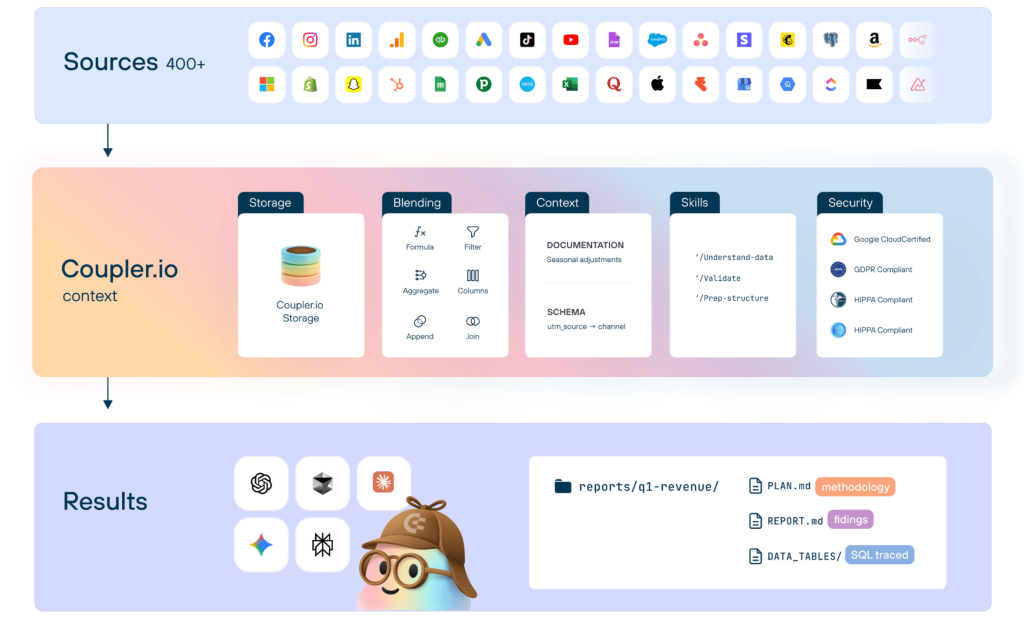
In practice, that means three layers stacked on the database: data context, business context, and skills with validation. Skip any one of them, and you get fluent answers you cannot defend.
Data context is literacy
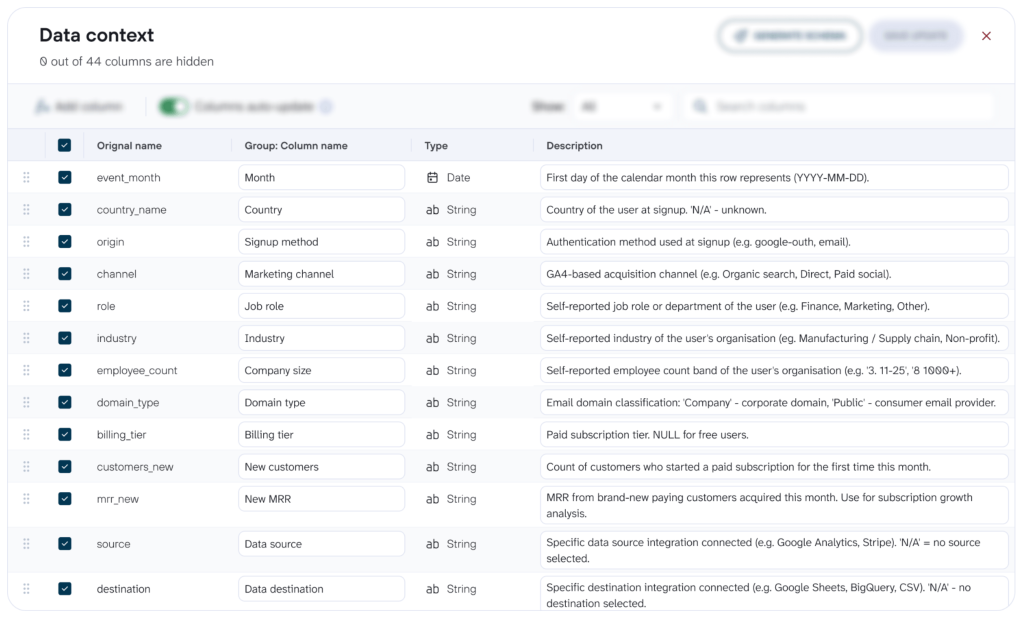
Data context is what stops an AI from guessing at your column names.
It covers table and column definitions, data types, business metric definitions, calculated fields and aggregation rules, naming conventions and synonyms.
Sounds obvious. It rarely exists. Take a column called ‘origin’. Is it the traffic origin, the country of signup, or the authentication method used at registration? A model will pick one and never mention that it picked.
Write one line — “authentication method used at signup, for example Google OAuth or email” — and the ambiguity is gone for every future question. The same applies to values.
In Coupler.io, this lives on the dataset itself. Every column carries a label, a type, and a description, and any AI tool connected over MCP receives that enriched schema before it writes a single query.
This layer is literacy. It’s the floor, not the goal.
Business context is for accuracy
Data context tells AI what the numbers are. The business context tells what they mean.
This layer holds your business calendar: launches, pricing changes, outages, seasonality. It also holds the definitions your team argues about in meetings — what “retained” means, where the line between enterprise and SMB sits, which numbers actually go in the board deck. Without these, the AI treats every metric as equally important and every definition as obvious.
One example: retained users and paying users are not the same, and only a minority of retained users convert. That single sentence prevents an entire category of wrong conclusions.
I’ve watched what happens without it. We deliberately changed our lead-scoring form to filter for higher-quality prospects, and scheduled calls dropped exactly as intended. Our AI looked at the funnel and flagged a massive acquisition problem. The data was read correctly. The conclusion was wrong, because nobody had told the system we changed the form.
This layer is a part of the stack that is genuinely yours.
But context decays…
This is an uncomfortable part.
Data context that is never revised and business context that is never updated produce output that looks exactly as confident as output built on current facts. Decay is invisible until a decision goes wrong.
The data team cannot fix this on its own because they simply can’t keep up with every (even small) change. For example,
- A website redesign. URLs change, events get renamed, a form moves below the fold. If the redesign date isn’t documented, every year-over-year comparison across that boundary is contaminated.
- A Google SERP update. Organic clicks fall while impressions hold steady. That’s an external market event, and nothing in your warehouse contains that fact unless someone types it in.
Your team has the richest unwritten context. They speak with leads and customers, monitor competitors’ behavior, and adjust to market trends and regulations. All of it explains the numbers.
So annotation has to become part of shipping. Give each dataset an owner and review the context monthly, the way you’d review a dashboard nobody has questioned in a while.
I know, this sounds like documentation work. But it takes a sentence, not a wiki page. And unlike the Confluence page nobody opens, this context gets read every single time anyone asks a question.
A human analyst missing context at least says “let me check with marketing before I call this a trend.” An AI agent never asks. It answers.
Where this context should live
Team knowledge has moved through three eras, and most companies are stuck between the two – tribal era (context is in scattered documents) and repo era (context is structured in MD files, yet technical).
The one that works is the hybrid era.
Keep the repo discipline (versioned, diffable, reviewed) but drop the technicality. In Coupler.io, dataset context is a document attached to the dataset: a marketer edits it in the browser, an AI reads it over MCP, and the change is visible to everyone downstream.
The third layer belongs to skills
Predefined, versioned workflows for analysis you run more than once, this is what finalizes the stronger semantic layer.
A skill carries metadata, a name and description, the role and tone, the steps, expected inputs and outputs, guardrails for edge cases, and a validation self-check.
An analytical skill should open with a context check as a hard gate: if a dataset has no context, the analysis doesn’t start. It should force every metric to be calculated in SQL rather than letting the model aggregate on its own.
So two people asking the same question get the same numbers because the method is fixed, not reinvented in each prompt.
One example: we have a skill for weekly ad performance reviews. It checks for a context document before it runs, calculates CPA and ROAS in SQL, and compares this week against the prior four-week average. If anything moved more than 20%, it flags the change with “check business context before interpreting.” That entire workflow runs the same way regardless of who triggers it.
Skills are also reviewable. You can diff them, argue about them in a PR, and improve them once for everybody — which is not true of the prompt folder on someone’s laptop.
Start writing it down
A generated semantic layer and a well-crafted prompt are not an architecture. They’re a starting position.
The stronger move is to document the three layers, keep them current through iteration, and let every department that changes something own the sentence that explains it.
Data context makes the AI literate. Business context makes it accurate. Skills make it repeatable.
If you’re at MeasureCamp London or Analytics Pioneers Summit 2026, come find me. I’ll walk this through live with a demo, and I’d be happy to chat.