
If you’ve spent any time wiring up marketing reports, you’ve probably heard “send your data to PostgreSQL” and wondered what that even means. Is it a tool? A coding language? Something only engineers are allowed to touch?
All plausible questions for marketers. Especially now that you probably want AI looking at your data, too.
In the article, you won’t see any setup tutorials or talks about API and complex SQL queries. I’ll explain the value of PostgreSQL for marketing analytics and show how Coupler.io fits as the data layer that connects your marketing sources to PostgreSQL, so AI and dashboards always read from up-to-date data.

Connect 400+ sources to PostgreSQL with Coupler.io
Start for freeWhat is PostgreSQL? A plain-English explanation for marketers
PostgreSQL is a database. It’s a free, very popular piece of software that stores your data and does calculations on it.
It’s a type of database, just like BigQuery and MySQL. People often shorten the name to “Postgres,” and the two words mean the same thing.
First, what a database even is
A database is just a sturdier, smarter version of a spreadsheet that holds data in tables made of rows and columns.
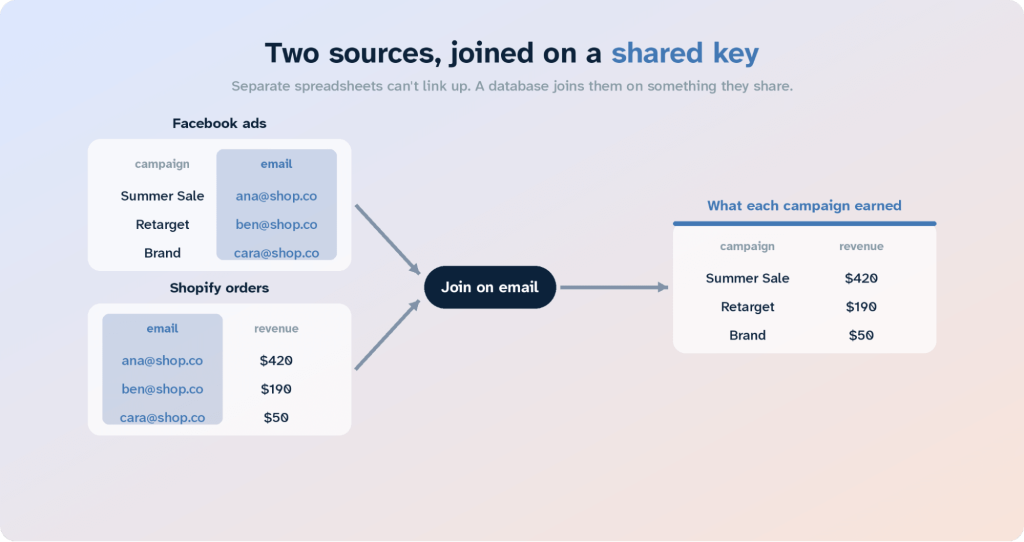
The difference is that a database doesn’t fall over when you load a million rows, it keeps your numbers clean instead of letting someone type text into a date column, and it can link tables to each other. Your ad spend table can connect to your orders table through a shared piece of information, like an email or an order ID. Separate spreadsheets can’t really do that easily and accurately.
That linking is the whole point.
It’s what lets you go from “here is my Facebook data, and separately here is my Shopify data” to “here is what each campaign actually earned.” The database keeps the relationships between your tables intact, which is why this category is formally called a relational database.
PostgreSQL vs. SQL vs. a “platform”: clearing up the confusion
Technically, PostgreSQL is an object-relational database management system, and you’ll see it described as an open-source relational database management system. Open-source simply means it’s free and anyone can use it.
Here’s the distinction that trips up every marketer, including me at first.
PostgreSQL is a database software. SQL is the language you use to ask it questions, like “total spend by month.” The “QL” in the name stands for query language, which is where the confusion starts.
The part that matters when you consider PostgreSQL for marketing data analytics: you almost never write SQL yourself.
Your dashboard writes it for you when you drag a chart onto a page inside your data visualization tool, or Claude and ChatGPT write it for you when you ask a question in plain English. The SQL language exists under the hood, and you don’t need to learn how to use it.
Who actually runs PostgreSQL, and how technical is it?
There’s one more thing software needs that a marketer rarely thinks about: it has to run on a computer somewhere. PostgreSQL is just the software, so something has to host it.
You have two options:
- Run it yourself on your own server, which is real work, and no marketer should sign up for it.
- Let a service run it for you using platforms like Supabase, Amazon RDS, or Neon. They host a PostgreSQL database in the cloud, handle the maintenance like backups, replication, and vacuuming (the routine cleanup a database does to stay fast), and give you a screen to work in. You never touch a server.
For example, Supabase is just PostgreSQL that someone else runs for you, with a friendly interface on top. So when you see PostgreSQL integrations in Coupler.io or other data integration tools, you can use it to send data to Supabase and store all of it safely in a database.
Is PostgreSQL like BigQuery?
Short answer: yes, they are like cousins. Both are databases where your data can live so that dashboards and AI can read it.
BigQuery is Google’s cloud data warehouse, built specifically for scanning huge volumes of data, and you pay based on how much data your queries touch. PostgreSQL is a general-purpose database you can host anywhere, and with a managed host you usually pay a flat monthly fee.
Why PostgreSQL for marketing data analytics beats spreadsheets and native platform analytics dashboards
So why would a marketer want a database at all? Three reasons, and they all come down to the limits you’ve probably already hit.
1. Your data outlives the platforms
Marketing platforms aren’t built to be your memory. Facebook, Google, and GA4 archive or quietly delete detailed historical data after a certain window, so the year-over-year comparison you want is often already gone by the time you go looking for it.
A database keeps everything you put into it, for as long as you want. Once your data is flowing into PostgreSQL, this year’s Black Friday can be compared against three years ago, because you own that history instead of renting it from a platform that may erase it.
Getting data into a database doesn’t require the API scripts and engineering tutorials you may have seen. Coupler.io connects your marketing sources and loads the data into PostgreSQL on a schedule you set, which is what makes “keep all my history” a realistic thing for a marketer rather than a developer project.
2. One place where your sources finally talk to each other
You can’t meaningfully compare a Facebook ad click and a Shopify purchase when they live in two different tabs or across separate spreadsheets, reports and dashboards.
A database lets you join those sources on something they share, like a customer email or a campaign ID, so the full path from first click to final dollar sits in one place.
That’s the difference between five dashboards you mentally stitch together and one source of truth you can actually query. Once the data is together, aggregation across channels (total spend, total revenue, blended performance) becomes a single question instead of a manual chore.
3. You stop redoing the same work every month
Because the data refreshes on a schedule and lives in one structured home, the monthly reporting data hunt disappears. You build the logic once, and the answers stay current as new data lands. The actual data analysis becomes the easy part, which is rarely true when you have hundreds of static spreadsheets from all your exports.
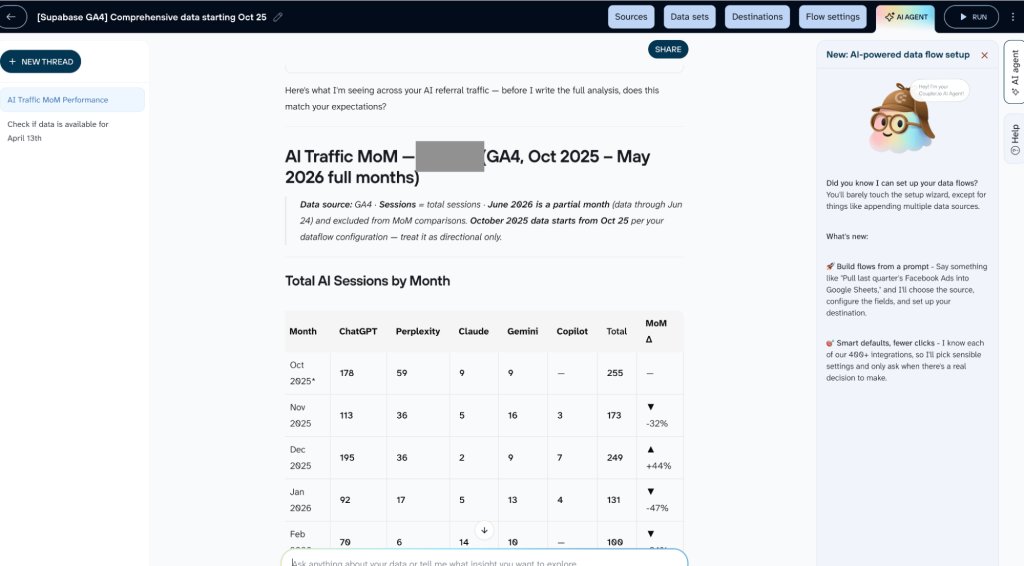
Tip: When you use Coupler.io to send data to a PostgreSQL destination (or other tools like BigQuery, Claude, ChatGPT, cursor, etc) that structured data becomes available to Coupler.io’s AI Agent that can answer advanced questions on the spot.
And it even flags if something is missing from that data that would generate partial results only.
Load Your Marketing Data into PostgreSQL with Coupler.io
Get started for freeWhere the math happens: PostgreSQL, spreadsheets, and AI
This is the most relevant reason sending your data into a database matters in 2026. The destination you choose for your data quietly decides whether your AI gives you correct numbers.
It comes down to a simple question: where does the math actually get done?
Why dumping data into Claude or ChatGPT breaks down
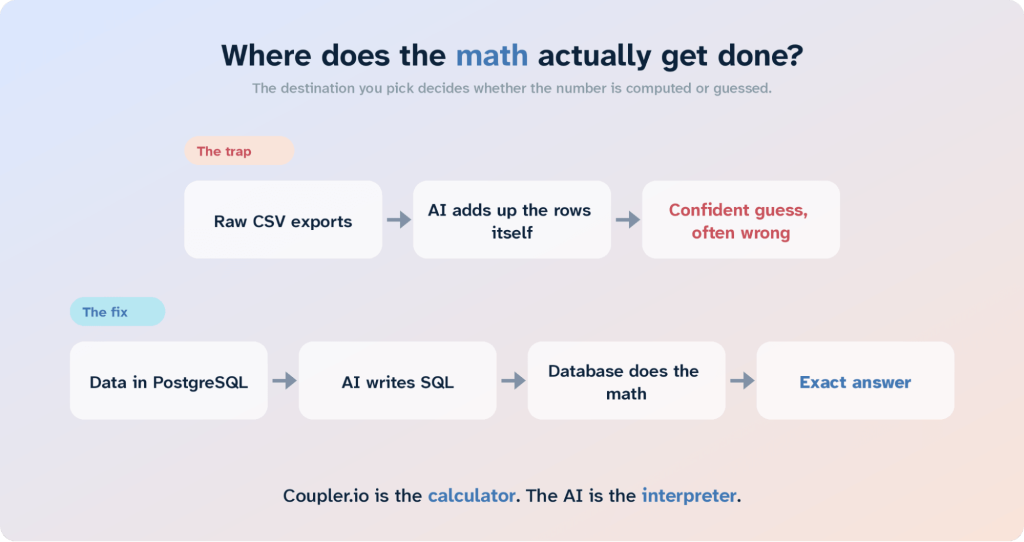
When you attach a big export straight into Claude or ChatGPT and ask for “total spend by campaign,” the AI has to read every single row to do the arithmetic itself. With a few months of ad data, that is tens of thousands of rows.
The AI runs out of room and starts forgetting what you said earlier or stops partway, and it sometimes returns a confident number that’s simply wrong. Language models are built to predict text, not to add up columns, so handing them raw data and asking for exact totals is asking for trouble. It works for tiny files and falls apart on real ones.
Note: Ask a math question inside Claude Cowork and it writes a script to compute the answer, so the number is calculated, not estimated. Paste the same CSV into a plain chat and it’s hit or miss. Chat can run an analysis tool that calculates for real, but it doesn’t always trigger and with a big file or several sources at once, it’s more likely to just read the rows and approximate, which is the failure mode above.
How a database keeps your AI honest
Now change one thing: put the data in PostgreSQL and connect your AI to the database instead of uploading files.
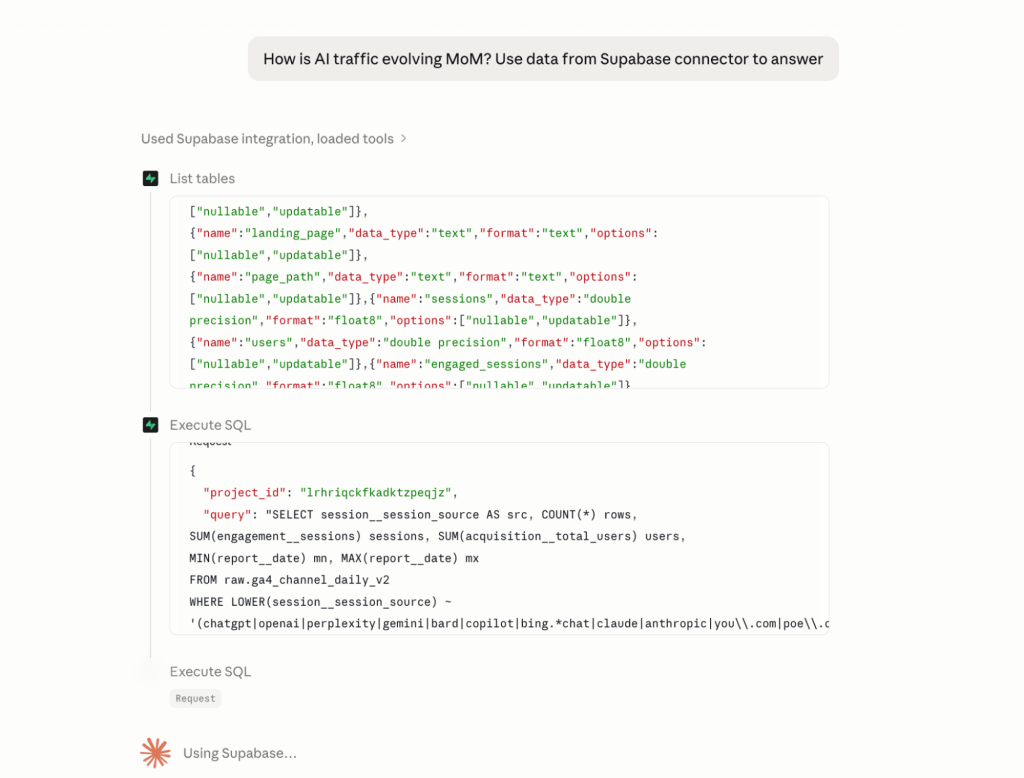
The AI no longer reads your rows. It writes a quick SQL query, the database does the calculation, and hands back a small, exact answer like a single number or a five-row table. You still ask your question in plain English.
The accuracy now comes from the database, which is good at math, rather than from the model, which is not.
This is the same principle behind Coupler.io’s Analytical Engine that you benefit from when using Coupler.io to send data to Claude or ChatGPT. Instead of trusting the language model to crunch the numbers, the calculation runs against the real data and the verified result is what reaches the AI.
It’s a small architectural detail that makes Coupler.io the calculator, and the AI the interpreter. This is what makes conversational, PostgreSQL real-time marketing analytics actually trustworthy, instead of a fast way to get a wrong answer.
Accuracy is only half of it
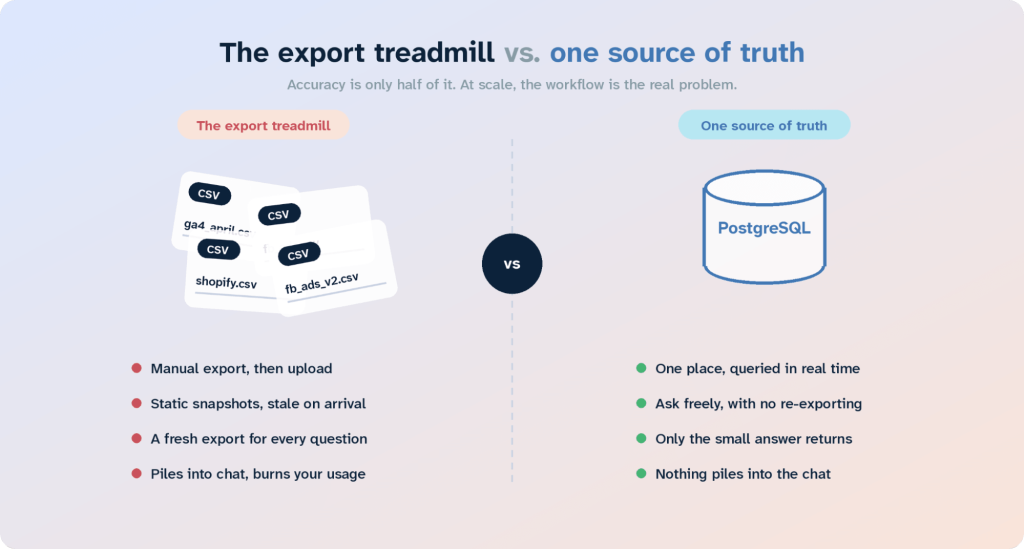
So far this has been about getting the number right. And AI has gotten better at math. If you know the nuances, keeping files small and clean and letting the analysis tool do the actual calculation, spreadsheets and CSV exports can get you accurate answers.
But accuracy was only ever half the problem. The other half shows up at scale.
Real reporting is never one question or one file. You pull from several platforms, so you’re juggling multiple spreadsheets and fragmented CSVs, each one a manual export and a manual upload. The data is scattered with no single source of truth, and every export is a static snapshot that’s stale the moment you pull it.
Dump all of it into one chat to compensate and you overwhelm the model and burn through your usage, then re-export again the second you want a different slice.
A database is the opposite of that. One source of truth, queried in real time. The data stays in PostgreSQL, the AI writes the SQL, and only the answer comes back, so the raw rows never enter the chat.
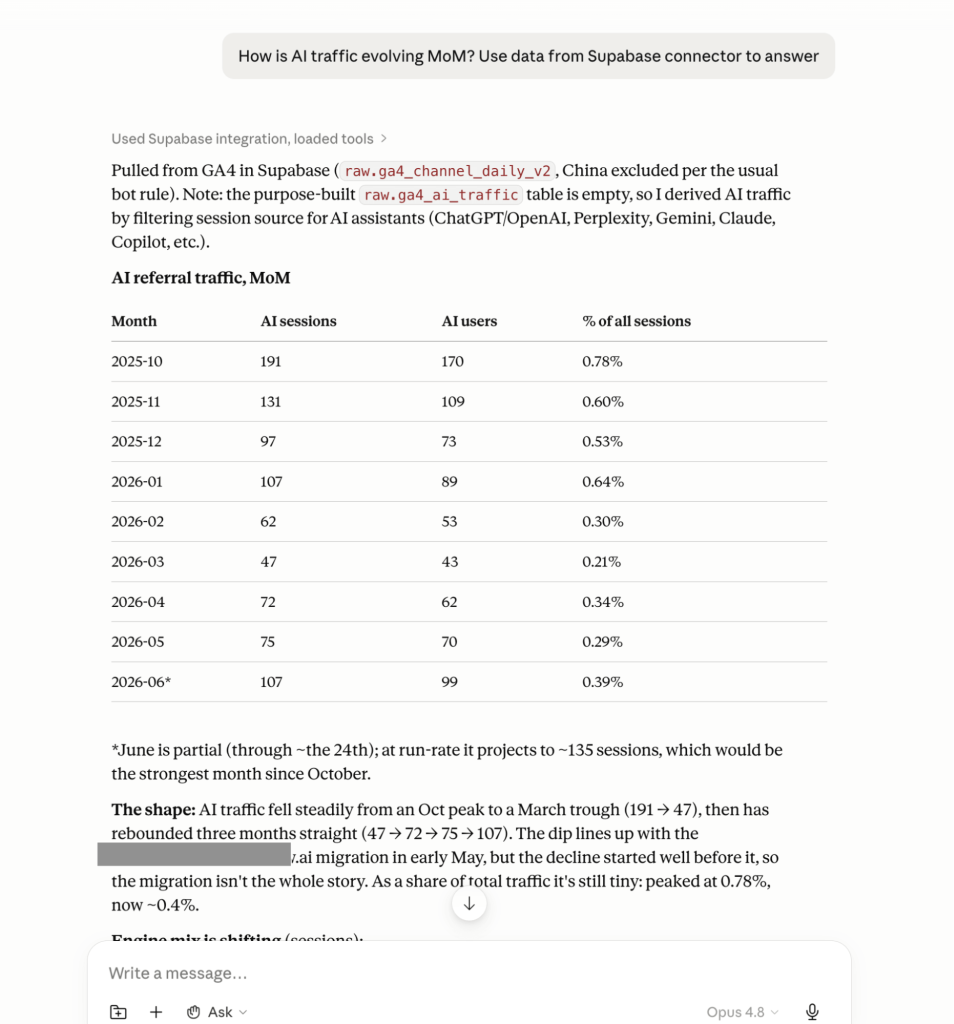
Here’s one simple question from my own reporting: How is AI traffic evolving MoM?.
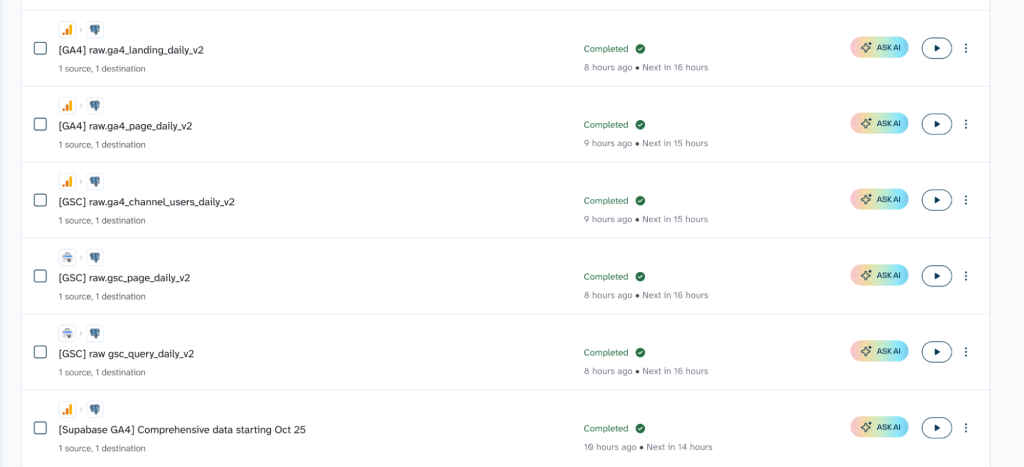
That needs Search Console clicks and GA4 sessions and conversions, joined by page. With Coupler.io’s scheduled dataflows keeping both sources current in the database, I just ask and the AI writes the query.
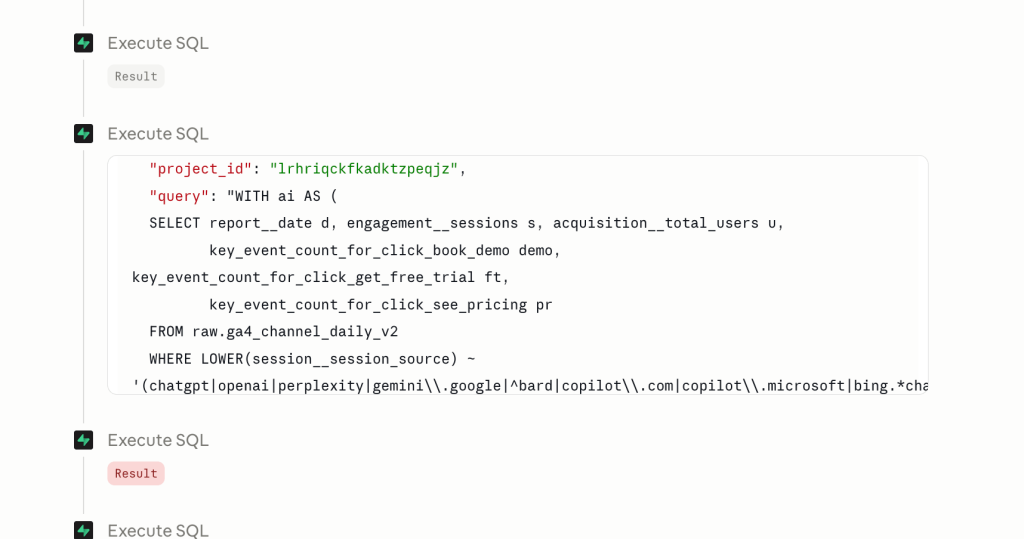
Tip: Schedule targeted data flow instead of raw dumps of every metric and dimension to avoid data transfer error and keep tables ready for specific queries.
The answer comes back complete, from every row rather than a capped export.
Keep PostgreSQL fresh and AI accurate with Coupler.io
Try it freePostgreSQL marketing analytics: the capabilities that do the heavy lifting
These are the capabilities that matter most when you use PostgreSQL for marketing data analytics.
Handle messy data from ad platforms
Ad platforms send back nested, inconsistent responses with fields that change shape. PostgreSQL has a data type called JSONB that stores this semi-structured data as-is, without forcing you to design a perfect table first.
In practice, that means your raw Facebook or Google API data can land safely and be cleaned up later, instead of breaking the moment a platform adds a field.
The marketing math, built in
The calculations marketers actually care about are native to PostgreSQL. This is why the answers come back fast and correct.
- Window functions handle running totals, rolling averages, and period-over-period changes, so “show me ROAS trending week over week” or “rank campaigns within each channel” is something the database does cleanly.
- It can store reusable logic as stored procedures, written in its own simple language called PL/pgSQL (and even other languages like Perl if someone on your team prefers), so common calculations live in one place.
- A built-in query planner figures out the fastest way to answer each question, which is why a good database stays quick even as your tables grow.
- Full-text search lets you dig through text fields like ad copy, reviews, or support messages without extra tooling.
Keeping dashboards fast as data grows
When a report recalculates millions of rows every time someone opens it, dashboards crawl. PostgreSQL can pre-compute heavy results and store them as materialized views, so a metric like monthly revenue is calculated once and loads instantly after.
For very large tables, partitioning splits them by date, so a query about last month doesn’t wade through years of data. These all happen in the backend and keep reports fast.
Extensions that grow with you
One reason PostgreSQL is so widely used is that you can add extra powers through extensions, without switching databases:
- TimescaleDB makes it strong at time-series data, which is most marketing data: spend, clicks, and conversions over time.
- pgvector stores AI embeddings, the basis for semantic search, recommendations, and audience similarity. It’s the bridge to machine learning use cases.
- PostGIS adds geospatial analysis for anything location-based.
- Citus and foreign data wrappers help it scale out and pull in data from other systems.
You won’t need to use all of these. The point is that PostgreSQL rarely becomes the thing you outgrow.
PostgreSQL for marketing data analytics: real use cases
This is what that setup actually unlocks. In each case, assume Coupler.io is already loading your data into PostgreSQL on a schedule, so setup isn’t the hard part.
True blended ROAS across ad spend and revenue
The challenge: Meta says it drove the sale. Google says it drove the same sales. Your Shopify revenue matches neither. While each platform sits in its own dashboard, you can’t tell which channel actually earned the money.
The fix: When every source lands in the same database, ad spend and orders sit in tables that share a key like order ID or email. “What did we make per dollar spent?” becomes one question across all channels instead of three exports stitched together by hand.
You won’t write it yourself, but here’s what that single question looks like under the hood, just to show how little it takes:
SELECT
channel,
SUM(spend) AS total_spend,
SUM(revenue) AS total_revenue,
ROUND(SUM(revenue) / SUM(spend), 2) AS blended_roas
FROM marketing_data
GROUP BY channel
ORDER BY blended_roas DESC;
That gives you one row per channel with its true return, calculated from your own numbers rather than each platform’s self-credit.
The result:
- Calculate true blended ROAS (total revenue divided by total spend) instead of trusting each platform’s self-credit
- Spot the channels that quietly over-report conversions
- Move the budget toward the source that brings the highest-value customers
Multi-year history the platforms would have deleted
The challenge: You want to know whether this quarter is strong or just looks that way, but the platform only shows you a rolling window, and the older details are gone.
The fix: Because the database stores everything you’ve loaded, your full history stays put. You can compare seasons across several years and spot trends a 14-month lookback would hide.
Asking “how did this Black Friday weekend compare to past years” is one short (SQL) question:
SELECT
EXTRACT(YEAR FROM order_date) AS year,
SUM(revenue) AS black_friday_revenue
FROM orders
WHERE EXTRACT(MONTH FROM order_date) = 11
AND EXTRACT(DAY FROM order_date) BETWEEN 24 AND 27
GROUP BY year
ORDER BY year;
You get one row per year, side by side, from data that the platforms would have already deleted.
The result:
- Benchmark this Black Friday or Q4 against the same period years back
- Separate real seasonal patterns from one-off noise
- Defend a plan with your own long-term data instead of a platform’s short memory
Always-current dashboards on millions of rows
The challenge: Your reports either load painfully slowly or are out of date by the time anyone looks at them.
The fix: With scheduled refreshes feeding the database and pre-computed results behind the scenes, dashboards stay both current and fast, even on large tables. Nobody has to rebuild anything by hand.
A monthly revenue rollup, the kind a dashboard hits constantly, is one query that a materialized view stores so it loads instantly:
SELECT
DATE_TRUNC('month', order_date) AS month,
SUM(revenue) AS monthly_revenue
FROM orders
GROUP BY month
ORDER BY month;
Pre-computed once, this returns immediately instead of recalculating millions of rows every time someone opens the report.
The result:
- Open a report and trust it reflects today, not last Tuesday
- Keep heavy dashboards responsive as data piles up
- Give stakeholders self-serve access without becoming the bottleneck
PostgreSQL marketing analytics platforms and databases compared
It helps to see where PostgreSQL sits among your options for marketing analytics. Three comparisons are worth making, and it doesn’t win all of them.
| Option | What it is | Best for |
|---|---|---|
| All-in-one marketing analytics tool (Supermetrics, Funnel, Improvado) | Pulls your channels together and feeds dashboards, no database to manage | Small teams that mainly want channel reporting |
| PostgreSQL | A general-purpose database you host anywhere, strong all-rounder | Most marketing teams that want to own their data, history, and AI querying |
| BigQuery | Google’s serverless warehouse, billed by data scanned | Heavy Google stacks and very large datasets |
| Specialist databases (ClickHouse, MongoDB, MySQL, SQL Server) | Each tuned for one job: scan speed, unstructured data, simplicity, enterprise | Specific needs once a generalist isn’t enough |
Do you even need a database, or can a marketing analytics tool do it?
When comparing PostgreSQL marketing analytics tools, the first question is whether you need a database at all. This is the first fork, and plenty of teams never need to go past it.
Some marketing analytics tools pull your data together and feed your dashboards without you ever thinking about a database. Coupler.io covers both paths: it connects your sources and loads them straight into a dashboard or AI tool when you want to keep things simple, and into a PostgreSQL database when you need the database layer. For a small team that mostly wants channel reporting, the no-database path is often enough.
The tradeoff with staying inside an all-in-one tool is that you work in someone else’s structure, with their limits and their pricing.
You start to want your own database when you need full ownership of your history, heavier or more custom analysis, a home for AI to query, or business intelligence that blends marketing with non-marketing data like finance and product.
At that point, PostgreSQL marketing analytics solutions that hand you a real database, whether that’s PostgreSQL or a warehouse like BigQuery, become worth the extra setup.
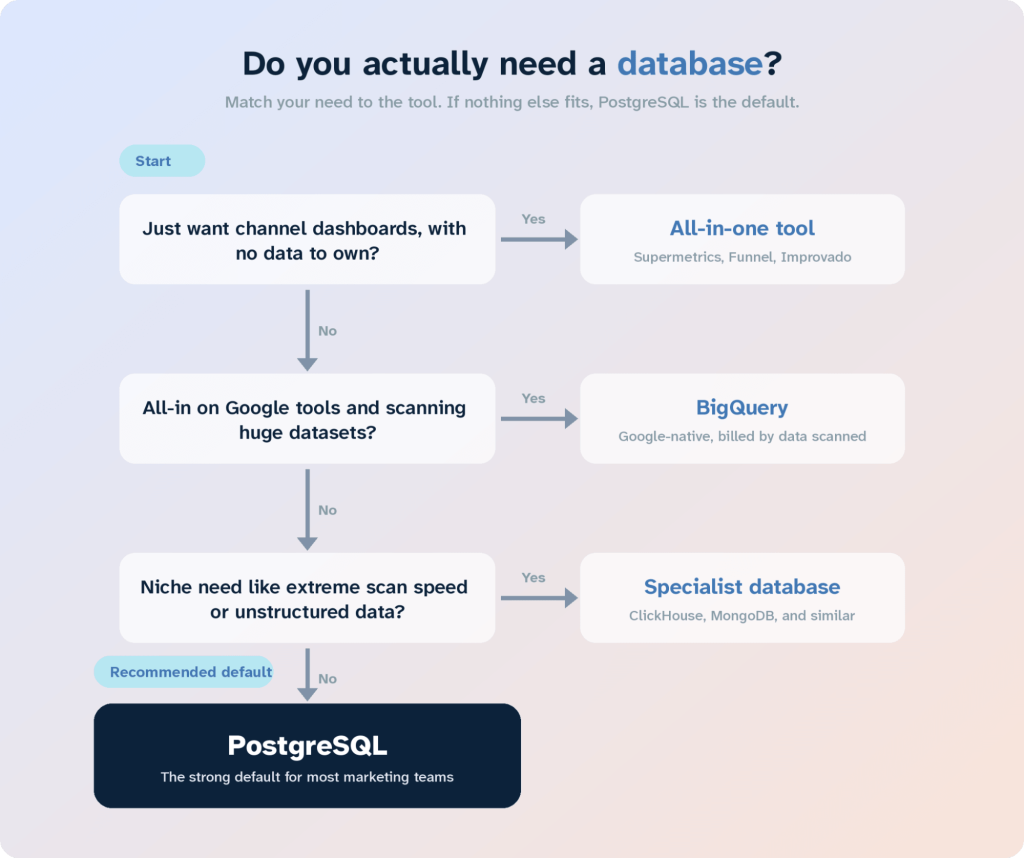
Which database? PostgreSQL vs. BigQuery, MySQL, MongoDB, and more
If you do want your own database, PostgreSQL is one of several, and the differences are real.
- BigQuery is Google’s serverless data warehouse, built for scanning enormous datasets and tightly wired into Google’s tools. It’s built for analytics, or OLAP (online analytical processing), and bills by data scanned.
- MySQL is PostgreSQL’s closest sibling, another popular open-source database, generally seen as simpler and more limited for heavy analytical work.
- MongoDB is a different shape entirely, designed for unstructured data rather than neat tables.
- SQL Server is Microsoft’s enterprise option.
- ClickHouse is a columnar database built for extreme analytical speed at large scale.
PostgreSQL’s appeal is that it’s a strong generalist. It was originally optimized for transactions, or OLTP, the everyday reads and writes that run an app, and it has grown into a very capable analytics database too. For marketing-sized data, that flexibility usually covers you without forcing a specialist tool.
Where should your data flow? Direct to dashboard vs. database-first
Your data doesn’t have to go into a database at all. You can send it straight to a dashboard, or straight to an AI. Each data destination trades off differently.
| Direct to dashboard | Database first (PostgreSQL or BigQuery) | Direct to AI | |
|---|---|---|---|
| Setup effort | Lowest | Medium | Low |
| History kept | No, only what the dashboard holds | Yes, everything | No, just the snapshot |
| Blending sources | Limited and clunky | Strong | Limited |
| Speed on big data | Slow, recalculates live | Fast | Hits limits |
| Best for | A quick, small dashboard | Permanent reporting and AI analysis | Quick ad-hoc questions on small data |
If you’re a solo marketer who wants one simple dashboard for this month, going direct is fine. The database earns its place the moment you care about history, blending, scale, or pointing AI at your data without it falling over.
Use PostgreSQL for marketing data analytics without the technical headache
The biggest myth is that using PostgreSQL means becoming a part-time database administrator. It doesn’t, as long as a managed service does the hard part.
You don’t manage anything, and you can actually see your tables
With a managed host, the server, backups, and updates are handled for you. You log into a clean interface and your data is right there in tables you can open and look at.
That last part matters more than it sounds. A lot of marketers describe sending data to a warehouse as shipping it into a void they never see again.
With a managed PostgreSQL interface, the data is visible and tangible, which makes the whole thing feel less abstract. BigQuery shows you your tables too and connects neatly to Google’s ecosystem, so this isn’t about one being better. The point is that you don’t have to trade visibility to get a real database.
Getting your marketing data in
This is where a no-code data pipeline does the heavy lifting. Rather than writing API scripts or maintaining custom code, you connect your sources, and Coupler.io loads them into PostgreSQL on a schedule, cleaning and shaping the data on the way in. Setup is closer to filling out a form than writing a program.
One honest caveat, so you can choose well: you don’t always need the database in the middle. Coupler.io can also send data straight to an AI tool for quick questions on a manageable amount of data. The database earns its keep when you have a lot of history, want permanent dashboards, or need your AI to handle big questions without hitting its limits.
Connect 400+ sources to PostgreSQL with Coupler.io
Get started for freeWhen PostgreSQL in marketing analytics isn’t the right call
PostgreSQL is a strong default for most marketing teams. It’s just not the answer to every situation. Here’s when I’d point you elsewhere:
- If you’re running massive analytical workloads and speed at scale is everything, a columnar database like ClickHouse, or a warehouse like BigQuery, will outrun general-purpose PostgreSQL.
- If you want zero maintenance and your whole stack lives in Google tools, BigQuery’s serverless, deeply integrated setup is hard to beat.
- If your needs are simple and short-term, a direct-to-dashboard connection is less to manage than any database.
- If you need heavy real-time marketing analytics on huge streams, that’s specialist territory worth a specialist tool.
FAQ
Is PostgreSQL a marketing analytics software?
Not exactly. PostgreSQL is the database engine that marketing analytics software often runs on top of. It stores and calculates; the analytics layer sits above it.
Do I need to know SQL to use PostgreSQL for marketing analytics?
No. Your dashboard generates SQL when you build charts, and AI tools write it from plain-English questions. Knowing some SQL helps for advanced work, but it’s not a requirement to get value.
Is PostgreSQL good enough compared to a “real” data warehouse?
For the volume most marketing teams deal with, yes. With the right extensions and a managed host, PostgreSQL handles cross-channel analysis comfortably. You reach for a dedicated warehouse mainly at a very large scale or when speed on massive scans is the priority.
PostgreSQL or BigQuery for marketing data?
Choose PostgreSQL if you want a flat, predictable cost, a visible interface, and a flexible general-purpose database. Choose BigQuery if you live in Google’s tools, want zero maintenance, and need to scan very large datasets. Both work well with automated pipelines and with AI. Coupler.io supports BigQuery, PostgreSQL, and other destinations, so you don’t have to choose a pipeline before choosing a database.
Is PostgreSQL really free?
The software itself is free and open-source. If you use a managed host like Supabase or Amazon RDS so you don’t run the server yourself, you pay that host, often a predictable monthly fee rather than a per-query charge. Supabase also has a free plan, so depending on your needs, PostgreSQL (with Supabase) can be free.
Can Claude or ChatGPT actually query my PostgreSQL data?
Yes, and it’s one of the best reasons to use it. Connected to the database, the AI sends queries and the database does the math, so you get accurate answers in plain language without overwhelming the model with raw rows. With Coupler.io loading data into PostgreSQL on a schedule, the AI always queries the latest sync, not a stale export.